
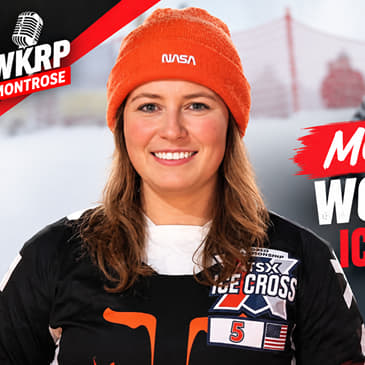
This week on WKRP Montrose, Dennis sits down with Sarah Seibold, a Montrose-based athlete ranked No. 2 in the world in Ice Cross, a high-speed sport where competitors race downhill on ice wearing hockey skates.
Sarah shares how she discovered the sport, climbed the world rankings, and balanced elite competition with a career as a data analyst and her passion for mountaineering. From training at high altitude around Montrose to tackling challenging mountain summits, Sarah’s story is about pushing limits, embracing discomfort, and learning from failure.
IN THIS EPISODE
* What Is Ice Cross? Discover the fast-paced sport that combines downhill racing, hockey skates, and intense competition.
* The Road to No. 2 in the World: How Sarah has steadily climbed the rankings since beginning the sport in 2023.
* Training in Montrose: How figure skating, hockey, rollerblading, and high-altitude outdoor adventures help keep her competition-ready.
* Life Beyond the Ice: Balancing a career at CU Boulder with elite athletics and 71 mountain summits.
* The Future of Ice Cross: Sarah’s hopes for the sport and the potential for a community-driven ice rink in Montrose.
* Embracing Discomfort: Why stepping outside your comfort zone and learning from failure can lead to growth.
Sarah’s journey shows how determination, adaptability, and a willingness to take on new challenges can open unexpected doors—from international competition to mountain adventures.
🎙️ Watch the full conversation on YouTube and meet the Montrose athlete making her mark on the world stage.
Get Montrose stories, events & local news in your inbox — free: https://wkrpmontrose.com/subscribe
Thank you to our underwriters for making WKRP Montrose possible:
* Clearnetworx — https://linkly.link/2akEO
* NuVista Credit Union — https://linkly.link/2akEV
* Flower Motor — https://linkly.link/2eIUO
* Atlasta Solar Center — https://linkly.link/2hs
* Waste Management — https://www.wm.com/us/en/location/co/
#WKRPMontrose #MontroseCO #SarahSeibold #IceCross #ColoradoAthletes #Mountaineering #WesternSlope
[00:00:00] Welcome to WKRP Montrose, a radio station masquerading as a podcast about Montrose, Colorado and the Western Slope. Recording live from the Clear Network Studio in downtown Montrose, Colorado. Hey everybody, welcome to another episode of WKRP Montrose. We are in the Clear Network Studio in downtown. It said that in the intro. Yeah. Oh, did it say that in the intro? Okay. It does always say that in the intro. You know, we're going to do something that we never do. What's that?
[00:00:30] We're going to play a commercial right off the bat. As long as it's a Clear Networks commercial, I'm all in. You're okay with that? Yeah. This is going to be new, so you guys will have to bear with us. It'll make sense though, I promise. Watch the commercial closely. It'll give you, this is foreshadowing, right? Watch the commercial closely. All right, here we go. Clear Networks, we're an internet provider that just gets it. We get that some things are better hidden. Like the fishing spot.
[00:01:00] I'll never share. Not when it comes to your internet bill. No hidden fees. Ever. Or that speed matters. Both download and upload. On your left? On your left! Oh man. And that sometimes locals know best. So we keep things 100% locally based in western Colorado.
[00:01:32] Clear Networks. Not just better internet, a better internet experience. Learn more and sign up at clearnetworks.com. All right. You know what everyone's thinking now. Yeah. We just completely sold out. Well, I mean we have. We have and we will continue to. And by the way, if you sign up for, if you go to Clear Networks and sign up, you should use WKRP because you get two months for free. So 200 bucks? Yeah. It's free money.
[00:02:03] Yeah. And then take some of that free money. You see this hat right here? Yeah. Look at this hat. Well, are you going to say buy a hat or spend it at Colorado Outdoors? I don't think you can buy a hat. Put it in a, put it in a, an account. Yeah. At New Vista. At New Vista Credit Union. And then go spend it at Colorado Outdoors. Yeah. It's something like Toasties in the morning for breakfast. What else can you buy without money? You know. You could put it towards. You know what you should do? You could start saving for a solar set. No. Put it in your pocket. Yeah.
[00:02:31] And, and go over to Flower Motor. Mm-hmm. And put it as a down payment on your, on your new Flower Subaru. Can you put 200 bucks down as a down payment? I think you can do that. Yeah. Why not? All right. So that's Clear Networks. Flower Motor. Yeah. New Vista. Colorado Outdoors. Colorado Outdoors. At last the solar. Which are great. Yeah. And. And when you put, when you put the solar panels on your house, now you're saving money on electricity. We'll be right back. We've made you even more money. Yeah. We're going to get to the guest for a second. We have one more underwriter. But. Coming. Yeah. Yeah.
[00:03:01] It's almost signed and sealed. Yeah. They'll save you some money too. We're not, we're not, you know. Oh, here's something you need to mention. Here's something you need to know. Yeah. You should sign up for our mic dropper subscription. We just started this. Oh yeah. Because once a month we're, we do a, we're going to start doing a cocktail hour. Right. You'll get an invitation to the cocktail hour. At our other underwriter. Yeah. Typhoon. The Typhoon Hospitality Group. Persimmon and Miss So. Yeah. For now. I'm sure they have more projects.
[00:03:32] But we'll have a cocktail hour once a month. Yeah. You'll get invited to. And with the new studio. You can come and speak to us in person. You can, you can come maybe sit in on a live, on a live taping. Oh yeah. Yeah. Well we've had some of the music artists we've had. People would want to sit in on this show today. I guarantee you. The other thing is when the studio, our new studio is ready to go. We're going to have live music, but I have already promised that Puka. Yeah. That we're going to bring one of his bands and be the first band to play at the new studio.
[00:04:02] So, so there's a lot going on. Yeah. All right. Without any further ado. That's enough ado. Is that enough ado? That's enough. Today's episode. I know I say this a lot, but this one I am truly. Says it every time. And he doesn't mean it most of the time. No, I do mean it all the time. But this one in particular, I was just telling our guest that I had discovered her through social media long before I ever knew who she was. And you're going to, you're just going to trip out on this today.
[00:04:31] So I'm not going to wait any longer, but let's introduce Sarah Seibold. Did I get the last name right? Yep. Seibold. Okay. Sarah, tell us. Let me, you know what? Let me just read some Instagram bio stuff. That'd probably be cool. So from Colorado. Make sure you get them all right. She is a skater, mountaineer, vice champion. That's what it says. And we'll get back to that in a minute.
[00:04:58] World ice cross, three time U.S. ice cross number one. So if you don't know what ice cross is, check it out because it's ridiculous. And Sarah is or has been the world, the U.S. number one three times at least. She's ranked number one at ice cross downhill right now with, with USIX. Right. And world cup number two right now. Presently. Yes.
[00:05:22] Moving, having moved up every year, a position every year since you started in 2023. Is that right? Yep. This will be my fifth season. That's crazy. And now. Like from unranked not doing it to second in the world in like two or three years. Well, yes, it is amazing. But let's not forget that you didn't come into this without having ever had skates on. Right. You have, I mean, I guess 20 years.
[00:05:50] Is it once a figure skater, always a figure skater? Yeah. But you're a figure skater. I have a lifetime of skating experience. Yeah. I still figure skate. So just not as well as I used to. So we'll, we'll come back to that. But I want to, can you tell us and everyone else what, what ice cross is? Sure. Ice cross has kind of been coined as the most insane sport you've never heard of. Right. But it's, it follows the same format as ski cross or snowboard cross. If you watch the Olympics.
[00:06:20] So there's four racers that go down a track. In our case, it's an ice track and we wear hockey skates. And each round of four, the top two move on until there's only four left. And then that determines your final ranking. So people that have seen, people would recognize border cross. Because border cross is an Olympic sport, right? I assume so. It's super fun too. So if you've seen border cross and you've watched the snowboarders go downhill. Yeah. Well, they go downhill, but also over jumps.
[00:06:50] And it's... So does Sarah. Right. But it's, I'm saying people will know that. You'll, you'll recognize it pretty quick. So while we're on the Olympics, I mean, I'm assuming you would love to see ice cross in the Olympics. Yes. Do you, is, has there been any talk in the ice cross world of that being a possibility? Yep. Unfortunately, it was a big thing these past couple of years. Yeah. And the IOC voted in June on the new sports that would go to the 2030 Olympics.
[00:07:18] And ice cross was not included in those. What did they include? We have the free ride sports. So free ride skiing and snowboarding made it. So more skiing and snowboarding events. Yes. And less ice cross. That seems like... But big for the figure skating world, Synchro 9 was inducted into the Olympics too. What is Synchro 9? It's a format of synchronized figure skating with nine skaters. Whoa. Oh, wow. So like, oh, so it's...
[00:07:46] Like synchronized swimming on ice. Right. Exactly. Okay. Oh my goodness. That's kind of fun, I suppose, but no good for you. It's not good for me, but it's great for women because now... Right. There's another... It kind of bolsters, so we're going to get closer to 50-50 participation. Okay. But this is an... I mean, in all seriousness, if ice cross was an Olympic event, how close do you think you'd get to qualifying and winning a gold medal? I would love to be there. I tell all my friends if it went, I would do anything to be part of it.
[00:08:17] Do you think you could win the gold medal? I think so. I mean, she's ranked number two in the world right now. Of course she could get the gold medal. Well, you know. What kind of ridiculous question is that? I want to ask myself. It's also really exciting because if we did go to the Olympics, I think the talent that does race would increase as well. We'd have more people who haven't maybe considered it before since it wasn't an Olympic sport yet. So that was 2030 they've made that decision for.
[00:08:44] So I guess it will come up again. I hope so, yeah. For the 2034 Olympics, that the ice cross community will push again for it to be included. Well, do you mind if I want to show people real quick? I pulled up a clip of ice cross. Yeah, it's insane. Let's see it. To be able to see it so that people could watch it. Here we go.
[00:09:19] Are you in this video? It's a recap from 2025. I'm trying to, because it kind of looks like that could have been you there a second ago. It's hard to tell. Yeah. Maybe. But you're getting a feel like, look at. Yeah, it's crazy. Are there elements of hockey to it? Are you allowed to push and shove a little bit and stuff like that? No, it's supposed to be no contact. Sometimes inevitably you get pretty close to people, but as long as you're protecting your line, that's allowed. Yeah. So you're not allowed to like check like you are in hockey,
[00:09:48] even though you're in hockey pads. Yeah. Is that right? Like you're skating in like full pads. Yep. Most people do hockey pads. I do motocross because I don't own hockey pads. Okay. But that's how it's been described too, is like a kind of a mix of motocross, you know, ice hockey, downhill. Yes. And skating. Yes. So it looks kind of dangerous, right? It can be, right? I mean, I'm assuming you must have taken a couple of tumbles at least. A lot. Yeah. One of my favorite things to do at the end of the season
[00:10:17] is create a crash reel because more often than not, I do have footage of piling up. And is that partly because you're kind of pushing it to the limit? You have to push it. Well, you're jockeying for a line to get to, to get down the fastest you can on the course, right? Does it hurt? Have you hurt yourself? Yeah. There's a lot of different factors. I have pretty much just walked away with some scrapes and bruises, luckily, but a lot of people have broken bones or been concussed. So it is possible.
[00:10:46] I mean, I could see how. It's an ice course. It's solid ice, right? Yeah. So you're taking a jump. Some of these jumps, it looks like you're hitting two, three, five feet off the air. Sure. And then landing that. I mean, I understand to somebody who's a figure skater, that might feel natural that you get airborne, right? But to a lot of the rest of us, I think I would freak out. To the rest of us, you are certifiably kind of insane. Super woman. Yeah. So here's the thing.
[00:11:16] You live in Montrose. I do. I'm assuming you love it here. We all do. I love it here. But we don't have an ice cross setup. We don't have an ice cross setup. Where is the nearest place where you can actually practice? So kind of one of the cooler things about this sport is it's a pretty level playing field because there are no permanent ice cross tracks. Okay. We mostly train on pump tracks at skate parks or skiing helps a lot of the time too.
[00:11:42] A lot of our athletes are actively playing hockey, figure skating or speed skating. So we supplement with those different things. But living in Montrose, I have really good access to a lot of lakes in the Alpine. And so I think I get an advantage from being able to skate wild ice and train at altitude in the winter months, assuming it doesn't snow as much as it might this year. I want to come back to that because not just lakes. Not just lakes.
[00:12:13] You've got some posts of you going down rivers, frozen rivers. Yes. Or creeks or whatever. It seems like whatever you can find, you'll try and skate it at some point. If there's ice, I'll find it. So do you, but back to Rob's question, you said, I think I read in an article that you sometimes practice rollerblading in like skate parks. Yes. And so what does that look like when you show up and everybody else is on the skateboards
[00:12:38] or whatever and you're hitting, are you hitting jumps in rollerblades? And like, are you knocking kids off of their skateboard as you go by? No. She would never hit the kids. I mean, I might. Just a little, you know. Despite doing a podcast, I am very introverted. And so I try to go around 9 or 10 a.m. when the kids are in school or not awake yet. Okay. Kind of not have to deal with any of those crashes. You're not looking to be the bully at the skate park? Well, also.
[00:13:07] I'm definitely more of the meek person who I'll stand there and I'll be waiting my turn and it'll just never come because someone else will keep going. That sounds kind of counterintuitive because then you put the helmet on and skates and then you're on an ice cross course and then you can't really afford to be the meek one when you're doing that, right? Do you become a different person when you get to that start? I'm very competitive. Right. Because you started at like a gate, right? Like you've got like bars that you get to push off of. Yep. To go down.
[00:13:38] Talk us through that moment. Like as you're getting ready for the race and you're now stepping up to the bar. What's your mentality like from the moment? Like everything's prepared before, right? You said you walk the course and everything and look for the lines. But is there like a switch that goes off when you do that? Yeah. When you get up there? It's very, it's something I've been planning or working on in the off season a lot too because it is very mentally stressful.
[00:14:06] I don't know if this is true of other sports, but we get the signal that says riders ready. And then that's your chance to say, I'm not ready. If you're not, if you don't say it, it just, it doesn't matter. You have to be ready. And then you get a five second warning, but you don't actually have five seconds to the buzzer. You have anywhere between like three to five seconds and they do it randomly. So you have to just be ready.
[00:14:29] A lot of people are almost shaking in the gates, like just bouncing their legs, like getting ready for that to go. And it's, I think that's the scariest part of the racing for me is the start gate. Because if you time that wrong, if you're behind right out of the gate, it's very hard to catch up. Right. And a lot of these skaters train very well. And I think that's something that hockey players are good at too. Just jumping out of the gate so fast because their sport is built around speed.
[00:14:55] And chasing and in figure skating, we're always starting very slowly and gracefully. So that's something I've had to relearn. You've had to relearn, yeah, to be less graceful. How long does a race take generally? How long is the course? Because you have all that nervous energy at the start. And then I'm guessing it's kind of over pretty quickly. It's over very quickly. The longest track that we've had has been 500 meters so far. For me, previous years, it's been a thousand meters. But that's roughly 0.3 miles long.
[00:15:25] And depending on what kind of track it is, if it's a downhill track or a flat ice track, it could take anywhere from 30 seconds to a minute. And then it's done. And then it's done. If you're in the top two, though, you get to keep going over and over. So being number two in the world, in the World Cup, how many races have you run? How many events have you gone to? Usually we have four to five a year. The past couple of years have been four.
[00:15:56] There's usually split evenly between North America and Europe. So two here and two in Europe. And one that we had in France, I think my fastest time was 17 seconds. And then in Austria, it's closer to 33. And then we get into the 40s in the North American tracks. Wow. So you've had a race that only lasted 17 seconds. Yes. Did you just like jump the whole course and go straight down to the finish line? Yeah.
[00:16:25] So that was a very proper downhill track. We barely pushed out of the start gate because if you lose control in those first couple of steps, you will fall down and you won't be able to stand back up because you'll just be like at a 45 degree angle, just sliding like, oh, okay. And it's not like skiing where you can like dig in your blades and stand back up. You could do that, but you'll probably just fall over the other side. Yeah. I mean, I've watched people struggle to get up on ice skates on an ice skating rink and that's perfectly flat.
[00:16:53] So it's a whole nother thing if you're on a downhill. So I just want to say, so Dennis mentioned that you, it looks like you're currently ranked number two. So do you know Veronica? Yes. Yeah. Friendly rivalry? So Veronica is the Austrian athlete who is currently number one. Yes. So do you know her? I do know her. And you race regularly against her? Yep. So there were two World Cups this year. The other two races were independent races, but Veronica is our reigning world champion.
[00:17:23] And so she's obligated to go to all of them because one person taking over the lead spot knocks her down. So she's, she's a very good racer. She's a very clean racer. Yeah. And she's obviously very good at what she does. And how old is Veronica? Because she's older than you, right? She's in her forties, I believe. And was, was she? She's 44. Yeah. That's why I thought she was older. And she was, was she a, she was a hockey player, right? She's a speed skater, actually. Speed skater.
[00:17:50] She actually went to the Olympics for short tracks speed skating. Okay. She's very impressive. Yeah. You're talking about some significant lower body strength. Yeah. Like to be able to do these things. So just remind, quickly that remind us, how many more, how many races do we have left this year? Or when are the next races? I guess my real question is, when do you next have the opportunity to become number one? It'll be most likely January of this year. Three races have been announced. We're expecting a fourth. We were expecting a fifth.
[00:18:19] That would have happened in December. But as it stands, I don't think that one is happening this year anymore. So I have until the last week of January to train, which might be pushed up if that fourth race falls in January. And where is that next race? I don't remember. I think the January 30th one, I believe, is the Austrian race. Right. It's in Winterleiden. So, I mean. Which is Veronica's home track. Oh, it is? Nice.
[00:18:45] So does that mean that you and the whole United crew here are going to, like, make a trip to Austria in late January? Could do that. I feel like having a home team crowd there would be inspiring, right? I mean, the reality, though, that I want to talk briefly about the reality of having a job and being, because, I mean, this is common, like, throughout Olympic sports, right? Like, there's not a lot of money in most Olympic sports.
[00:19:07] And so we've had other people on the podcast who are trying to pursue their dreams and their passions. But financially, it can be very difficult. Can we ask, how do you make it work? Because you've got to fly to Austria, stay there. You know, you've got to take the time off work and all that kind of stuff. So is that, I mean, arguably the most difficult part of trying to be the best in the world? It's not. I think finances are definitely a big part of it.
[00:19:35] And I am trying to get my sponsors in order for the season. But I'm very lucky and privileged that my workplace is very flexible. I have lots of vacation time that I am able to use when I go abroad. And I'm also able to work, like, Monday, Tuesday, Wednesday, leading up to a race if I have to. Right. I work in higher education. I was about to say, can we talk about who employs you? You want to give them a shout out? Because if that's a great employer, they need to be. Like, Clear Network is a fantastic employer.
[00:20:02] I mean, they're located in the wrong place, but they're a great company. I work for CU Boulder. So obviously I live in Boulder. I'm a data analyst. Okay. That was something I didn't expect. Only because it feels like, well, tell us what your job is as a data analyst for the IT department at CU? Yep. I work for the Office of Information Technology. We are under the academic technology umbrella and student success.
[00:20:28] So we run a lot of reports to make sure that the tools that we are centrally supporting, like Zoom or Canvas is the learning management tool that we use, are supporting our students in the best way. We run reports on outcomes, so like grades, when assignments are submitted, when they're graded, how a student is doing in the class, attendance, all those types of things to kind of inform our strategy. You know, should we tell our faculty to have very standardized courses? Okay.
[00:20:57] And you're currently also, so in addition to that job and in addition to racing, trying to find sponsors, you're also currently pursuing your master's degree. I'm not currently pursuing my master's degree. Oh, were you? I graduated in May of 2025. Okay. Congratulations. So you got your master's degree. That could have gone really badly. She might have said, no, I decided to give up on my dreams. Well, it could be my success at Ice Cross has not allowed me to continue to do that.
[00:21:24] I will say that was probably the hardest part of racing was not the job, but having to log on at 1 a.m. to go to class when I was in France. Yeah. So wait a second. And annoying my roommates. You mean Coach Prime can get allowances for his students to take a test at a different time, but a World Cup number two couldn't get it? Yeah. I'm sure I could have. Let me start some fights here. Well, let's just, I mean, do you want to give your sponsors a shout out? How many sponsors do you have right now?
[00:21:53] I have four, but I'm kind of working on some other things. I actually have a really nice sponsor match right now for $10,000. So they've asked to remain anonymous or anonymous until I get that $10,000 raised. Okay. So you raise $10,000. Then this anonymous donor or the anonymous, is it a company then? Yes. They will match that. Montrose local company. Whoa. Whoa. All right. That you guys are very familiar with. Hmm. I was going to say, we have some. We know.
[00:22:23] I'm not going to tell you. We know some people. Yeah. And okay. Can you name the other three then? Yeah. So I have Stio, which is an outdoor brand company. They're actually, they've been partnering with me for a few years because I like to go outside all year round in Colorado and their gear kind of helps get me there. Bauer Hockey has sent me some skates in the past and we currently run an ad of me skating wild ice for them. And then I have Blade Tech, which is new this year. Okay. So they're going to send me some really nice blades. Cool.
[00:22:52] Well, can we, this, this seems like a good opportunity to play the video that, that I saw that introduced me to you out wild ice skating. Is that what you call it? Yes. Okay. Do you mind if I play this? Let's see it. All right, here we go. So this really, I know you can't see it cause I don't have it up on the screen, but this really looks like you're out at blue lakes and it's like, um, it's a highlight clip
[00:23:22] of you skating on wild ice out there and you're in hockey skates. And I guess you've got like a 360 cam that you're carrying. Yes. But you're doing some like definite figure skate, like mixing in figure skating and ice, like I would say ice hockey moves in this. Now, do you coach? I used to. Yeah. I coached for almost a decade. Cause there's, there's two, two things, right?
[00:23:50] One, uh, in the last couple of years, I've really gotten into hockey. I'm a big hockey fan now. I love it. Uh, I can't ice skate. I can just about hit a, uh, hit. See, I say hit a puck, shoot a puck. Um, I've been learning to shoot pucks, but I also, I need to learn to skate and ice skate at some point. Um, and I had an idea the other day that I haven't told Dennis about yet. Um, and it's called, can you ice skate? I can. Oh God. This would be hilarious.
[00:24:20] It's called old dogs, new tricks, right? Where Dennis and I learn new skills from talented people in our community. And I thought about you because I looked at the ice cross and I thought, I mean, there's no way we could ever, I don't think we could ever get down a course. I don't think we're capable of learning. Oh, we can get down a course. It's not whether. On your feet. Oh, well, but I did think we have a lot of talented people come on the podcast and I
[00:24:45] thought it could be a very fun segment, um, to see if we can arrange for people to teach us how to do. And this is all goes back to my idea of how can I make him look stupid? And I think putting you on ice skates could be the funniest thing I'm ever conceivably see. So my, my daughter chose to do worst name ever for a school program, by the way, my daughter chose to, we lived in Telluride and she chose to do SCART versus skiing. Okay.
[00:25:15] And SCART was ice skating and art as opposed to taking ski class because we lived in a ski town. That's awful. I'm not sure who came up with that or whatnot, but so my daughter loves to ice skate and therefore I ice skate. So this winter I am going to learn. Okay. Cause I'm not a big skier or snowboarder. I'll go out and hold your hand. I injured my shoulder years ago and I've never really skied properly. Can we go with you and go out on, on the, that would be unreal. Yeah.
[00:25:45] I would be all about that to go out. I love sharing the wild ice with people. It's so different than what you find an outdoor rink. Tell us about that real quick though, because I thought this was really interesting. Somebody turned you onto wild ice and I'm going to butcher her last name. So Laura, I apologize. Do you want to tell, do you want to say her last name for me? Laura Kotloski. Kotloski. How did you meet her and how did she, how did she introduce you to wild ice?
[00:26:12] Well, so Laura and I used to coach together at the Apex Center in Nevada. We didn't really like speak much when we were coaching. We kind of just like did our own things. But because I am a hiker and I do lots of 13ers and 14ers, I kind of looked at skating one day and I was like, oh, I could go to Long's Peak and skate Chasm Lake underneath. And I saw that I followed Laura on social media for a really long time.
[00:26:37] And I saw that she had been trying and had been unsuccessful to skate Pacific Tarn, which is the highest named lake in the US. It might be North America. Okay. We'll have to fact check that. But it took her three tries to get up there. And I was like, well, I have a very specific skill set. So let me go up there and try it. And so she became the first person to skate that lake and I became the second. And after that, she was like, oh, this girl's the real deal.
[00:27:03] I'm going to teach her how to skate like real ice, like big ice, like the Blue Mesa. And she did. She's been an incredible friend and mentor. And we've done lots of first known skates since then. That's cool. That's amazing. And you're both you and Rob are understating this. You've done 65 summits. At least that's what I saw online. Is that true or not true? It's up to 71. 71 was my goal and I'm retired for the season. Okay. Officially.
[00:27:31] So that also includes Mount Shasta, which I've never heard. Oh, that was in 2025. Okay. What is a strata volcano? So those are just kind of the names of the line of volcanoes that live in the Pacific Northwest. Okay. So unlike Colorado, where we're kind of high elevation and then we have peaks that rise 4,000 to 5,000 feet, in California, Oregon, and Washington, they go from nearly sea level up to 14. Okay.
[00:28:00] So they have incredible promise. So you can't drive up to 10,000 feet with those. You kind of start at the bottom almost. Yeah. I guess, yeah. Sea level is maybe not. But it is like 7,000 feet of gain for a hike is pretty standard. So how do you get up there and then think, okay, I'm just going to put some skates on now and skate around. How are you not? I mean, I know it's practice and fitness, but is that a big part of your training for ice cross? Yeah. Keeping that fitness up as much as you can. I think that gives me a distinct advantage. Yeah.
[00:28:29] Not only am I like very fit cardio wise, my resting heart rate is close to 30 because of I'm up there all the time breathing thin air. Right. So when I go somewhere like Austria, which is a much lower elevation, but still mountainous, I can walk up to the top of the track, go down the track. You've got all those extra red blood cells. Yeah. So do you time it when you go to these places?
[00:28:54] Because obviously the advantage that you have doesn't last indefinitely in terms of having those extra red blood cells, right? Like you can go somewhere for a few days and feel extra fit because of the elevation. Yeah. I don't think that's a huge proponent of things. I generally will work out anyways.
[00:29:15] Like, so I don't know that if I were to like summit Mount Albert, the highest mountain here in Colorado, and then immediately go to Austria, that I would be 10 times better. You know, I think I would feel. You feel a little bit, but it's the general fitness. I would feel like I was ready to race. But yeah, I don't know that it's leaps and bounds. Yeah, right. Especially like someone like Veronica who's also training and doing endurance activities. Right, right, right. Yeah. Yeah. But I guess to his point, the average person.
[00:29:44] And that benefit wears out like really fast. Yeah. Really fast, apparently. I didn't know that. But like when you go down to lower altitude, like it starts right away. Yeah. And it starts to. But like you said, it's Veronica and everyone else. They are also training. They're in the same boat with you. Yeah, yeah. Okay. I do want to mention, you brought up that I wear hockey skates when I skate most often. And I do now because they're very comfortable compared to my figure skates.
[00:30:08] But in the winter, if we have a mild weather day and we have ice, I will bring my car, sleep in my car, wake up with the sun, skate all day, 10 hours, all sunlight. Yeah. Go back to bed and do it again the next day. So I'm not going to a rink and training for a couple of hours. Right. I'm skating marathons every time I go out. And I think that really helps my stamina. Wow. I would think so.
[00:30:37] How did, when was the first time that you skated like a creek or a river? Like that looks really, that looks even harder than doing the ice cross in some cases. Cause like you've got some videos of you going down a very narrow stream with like the frozen, like, I don't know how to explain it, but like the frozen rapids. So it's not like a smooth piece of ice either. How did, like, how did you get into that? Is it just like one of those things?
[00:31:07] Like once you got started, you were like, I could probably skate that. I could probably skate that. I was good for ice in everything. That last year is actually the first time I've done like a actual downhill river scenario. But we pretty regularly skate in the Black Canyon. So that freezes smooth and is good for skating. But I was very lucky to go to India last year. And that's where that frozen river was. It's just a glacier runoff that froze.
[00:31:33] And it's very difficult to skate because the way that the ice freezes on top of each other creates pockets. And so more often than not, my skates would just be like inside the ice and I'd be like stuck. But once I found kind of like a line that I could do, I would go over that over and over again. So you skated all over the world. Yeah. I mean, not just ice cross events, but you will go specifically to places like India so you can skate in interesting places.
[00:32:03] To skate, yeah. India, I was lucky enough to be part of a program called Skating in the Himalaya. So I got to go coach there. And they're very lucky. I was sleeping at 14,000 feet every night while I was there. Right. And they regularly go up to like 18,000. You know, their monarch pass is 18,000 versus ours at 10. So. So you, I read this in an interview that you had online and I thought this was really interesting. You said, I've built a life around motion. What does that mean?
[00:32:31] What does that mean to you specifically? It means that I don't sit still and I don't train one way. I kind of flow with the season. So I just finished my hiking season. I think I'm probably done. I don't know if it'll stop snowing and I'll do more, but now we're going to transition. The earliest I've skated wild ice is October 15th. So we're pretty close. I usually skate wild ice through February and I race. And then I go ice climbing if I have a free weekend.
[00:32:59] And then in the spring I'll transition to skiing and then I'll transition back to hiking. But I like to be moving and I like to doing, I like to do different activities. And I think living in Montrose is very special because we have access to so many different things. I'm never bored. I'm never like, oh, what am I going to do today? Like, I have my pick. Is it tough to get you to like sit down and watch a movie or do something where you're not being moving? Sometimes. Yeah. A lot of the time I am getting better at resting.
[00:33:28] That is like something that I've needed to like train out of. Like, I think that's a figure skating thing. Like I used to train before school and after school and on weekends. And now it's like, okay, in order to recover, you should probably rest. You should probably sit. But it is also my brain's going a mile a minute. And I really, like I like being in this competitive mindset because if I lose that motivation, then I lose the momentum. And I'm like, ah.
[00:33:57] If you need a coach on how to rest and not do anything, Dennis is available. I can definitely help you with that. He's an expert. I was just about to tell you, go ahead and get it all out now. Like there'll be plenty of time to rest later. So we skipped a part that we normally do. You live in Montrose. Yes. Have you always lived in Montrose? I've not always lived in Montrose. Okay. So where are you from? I'm from Arvada, Colorado. Okay. We won't hold it against you.
[00:34:24] Actually, we'll take all the imports from the front range that are like you that want to come over. We'll take future world champions. Yeah. You can come over and Montrose will claim you on behalf of Montrose. What brought you over from the front range? Um, we moved here after COVID, my partner and I. And I think the summer before we actually did it, I'd driven to Montrose seven times. And from the front range is about five hours.
[00:34:50] So I was like, oh my God, if I'm going to be here this much, like I should move. So you drove specifically though to be here so you could go out into the mountains and do all the things that you just talked about. Yep. It's a gateway to all the things I want to do. And I was very happy with what I found. I have a few like weird requirements for where I want to live. Yeah. And so. You can't say that and then just skip over that. I mean, you said weird requirements. Are we talking about obvious things like access to the outdoors or have you got some of that?
[00:35:17] No, like I, I was very suspicious one day at the grocery store because I was just walking around the aisles and making sure you have all the things I normally buy. Like someone was like, do you need help? And I was like, no, I'm just being a weirdo. Yeah. Well, yeah, we don't have a Trader Joe's. I would love that. But there, I mean, there are things. We don't have a Cane's chicken. We're not. We're five hours from the front range, but it is kind of a different world out here. Like we don't have some of the things that you have on the front range. What is something that you miss from the front range that we should have over here?
[00:35:46] Somebody should start and make it happen here. Besides an ice rink. Yeah. We should talk about it. There's one, there's one of those in that, that other community, not too far from here. We don't, the community that shall not be named. Yeah. We kind of love them really, but I love to, we need to talk about that because there's a, there's a, there's a good group of hockey lovers in Montrose. Yes. I found them through you guys. Oh, really? I think you had shared their Instagram. Yeah. And so I reached out and I was like, have you spoken to Josh? Yes. Right. Okay.
[00:36:15] I just sent Josh a message this weekend because today, Wednesday, October 7th, there is a community meeting in Durango to assess the feasibility of an ice rink there. Okay. Well, I've spoken to. And good for you, Durango. Yeah. But Montrose. I've spoken to the rec district about their long-term plans for Riverbottom and the rink there. Mm-hmm. We'll talk about that after. I also feel like. How can we have a world champion in Montrose and we don't have an ice rink? Right. Shame.
[00:36:43] Well, Montrose County, if you're listening, and we know that you are, you have a facility, you've graduated to a new facility for the majority of your events. And you have another facility that has concrete flooring that would be perfect to put refrigeration over, but also could be roller skating and ice skating. Yep. So I'm just saying. I know.
[00:37:09] On the Montrose message board, someone will inevitably always write, what does Montrose need? And 10 out of 20 comments will say either a roller skating rink or an ice rink. Yeah, or an ice skating rink. The rest of the comments are about fast food chains that need to come in. Would you, if we had a roller skating rink, would you consider joining a roller derby team? I don't think so. I don't skate on quads. That's honestly the most difficult form of skating, in my opinion. I don't understand how those quite work, but I would support it. Yeah? I just don't think that's.
[00:37:39] You'd be a fan? Yeah. Would you dress up as your favorite team or whoever? Sure. Yeah. Absolutely. You'd be down for it? Okay. WKRP will sponsor a team. If we ever have a roller derby league, we'll sponsor a team. Yeah. Yeah. I feel like we should be sponsoring an ice cross athlete. I think we should. So when did you move here? How long ago was that? 2022. Oh, you said after COVID, right? Yep. So what, four years, four and a half years? Yep. So what's your assessment? I mean, obviously it sounds like you kind of love it here. It's perfect. It is? Yeah.
[00:38:08] I think, again, maybe I'm not your stereotypical person who might move here, but it has everything that I need besides an ice rink. Right. The community is really great. I haven't had a hard time finding friends or restaurants that I enjoy. Yeah. I think maybe we do lack a little bit of nightlife, but I'm pretty introverted. So I'm not missing out on that. I'm just trying to entice people to come visit me and they're like, well, what do you do? And I'm like, let's go look at the water. Yeah. And they're like, no. What do you do after 9 p.m.?
[00:38:38] What do you go to bed? Yeah. Exactly. Like, well, I have to wake up at 3 a.m. and go find that trailhead to be at. So I'm going to bed. Well, we have a lot of people, particularly one maybe like just up behind you there that often gets involved in new projects in the areas that they are part of. Are you talking about these guys or these guys? I think both. Both Colorado Outdoors and Clear Networks. You guys are now short of a few bucks. Yeah.
[00:39:06] We should make something happen. All right. Now, there was another quote from another interview that I was reading, and this is becoming a theme with the younger people that we have in this community that are successful. And you said, discomfort is nothing to avoid. It is a compass to point you in the direction you need to go. Is that something you read somewhere else?
[00:39:32] Did you just like, I mean, I've heard it said so many different ways, but I haven't heard it said that way. Yeah. It stems from the quote that's what a privilege it is to be exhausted by a challenge of your choosing. Right. So it's, you know, different font for to say the same thing. Like, yeah. We were so lucky to live in a time period where not only do we as a society have time for hobbies. We're not just like hunter gatherer trying to live. Right.
[00:40:01] We're having these community activities and all of these things where we can push ourselves. But also we live at a great time where women can do this too. And we're not second class citizens anymore. And you're a huge advocate for women's rights in sports as well. And equality in sports. When you say that though, like I think in an age of social media, and I'm glad that you
[00:40:28] said earlier that one of your favorite things to do is to put a reel together of all the crashes that you've had. But do you think that it's important, like if you had a message to share with the next generation coming up behind you, that failure, it gets said so much, but I don't think it sinks in because of social media and we only get to see like the refined finished product. Right. That especially in ice skating, right. To be able to land a trick. How many times do you have to fall before you actually land a trick? Yeah.
[00:40:56] How many times do you, you know, do you have to fall in a race before you really understand how to take that line? So how important is it to lean into the discomfort and the failure of something to really enjoy it and be good at it? I think that's the most important thing. It not only helps you not be afraid of things anymore, but it helps you mentally just become okay with the idea that you're not going to succeed every time. That's not realistic for anyone. You're going to fall. You might get hurt.
[00:41:24] But next time you're going to be bad or better at it, you're going to be way more prepared and you can only grow from that. I think in college I was kind of stuck and I was like, I'm not really doing anything. I'm kind of bored. Like I was a figure skater and that's not my identity anymore. So I was really struggling with that.
[00:41:47] And I kind of changed my mindset into live more spontaneously and say yes to things. So if you're able to say yes more often than you're saying no, that's very important. Because like, again, I'm here doing a podcast. This makes me uncomfortable. I'm saying yes because it's going to help me grow. It's going to help me professionally. It's going to help me at work. It'll help me speak in case anyone else down the line wants to talk to me. That's a lot of pressure on us.
[00:42:17] Like, yeah. Well, you're doing fantastic. Okay. So other than this, what's something else that you've said yes to recently that your initial reaction was no, but then you forced yourself to say yes? Um, I, I'm not doing a really bad job at resting. I think I might be going to Ecuador this winter. Okay. So that was something that I'm going to say yes to. Okay. Are you going down? Yeah. There's no ice in Ecuador in window, right? Oh, they do have mountains exposed. They have tall mountains. Oh, I'm sure there's plenty of ice.
[00:42:46] Are you going to take your skates or is that a rest vacation? I'm going to take my, oh, it's not a vacation. You don't do that? I will take my skates, but, uh, there's a mountain there called Cotopaxi that was closed for a while because it's an active volcano. Right. And they closed it for safety reasons and it's been open now for gosh, maybe five years or so. Like it's pretty recent, but it has just opened like, yeah. Um, and so I want to climb that mountain before they close it again.
[00:43:14] And then there's a few other really interesting peaks over there, like Chimborazo that I would like to climb. And when are you going to go do that? Probably over Christmas. Okay. Will you, will you send us a picture from Cotopaxi if you get up there? Sure. Okay. That'd be cool. I'm going to live vicariously through somebody else. But I mean, you're fairly active on social media. Yeah. Um, so I'm sure. We'll catch it. Cotopaxi will pop up. Are you sponsored by the company Cotopaxi? No, but that would be cool. That would be it. Maybe. I do like their color schemes. Me too. Actually, I have a few of their products.
[00:43:43] Maybe Cotopaxi should sponsor Sarah going to Cotopaxi. I mean, that would be the coolest ice cross outfit ever. I think. Yeah. I, we recently changed the format. So I have to, I did bring my Jersey if you're interested in seeing it, but we have to wear our nation's colors. So I wear a red, white, and blue now. But prior to that, I wore orange because orange is like my powerful color and I really like it. And being from Colorado, we have so many wildfires.
[00:44:11] I was like, wow, how is there, like, is there a way I can put flames on my Jersey and we can like spread awareness about, you know, safe recreating and kind of, you know, how we need to prime our forest. Let's, um, that feels like a built-in sponsor right there too. Let's take a look at the Jersey. Yeah. Can we see the Jersey? And while you do that, um, you mentioned that you found places that you like to eat around here. Yes. Where's your favorite place to eat in Montrose?
[00:44:40] Oh, I love all of the restaurants like Chang Thai or, um, I know people have mixed opinions about Panda Palace. I love Panda Palace. I love it too. I, I kind of do it too often though. It cannot be good for you. Yeah. There's some wonderful food trucks that we have now. Okay. Um, I haven't made it out to persimmon yet, but I'm very interested in the, what's the other one? Persimmon and miso? Yeah. Miso. We, uh, we might know somebody. Yeah. We can, we can make that happen. Yeah.
[00:45:09] We can, we can make a nice dinner happen for you. A seafood boil place. Oh yeah. Grand opening this week. Yeah. It's like, yeah. Cajun seafood boil place. And the Ryan Rose has, has oysters now. Yeah. Yeah. I love oysters too. Bring those prices down, Ray. I was just about to say, Ray, you're welcome for that little sound bite. Like he gets, he gets more free publicity from this show than I think anybody else. Let's have a look. Can you hold the jersey up again? Yes.
[00:45:36] Now have you done, uh, so Red Bull also does ice cross races. So Red Bull used to be the governing body of ice cross. It was called crashed ice before now, but, um, yeah, it sounds about right. Yeah. There, I think, um, someone in Red Bull passed away during COVID. And so they no longer support the sport after that. Oh man. But also in order for us to continue growing like into the Olympics or even into something
[00:46:04] like the X games, we don't, we shouldn't be under one sponsor like that. It's, we need to be like a, an association, an independent association. That was, that was something interesting that I had, that I had read is that part of the reason for the decision from the IOC was that this, the courses have to be manufactured and made and there's not enough access to it for what they would prefer for younger generations and as many countries to participate in.
[00:46:34] And that was one of the decisions that caused them not just because I think the popularity of the sport could definitely be there if it got a little bit more airtime. Yeah. Um, I mean, I'm sure I mean winter Olympics, I mean, countries like anywhere around the, you know, Austria, France, Italy, Germany, I mean, all the Scandinavian countries, I'm sure if it became a thing, those nations would embrace that in a heartbeat. I mean, they're all, they're all figure skaters. There's the hockey countries. I mean, they have all of that.
[00:47:02] Yeah, we do have a lot of racers from Europe in and yeah, a lot from the Scandinavian countries. Is there something that we can do about that? Like, can we, can we encourage our ski areas to start creating more courses? It's I mean, yeah, I know the water before you guys start yelling at me. I know the water and snow creating and everything else, but it seems like the ice courses might be a little bit easier to manufacture. I don't know. I could be wrong about that, but yeah, it only takes about two weeks to create an ice
[00:47:32] cross track. Typically, the first week is spent creating like the layout with the jumps and making sure the snow is packed. And then the second week is dedicated to icing. And I don't know, I don't have any statistics on how much water it uses. Right. But if we're looking at the grand scale of ski resorts, it's a mere drop in the bucket. It's a fraction. What, um, I mean, how many other ice cross athletes do we have around here in, in Western Colorado?
[00:47:59] Oh, in Western Colorado, I don't think we have any, but in Colorado are one of our other U.S. ladies is lives in Longmont. She just graduated from CSU. Jordan. She's really shout out Jordan. Yeah. Really fun to travel with. All right. But Jordan's the partier. We're looking, we're looking for it. There's a few people. There are not that many. Yeah. There are not that many. In Colorado. And then I guess you can extrapolate out from there. They can't really be that many in, in the country then really. Yeah. So. Cause you don't have ice.
[00:48:28] It kind of blows my mind that there aren't more of us, but the, there's three of us women that travel internationally for this sport regularly. Yeah. And it's us two in Colorado and there's Suzanne in Maine. Well, it completely blows my mind that there's not more of you because women's hockey was so popular, you know, they've done so well. Uh, women's college hockey is, is a big sport. Uh, it seems like athletes that wanted to go on because it seems to fit so well, there
[00:48:57] would be a lot more of them. It's one of those things where, because it's not necessarily recognized as a, you know, big sport yet, it's still fairly new. I mean, our first races were in 2010 and women didn't even race until 2016. So it's one of those things where if someone is going to go to college and play hockey or figure skate, they're going to do that sport because when you're faced with either the thing you've been doing your whole life or something that looks incredibly dangerous and where all
[00:49:27] of the media surrounding it is crashing, we, we find a drop off. And so a lot of the people that do do the sport come after college as kind of, well, that's what I'm saying. I would, I would, I would think a lot of, a lot of college athletes would look for something to keep, like keep being competitive in and that would be, it seems like it just seems like a natural fit. Okay. Well, so is there, we've got to, we've got to find $10,000 for a sponsor to match. Yes.
[00:49:57] We've got to get more people watching ice cross on YouTube, right? Maybe that's a great place to help bring awareness to the sport and get more people. As a whole needs someone to film the races too. Ah, we're really struggling to get live streaming. Do you think we could be like a race announcer? It's almost like if we had someone who has a good network at ski resorts. Yes. You can, you can, you can point directly up. Yeah. And you can do the Vanna White moment of like, Yeah.
[00:50:25] Like if we can have good service at the Ure Ice Park. Yeah. I'm curious. What we could do. Wow. Okay. No kidding. Why not? What a great event to add to the, the Ure Ice Festival that they have. What an amazing addition to San Juan ski joring Ure Ice to then have. Yeah. Dude, I would. Yeah.
[00:50:49] If you, if we can, if we can, we as a community, communities can pull off ski joring, we can have an ice cross event. Yes. We have the open space. I don't know if Montrose has the temperatures. I'm a little worried it's too warm. Even in Ridgeway this year, there was hard, like the ski joring. But Telluride, we go up in elevation, Telluride or Norwood, anywhere like that. Are we? This, this should be doing. The Grand Mesa. The Grand Mesa. Grand Mesa. This should be. Oh yeah.
[00:51:19] This is do, this should be doable. Are we volunteering to be the, the streaming? I think we've been volunteered. Yeah. We've been voluntold. Right. Yeah. That we, we will be the race announcers. We'll do the streaming. Okay. That's it. Stop there. Oh yeah. But we will, we can hit up. Why did you stop me? You knew it was coming next, right? We might, yeah, we might, Amy, we know some people. I think when would be a good time of year to do that? January, February, whenever the temperature is low enough to sustain frozen ice. Yeah. Okay.
[00:51:47] But up on the Grand Mesa, up in places like Telluride at elevation, that's not. It's hard with a lot of snow too though. Right. But I don't, yeah. We can make something happen. We should, we should, we should be able to figure this out. We can try for sure. I also know that we, we volunteer for a lot and then we need to make a few of these things happen. Yeah. Yeah. We do this a lot. All right, Sarah. Well, man. I want to just say one more thing that, but everyone should go and follow you on Instagram. How do we follow her? It's, is it, sorry.
[00:52:16] Do you want us to give it out? Sure. How do you say your name? Seibold? Seibold. It's Sarah Seibold. S-A-R-A-H-S-E-I-B-O-L-D. Just Sarah Seibold. You'll know it's her because of all the wild stuff on her Instagram. Yeah. It's worth like going and spending 20 minutes to just go through all of the reels that you have. They're, they're pretty incredible to watch. And speaking of filming, I mean, you do a great job on your Instagram of capturing that content.
[00:52:42] Some of it is magnificent, like, well, you know, really well done. Yeah. I mean, I short, I shared it again. My daughter is big into ice skating. So it was the first thing I did. I was like, check this out. Did you know you could do this? So check out this maniac. It's this. So, yeah, I think we'll, we should talk about how we might be able to help with something. But all right. So I think the best way to close this out is we were super excited to have you. Who would you be super excited to see on the show in an upcoming episode?
[00:53:12] I have been thinking about this. I, I'm excited that you talked about Mike Bowes on one of your previous episodes. I think he's a really great guy. So I'd like to hear him talk. He won't come on. I've asked him to. We've asked him. Did you see the episode we had Joey replace Rob? That was a great episode, wasn't it? She was beautiful. She was beautiful. And she was exciting and fun to hear from. You think you're an introvert? Mike's, Mike's not going to come on. Come on, Mikey. Well, I think you should make his photos the background then.
[00:53:42] We'll interview him without him here. Yeah. That's what we should do. That would be, hey, Mike, we might have to make that happen if it doesn't, if you won't come on the show. Yeah. We'll just put a paper Mike up there and interview him. Okay. You got anyone else in mind? If it's not already in the works, I'd like to hear from the Montrose's hockey team. Okay. Ah. Yeah. We've definitely, we can definitely get Josh and a few of the guys on the show. A couple times. Yeah.
[00:54:07] In fact, Josh has just started regular roller hockey meetups on Thursday and Sunday down at Riverbottom. Okay. Well, you came ready. And Rebecca Slider. Okay. I think she's a beekeeper. She's born and raised in Montrose. And it's very interesting. We have not had a beekeeper on. No. So we'll definitely, we can ask Rebecca. We know a couple of beekeepers actually, but that would be, yeah. Yeah. Is there a beekeeper group in Montrose? Oh, I'm sure there's a Facebook group for it. There's a Facebook group for everything. For everything. Yeah.
[00:54:37] There's even one for a stupid podcast called WKRP. I know. Any old crap you get on Facebook these days. Well, man, it was so exciting to have you here. Thank you for coming. I think you did a fantastic job for somebody who calls himself an introvert. Thank you. We've had people on here who have made it more difficult. Sure. By being genuinely scared or introverted. That's it, Rob. Insult people so they won't come on the show. I'm getting so good at being uncomfortable. You can't even tell. Yeah. No, you can't tell.
[00:55:06] Unless that's nervous laughter. But you seem pretty fine with everything. Did you have a good time? I had a great time. Awesome. I appreciate this so much. Will you come back? I would love to come back. After you've gone to Austria and whatnot, it would be great. Or Cotopaxi, that would be great to hear about again. And, well, obviously, here's the other thing, too. I'm going to volunteer us for something else. Yeah. When, not if, when she becomes world number one, we're going to have to have some kind of homecoming with streamers and a parade. A parade. Then we'll see how much of an introvert you are.
[00:55:35] That might be hard. We'll put you on the back of a big flatbed truck and parade you downtown. Could we get you on the back of a flatbed truck in the winter for the Christmas parade? Ice skating? Like, would that be, that'd be crazy. That sounds crazy. I'm down to try. Yeah. Yeah. All right. We're going to have a ticker tape parade when you're with them. Hey, clear networks. Yeah. Just saying. Yeah. It's like we don't lean on you enough. Give us more stuff.
[00:56:01] No, but they do, they do an annual entry into the Christmas parade. Maybe WKRP should have one. We've talked about that for years as well. Yes, we have. I want us to be the marshals of the Christmas parade. I think that would be, I think that would be fun for us. Nobody would tune in except for like random people. Yeah. But it would be hilarious. Don't you think? Well, we should have a float and we can invite anybody who's been on the podcast can come and join us on the back of a big truck. Be on the float. Big truck. That'd be great. Sarah, thank you so much for being here. Thank you for what you do.
[00:56:31] I think it's, it's exciting to be a fan of yours. Yeah. So we want to see you continue to be successful. I mean, and a role model, not only for women, but in the sport, but for people in Montrose, you know, the fact that, you know, you could be hobnobbing around city market and you won't know that the world number one is standing in line behind you in the self-checkout. Are you a self-checkout or do you let people check you out? That depends on how good I am at shopping that day. If I hit a big cart, I'll go have someone do it. Do it for you. Okay.
[00:57:01] Are you a self-checkout guy? Yeah. Cause I don't want to talk to people. That is it. That's true. Yeah. I do save a lot of money being afraid to go through drive-thrus. I don't want to. I think that's a perfect way to end this. Hey people, did you know you could save money by being too afraid to go through a drive-thru? Yeah, exactly. Well Sarah, thanks so much for being on the show. We'd love to have you back anytime you want to come back. Uh, everybody that's been another episode of WKRP. We will talk to you soon. Bye.