
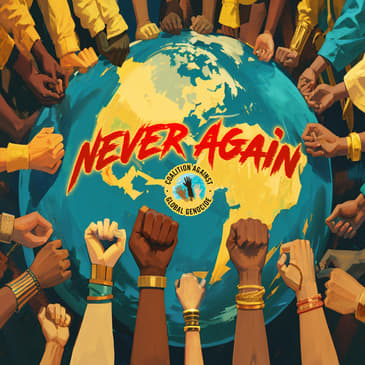
Discover how the Coalition Against Global Genocide aims to expand its reach and impact in the coming years, empowering individuals and communities to take action for a better world. Join Dr. Pius Kamau and Ivonne Cameron as they explore the critical themes of advocacy, education, and empowerment in the fight against global genocide. They highlight the importance of addressing "flashpoints" around the world, fostering democracy, and instilling resilience in affected communities. The episode also touches on the crucial role of both community involvement and financial support in driving change.
Key Takeaways:
- The Coalition Against Genocide focuses on three pillars: educate, motivate, and empower, to combat global conflicts and promote peace.
- Initiatives for 2025 will include a Youth against Genocide conference and increased collaborations with religious communities to educate on democracy and human rights.
- The concept of democracy as a tapestry of global peace is explored, highlighting how its unraveling can lead to widespread international unrest.
- Historical awareness is crucial in understanding current global conflicts and motivating communities to strive for cohesive solutions.
- Resilience and action at the grassroots level are powerful tools to overcome despair and instigate positive change in war-torn regions.
Listen on Apple Podcasts | Spotify | Amazon Music or wherever you get podcasts!
Presented by The Coalition Against Global Genocide (CoAGG) and its mission to educate, motivate and empower individuals and communities to oppose Genocide and Crimes Against Humanity.
Donate to The Coalition Against Global Genocide Here
See Privacy Policy at https://art19.com/privacy and California Privacy Notice at https://art19.com/privacy#do-not-sell-my-info.
[00:00:00] Never Again, Never Again, Never Again, Never Again, Never Again, Never Again, Never Again.
[00:00:09] Join Dr. Pius Camau and the Coalition Against Global Genocide, as we journey across the globe,
[00:00:15] taking a deep look at past, present and impending genocides and mass atrocities.
[00:00:20] Listen to experts who discuss not only the history but also the resiliency and mental
[00:00:24] health of people who are recovering from these heinous acts. Learn how we can move from bystander
[00:00:30] to active involvement, calling out genocidal acts where you are.
[00:00:35] Good afternoon, everyone. And good afternoon to you, Yvonne. Yvonne, before we go any further,
[00:00:42] could you kindly tell the listener who you are? And then I will tell the listener who I am.
[00:00:49] Sure, I'm happy too. I am currently serving as the vice chair, moving to the chair role
[00:00:58] for the Coalition Against Global Genocide. That is how I am tied into the organization, COAG.
[00:01:09] But on a professional level, I'm a serial entrepreneur, having started 17 startups.
[00:01:17] I do philanthropy work globally, and especially in African countries. I've raised close to a billion
[00:01:27] dollars through different programs, grants, a lot of ways in which we can put action to words behind
[00:01:36] the work that I do. I have been a delegate to the United Nations for women. And, you know, that's just
[00:01:47] the little part of Harvard Policy Fellow. I have served as a senior policy fellow on Capitol Hill,
[00:01:56] an assistant professor at Howard University, and I've run nonprofit organizations.
[00:02:05] So on a professional level, that's who I am. And what ties me to COAG is the desire to make a difference
[00:02:20] globally from things that I've witnessed in my childhood, from stories that I've heard from
[00:02:28] my relatives. I've been one that has always said, how can you turn tragedy or real issues of challenges,
[00:02:42] how can you turn those things into action? And I always say it can either do one of two things.
[00:02:48] It can make us better or can make us bitter. And I choose for it to make me and the world around me better.
[00:02:56] Yes. Before we jump into our discussion here, let me just simply say that my name is Pius Kamal.
[00:03:07] I am the host of a Coalition Against Genocide podcast, which we call Never Again. And here,
[00:03:16] once again, Never Again essentially means that that which has happened and it continues to happen in our
[00:03:24] world should really be proscribed. It should never happen again, really. It kind of explains itself,
[00:03:30] never again. We should do everything we can to make sure the bad things that humanity does to other
[00:03:40] human beings. The way that systems fail in our world are corrected and don't happen again. I'm a physician,
[00:03:52] I'm a surgeon, I have been a surgeon for over 35 years, and most of all, I write up. I have written
[00:04:02] columns for the Denver Dailies. So I wrote for the Rocky Mountain News, I wrote for the Denver Post for many years.
[00:04:13] I was a contributor to the Huffington Post, and I have contributed to the National Public Radio.
[00:04:20] I've also been on PBS and done a bunch of things for them. And now I write for the Denver Gazette.
[00:04:29] But in addition to that, I mean, I have also been, I have also run a group called Africa America Higher Education
[00:04:37] which is the concern with the education of women scientists in Africa to obtain their graduate degrees
[00:04:52] in this country. Those are a few other things that I have done along the way. And I'm very intrigued and
[00:05:00] excited to be a part of a coalition against genocide. Let me also mention here that the head of the
[00:05:10] the person who began the coalition against genocide, and with all this sort of behind us, and sort of
[00:05:18] standing standing on our shoulders as we talk is a Miss Rose Duman. I think a tribute has to be paid to her
[00:05:27] on a consistent and a regular basis. So going back to our discussion, Yvonne. So the three planks
[00:05:37] that the coalition against genocide has is to educate, to motivate and to empower. Those tend to be the,
[00:05:48] those are the three things that we sort of highlight as we go on. But maybe
[00:05:57] what we, we can sort of talk about for a moment is about democracy. How does democracy and genocide
[00:06:07] and the killing, the destruction of different nations, how does, how do you think it happens? And what can we
[00:06:19] say about that? That's a loaded question. It's very loaded. I think that as we look at the world today,
[00:06:36] there is, it's almost like there's no even one flashpoint that you can even point to because
[00:06:45] you look up and there's this happening in, you know, this part of the world or what's happening in Africa or
[00:06:53] what's happening, you know, between Russia and Ukraine and what's happening. You know, there's so
[00:07:00] many different flashpoints that it's really made us, COAG, talk about, well, what if democracy fails?
[00:07:13] Right. Because for, and I'll say this for me personally, you mentioned, um, what I always call her is our
[00:07:22] illustrious leader, Roz Duman. As we talk about setting the stage for COAG or where COAG should be,
[00:07:32] should be going, it's, it's almost like drinking from a fire hose. There are so many,
[00:07:39] like I said, flashpoints and so many things that need to be addressed and so much action
[00:07:48] and awareness. Like you said, education, of course, um, there's so much education that needs to happen
[00:07:55] that I believe your average American doesn't really have a grasp on the different flashpoints. Because
[00:08:04] can I say that I, aside from working with COAG, of course, it's our business, right? Your business,
[00:08:13] Pius, my business to know these are the things that are happening. But as we look at what's happening
[00:08:21] every day, there's something new. Every day, there's, there's a new way in which there's another idea on
[00:08:31] here's additional educational programming that we need to do to make sure that everyday Americans are
[00:08:38] aware of not only what's happening in our nation, but what's happening globally and the way in which
[00:08:48] we are so much more interconnected now. So I, I just had a thought, um, which, which essentially is
[00:08:59] if you, if you, if you can consider world peace, you know, because, which is essentially what, what we
[00:09:06] require, what we want for things to think for, for good things to happen, you have to have peace. For
[00:09:14] good things to happen, you have to have good governance. I think of, uh, the world at, at peace as if it was a
[00:09:22] beautiful carpet, wonderful, wonderful carpet, but the, the carpet has got threads. And when you
[00:09:31] begin pulling a thread, right? The carpet or the, uh, the, the, the structure of that mosaic begins to
[00:09:40] unravel. And maybe you can also think of democracy failing as the unraveling of that, the structure of
[00:09:51] that beautiful carpet or beautiful painting, you know? Absolutely. So really, I think, I think what
[00:09:58] we're seeing when we, when we talk about what's happening in, in, um, in Myanmar, the fighting going
[00:10:05] on between the Buddhists and the Rohingyas, you know, that, that, that is a, uh, when you don't,
[00:10:14] you don't admit to other people's rights or having rights, having, having a human, a humanity.
[00:10:22] The same thing I think is happening in, uh, in the Middle East with Syria, for example,
[00:10:29] you know, which is, which is, which is, which, you know, al-Assad is now gone.
[00:10:34] Right.
[00:10:35] But, you know, but what you see, what he did, you know, for the last 15 years was a denial of
[00:10:41] humanity of a lot of people, you know, who he killed and killed and killed. The same thing with
[00:10:48] Ukraine, of course, the same thing in Sudan, for example, you know, where, where these two generals
[00:10:54] are fighting each other. And it really has a lot to do with the two men with guns denying the rights of
[00:11:03] a whole bunch of, of the, of their citizens, you know? But, you know, I'm sorry I interrupted you,
[00:11:10] but, but just a thought came to me how this beautiful tapestry, this wonderful, wonderful
[00:11:18] carpet on the, uh, on the, on the floor is being, um, unraveled because democracy, democracy is failing.
[00:11:28] Yeah?
[00:11:30] Absolutely. And so, um, you did a, a great job of just, you know, hitting on a few of the different
[00:11:38] flashpoints that COAG is looking at not only making sure that people are aware,
[00:11:49] but how can we better engage? Yeah. What, what does action look like? What does tangible action
[00:11:58] look like that is realistic in our everyday lives? Because as we look at, like you said, the mosaic of
[00:12:09] what's taking place and the threat, the actual threat to democracy, it can, it can be a bit overwhelming.
[00:12:18] And so for the, for, you know, regular American, you know, in their, in their home there, I'm sure
[00:12:27] they're thinking, well, how can I make a difference? And it could be, it can be, it can be overwhelming at best.
[00:12:36] So how do we take what's happening? Like you said, in Myanmar, how do we address, uh, Myanmar? How do we
[00:12:45] address what's happening in Ethiopia? In it's, uh, fatigue way people. How do we address what's happening
[00:12:56] in, uh, between, you know, Russia and Ukraine? How do we address what's happening in Sudan? How do we
[00:13:05] address what's happening with, you know, what's, what has happened with the Assad regime? How do we
[00:13:12] address what's happening in Palestine and Lebanon and Israel? How do we address those things in a way
[00:13:19] that looks at the big picture? How do we address it in a way that not only looks at the, the big picture,
[00:13:28] there's always one side is always saying whatever against the other side, but how do we get the two
[00:13:37] sides to meet? Like you said, to foster peace? Because at the end of the day, that's what we want.
[00:13:48] Peace.
[00:13:49] I mean, I mean, the day you need security and you need, uh, you need, I mean, to have, uh, to be able to
[00:13:55] do anything at all. It's just constructive. You really have to have peace. And I think the best way for
[00:14:01] nations, uh, the best way for, for our population, you know, is, you know, for there to be a democracy,
[00:14:09] there to be the respect of the individual and the respect of, uh, of families, respect of women and
[00:14:18] the respect of, uh, the respect of how different we all are because we are different, but we are equal.
[00:14:25] And I think that's, that's extremely important. So the question of course, then is, uh, what,
[00:14:32] what, what vision might you have, uh, at least talk about, uh, regarding what, you know, what COAG,
[00:14:41] I think might, might sort of, uh, be launching, launching into in the, in the coming, in the coming,
[00:14:49] coming year, in the coming decades, for example. Um, what, what, what are your thoughts about that?
[00:14:57] Well, I will, I will put just kind of like a, a, an emphasis on, um, this, this piece about, um,
[00:15:09] democracy failing. I, I, I think COAG has, um, a lot of work to do as far as educating, um, on the,
[00:15:19] the, the historical precedents. Like why, why are things happening? It's not just, we look up and,
[00:15:27] oh, it's just a war because someone wanted land. Well, we need to do a deeper dive. Why? Well,
[00:15:37] what it's, like I said, what is the historical precedents behind, behind this? Because that adds to
[00:15:45] the understanding of, and lights a path forward. I think, I think, I think what, I think what you're
[00:15:53] saying is that history is important. Absolutely. And everything that we see happening today
[00:16:01] has a historical background. Absolutely. You know, and the educated person is a person who knows their
[00:16:09] history, which essentially comes to our educate, educate part of, uh, of, uh, of the COAG, uh, you know,
[00:16:18] uh, three, three, three points, uh, you know, of, uh, of functioning. Yes. Of educating,
[00:16:25] motivating and empowering. I mean, those, those things are really interwoven into not only the,
[00:16:35] the educational programs, um, that, you know, that we will be, um, embarking on like a youth conference
[00:16:43] because we need to make sure that the next generation, our future, right? The legacy of
[00:16:51] a nation, the legacy of a family, the legacy of a community, uh, really understands the,
[00:16:58] the historical precedence, but there is a way forward to empowering them to, to feel like they have a
[00:17:08] voice and they're not powerless. And as they see the world looking shaky around them, that it doesn't
[00:17:17] create a sense of there's nothing I can do. There's absolutely, there's absolutely, um, things that can be
[00:17:26] done. And, and it's important for COAG to make sure that we do empower the youth. So we will be
[00:17:35] planning our, and launching our youth conference in, um, 2025. So, I mean, that's one thing. Another
[00:17:46] is how do we engage and how do we get religious leaders of different beliefs? How do we engage them?
[00:17:56] How do we empower them as well to say, you have a platform and a platform that can be used for good?
[00:18:09] What, what, what do we have in common? Right. And I think one thing that we can say that we, we,
[00:18:18] we can engage our religious community is that yes, we, we want to see peace. Yes, we can, um,
[00:18:31] make an impact and leave a positive message and let, um, brother and sister know that there are things
[00:18:42] that you can do to make sure that your community, your family and your children understand and know
[00:18:55] what's happening and how we ensure that democracy doesn't fail. So, you know, those are just, um,
[00:19:06] some of our programmatic things that we'll be doing in 2025. But here again, the podcast has been
[00:19:15] instrumental for us, Pius, as you know, as you know, as you've been our host, never again is
[00:19:23] instrumental. We're saying these things happened. And, and we thought, Hey, never again. But
[00:19:33] as we look at our world today, while some of those things are emerging again, some of the things that
[00:19:42] we thought we wouldn't be dealing with are happening again in different parts of the world.
[00:19:48] Yeah. The expansion of our podcast, never again, it's critical. Educating here again,
[00:19:59] the, the, the, one of the, uh, pillars of, um, education. Um, it, it's, it's critical. It's key
[00:20:07] for COLEC. Um, and I think, I think, I think, I think what, I think what I'm hearing you say
[00:20:12] is that this podcast needs to be heard across the world. Absolutely. I think, I think, I think,
[00:20:22] we have light in our hand and we need to throw it so the whole world can see our light.
[00:20:29] Right. You know? Absolutely. And, you know, we, the discussions have been so rich, uh, that
[00:20:41] never again has featured, but we, I think we still need to continue to challenge our perspective on
[00:20:49] governance. We need to challenge, you know, rights. What, what do, what do rights and responsibilities
[00:20:55] look like for citizens to safeguard their freedoms? We need to continue to challenge and ask the questions
[00:21:05] that people aren't really talking about or, or, or the hard questions that, that people aren't asking.
[00:21:11] Um, we can't afford to, there's such an, a sense of urgency that I feel that not only does never again
[00:21:21] need to be more global, but so does COAG. You know, we've been a bit, I think, self-contained,
[00:21:30] but we can't afford the luxury of that. Yeah. Yeah. Well, you know, you know, there's an interesting,
[00:21:39] uh, uh, uh, uh, uh, two points I wanted to make. One is, uh, uh, a thing that my mother back in Kenya
[00:21:47] used to say, a tribal, tribal woman. And she said, well, if you have a food, you can feed two or you
[00:21:56] can, you can feed five without the same food. So in other words, that message that we are sending out
[00:22:04] and is heard by a thousand people, it should be quite easy or should not be hard for it to be
[00:22:12] listened to and heard by a million people. You know, is the food that you're giving out, you know,
[00:22:19] the same portion of food, share it, share it with more people, you know, it makes, it makes more
[00:22:26] people whole and more knowledgeable. Another point I was going to try and make is, uh, there was a young
[00:22:33] fellow, a 12 year old guy who had HIV in South Africa. His name was Nkosi Johnson. And Nkosi Johnson
[00:22:42] said not too long before he died, he advised all of us to do what we can do with what we have,
[00:22:52] where we are. So in other words, I mean, he's a little boy telling all of us,
[00:22:59] building all of us to do what we can with what we have, where we are. And that, that's very,
[00:23:08] very, very important. Now to go back to, uh, to, to, uh, what you were saying. So what would you say
[00:23:15] the coalition against genocide is going to be doing next year? Well, some of the things, um, I've,
[00:23:23] mentioned like the, the youth conference and the engaging, uh, the faith community, but also we
[00:23:33] have talked about how we, uh, develop additional toolkits. Uh, I call them toolkits in ways in
[00:23:44] which we get, we get others to join the conversation. Uh, how do we get others to really care
[00:23:52] and it not be about, well, as long as my community or my neighborhood is safe or my family is safe,
[00:24:03] that's all that matters. How do we engage the conversations? How do we change the tone of the
[00:24:10] conversations? Right. How do we change the tones so that we continue to challenge norms? Yes. We
[00:24:21] change the tone of the conversations to engage our listeners, to engage our communities, to engage
[00:24:33] youth, to engage faith leaders, to want to ignite change. Yeah. So I don't know if you've seen, um,
[00:24:44] Pius Coag's display. I have. Um, it's museum worthy looking at all of the different regions around the
[00:24:56] world and different racial and ethnic groups, Native Americans, well, Native people, Asian people, African
[00:25:07] people, Hispanic and Latin, you know, Latinx people looking at just all of the different racial and ethnic
[00:25:18] groups around the world and how everyone, I don't think anyone can say that their community has not
[00:25:29] experienced some sort of crimes against humanity in which, um, these groups have, have experienced
[00:25:38] some form of genocide. It's impacted all of us. Yeah. So with that, with the, with the,
[00:25:48] the, our exhibit, we're looking at that being a key piece of education as well and taking parts of that
[00:25:58] to use for our kind of community toolkits that, that speaks to, this has touched your community. This has
[00:26:10] touched your backyard and igniting that conversation of hope, igniting that conversation
[00:26:18] of let's challenge the norms. Let's educate. And with that comes empowerment. With it comes a sense of
[00:26:30] my people, my community, my family. And how can you ignore that? You can't. And that's what we're looking to,
[00:26:44] um, engage and, like I said, ignite the conversations around all of the flashpoints and all of the crimes
[00:26:54] against humanity and genocide that we are seeing not only in our past, but that is happening currently
[00:27:03] in the world around us. Yes. So as I think, uh, the way I'm, I'm hearing you is that, uh, we should engage
[00:27:12] more people maybe, I mean, more people that, or maybe people who have been affected by the different
[00:27:19] crises around the world. Because, because I think they, they all have a story to tell.
[00:27:25] And that, that story can be told using COAG as a mouthpiece and using this podcast as a mouthpiece also
[00:27:35] to, to see what we can do to change, to change the hearts of people around the world. Yeah?
[00:27:42] You've pretty much summed it up. One of the things that you said is engaging more people. And
[00:27:50] a key point for COAG has been, how do we make sure that this message, making sure that we empower or that
[00:28:00] we educate, that we motivate people. And so it goes beyond, like, like you said, it goes beyond,
[00:28:08] it goes beyond just our personal conviction. It goes beyond where COAG is, is headquartered.
[00:28:19] In Denver, Colorado. It goes beyond Denver, Colorado. Yes. Um, it, it goes, it's, it's, it's,
[00:28:27] so it's on a world stage. Cronce against humanity, genocide. It is happening fast and furious on a global
[00:28:36] stage. We look all around us and it, it is like a tinderbox. And so the podcast, our, you know,
[00:28:49] educational programs, engaging the faith community, engaging our youth, making sure that what we're
[00:28:58] doing even goes down to the legislative level. Uh, there, there's, there's so many different angles
[00:29:07] and there are so many different ways in which we COAG, meaning we COAG have a lot of work ahead of us
[00:29:17] in 2025 and beyond. There's so much more that, um, we have planned and we want to do, but this is like,
[00:29:27] how do you, you know, how do you eat an elephant one bite at a time? Because there are so many flash
[00:29:37] points and because there is so much education and continuing to grow that audience and empower
[00:29:48] people to, to care and take action.
[00:29:51] I think you just said something beautiful there. You just say that, that we have an elephant in front
[00:29:57] of us and we are, all of us need to eat that elephant. So how can we get people in Tigray?
[00:30:06] How can we get people in Sudan? How can we get people in Myanmar to take a bite, to take a good bite of
[00:30:14] that elephant? We have to let them know that the elephant is there. We have to let them know that
[00:30:21] they have a role to play in demolishing that, that elephant. So it seems to me that what you're saying,
[00:30:30] Yvonne, is that COAG needs to be in London. It needs to be in Paris. It needs to be in Nairobi.
[00:30:37] It needs to be in Dakar. It needs to be in Bombay, in Mumbai, I'm sorry. You know, in other words, I mean,
[00:30:47] this COAG has roots and it needs to grow those roots into around the world. It needs to grow roots
[00:30:57] wherever bad things are being done to a child, a woman or a girl. All those places where people are being hurt.
[00:31:09] That's our job.
[00:31:11] That is absolutely our job. One of the things that we didn't even touch on is resilience.
[00:31:18] Yes.
[00:31:19] With crimes against humanity and genocide and atrocities against women and children.
[00:31:28] Just empowering and instilling and giving that sense of hope and resilience to communities that are being
[00:31:43] decimated, to areas around the world that... I had an interesting conversation with one of my colleagues
[00:31:55] who is from Africa. And what they've joined forces is they're working with a school
[00:32:08] just to snatch kids off the street who are being killed.
[00:32:15] And there was more of a sense of hopelessness and helplessness. But one action with just taking
[00:32:31] a few children off the street and beginning to educate them to the point where now those handful
[00:32:43] of kids has turned into a school of 250 students has turned into a community garden,
[00:32:57] has turned into a well, has turned into a health clinic, has turned into employing teachers.
[00:33:07] So where there was a sense of hopelessness, helplessness, helplessness, you wouldn't think that rescuing
[00:33:19] kids from a war-torn area could lead to this. And it's led to, like I said, a community now that has
[00:33:33] more of a sense of empowerment, that has more of a sense of being motivated, that has more of a sense of
[00:33:45] resilience, that we can come back from the edge or we can come back from war. We can come back from
[00:33:55] crimes against humanity. We can come back from ethnic cleansing and genocide to thriving.
[00:34:04] Yes, yes, yes.
[00:34:07] Well, I think what you're saying is that it's beautiful. The fact that the limitation that most of us have
[00:34:16] is that we cannot imagine or we are unable to imagine. And because, as Einstein said,
[00:34:23] really the most important thing for a human mind, for a human being to have is imagination.
[00:34:31] Right.
[00:34:32] Because, like you were just saying about this tiny little nugget that, you know, that this seed
[00:34:42] that was seemed to be hopeless was somehow helped to grow to become a community.
[00:34:52] A community of 250 people, 250 kids with a well, hospital maybe, a school. And that takes imagination.
[00:35:03] That's what we have to engender. That's what we have to grow and to make into a huge baobab tree.
[00:35:13] Yeah?
[00:35:14] Absolutely.
[00:35:15] That's our calling for these coming decades, I think.
[00:35:20] But here again, with all of these, you know, the pluses that we have with educating,
[00:35:27] motivating and having our communities come to a sense of action, it does take groundswell.
[00:35:39] And it does take funding. It does take dollars and cents to, you know, build communities.
[00:35:49] And we know that we're very fortunate to live in the United States where people can be very generous,
[00:36:00] where people can want to put dollars behind a sense of conviction, behind a sense of being empowered.
[00:36:13] And so that is, that is another, another item that COAG has on its list of, you know, our donors have been some of the best, absolute best people that have helped us get to the point where we are.
[00:36:33] But where we're headed to, it's going to be a bit more of a heavier lift because there is so much that needs to be done.
[00:36:46] It's not enough to be confined to your, your own neighborhood.
[00:36:54] Or for example, as COAG, our headquarters is in Denver.
[00:37:00] Now, like you highlighted, we have been educating and motivating on a global stage.
[00:37:10] Well, it's going to take global dollars to go into some of these areas and, and really make sure that there are boots on the ground,
[00:37:23] working with, working with others, working with these communities to make sure that they do have a sense of hope and resilience and are educated and empowered.
[00:37:36] Making sure that we can say never again, because we put real boots on the ground, real action and, and real engagement to this call to action that we, that we know we have on a global stage.
[00:37:55] No, I, I, I think, uh, I'm looking at, uh, um, a schedule here or something you've written where $50, if we get, we get somebody to, uh, give us $50,
[00:38:13] they can find material for one community workshop.
[00:38:19] $100 can support the podcast production.
[00:38:23] Action.
[00:38:23] Yeah, yeah, yeah, yeah.
[00:38:26] You, you, you want to say something more about, about dollars and cents maybe?
[00:38:32] Um, well, you know, like I, like I said, we, we are asking, it is what we know in the nonprofit community to be a season of giving, um, up to the end of the year.
[00:38:46] And so we are asking our supporters.
[00:38:49] We're asking our supporters.
[00:38:51] We're asking our friends.
[00:38:53] We're asking those around the world who have a real sense of, and have been thinking, or even maybe asking a question.
[00:39:07] What if democracy fails?
[00:39:08] Yes.
[00:39:09] How do we prevent that?
[00:39:11] And we are asking for help.
[00:39:15] We're asking for help from, like I said, our supporters, our donors to help us, to come together with us, to help build a better world.
[00:39:24] Where we, again, as we've been saying during our podcast, during our programming, our educational initiatives.
[00:39:35] How do we, how do we, how do we leave our world better than we're finding it?
[00:39:42] Better than those around us are not doing the best job in, in these different flashpoint areas of, of stewarding our beautiful world.
[00:39:55] So we're, we're asking our supporters to join with us as we, uh, lay out our vision for 2025 and beyond with our youth, um, youth against genocide conference.
[00:40:10] And the expansion of our never again podcast, our sermon weekend, our advocacy toolkits.
[00:40:18] As we look at, you know, different programming on genocide, like genocide and slavery that we haven't even touched on.
[00:40:27] I know, I know.
[00:40:28] Yeah.
[00:40:29] So, so we, we have a big agenda and we would ask our, again, our, um, supporters, our donors to join with us so that we continue to instill hope in communities to, we continue to empower.
[00:40:47] We continue to educate and motivate.
[00:40:50] These, these are not just dreams.
[00:40:54] These are things that we have put into action.
[00:40:57] That's how, um, our donors and supporters can help us.
[00:41:01] We have a, a PO box.
[00:41:03] It's a, let me give you that.
[00:41:05] It's a COAG.
[00:41:06] It's C O A G G.
[00:41:09] That's our acronym.
[00:41:10] The PO box.
[00:41:12] 6, 7, 1, 4.
[00:41:13] Denver, Colorado.
[00:41:16] 80.
[00:41:17] 2 0 6.
[00:41:18] We have a website.
[00:41:20] Coag.org.
[00:41:21] That our supporters can also find us.
[00:41:25] That would, if you're enjoying the thoughtful questions and the great dialogue that, that Pius is asking, that we can make sure that continues.
[00:41:36] And for those that are listening to our podcast, never again, there is a link on our podcast that you can click on that link and it'll take you to our donate page where you can, you can make a contribution.
[00:41:55] And it would be so much appreciated to know that what we're doing, the strides that we're making are not in vain, that we are having even an impact with our listenership.
[00:42:10] So in essence, really, we're inviting, we're inviting the listener.
[00:42:15] We're inviting our audience.
[00:42:17] We're inviting the world to join Coag.
[00:42:22] Because here, once again, it does take more than words.
[00:42:27] It also, also, it takes bread to be able to survive, to live.
[00:42:33] For us to, to really sort of be servants of democracy and to be, to be, to be servants of humanity.
[00:42:42] We need help.
[00:42:44] We need a hand.
[00:42:46] We need somebody to push us along.
[00:42:48] And then if we do that, we can all sing this wonderful song together.
[00:42:53] We have fantastic chorus.
[00:42:56] I thank you very much, Yvonne.
[00:42:58] I think we have, there's so much more we can say.
[00:43:01] There's so much more, so much more we will be saying as, as, as the, the, the days grind on.
[00:43:09] But we need to, we, we are here to do good work.
[00:43:13] And, and you are doing a great job, Yvonne.
[00:43:17] Thank you so much.
[00:43:18] And I thank you, Pius, for coming, coming alongside and standing with Coag.
[00:43:26] And I, I just want to leave our listeners with the thought that your compassion and commitment does inspire hope in the face of adversity.
[00:43:40] So.
[00:43:40] Yeah.
[00:43:41] That's good.
[00:43:42] Again.
[00:43:43] Yeah.
[00:43:44] Well, Merry, Merry, Merry Christmas to you and a Merry Christmas to the world.
[00:43:48] Merry Christmas and a Happy Hanukkah as well.
[00:43:53] That too.
[00:43:54] Yes.
[00:43:54] Yeah.
[00:43:54] Thank you.
[00:43:55] And Happy Kwanzaa.
[00:43:57] And happy, yes.
[00:43:58] And Happy Kwanzaa.
[00:43:59] Happy Kwanzaa.
[00:44:00] We can't forget that.
[00:44:01] That's right.
[00:44:02] Can't forget that.
[00:44:03] In, in Africa we say, in Kenya we say Asante Sanaa, which means thank you very much in Swahili.
[00:44:11] Asante Sanaa.
[00:44:12] Asante Sanaa.
[00:44:14] There you go.
[00:44:16] Thank you.
[00:44:16] Thank you.
[00:44:20] The Never Again Podcast is presented by the Coalition Against Global Genocide and its mission to educate, motivate, and empower individuals and communities to oppose genocide and crimes against humanity.