
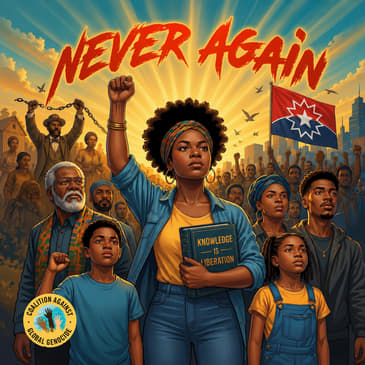
Dr. Pius Kamau speaks with Dr. Ryan Ross and "Reverend Quincy" Shannon on the significance of Juneteenth, ongoingsystemic inequities, and the importance of education for community resilience. The guests explore historical and the modern examples of tje struggle for freedom. Emphasizing the need for continued vigilance, communication, collective leadership, and strategic resistance to sustain progress in the fight for freedom.
Listen on Apple Podcasts | Spotify | Amazon Music or wherever you get podcasts
Never Again, is presented by The Coalition Against Global Genocide (CoAGG) and its mission to educate, motivate and empower individuals and communities to oppose Genocide and Crimes Against Humanity.
Donate to The Coalition Against Global Genocide Here
Key Takeaways
- Understanding Juneteenth: The episode underscores Juneteenth as not just a celebration of emancipation but an ongoing testament of the struggle for true freedom and equity.
- Strategic Activism: Effective community leadership requires informed action and strategic unity beyond mere outrage to combat systemic inequities.
- The Role of Communication: Highlights the crucial role of effective communication and breaking social silos to foster a cohesive movement for change.
- Historical Legacy: Encourages reflection on ancestral sacrifices and the responsibility of current generations to build a more equitable future.
- Civic Engagement and Education: The importance of education and civic engagement is pivotal in understanding and reshaping the systems that affect African-American communities.
See Privacy Policy at https://art19.com/privacy and California Privacy Notice at https://art19.com/privacy#do-not-sell-my-info.
[00:00:00] Never Again, Never Again, Never Again, Never Again, Never Again, Never Again. Join Dr. Pius Kamau and the Coalition Against Global Genocide as we journey across the globe, taking a deep look at past, present, and impending genocides and mass atrocities.
[00:00:21] Listen to experts who discuss not only the history, but also the resiliency and mental health of people who are recovering from these heinous acts. Learn how we can move from bystander to active involvement, calling out genocidal acts where you are. Juneteenth, Beyond the Celebration and Strategies for Collective Liberation.
[00:00:46] Dr. Pius Kamau, I am Dr. Pius Kamau. I am a physician and I'm a writer. I have a memoir coming out in July, and I host this podcast for Coalition Against Global Genocide. Dr. Pius Kamau, Dr. Rai – Dandrenative Dr. Rai – Rai – and today I have two guests, Dr. Ryan Ross, who is an educator, a speaker, and a gentleman committed to access equity and development of leaders.
[00:01:17] And we also have Reverend Quincy, who is a Dandrenative. Dr. Rai – And he serves at the New Hope as a youth and a young adult pastor. But that said, I would like them to introduce themselves for the audience. So, Dr. Ross, tell us about yourself. Yeah, good morning, Pius, first and foremost. Thank you, Reverend Q. It's always great to see you and share space with you.
[00:01:45] Again, my name is Dr. Ryan Ross. I'm a Denver native. I'm a father. Grew up in the east side of Denver. I have had the opportunity to serve as an educator and an actualization coach for nearly 20 years. I have the great privilege of working for the Urban Leadership Foundation of Colorado, where we work with emerging and arriving Black leaders focused on civic engagement and moving from good to great in their personal and professional lives.
[00:02:13] And so that embodies a lot of different things from personal coaching to career coaching and mental health and self-awareness. And so it's been a great joy to do this work and transitioned out of higher education after 20 years to do this work full time and just have a great time doing it and really happy to be in a space where I can just unapologetically serve Black people. And it's a really good feeling. Yeah. The Reverend Q. Yeah.
[00:02:44] So my name is Q. I am a Denver native. I grew up in Park Hill, went to Denver East High School, was the third generation to go to Lincoln University in Jefferson City, Missouri. My grandmother went there. My mother and my father met there. And now I live back in Colorado. For the last 14 years, I've served as the dean of students for the Denver School of Science and Technology. I'm also the CEO of Neighborhood Uplift, which is a program that was created to help diversify the mountains.
[00:03:09] And so we have a building in Park Hill that has about 1,500 skis and snowboards that members of the community can rent and utilize. We have soft gear opportunities where people can come get coats, gloves, goggles, helmets, ski pants, so that they have the resources that they need to be able to go up to the mountains. And then we also own a 28-passenger bus, but partner with the Colorado Department of Transportation to take people to the mountains.
[00:03:35] And so last year, we did 17 ski trips, averaging about 100 to 150 people going to the mountains and trying to make an impact on an area that is still being redlined based off of either socioeconomics or the perception around stereotypes that keep people looking west but never going there. Beautiful. Beautiful. Gentlemen, so this podcast is about things.
[00:04:02] And I can't think of a lot of people to talk about that particular occasion. And maybe what we could do for a minute is talk about Juneteenth. I mean, what it means to one of us, one of you. Ryan, so what do you think? Yeah, so I think Juneteenth is critically important for a variety of reasons, right? I think first and foremost, it reminds us that there was an effort and a fight for freedom, right?
[00:04:32] But at the same time, I think we have to recognize and realize that Juneteenth isn't just an historical event where we celebrate, right? Juneteenth represents freedom. It represents responsibility. And I think that we have to be thinking about what our ancestors fought for and what they did. So we have some of the limited freedoms that we have right now and really ask ourselves, what is it that we're doing with our freedom?
[00:04:59] And I think also, and this may make people uncomfortable, but, you know, when we think about Juneteenth, we have to think about the struggle of Black people. And I think we have to remind our community and the majority in community that Black people in America aren't struggling because Black people have failed, right? We are, we're struggling because everything that the fight for Juneteenth was, right?
[00:05:25] We're navigating the accumulated consequences of centuries of policy decisions, economic exclusions, educational inequity, housing discrimination, and very intentional barriers to opportunity, right? And that evidence is all around us. And so I think Juneteenth is a reminder of our responsibility that we have to continue to be fighting against that. How about you, Pastor Rakew?
[00:05:53] Yeah, I think Juneteenth to me is a reminder of the value of communication. When we think about the reality that there were individuals in this country that had been freed, but because they had not been given the information about said freedom, they were operating as business as usual.
[00:06:11] And so if we don't learn from the history of adequate opportunities to communicate in an educational aspect, we run the danger of continuing an aspect of people being able to use us for our mind, body, and spirit. And so I think when I think of Juneteenth, I think about Galveston, Texas, I'm thinking about an opportunity to utilize healthy communication as an adult.
[00:06:37] And that means talking to my daughter, talking to younger generation about things that I was never talked to. That means reaching up to our senior saints and having conversations with those who have walked paths that I have yet to walk and try to learn from the sage advice that they have. I think communication to me is the first thing that comes through when I think about Juneteenth. And then I would say, secondly, the danger of siloing.
[00:07:01] When you are able to put a group of people away from others and isolate them in a way that you are able to stop that communication, there is danger in the lack of unity coming together. And I see that happening often within our Black community, more specifically of, all right, Ryan's from the East Side, I'm from Park Hill.
[00:07:24] If we allow those silos to be the things that ran our lives, there is so many opportunities that we would have missed from collaboration. Or he went to a different high school than I went to or a different college than I went to. He's in a different fraternity than I'm in, right? There's all these different opportunities for us to think about what makes us different and therefore gives us opportunities not to work together.
[00:07:50] And that siloing only continues to help this version of white supremacy that wants to continue to utilize who we are and what we are. And so I think learning from Juneteenth helps me to think about, all right, what are ways that I can break through certain silos that I would normally allow to be the things that would keep me in certain places, work in certain communities that I may not normally feel comfortable working in.
[00:08:15] And I say a lot of the work that we're doing in the mountains is around that understanding of we have a place in these spaces just as much as others have, and that we can't allow some of the things that would keep us siloed to stop. And then, like Ryan said, we can't just look back. It's not just what has happened in the past and then highlighting that, but really having those Sankofa moments of, like, how do we utilize what's in the past and move forward to our future?
[00:08:43] And so I'm super proud of Norm Harris and some of the work that he's done around celebrating Juneteenth here in Colorado and making sure that we have a celebration. This year, some young fellas that I've known for a long time who created a thing called Munchies and Mimosas are actually highlighting and having something during Juneteenth weekend. When you drive through different communities, there's art venues, there's stepping opportunities, there's a lot of different collaboration opportunities.
[00:09:10] So I think with Colorado having such a low demographic of Black and African Americans, the fact that we continuously have one of the largest Juneteenth celebrations shows the value of understanding not staying in those silos, coming together and continuing forward for the future. This is a very interesting, interesting concept where the silos that you mentioned, who engineers them? Who creates them? Say that one more time, Paisa. I lost your sound.
[00:09:40] The siloing that happens between the different groups of Black people, who engineers that? Is that something that we do naturally or is it something that's artificially created? Oh, yeah. I think that answer is twofold, right? I think there's the unhealthy siloing that was created, you know, by supremacy, right? It was dividing people who were enslaved in houses versus people who were enslaved in fields, right?
[00:10:09] It was the intentional breaking up of the Black family by separating fathers from mothers, from families. It was the literal destruction of the family. Think about it. I have a lot of conversations and Q and I have had this conversation, too, right? Just on the relationship between a father and son. And I really love the relationship that he has with his father, right? Just the ability to hug your father, cry with your father, love your father, be vulnerable with your father.
[00:10:35] For so many years, that didn't happen because men had to focus on making their children tough so they could survive their environments, right? Hey, I can be sold or killed or hurt at any time, so I don't have time to hug you. I have to make sure you're able to exist in this world. And so we see the breaking of the family like that and creating silos in that way, right?
[00:11:00] If somebody wanted to try to join Harriet Tubman and run for freedom, you have people who are literally thinking about, do I snitch? Because maybe the rest of us are going to get in trouble, right? And so there's that kind of siloing. And we see that all the way through. We can draw a straight line from slavery to the Black Code, from the Black Code to Jim Crow, from Jim Crow to redlining, from redlining to modern wealth disparities.
[00:11:26] And then from wealth disparities to many of the challenges we see today, even with alienation of education and the attack on equity and inclusion, right? That's all a siloing effect to keep us from information, right? And then there's healthy siloing, right? Being able to find a tribe, right? Think about fraternities and sororities. When I was in college, I connected with the men of Kappa Alpha Psi. Quincy connected with the men of Omega Psi Phi, right?
[00:11:54] There are some different fundamental values of the organizations that attracted us to both of those. And that's good, right? We get to have our tribe. We get to have those things in common. But the power then is understanding that we come together as Black men who are in fraternal organizations. To inspire children to do work, to learn from each other. And you know what I mean? And I think that's healthy because we also get to divide and conquer because we focus on different things.
[00:12:19] And then when we come together, we bring that, all of that talent and all that intellect and all of that purpose and passion to make something happen, right? It's been really cool to watch Norm Harris and his purpose bringing Juneteenth back to life, right?
[00:12:35] It's been really cool sitting back watching Quincy take this thought about racism in outdoor activities and sports and siloing Black people from the outdoors and turn it into what it was meant to be, right? An opportunity to be and sit at any table. So I think that we see those two different kinds of silos.
[00:12:57] And I think that it's important to understand that there's positive and there's negative and there's intentional hurt and then there's intentional opportunity to build villages. And we have to do that because we can't be alone in anything we do, right? And we're not a monolithic people, right? So there's going to be different things. I think about artists and educators, guys and women who do poetry or hip hop, right? There's a community for them. They go find that community and then you come back and share it with everybody else.
[00:13:26] And so that's the richness of siloing or having a tribe and then impacting the community. And so I think it's important to differentiate between the two because then everybody can have that name. You know what I mean? Absolutely, yeah. So one of the things that we've been talking about among ourselves, Coalition Against Global Genocide, is whether we say enough or we say too much about the Juneteenth.
[00:13:55] What do you guys think about the limits of discussion about Juneteenth? Have we said enough about it or have we not said enough about it? Is there much more to be said about Juneteenth? I'll jump in and say I think that I don't think we say enough, but I also think the challenge is that people think that it was a regional holiday for a specific group of people.
[00:14:19] So when you are talking to a large demographic like Ryan was saying or Dr. Ross was saying, we are not a monolithic group. And so when we're looking at individuals who had their own challenges in their own community, right? My grandmother's from Okmowgli, Oklahoma, but was raised in Tulsa. She was raised through 1921. Black Wall Street was a reality for our family, right?
[00:14:45] And so if you ask her some of the challenges, she would have said she would have liked to highlight more of what happened there because it was a similar type of genocide of lack of communication. People being mad about resources going to the wrong place or all of the challenges within supremacy that made Juneteenth and Galveston, Texas what it is.
[00:15:06] So I think the challenge within it is that I think we can say more, but the challenge is that we see it as, okay, that was a specific thing that happened to a certain demographic of people in a certain area. And we could highlight many different genocides that have happened within this country. And why aren't those getting highlighted the same or given the same type of platform for individuals to be able to either grow from or learn from?
[00:15:33] And so I think one of the greatest things that we can do within this world of understanding our history is not dim the light of one to highlight something else, but continue to teach as much as we can. And so as much as we are learning and sharing about what happened in Juneteenth, and that only happened because we have people who have ties to Texas who came to Colorado, right? Then we can start to think of what are the ties that we have to other places?
[00:16:01] Okay, we have a large group of families that came from Nicodemus, Kansas. How do we talk about and highlight what happened with some of the Black communities that were created around where we're doing Deerfield here in Colorado, Nicodemus, and we can name several throughout the country. How do we share and highlight that? Okay, we know that there was a migration of individuals who went from the South up into the North.
[00:16:26] How do we highlight and talk about how Chicago and Detroit have ties to Mississippi and Alabama and why those ties exist and then be able to share some of the histories of both places that continue to make us have a complex history? Okay, we realized that the railroad became a main reason why many African Americans had an opportunity to go west.
[00:16:48] How are we going to be able to highlight how the Pullman Porters and others were able to help the reality of the Harlem of the West in which Colorado becomes, but then other locations, how are we able to highlight those things? So I don't think the conversation is, are we doing enough for one, and then shifting the conversation to celebrating or not celebrating.
[00:17:10] I think it's all a rising tide lifts all boats, like we have to highlight our history, know our history, share our history, celebrate our history. So then we don't A, repeat said history, but also we're able to learn and grow from those things to be able to say, all right, when people talk negatively about Denver, Colorado, because of our Black population,
[00:17:35] and they're comparing it to an Atlanta or Chicago, we're able to say, yes, we'll never have the numbers that those places have, but we still have a rich history and being able to share that history while also being able to recognize the value of history in other places like what happened in Texas. Yeah, and I think I would just add, those are excellent points made by Quincy.
[00:18:00] I think what I want to add to that is, is we have to actually think about what Juneteenth is and what it isn't and what it represents, right? And what I mean by that is, is like we oftentimes celebrate Juneteenth as it's the day freedom arrived. And that's not true, right? It didn't arrive on that day, right? Freedom didn't arrive on Juneteenth, an announcement did, right? It was an announcement. And so it's the promise, the promise arrived, the possibility arrived.
[00:18:28] The struggle to make freedom real has to continue every day. And when we talk about Juneteenth, we have to talk about it more, but, or rather, and, we have to think about who's talking about it. Because the right narratives have to be out there because there are folks talking about it, downplaying its significance, telling people what it is. People are excited that it's a federal holiday. But some of the language around it being a federal holiday is false, right? We need to go on vacation.
[00:18:57] Nah, this is a day on, right? This is a day to remember, to reflect, to think about what we have, right? It's a day to really focus with our young people, right? And talk about the blood, sweat, and tears that happen, right? It's talking about the importance of voting. It's talking about understanding that we live in systems that weren't designed for us and that they're not broken, right? They're working the way that they're supposed to be working. So what is it that we need to do? How is it that we show up to address these things, right? And it's not, it's not for me.
[00:19:26] I'm not going to participate or, you know what I'm saying? Or I'm just going to go get me a turkey leg and call it a day, right? We have to, what it is because the work isn't finished, right? And if freedom were complete, we still wouldn't be talking about equal access to quality schools and healthcare and economic opportunity, or even teaching history itself, right? The fact that we have to teach history lets us know that freedom hasn't been achieved, right?
[00:19:53] And so those are the auxiliary or surrounding conversations that we have to have when we talk about Juneteenth. And these are the conversations we have to have more of. And as a community, we have to have them in other places because they don't always, we don't always get an educator like Quincy, who's in a school to bring that up in meetings. So it happens in the building, right? And so we have to support that by anchoring these conversations in our homes and our churches and our barbershops everywhere,
[00:20:20] where are we going to touch people, especially young people? So we don't lose the connectivity to the history and to the purpose and to the struggle, right? Yeah, I think what Ryan is saying right before you jump in is so important because we're thankfully a part of this generation. Him and I are similar in ages of we had an analog growing up and a digital growing up where there was a time when we played outside and a time when we played video games, right?
[00:20:48] And so when we think about that reality within our current context, we have several young people where if we don't create a lane and an avenue for people to learn about said history, it is not going to be time. We don't we can't rely on a school system to teach it. We can't rely on the black church to teach it. We can't rely on one particular organization to teach it because we're living in a time where things are being rewritten and changed
[00:21:16] and books are being banned and organizations are being doged and our reality of our history is under attack. And so if we are not vigilant about said history, we run the risk of 10 years from now, Juneteenth being a history of a celebration that happens in Five Points because it's a great place to get food.
[00:21:40] And it's a celebration of coming downtown and walking down the street as opposed to anything connected and linked to history. And so I think this is a very critical time for us to be able to say, as those who have an understanding of said history, how can we preserve that history and make sure this next generation has the same reverence for it?
[00:22:05] Because the sad reality is that, you know, the individuals who are taking claim to power right now aren't ignorant, right? One of the biggest things happening within the administration right now from a national perspective, one of the people helping to be in the era of the president of the United States went to school for African-American history, wrote papers and did dissertations on our existence,
[00:22:35] therefore able to use that information to figure out what are ways to alter change and make it to their advantage. And so if we are not taking it with the same seriousness of we are under attack, our history is valuable, then we run the risk of 10, 15, 20 years from now, this being a great podcast that somebody can look up and people having no connection to anything we were talking about
[00:23:04] because the history would have been changed. Something you both brought up is the concept of freedom and the freedom that black people were, quote-unquote, given. And of course, a philosophical point of view, freedom is not something anybody can do. We are all free. We are free people. In fact, I think what happens is that many of us have to hold on to our freedom,
[00:23:30] have to hold on to who we are as human beings, while others are trying to snatch it away. So talking towards that direction, we can begin talking about what the current administration is doing to try and pull that away from all of us. For example, the Supreme Court, for example, just passed a ruling about black people being represented. And so I would like you to maybe comment a little bit about that,
[00:23:59] your views, your views, what you think we should all begin doing, or we can do. Yeah, I would say our history is important. And when we think about freedom is a very valuable thing. My grandmother, I bring her up often because she's the closest thing to a sage elder that I had in my life that was able to share information that would slow me down. And I think in a microwave generation,
[00:24:29] it is valuable to have those in your life that allow you to take things slow. Because when you slow things down, things better. There was a statement that I was taught from a young age. It says, A wise old owl sat on some oak. The more it sat, the less it spoke. The less it spoke, the more it heard. Why can't you be like that wise old bird? And so this idea of pausing, looking, listening, before speaking in action, I think is very valuable.
[00:24:57] And so when you are talking about freedom, it starts in yourself. It starts in your mind. It starts in your understanding of who you are before you could ever think about the chains that may be physically on you. Those mental chains are the things that are very dangerous. And when you have social media raising certain people, when you have genres of music being more valuable than elders and communities that are giving information,
[00:25:27] it's dangerous because the freedom that you may pursue won't actually make you free, right? I can do smoke and mirrors and can make you think that the block that you're on or the socioeconomics that you're going to possess or the girl or guy in your life or the most important things that you have, then I can hide the things that will truly make you free. And so opportunities to gain education
[00:25:57] and pause and think and just pay attention to things, I think are going to be the greatest ways that we're going to combat what the current administration is doing. Because when I was in grad school, I lived in Richmond, Virginia, and people thought I was weird that I would go down to the James River and do some of my studying at the same places where the slave ships came in and walk down the path where my enslaved ancestors walked
[00:26:26] and just sit on the dirt there. And people were like, why? This has such a troubled history. Why do you choose to study here over a library? And my response was, because I know that there were people who looked like me who would be killed for possessing any of the knowledge that I'm currently trying to attain. And so a part of what I'm doing right now is a thank you to them that they didn't jump in the water and give up because something about them got us to a situation
[00:26:56] where I'm able to now learn on these spaces. And so having that version of reverence helped me to see a version of freedom of there is value in education. There is value in showing up in my family. There is value in showing up for my community. And that becomes the freedom that gives me the ability to move how I move. And so as this current administration is taking plaques off of national parks
[00:27:22] or taking history out of said museums or taking funding from organizations, it's going to be those abilities that we have to pause, to learn, to grow, to organize, and then to move. Most of the most valuable movements that we ever could think of that happened in this country didn't happen in the spotlight. The spotlight was just once we started realizing
[00:27:51] what was happening, right? The only reason we have the free lunch that I grew up on and valued was because there were a group of individuals in Oakland, California who saw value in saying, there's kids in our community who aren't eating. We're going to make sure that we're providing free lunch and breakfast for these folks. And the smoke and mirrors is that the folks who got upset with them were more concerned with them carrying around rifles and guns and trying to police the streets over recognizing and realizing
[00:28:21] some of the values that they were trying to enrich the community. How about you, Ryan? Yeah, man. That was a mouthful, Q. I think when I'm thinking about freedom and I'm thinking about this current administration, I think the thing that I think about most is that we have to refuse to surrender to cynicism, right? Because it's really easy to say, look at what just happened with Carmelo Anthony, right? No matter how you feel about that, somebody may say, the justice system doesn't work at all,
[00:28:49] so I'm not going to participate in it, right? We can't have those kinds of responses, right? We have to double down on, all right, how do we make sure that this system works and we have to continue to do the work? We have to continue to disruption. We have to continue to fight for our freedom. I think we have to double down on hope and education, right? We have to, people forget how powerful faith is, right? That faith, that hope is what fuels,
[00:29:18] it fuels protests, it fuels revolutions, right? We have to believe that we can achieve more and that we can actually secure the freedom that we've been looking for. From an education perspective, that is the first thing that supremacy wanted to take away from us, right? We don't want you to be able to read, right? We don't want you to be able to, to Quincy's point, when we started at the top of the podcast, we don't want you to be able to communicate effectively. We don't want you to be able to build.
[00:29:48] We don't want you to be able to galvanize and come together. The worst thing that could happen to supremacy in this country is that we all come together as one, right? And so we have to continue to fight to do that and to be strategic. And I think that the other thing is we have to stop confusing outrage with strategy, right? Like we should be upset. We should be mad, right?
[00:30:15] And that same kind of anger and outrage was the strategy that helped our ancestors build churches, build schools, build institutions, build organizations, right? You want to take something from us? We'll go build this, right? And use it to protect our community, right? I think about the great stories, even though the stories here, right here in Colorado, where we had individuals who would go undercover in the Klan, right? And bring back information. We'd have people who would go work in these white spaces as secretaries
[00:30:45] and bring back information on, hey, who should run for office or where are the holes, right? And so those are the kinds of things that we have to continue to do and continue to think about as we fight for our freedom. And we have to recognize that freedom isn't free. Like now we're going to have to fight for it. Yeah. We have to have all hands on deck when we do it, right? And then I think the last thing I'll share in terms of what we need to do in terms of our freedom is we have to really get serious and intentional about what where we invest. We have to invest
[00:31:14] with black institutions. That's financially, that's emotionally, that's spiritually. In every way, we have to start investing in our own, right? And going back to the example Quincy gave of Black Wall Street, right? That is that example. We've been doing it since the beginning of time, right? And so we have to do a better job of coming back to that and supporting our institutions so that we can ensure our infrastructure and our hidden mechanisms as a community are actually strong.
[00:31:43] So one of the things that I thought maybe to discuss was the issue of how the southern states, the red states, have been rushing to gerrymander, the gerrymandering and somehow taking away black representatives from the south. And that's a terrible thing to really do. And I'm wondering from your point of view, you two gentlemen, what do you think, what do you think the black community needs to do
[00:32:13] as they face that sort of opposition and attack? What do you think we should all be doing? I think it goes back to education, right? We have to learn how redistricting works for most people can name the president, but they can't tell you who drew their legislative district, right? So we get educated on that process, right? We have to understand congressional districts, statehouse districts, senate districts,
[00:32:43] school board, municipal ward, right? Because it's, that civic power is something that is not something that civic power can't be taken away from you. It's once you know it, you know how to play the system and get in front of it, right? We have to pay attention to local and state government, right? Because that's where it starts and it doesn't happen overnight. It's a strategic plan, right? When we look at different sets of politics, you can see Republicans had a plan. These southern states had a plan
[00:33:12] and they've been very intentional about trying to erase voice, trying to erase equity and they're doing that because our numbers are increasing, right? They understand the minority-majority shift that's going to happen and so very similar to the period of enslavement where you have a plantation owner with maybe 10, 12 white folks in the plantation and then you've got 60 people enslaved out there, right? If you don't have the numbers, you take away the process. You take away
[00:33:41] the ability for people to think and connect and grow and right and that's what I think one of the major dangers of gerrymandering is and people don't play the game and we have to get more active in these systems that we know are designed against us and so we have to participate in the public process more and we definitely have to build coalitions to shut down people who might come into power to then
[00:34:10] support the gerrymandering that's going to have a negative impact on us. Yeah. I think you remember the point, one of the things I was thinking about is that the struggle never ends. The struggle is a continuous process. In other words, I think sometimes people get very comfortable as a boy. Now we have a black president. We are now post-racial so to speak and that's garbage, that's nonsense. I think the struggle has to continue. Sorry, Q,
[00:34:40] I interrupted you. I'm sorry. No, you're here. I love that because the struggle does continue. I often think about the quote where they talk about they came for the communists but I didn't say anything because I wasn't a communist. They came from the trade unionists and I didn't say anything for the trade unionists and it goes through some of the others but it concludes with and then they came for me and there was no one left to speak for me. And so I think as I'm thinking about the redistricting of what is happening in a lot of locations,
[00:35:10] it allows me to think of who are my allies and who are the people that I should be also standing up for. It's easy to want or ask for help when you feel attacked. It's harder to recognize that there are other communities that are also being attacked and figuring out how to stand up for them. And so our collective strength is that supremacy believes that it's greater than
[00:35:39] and it tries to put itself above all. And the danger of what we've had in the past was that if it can convince our small differences that we are too much different to work together, then we're able to look to a collective hierarchy of race or opportunities, which is why we have poor white people
[00:36:07] who will vote against their own interest because they're like at least I'm better than name the other group. And so as they are coming together to redistrict, I think what I have been trying to do is take a moment to see who is being impacted outside of just the glaring reality of folks who look like me. because
[00:36:37] that's going to be our secret and collective power of civil rights was not passed because we were able to get all black people on one page and a vote on one collective ticket to get it to pass. Civil rights was passed because we were able to galvanize other communities and get them to collectively vote in our interest, right?
[00:37:07] If we're thinking of a time in our country where we had black senators and congresspeople still in a time when black people couldn't vote is mind-boggling, right? If we can understand that there is collective power in going outside of your comfort zone and leaning on the compassion of others and saying look this
[00:37:36] doesn't help us all by staying in this box let's figure out ways to work together and to grow together and so as they are redistricting and creating false narratives around what is happening in certain places I agree with everything that Dr. Ross said and it is allowing me to look around and say who are the people that I can join
[00:38:06] hands with that yesterday I didn't even recognize as being there who is the history of others that I can learn and grow from so that when I share my story they can see okay all right cool you're from an indigenous background cool the trail of tears relocated your family from this place to this place that's very similar to the displacement that many people in my community felt when they weren't able to stay
[00:38:35] in a certain community because there would be a white realtor that would come on the block saying a black person just moved on your block sell this property for as much as you for as little as you can and then they went around and doubled the price for individuals who look like me to pay so if we can start recognizing that the same playbook is being used on different communities at different times if we're able to say oh no it fooled me once now I see what's happening to the communists now I'm
[00:39:05] seeing what's happening to the trade unionists now I'm seeing what's happening to these other communities and I'm not going to be quiet I'm not going to act like it's not my problem now I'm going to stand up for them the same way that I hope that as this continues to play out that they'll be able to stand up for me so that yes the gerrymandering and redistricting may change some seats but then it's also going to be the opportunity of what Dr. Ross
[00:39:35] said we had folks here in Colorado who are members of the Ku Klux Klan who either were perceived as being white or actually were but understood the value of the assignment of what they needed to do and that's where we are right now okay redistrict rechange redo some things but you can't stop us all and if we can collectively figure out how to work together there may be some
[00:40:04] Trojan horses that we're going to be able to place and implant in certain places that may seem as if they are on the other side but are going to be ultimately for our survival I think you're saying something very interesting because as you are articulating your ideas and your thoughts it occurs to me that what black people and poor people of America need to do is to wage a guerrilla
[00:40:34] war you don't give up and you find different strategies to fight to fight the dominant power whether we have leaders or don't have leaders we may not have a Martin Luther King or a Malcolm X going around the country giving big speeches but you're a leader of your own family you're a leader of your own block you're a leader of your own people does that make sense
[00:41:05] yeah I think that the challenge for us was that martyr term leadership isn't as effective as some other things right Martin Luther King Malcolm X were valuable in the time span that they were but the ability to kill one specific leader and have them be a martyr for a cause is challenging and so I think we have learned from some of those realities of saying if you can't whack-a-mole and know who is
[00:41:34] really pulling certain strings you can't really stop it and I saw that happen some of the most effective I went to Ferguson after Mike Brown was killed and I was there with a group of individuals and while we were there we were utilizing Twitter social media to communicate with different leaders about which places we were going to show up to protest and that information was not shared to the general public it was shared with a select group of
[00:42:04] people and then their different communities would show up and then others would show up and then by any given time you would have thousands of people at a location for something that only a small demographic of us had talked about and it went out to the masses but there wasn't one person saying I'm going to give the speech at said location or I'm going to be the one who pulls all of the people to said place it was different groups who had community of our own that had trust
[00:42:34] who had known our heart and our intentions that were able to move so then when the police couldn't necessarily stop the movement because they didn't know and couldn't tell who was the leader because there was no one person that if they would have grabbed could have stopped it and so I look at that reality of what we have going on
[00:43:04] now of saying I don't want to be a martyred leader I don't want to be somebody who needs to lead my community then die for my community to move forward I want to be a collective leader and say there's things that I add to the revolution and the struggle and there's certain things that I
[00:43:44] get it and who supports it and so when we start looking at what do those things look like within our community currently there is value in us working together collectively and moving forward but I don't think us trying to highlight one specific leader in our community is going to be the solve for any issue because that person then becomes a target that can be manipulated with money and or
[00:44:14] death that's great and what are your thoughts Dr. Ross I agree with Quincy right the other I think one of
[00:44:44] is I don't know I the quote came from the reality is that's the approach right everybody has to care a little bit and everybody has to do a little bit of something right engagement is the key and I think on any game if you play for any team, you can't score a point if you're on the sideline. Simple as that. Read as many people as possible to understand and be self-aware about what it is they offer
[00:45:11] and offer just that, right? We don't all have to run in the same lanes. I would have loved to run around the country and participate in some of the protests and be in some of the places that Quincy was in, but I couldn't, right? And so when he made a post, I forwarded the post. When he said something, when he shared information, I regurgitated that information,
[00:45:35] right? That was the way I could participate, right? I amplify the information that he was sharing, or I could amplify the information that someone else is sharing. That is that for that particular scenario, that was the lane that I was in, right? And so we have to understand the lane that we're in and we have to respect the lanes that other people are in, right? There are some people who are masterful at disruption. So let them disrupt. Don't go say, don't go say, oh my God, you're
[00:46:05] causing, no, go disrupt. And when they disrupt, you follow in with diplomacy, right? We have to really be thinking about that in that way, because when we do that, to Q's point, there's nobody to attack. When you have an army of a thousand generals, they're getting nowhere. What are you going to do, right? You actually have to focus and address the challenge at hand, right? And that's, I think that's the sweet spot. That's where we need to be. And I, again,
[00:46:34] I double down on being informed, being educated, right? You have to understand the systems in order to be a general in it and navigate it, right? And so that is where we have to really focus our efforts. And we have to do that on our own because these things aren't going to be taught in every classroom, right? Or they're not going to be taught by every organization. Everybody's not going to have the benefit of having access to an amazing elder, right? And so with those things
[00:47:03] being, with that being understood, we just have to figure out where we replicate, where we duplicate, duplicate, educate, right? So the last question I was going to ask you guys is, what are your thoughts about Black Lives Matter? My thought is Black Lives Matter. I think what I'll say about Black Lives Matter is, I think it was a really great example of that, right?
[00:47:32] Like, I think there's so many, it was so provocative because nobody for a while, for a time, nobody knew where the root was, right? You just knew that there was a movement happening. And even if you weren't connected to it organically, you can just hear Black Lives Matter and be a part of it, right? Like, you matter. Show up and live as if you matter. So I love that part of it. I think one of the things
[00:48:02] we have to be aware of in any situation like that, when you have a movement, you got to understand that as soon as the movement starts and catches wind and becomes successful or helpful in any way, right? Just like any other time in history, you're going to have people come attack it, infiltrate it, try to bastardize it, perverse it, right? And so we have to stay focused when we have these kinds of
[00:48:28] opportunities to say, what's the core mission? What do I value about it? And why is it important to me? And move forward in that way and not get caught up in the attacks that are going to happen on a scene like that. Yeah. I think Black Lives Matter was one of the most exciting times of my life and also one of the most challenging. We've heard these stories for years as far as people who have marched and people who have
[00:48:56] stood up and fought for us. And so it felt great, feeling as if I was on the right side of history, standing up for things that I believed in. And I gave speeches, I organized and put together marches in which people followed. We went to Ferguson, we went to Standing Rock, we went to multiple different
[00:49:20] locations to stand up for what freedom was. And I got to see how you can dismantle a movement by pulling looking at the threads and the thousands of paper cuts that can kill a body. And so I think the challenge was that within Black Lives Matter specifically, the movement side of things is
[00:49:45] that they were able to highlight our differences just enough to make there be infighting where there was specifically thoughts around too many men leading and so women wanting a chance to step up and then infighting between how many men or how many women were on the on said opportunity to speak or how many
[00:50:11] put together said march and had a place at the table. Then there was the infighting between our LGBTQ plus and our heterosexual community of saying, all right, why is Black Lives Matter not standing up for our Black trans community or our this or our that? And so we started seeing infighting between
[00:50:35] who were the Black lives that mattered and how people showed up. And that was hard to watch from the inside of people who I have a lot of respect for seeing a different side of them when the spotlight was shined one way or the other, or there was respect given one direction and one person felt like they were
[00:51:04] weren't respected. And then what that response was, that was hard. And then finally, I would say the infiltration piece was real. And I have always heard about how the FBI infiltrated the Black Panther Party, how the FBI did different things with Contras and the crack epidemic, gangs, all that type of stuff. But I never experienced
[00:51:31] it the way that I did on the inside of a movement where I remember very specifically, there were two different marches that I had a hand in planning and had put some flyers out about and we got pretty decent circulation. And for the first march, we had probably about 10,000 people who had walked behind like an outline that I had lined for downtown and started getting messages from people, both positive and negative.
[00:52:00] And this gentleman reached out to me and was like, hey, I see what you're doing. I would love to help. And at that point, I was a very open to whoever could help type of person. And he said he had access to the Broncos and was going to have some of the members of the Broncos march with us. He was going to provide porta potties when we did one of the speeches that we were going to do. We were normally doing things on the Capitol steps, but he
[00:52:29] was like, no, we should do it at Civic Center Park because we could fit more people there. I'll pull a permit, all these things. And I was like, oh, this is super helpful. I'm loving it. Cool. Let's move forward. And so we planned this event where members of the Denver Broncos were going to be there. The current mayor at the time was going to stop by who I had ties to through my church. We had already worked with Chief White at the time, who was the
[00:52:53] police chief and put this event together that I thought was going to be valuable. And I remember moments before I was supposed to get up and speak, a young lady who I have a lot of trust for, who has been in movements for a long time, essentially cussed me out on the stage and said some hurtful things. And she was like, that guy that you are working with is a police officer. He's a fed. You are essentially killing the
[00:53:21] movement by working with this person. And I was like, what are you talking about? He's only been provided value to what I thought we were putting together and has been solution oriented and nothing that I can think of is negative. And so stood up for him in that moment, stood up for what I thought was right in that moment. And we went forward with this march and we had members of the Broncos speak and walk with us. And we did a whole path and we had thousands, tens of thousands of people involved
[00:53:51] in this march. And I felt validated by the work that was being done. And four or five years later, that person that helped and showed up and gave those resources, I go to community events all the time. I'm pretty involved in things. I've never seen that person in the community since Black Lives Matter. The movement has ended the way that it was. And in further reflection upon the interactions,
[00:54:18] she was right. This was a person who was implanted into the organizing of the movement and provided value for us in that moment. But I sit with that and it hurt because I realized that I was complacent in pieces of this movement. And this woman who I've known for a long time, who I had trust in,
[00:54:48] who I have respect for still, because of how it was communicated to me, it hurt my ego of, why are you doing this? And so I wanted to protect my ego, who I was, what I thought I was doing. And so I doubled down on the work that was being done and continue to have a wolf in the rooster house. And the impacts of that will be things that I'll continue to understand and process.
[00:55:16] But it helped me to see it's easy to condemn Black Lives Matter, a movement. It's easy to condemn the Black Panther Party. It's easy to condemn a lot of these different revolutionary organizations until you actually had a chance to sit in it and find out that it's hard to vet people. It's hard not to want to trust people. It's hard to not believe that everybody has your best interest in mind.
[00:55:45] And it helped me to understand how members of the Nation of Islam were a part of the killing of someone like El-Haj Malik El-Shabazz. It's easy to understand how members within certain movements have been able to bastardize it moving forward. And so when you say, what are my thoughts on Black Lives Matter? I think the movement was beautiful. And I think it was a great opportunity to
[00:56:12] want to stand on the right side of history. And I think I learned a whole lot. And it's why in 2026, I'm not organizing marches and on the streets the same way, because there was a version of been there, done that. And now to Dr. Ross's point, I serve in a different capacity, where at that time, I was boots on the ground. And now it's a
[00:56:38] very different, I'm a very different chess piece. You can't use me like a pawn anymore. I've definitely elevated. And so I think it was a valuable thing. And I think for anybody's arc of how they want to be involved, there are going to be different ways that you are activated and how you will be moved and motivated to be a part of any movement. And that should be celebrated. Not everybody can be any and
[00:57:05] every role. And hopefully, you can grow within whatever role that you are, where the worst thing that could ever happen for me or for anybody is to be the exact same person they were 10 years ago, six years ago. And to think about that, we started doing Black Lives Matter in 2014.
[00:57:26] I am thankful that I am not the same person I was in 2014. While the same need for us to come together and to fight back and to show the world that we matter still exists. And so my hope is that we don't replicate Black Lives Matter movement, but we still see value in moving forward, coming together and fighting for our freedom. Because like Asada Shakur said, it is our duty to fight for our
[00:57:55] freedom. And it is our duty to win. Yeah. I think maybe it's time for us to stop here. Do Dr. Ross, do you have a few words that you'd like to say before we conclude for Juneteens? Sure. I think that when I think about what keeps me up at night or what I'm concerned about,
[00:58:17] I'm not concerned whether Black people have the talent or the ability to succeed. I think history has answered that question over and over. My concern is whether America has the courage to confront the truth about why so much Black talent has been underutilized, underinvested in, and underestimated
[00:58:41] and manipulated. And my hope is that we stop treating freedom or Juneteenth like a destination, right? Freedom is work. Freedom is stewardship. Freedom is responsibility. Freedom is engagement. And I think the greatest honor, the greatest way we can honor our ancestors is not by celebrating the chains that were removed, but by ensuring that every generation that follows has greater access
[00:59:08] to opportunity, dignity, voice, humanity than the generation before it. Right. So thank you. Yeah. Quincy, do you have a word or two? Yeah, mine is quick. It's just this idea or thought, if we can help somebody along the way, then our living will not be in vain. And so we don't have to be the biggest or the greatest. We just have to be. And our opportunity in this moment is to just be. And so I am thankful for
[00:59:37] an opportunity to share a platform or a stage with you all, because who knows who will see something and that be a spark that changes something else. It doesn't have to end or be us who is the thing that changes. It just has to be a role that we play within the greater thing. And so when we're talking about freedom is so much bigger than anything we've ever been able to obtain, because living in an
[01:00:03] oppressive system, I would challenge that most of us have never experienced true freedom. I still walk with fear majority of the places that I go because it's a survival tactic. And I have more resources and opportunity than many. And so if that's still the current reality of living within a white supremacist world of realizing I don't have the luxury of just doing anything at any given time
[01:00:32] without understanding the consequences that it may bring, then I would say we still have a fight to have. And I encourage all to learn about the struggles that others have dealt with, while also recognizing that there is a mental health impact of all of this work that we do. And what are the right avenues to
[01:00:54] then share, understand, and then we have to travel, we just got to get out of your whatever comfort zone that is, whether that's leaving the neighborhood you grew up in, the state that you grew up in, the country that you grew up in, the continent that you grew up in, there's value in having exposure to something else, because it will help you a recognize what you have, but then also see that there's humanity in so many other places, and that there's work for us to do. There's Juneteenths
[01:01:23] that we need to continue to highlight where there's been misinformation given to our community a whole lot of different times. And thankfully, we had a group of people who were able to take this misinformation, celebrate it, change the narrative, and make it a federal holiday. But there's so much more work to be done. No, I think that's wonderful. Wonderful in that what we are all doing, what we are doing,
[01:01:48] is the continuation of what began a long time ago. And that this is not the end. It has to continue. The work has to continue to be done. And we should never rest at all. And thank you very much.