
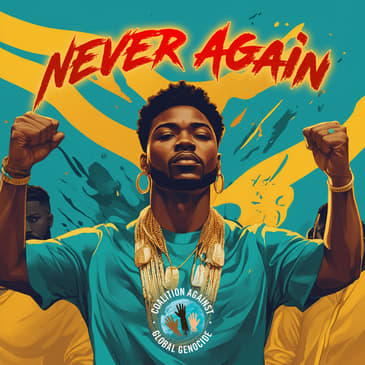
Donate to The Coalition Against Global Genocide Here
This episode connects systemic racism's impact on Black Americans, from housing discrimination and the racial wealth gap to the school-to-prison pipeline and generational trauma. Explore how institutional racism in education, criminal justice, and mental health care perpetuates inequality. Learn about redlining, appraisal bias, and the legacy of slavery's long-lasting effects. Discover resources for mental health support and the systemic barriers Black communities face.
Listen on Apple Podcasts | Spotify | Amazon Music or wherever you get podcasts!
Presented by The Coalition Against Global Genocide (CoAGG) and its mission to educate, motivate and empower individuals and communities to oppose Genocide and Crimes Against Humanity.
Key Takeaways:
- Redlining and housing discrimination are deeply rooted systemic practices that continue to impact the generational wealth of Black Americans.
- The school-to-prison pipeline exemplifies institutional racism within the education system, disproportionately affecting Black students and contributing to the cycle of marginalization.
- Mass incarceration and the privatization of prisons are intricately linked to systemic biases, with profit motives exacerbating racial disparities within the criminal justice system.
- Generational trauma from systemic racism leads to significant mental health challenges for Black Americans, with limited access to culturally competent care exacerbating these issues.
- The need for broader societal reforms in education, housing and criminal justice systems is critical to mitigating the effects of historical and ongoing racial discrimination.
This podcast is powered by The Plug Podcast Agency
See Privacy Policy at https://art19.com/privacy and California Privacy Notice at https://art19.com/privacy#do-not-sell-my-info.
[00:00:00] Never Again, Never Again, Never Again, Never Again, Never Again, Never Again, Never Again. Join Dr. Pius Kamau and the Coalition Against Global Genocide as we journey across the globe, taking a deep look at past, present and impending genocides and mass atrocities. Listen to experts who discuss not only the history but also the resiliency and mental health of people
[00:00:25] who are recovering from these heinous acts. Learn how we can move from bystander to active involvement, calling out genocidal acts where you are. Being Black in Todays America Today we explore the multifaceted black experience in America. We're here to have real, raw and unfiltered conversations about being black in today's society. To understand today's America, we must acknowledge
[00:00:55] its past. The legacy of slavery didn't end with emancipation. It evolved into systemic racism embedded in our housing policies, our schools, our workplaces, and our criminal justice system. Take, for example, redlining, a discriminatory housing practice that prevented black families from purchasing homes and property in certain neighborhoods. Economics is power, and for centuries,
[00:01:25] black Americans have been systematically denied it. After slavery, black farmers were refused or redlined from land ownership opportunities, limiting their ability to build generational wealth. Today black farmers make up less than 2% of agricultural landowners in the U.S. Redlining is a discriminatory practice when the federal government, through the Homeowners Loan
[00:01:50] Corporation, or HOLC, created color-coded maps. These maps were created to supposedly assess the mortgage lending risks. Neighborhoods with high black and minority populations were marked in red, telling banks that these areas were hazardous for investment. This resulted in widespread denial of home loans, insurance, and other financial services to particularly black Americans, preventing them from building or creating
[00:02:19] generational wealth through home ownership. A key foundation of the American Dream again deferred for black Americans. Famous black American poet Langston Hughes created a poem called Harlem, which sums this up beautifully. This is not his voice, but he wrote, What happens to a dream deferred? Does it dry up like a raisin in the sun, or fester like a sore and then run?
[00:02:45] Does it stink like rotten meat, or crust and sugar over like a syrupy sweet? Maybe it just sags like a heavy load, or does it explode? Federal Housing Administration FHA and Veterans Administration, also known as the VA, refused to insure mortgages in redlined areas, while at the same time subsidizing the growth of white-only suburbs. This practice continued even after the Fair Housing Act of 1968 was passed and made housing
[00:03:14] discrimination illegal in the United States. Banks and real estate agents found new ways to perpetuate segregation, typically steering black buyers away from nicer homes and properties, usually in white neighborhoods, plus charging black people higher interest rates and closing fees. Even though redlining was legally banned, the effects remain with us today in home ownership rates, property values,
[00:03:40] environmental hazards, and overall wealth disparities between white and black Americans. As of 2023, the home ownership rate for white Americans was 74%, while for black Americans, it was 45%. That s a nearly 30 percentage point gap. It s been reported that the average worth of white households is around $285,000,
[00:04:04] while black households had an average of $44,900, a disparity largely driven by differences in home ownership rates and generational wealth. There have been numerous documented instances where homes owned and sold by black Americans have been appraised at significantly lower values than comparable homes owned and sold by white Americans. This discriminatory practice, often referred to as appraisal bias or valuation,
[00:04:34] bias has a long history rooted in systemic racism and housing discrimination. Here are several factors contributing to this. Implicit bias. Appraisers, like many individuals, may hold unconscious biases that influence their perception of a home's value based on the race of the homeowner or the neighborhood's racial composition. Limited access to credit. Lower appraisals can make it difficult for black
[00:05:02] homeowners to refinance their mortgages to make home improvements or obtain home equity loans, limiting their access to credit and other financial opportunities. Comparable sales. Appraisers often use data like recently sold homes in the area to determine a property's value. In historically segregated neighborhoods where black owned homes have been undervalued for generations, this approach continues
[00:05:27] the cycle of undervaluation and becomes the fuel for gentrification. Neighborhood disinvestment. Historically, black neighborhoods have often been subject to disinvestment and redlining, leading to fewer amenities, lower property values. Predatory lending. Black homeowners have historically been targeted by predatory lenders. For instance, lenders targeting black churches offering high-interest loans and unfair terms like
[00:05:57] adjustable mortgage rates that could and would spike out of control. The consequences of appraisal bias are far-reaching and devastating. The Fair Housing Act was passed in 1968, and this gap has remained largely unchanged since 1968. Black homeownership peaked at 49.7% in 2004. That was before the subprime mortgage crisis, which disproportionately affected black homeowners.
[00:06:24] The Fair Housing Act of 1968 was supposed to help more black people own homes, but it didn't really work out. This gap or difference in people's income, livelihood, and everyday struggle is a key driver of the racial wealth gap in America. From the school to the prisons, a pipeline for racist practices. Racism isn't just personal prejudice. It's institutional. The school to prison pipeline.
[00:06:52] The school to prison pipeline is a disturbing national trend, wherein children are funneled out of public schools and into the juvenile and criminal justice systems. This disproportionately affects black Americans, students of color, and those with disabilities. Here are some factors contributing to the school to prison pipeline. Zero Tolerance Policies These strict disciplinary policies mandate predetermined punishments for specific offenses,
[00:07:21] regardless of the circumstances. They often result in suspensions and expulsions, pushing students out of school and making them more likely to become involved in the criminal justice system. Now, a disagreement within school hallways could lead a child to handcuffs and probation officers. Implicit bias. Unconscious biases can influence how educators perceive and respond to student behavior, leading to harsher
[00:07:48] treatment of students of color and those with disabilities. School policing. The presence of police officers in schools can create a climate of fear and mistrust and can lead to criminal charges over minor offenses. Inadequate resources Many schools lack the resources to address the underlying causes of student misbehavior, such as poverty, trauma, and mental health issues. This can lead to a reliance on punitive measures
[00:08:18] rather than supportive interventions. The consequences of the school to prison pipeline are severe. Students who are suspended or expelled are more likely to drop out of school, experience unemployment, and become involved in the criminal justice system. This continues a cycle of disadvantage and marginalization. To dismantle the school to prison pipeline, we need to implement a range of reforms including
[00:08:45] ending zero tolerance policies and adopting restorative justice practices to investing in school resources and support services while addressing implicit bias through professional development and training. Educators need to be aware of their own biases and how they can impact their interactions with students. By implementing these and other reforms, we can create a more equitable and just education system
[00:09:11] that supports all students and helps them reach their full potential. The injustices continue in higher education. Schools have long been centers of segregation, with black students systematically excluded or underrepresented due to financial barriers and discriminatory admissions policies. Black students haven't gotten a fair shake at school for a long time.
[00:09:36] Institutional racism permeates various facets of society, and colleges and private schools are no exception. Historically, these institutions have played a huge role in perpetuating segregation. Black students have faced systemic exclusion from financial barriers, such as high tuition costs and limited scholarship opportunities, which disproportionately affects black families. Back to the wealth gap, right?
[00:10:03] Discriminatory admissions policies, including legacy family preferences and subjective criteria, further disadvantage black applicants. Plus, the lack of diversity among faculty, students and staff can create a hostile environment for black students, hindering their academic and social development. And what about our prison system? The issue of mass incarceration in the United States is deeply intertwined with systemic racism,
[00:10:32] and the privatization of prisons has exploded this problem. This disproportionately affects black Americans, as evidenced by stark statistics like those from Louisiana, where black individuals constitute nearly 60 percent of the prison population, despite making up only 33 percent of the state's total population. This overrepresentation is not coincidental, but rather a result of systemic biases,
[00:11:06] the privatization of prisons has further fueled this issue, as private prison companies are incentivized to maintain high occupancy rates to maximize profits. This profit motive can lead to laws, policies, and practices that perpetuate incarceration, such as lobbying for harsher sentencing laws and opposing criminal justice reforms. Remember President Abraham Lincoln signed the 13th Amendment, abolishing slavery and involuntary servitude.
[00:11:36] Except as punishment for a crime whereof the party shall have been duly convicted. This exception means that individuals who have been found guilty of a crime can be legally compelled to perform labor without receiving compensation. This forced labor, often referred to as prison labor, can take various forms,
[00:12:00] including working on public projects, manufacturing goods, or providing services within the prison system. Private prisons often lack transparency and accountability, making it difficult to address issues of mistreatment and abuse within these facilities. The combination of systemic racism, profit-driven incentives, and lack of oversight creates a perfect storm that disproportionately impacts black Americans
[00:12:28] and perpetuates the cycle of mass incarceration and racism. Generational trauma and its mental health effects Racism doesn't just affect our opportunities, it affects our minds, our hearts, and our souls. Generational trauma is the inherited psychological impact of oppression. Passed down through generations, it manifests as anxiety, PTSD, and distrust of institutions.
[00:12:58] Studies show that the stress of racial discrimination leads to higher rates of depression, anxiety, and even physical health issues like hypertension in black Americans. There's a profound and lasting impact of growing up in an untrustworthy, over-policed, or impoverished environment, on a child's development and overall well-being.
[00:13:20] Imagine a child's formative years spent in an environment where this heightened state of alertness becomes their norm, shaping their worldview and influencing their interactions with others. The psychological toll of living under such conditions is immense. Studies have consistently shown that exposure to racial discrimination and over-policing in the black community has a detrimental effect on mental health,
[00:13:47] leading to increased rates of depression, anxiety, and PTSD among black Americans. The constant stress can also manifest physically, contributing to higher rates of hypertension, heart disease, and other chronic illnesses. The over-policing of black neighborhoods perpetuates a cycle of systemic injustice. When law enforcement is focused on surveillance and control rather than community engagement and support,
[00:14:15] it erodes trust and creates barriers to opportunity. Children growing up in these neighborhoods are more likely to experience negative interactions with police, leading to arrests and involvement in the criminal justice system. Children growing up in the suburbs are more likely to be a negative interaction with police. Children growing up in the suburbs are more likely to be a negative interaction with police versus a child growing up in the suburbs.
[00:14:39] Remember this child's parents were redlined or often discouraged from moving to these areas in past generations. This, in turn, limits this child's access to education, employment, and other resources that are essential for upward mobility in America. Yet black communities often face barriers to mental health care due to stigma and lack of access to culturally competent providers.
[00:15:06] Only 4% of psychologists in the U.S. are black, compared to 82% who are white. About 11% of social workers identify as black and only 2% of psychiatrists are black, despite black Americans making up about 13% of the U.S. population. The lack of black mental health professionals creates a significant barrier for black Americans looking for mental health care. If you're looking for black therapists, these platforms can help.
[00:15:36] Therapy for Black Girls A directory of black women therapists specializing in culturally competent care. Therapy for Black Men A resource connecting black men with licensed therapists and life coaches. InnoPsych A platform to find therapists of color, including black, Latinx, and Asian professionals. Melanin and Mental Health A directory highlighting black and Latinx mental health professionals.
[00:16:06] Black Mental Health Alliance A directory of black therapists and resources for black mental wellness. Being black in today's America means carrying the weight of history while fighting for a better future. The work isn't done, but neither is our fight. If you found this episode informative, share it with your friends. And let's keep this conversation going. Until next time, thank you for listening.
[00:16:34] The Never Again Podcast is presented by the Coalition Against Global Genocide and its mission to educate, motivate, and empower individuals and communities to oppose genocide and crimes against humanity.