
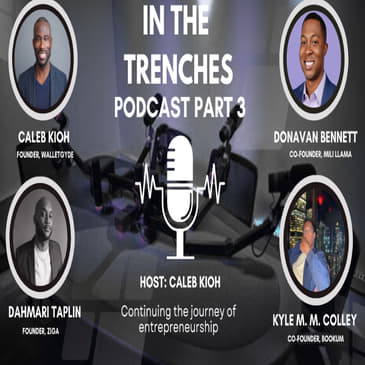
In The Trenches — Episode 3
In this episode of In The Trenches, host Caleb Kioh sits down with founders Donovan Bennett (MilliLlama), Kyle Colley (BookUm), and Dahmari Taplin (Ziga) to move past the initial honeymoon phase of entrepreneurship and dive into the realities of "founder maturity."
This discussion centers on what happens when the early excitement fades and founders are forced to confront the harsh truths of building a business—from managing cash flow and burnout to navigating co-founder dynamics and building sustainable operational systems.
Timestamps & Section Summaries
[0:00 – 1:57] Section 1: Introductions and Mapping the Founder’s Journey Caleb Kioh opens the episode by framing this installment as the next stage in the founder journey. The panel introduces their respective ventures: Donovan Bennett (MilliLlama), Kyle Colley (BookUm), and Dahmari Taplin (Ziga). The group aligns on a shared "trench warfare" metaphor, noting that long-term success requires staying in the arena and continuously perfecting one's craft.
[1:57 – 7:54] Section 2: Year-Over-Year Reflections and Strategic Pivots Founders evaluate their business milestones against real-world market variables. Kyle discusses BookUm's growth to over 3,000 users, while Donovan candidly shares how MilliLlama lost a major contract due to over-expansion and neglecting their first customer. Dahmari reinforces that pivoting is a necessary survival mechanism for any founder.
[7:54 – 11:07] Section 3: Feature Mode vs. Core User Nurturing The panel explores the "feature mode" trap, where founders add unnecessary code instead of listening to their true users. Dahmari details spending thousands annually fixing the Ziga app for features that yielded no financial return, leading him to freeze development to focus on what actually works.
[11:07 – 13:20] Section 4: Community, Accountability, and Leveling Up Dahmari explains how surrounding himself with niche peer groups—specifically in podcasting and calisthenics—enforced discipline and growth. The group agrees that proximity to high-performers dictates the pace of an entrepreneur's progress.
[13:20 – 24:25] Section 5: AI Frontier Hype vs. Practical Reality Caleb leads a course correction on AI expectations, arguing that while AI will disrupt industries, it is not currently capable of replacing human workers. The founders share how they use AI personally and professionally—from help with math homework and Bible study to sparring partners for cultural analysis.
[24:25 – 35:45] Section 6: AI Tools, Vibe Coding, and Prompt Evolution The panel discusses the transition from technical coding to "vibe coding," where natural language replaces complex syntax. They emphasize that the premium skill in the AI age is not prompting, but critical thinking and the capacity to ask advanced questions.
[35:45 – 54:00] Section 7: Founder Reality Check A raw conversation on the emotional weight of entrepreneurship, including balancing marriage, parenting, and managing "cockroach" lean-startup survival. Donovan and Dahmari emphasize that a stable nine-to-five is a valid funding source for a business, and founders should not feel pressured to quit their day jobs prematurely.
[54:00 – 1:06:14] Section 8: Co-Founder Chemistry and Alignment Kyle discusses the evolution of working with his brother, Kris, noting how letting Kris handle operations allowed Kyle to shift toward visionary leadership. The group agrees that while difficult, leadership development requires delivering hard organizational decisions—such as firing—in person rather than over text.
[1:06:14 – 1:15:00] Section 9: Operational Systems, SOPs, and Project Management The founders share the standardized frameworks needed to scale. Dahmari defines SOPs as the step-by-step documentation, purpose, and outcome of every task, which allows for effective delegation. Caleb, Kyle, and Donovan debate the balance between structure (Jira, Slack, Figma, Trello) and the speed required in early-stage startups.
[1:15:00 – 1:30:48] Section 10: Alternative Capital: Bootstrap Sales vs. Venture Funding The panel discusses the "fundraising brain" versus the "operator brain." Kyle shares how his podcast acts as a "Trojan Horse" to build trust and pull audiences into his platform, while Caleb highlights that founders can provide immense value before needing a revenue model.
[1:30:48 – 1:44:17] Section 11: Paid Ads, Organic Content, and Funnel Problems The founders dissect why paid ads often fail, attributing it to weak hooks, broken funnels, or lack of organic validation. Kyle asserts that modern founders must act like media companies, as organic reach is declining across all platforms.
[1:44:17 – 1:52:37] Section 12: Technical Moats and Specialized Domain Agents Caleb argues that the future of AI belongs to "specialized agents" backed by proprietary data, rather than general model wrappers. Dahmari expresses a need for better automated AI bookkeeping tools for small business owners.
[1:52:37 – 1:58:15] Section 13: 2026 Visions and Institutional Growth The episode concludes with the founders setting their goals: Dahmari launching his high-ticket webinar funnel, Donovan focusing on consistent customer conversations, and Caleb preparing for WalletGyde’s second product launch and bank partnerships.
See Privacy Policy at https://art19.com/privacy and California Privacy Notice at https://art19.com/privacy#do-not-sell-my-info.