
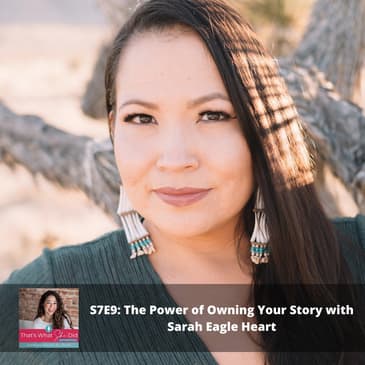
Sarah Eagle Heart is an Emmy-winning social justice storyteller, activist, media strategist, and producer focused on advocacy on behalf of Indigenous Peoples. She is an internationally accomplished executive with a diverse background in tribal, corporate, and non-profit organizations. Her creative projects are rooted in her worldview as an Oglala Lakota raised on Pine Ridge Indian Reservation supporting narrative change for healing and impact.
In This Episode:
- The power of following your intuition and tapping into your spiritual beliefs to achieve your goals
- Why narrative change is a key step in social justice work
- The important role Black activists and leaders have played in supporting the advancement of indigenous movements
- Why extracting stories can be highly problematic
Follow Sarah:
This Is How We Come Back Stronger
Support The Show ---> BuyMeACoffee
Listener Perks:
---> Enter Our Giveaways! - Go to www.Thatswhatshedidpodcast.com to enter to win our season giveaways. Each season we pick listeners at random to win cool FREE stuff like books and show merch. Don't miss out!
---> Our listeners get 10% off at The Feminist Shop! Use code SheDid at checkout.
Follow The Show:
Contact the Show: ThatsWhatSheDidPodcast@gmail.com
Website: That'sWhatSheDidPodcast.com
[00:00:00] Hey there my fellow inspiration junkies, its Tangia Renee here. I have a quick heads up and
[00:00:10] a thank you. After today the season is a wrap. I'm dropping the last two episodes right
[00:00:18] here right now so you don't have to wait because you've waited long enough. Thank you
[00:00:24] for hanging with me through a tuck year and a few ups and downs. I did have to take
[00:00:29] a mid-season break to tend to some personal stuff. Things are all good, I swear and I'm
[00:00:36] looking forward to finally getting these last two episodes into your ears. And as I do
[00:00:43] every season I want to remind you that we are looking for guests for our next season
[00:00:47] season 8 which is due out late summer of 2022. Our season 8 theme is already selected,
[00:00:55] its going to be the She Know's Money Season. I will be talking to women experts that are
[00:01:01] going to teach us the ins and outs of getting money, keeping money and making that money
[00:01:06] work for us. You're gonna want to bring your notebook with you to season 8 because
[00:01:11] the guest lineup is crazy dope. If you want to pitch yourself as a guest or someone you
[00:01:18] know does all you gotta do is send me an email to that's what she did podcast at gmail.com
[00:01:23] and let me know why you would be a great guest on the show. Thank you again for coming back
[00:01:29] season after season to learn with me as we get to hear the stories and insights of truly
[00:01:34] brilliant women. Don't forget to follow us on social media and your listening apps and
[00:01:40] sign up for the newsletter so you know exactly when the next season is ready to drop.
[00:01:46] And signing up for the newsletter is also the only way you're going to hear about awesome
[00:01:50] listener giveaways. Head over to that's what she did podcast.com and drop your email.
[00:01:56] Now let's get into it. Our next guest is an Emmy award winning social justice storyteller,
[00:02:04] activist, media strategist and producer focused on advocacy on behalf of Indigenous Peoples.
[00:02:12] She is an internationally accomplished executive with a first background in tribal, corporate
[00:02:18] and nonprofit organizations. Her creative projects are rooted in her world view as an oglala
[00:02:25] locoa raise on Pine Ridge Indian Reservation supporting narrative change for healing impact.
[00:02:32] She is a founder, she's a CEO, an author and a multi-talented creator who has developed narrative
[00:02:39] change initiatives for Native Americans with Anne Halfway, John Legend, Marissa Tomei, Mark
[00:02:47] Raffloh and the Obama administration just to name a few. Her resume is stacked and goes on and on
[00:02:56] and I am super excited to introduce you to Sarah Eaglehart. We have a really thoughtful conversation
[00:03:04] about narrative change and the importance of harnessing our own stories as communities of color.
[00:03:11] Really excited to bring this conversation to you.
[00:03:17] Welcome back everyone to that's what she did podcast. It's me, Tinsier Renee and I
[00:03:23] thrilled, excited even to introduce you to our guest this week Sarah Eaglehart. She's a activist,
[00:03:31] a storyteller and author, a media strategist, an Emmy award winner, many many things wearing
[00:03:38] many many hats doing all of the work and killing it. So I'm excited to introduce you to her work
[00:03:45] and her latest projects. Welcome to the show Sarah how are you? I'm doing great thank you so much
[00:03:53] for having me on your show. It's definitely my pleasure as I was sharing with you before we started
[00:03:59] recording. I'm pretty sure an audience member tagged me on something on social media that you're
[00:04:05] working on and that's how we made our way together. So thank you audience member whoever that was
[00:04:13] because I'm really bad about tracking who tags me on what and when and all of that but the majority
[00:04:18] of the guests that we get on the show are curated by me I suppose but really they're curated by our
[00:04:25] audience members who were saying there's this really badass woman that you need to talk to you,
[00:04:30] you need to figure out how to get her on the show. So thank you audience for continuing to
[00:04:36] curate and do that work for this show. And thank you specifically whoever brought your work to my
[00:04:43] attention. So I wanted to shout out that person. So as I mentioned Sarah, you are working on a lot
[00:04:53] of different things but one of the things that stood out to me when I was looking into all of the
[00:04:58] many things that you do is that you're defined as a social justice storyteller and you know podcasting
[00:05:08] is storytelling sometimes depending on the podcast. But I love that title, social justice storyteller
[00:05:16] and I want to know what does that mean to you? Well it means so many things. I think in my life
[00:05:22] I've been just curious about a lot of things in the world and I've always really cared about
[00:05:28] making it impact and TikTok told me that I'm a multi-hyphenate. So it's kind of hard to describe
[00:05:38] yourself when you are somebody that's curious about a lot of different things in this world.
[00:05:43] So for me it just really all comes down to that I want to make a difference in my home community
[00:05:51] of Pine Ridge Indian Preservation which is the home of the Oguala Sioux tribe and so I am
[00:05:59] Oguala Lakota, I'm a member of a tribe and grew up there. And just seeing the poverty and you know
[00:06:10] that over 80% unemployment that's been there for decades that has really driven a lot of the work
[00:06:20] that I do and I because I see also similar things happening in other Native American communities as
[00:06:25] well. That when I got, you know it's a painful circle. I started out as a young teenager that wanted
[00:06:34] to be a journalist. She was also an activist by the way and protested her high school at like age
[00:06:41] 16 for a racist stereotypical spiritually degrading homecoming ceremony and quotes
[00:06:52] that was done by mostly white kids. And the medicine and dance around the women and chose one
[00:07:01] by looking at her mouth, looking like petting her head and like manually weighing her
[00:07:07] and then whoever was lifted by the medicine man again. He then gave her to the big chief
[00:07:15] as a gift and she was like the homecoming queen so my twin sister and I saw a lot of problems
[00:07:22] with this and protested for four years until they finally finished and that would have been one
[00:07:26] of the earliest protests against a mascot. So that was in, I'm going to like date myself but like
[00:07:33] 1994. So as an adult I you know I did the writing for a little while and then I was in advertising
[00:07:45] and marketing at Indian casino and then I went and worked at a church which ended up actually
[00:07:53] landing me at the National Episcopal Church on the staff of the presiding bishop Catherine
[00:07:58] Jefferson which then I helped support a movement of the repudiation of the doctrine of discovery
[00:08:06] which is basically saying manifest destiny was wrong like no one has the right the inherent right
[00:08:12] to conquer anybody. And so I really learned about these sort of campaigns, the narrative change
[00:08:21] campaigns that you can do on such a large scale and I did that work at the Episcopal Church which
[00:08:30] also led to several denominations also repeating the doctrine of discovery including the World
[00:08:35] Council of Churches in 2012. So then I ended up in philanthropy and it was in the non-profit space
[00:08:44] and I think a lot of the threads that I keep happening is social justice and I also learned that by
[00:08:51] telling my story which most people had never heard of any Native American that grew up on the
[00:08:57] reservation that had you know had all the good and bad of growing up on that reservation right like
[00:09:04] all of the trauma but also like all of the cultural knowledge and wisdom. So I used stories to educate
[00:09:11] and it became this way for for me to have a larger impact. So now that you know I've had this
[00:09:21] career that's gone full circle has always been around healing communities, healing people,
[00:09:27] healing my own people, educating. I decided you know social justice storyteller was a good
[00:09:34] label to land on myself. PSI also got that advice from a really amazing filmmaker that was like
[00:09:41] you need a brand and I was like okay yeah I probably do need a brand and she had recommended it. She
[00:09:50] said yeah she's like like social justice storyteller which is good right because it lets me do all of the
[00:09:57] general storytelling that I want to do whether it's an animation or horror or like you know drama
[00:10:07] or my books you know that I'm currently working on or my you know my philanthropy because I co-founded
[00:10:13] a foundation to support Indigenous women led initiatives return to the heart foundation.
[00:10:19] And I also got a co-CEO so I developed the organization so that I would have freedom to do all my
[00:10:27] multi-hyphenated things. And so yeah that's where I'm at today. Social justice storyteller.
[00:10:37] Yeah I was gonna say it's so open-ended because that could be a journalist, it could be a novelist,
[00:10:44] it could be any number of things and to somebody could say well what is that exactly are you journals,
[00:10:50] are you a writer, are you a filmmaker? What are you? You can say all of the above. All of them. Yeah
[00:10:57] exactly and I feel like you know people are always trying to put you in a box which is so limiting but
[00:11:04] I also think that hey friends it's me Tangea Renee with that's what she did podcast
[00:11:13] and I am excited to introduce you to our episode sponsor history Colorado. I love a great museum
[00:11:21] and history Colorado is one of my favorites at eight museums across Colorado including the center
[00:11:27] for Colorado Women's History in Denver the team at history Colorado wants you to discover a personal
[00:11:33] and powerful connection plus their incredible bold women change history series is coming back
[00:11:40] this fall of 2021 their members support local artists and designers after school programs for
[00:11:47] working families and educators working with at rescue find your history at historycolorado.org
[00:11:56] Native Americans you know we grow up well Lakota people Native Americans but like Lakota people
[00:12:03] grow up with just this very inherent worldview around our prayers and one of them it's like the
[00:12:14] Lakota amen is Medaquea Oyasay which means we're all related we are all connected
[00:12:19] and so obviously like all of my solutions to all of these problems are going to look different
[00:12:29] and because I all I care about the impact on the ground so if it's going to take me you know
[00:12:36] working with Mark Ruffalo to like change stuff you know in the grassroots community like pipelines
[00:12:44] or you know telling stories then I'm gonna I'm gonna do it or you know if if Anne Hathaway wants
[00:12:52] to help you know get out the vote then you know I'm like okay cool like let me use your
[00:12:59] megaphone that you have and educate all of these people all at once and you know and then I get
[00:13:08] to meet cool people along the way but do amazing projects and actually truly really do care so
[00:13:15] right you know it's everything you're doing all the things you're like you're really out you're
[00:13:22] doing the most what I was looking at your resume I was like oh my gosh she's doing everything
[00:13:29] like everything sometimes I forget I'm just like when it all makes sense in my head
[00:13:35] so long as it makes sense in your head that's all that matters and you know and it's leading to
[00:13:39] impact and and I think that what's really smart is that it's not you trying to run off and do all
[00:13:45] these things with yourself it's a lot of partnerships so that there's this pooling of resources
[00:13:51] and creating a greater impact which just makes sense. So true that's what I say right it's just about
[00:13:57] getting the bigger impact and I think for me it's about also I'm very spiritually led so like let
[00:14:05] me say that like it might look crazy like all over the place but like I'm also very spiritually
[00:14:10] led so like I follow my intuition or my gut down a pathway that I'm like I don't know what's
[00:14:18] going to happen at the end of that pathway and then all of a sudden I win an Emmy and I'm like oh
[00:14:25] okay like I did not expect that to happen working with John Legend and working on a virtual reality
[00:14:32] project and being able to tell a native story that also can change people's just inside and world
[00:14:42] view and so I so yes it might look crazy but also it leads to like really amazing things
[00:14:50] that is all just really guided by the great spirit temposhola you can call them god or whatever
[00:14:59] but it's just telling me following you know that intuition and guidance.
[00:15:05] Beautiful I want to zero in a little bit more on this idea of narrative change
[00:15:14] and storytelling I think that's an important thread to pool because as before I started doing
[00:15:21] this podcast I'll just back up for a second before I started doing this podcast in 2018
[00:15:26] I can there was so little about the world and women who are different than me that
[00:15:36] I actually knew. I'd like to think of myself as pretty well educated and very open-minded and
[00:15:43] always seeking to learn and make connections and that kind of thing but then I started doing this
[00:15:49] podcast and actually sitting down like this and talking to people from different communities than me
[00:15:57] and being sort of slapped upside to the head with the sheer lack of information I actually had
[00:16:04] and I like read constantly you know I'm like I'm well informed and even as someone who previously
[00:16:11] considered myself well informed I was like oh god I'm not well informed at all and one of the
[00:16:17] things that I realized pretty quickly was that whether I like it or not the dominant narrative
[00:16:27] in whatever the culture is impacts me certain pieces of that get sort of filtered down into my brain
[00:16:36] and stick there and whether or not they're accurate or not I just kind of think that they are
[00:16:42] and so this has been a really eye-opening growth experience for me just as the podcast host as
[00:16:52] you know someone that curates the guest and and so I'm really interested in this idea of narrative
[00:16:57] change as a social justice tool and I think it's something that we don't we haven't really been
[00:17:04] talking about until recently at least openly in the media and in just every day discourse it's
[00:17:12] where do the ideas about what you think about people or communities come from and we don't often
[00:17:19] interrogate that so I'd love to hear more about how did you specifically land on narrative changes being
[00:17:29] one of the key foundational steps that has to happen in order to empower
[00:17:35] your community and others well it's exactly that it's just the ignorance of America right like I feel like
[00:17:48] most of us if you grew up in America then you grew up learning a history that was basically a lie
[00:17:58] and you know so when you're young it's like we learned all of this propaganda about how it was so
[00:18:06] great that we had these pioneers that came in and took all this land and Christopher Columbus discovered
[00:18:13] the you know Americas and you know but like nothing about the genocide or the forced relocation
[00:18:23] or the prison camps or any of that right and even just this year accurate histories are for Native
[00:18:32] Americans are just now being told in the United States so for me it didn't take me long to figure out
[00:18:43] that the education that I was doing one by one like group by group was just taking to damn long
[00:18:54] I had to figure out a way to have a bigger impact again because I want to see change and I don't
[00:19:03] think it's fair so I sort of you know after working in the non-profit space and you know hustling
[00:19:11] and working with communities and you know big organizations whether it's philanthropy or churches
[00:19:18] or nonprofits you know you get to a point where you're like this system is not working
[00:19:25] and if I'm going to change the system then we have to start at the top and we have to just start
[00:19:33] educating and changing people's knowledge so for me like that's why narrative change has become
[00:19:42] such a key component of my work and I'll tell you it was not five years ago it was not a key
[00:19:51] component of my work of five years ago but the moment that Trump arrived and you know that was
[00:20:02] the moment where it was like all of a sudden people were willing to listen and all of a sudden people
[00:20:08] were like oh no we got to we got to work hard here and we have to change this so the opportunity
[00:20:15] presented itself because more people were willing to listen and willing to use their platforms
[00:20:21] to create change that's where I landed in all of it just you know five years ago
[00:20:29] so the Trump presidency was the catalyst events for a lot of people yes yeah yeah I think that's
[00:20:38] probably accurate even for myself and as I was reflecting recently thinking about narrative change
[00:20:47] and how much I've learned and grown just by being you know part of this podcast I came to this moment
[00:20:57] where there was there was everything that happened before 2016 and everything that happened
[00:21:03] after 2016 and and I was reflecting on that myself and I was thinking you know in my previous career
[00:21:11] I was in politics I ran campaigns I was in nonprofits I ran nonprofits I did all these kinds of things
[00:21:17] and walked away from it because I was so burned out and feeling so jaded and feeling like
[00:21:23] there is no amount of work that I could do that was actually going to change anything
[00:21:29] and so I just opted out for a few years I was like oh my god I don't find something else so much
[00:21:35] I didn't know and then Trump happened and I was like oh hell to the know
[00:21:44] I got you know it re-engaged me it lit a new fire so I that resonates for me completely but
[00:21:54] so you have this moment you're like sort of similar to mine where you're like okay
[00:22:00] we got to do something new here when did you know that narrative change was going to be a key pillar
[00:22:08] in creating big impacts women's march I mean that's when I knew I was going to be a really key
[00:22:19] role but it also took me pushing myself out of my comfort zone I mean people laugh at me because
[00:22:25] they're like I'm like no I'm actually an introvert people and they're like but they're like no you're
[00:22:30] not I'm like yeah I actually am I know I'm an introvert so I'm never like whatever like I'm on
[00:22:37] the line right but I know because I get really tired having to talk to people so like that's how
[00:22:43] I know I'm somewhere in the introvert spectrum and I with women's march it was just one of those
[00:22:51] things where it was like oh hey are you going to women's march are you going like wait they have
[00:22:56] no but they have no Native Americans on the convener's table like what the hell and and then you
[00:23:03] know just sort of pushing myself out there into those spaces and honestly I had advisors at the
[00:23:12] times I was working with these people that had worked at the Obama administration I'll give them a
[00:23:20] shout out doctor David Washington and then I and Dale from the P4P crew and they were like
[00:23:30] hey like are you the face of this organization or not like you need to get out there and like you know
[00:23:39] be be out there like you know like you need to I mean the social media stuff too right like all
[00:23:47] of a sudden they were like okay take your profile off of private you know I like delete all the photos
[00:23:54] you know what people to see and they're like and we need you know we need you to jump into this space
[00:24:02] and I think at that time it was really I was like oh wait a minute like I've been doing all the
[00:24:08] bridge building within Native communities for like over a decade like you know I have a degree in
[00:24:14] American Indian studies like I I have all the all of the knowledge and and but just you know the
[00:24:21] tools basically and was like okay like let me help create something and so with women's march it
[00:24:31] just became an opportunity to be a part of a change and and so now like seeing that Native American
[00:24:40] issues are kind of an everyday thing now for most groups that are woke anyway like the issues
[00:24:48] are on the table right like people know about missing murdered indigenous women people know
[00:24:54] about pipelines but they didn't know about before so I think for me it's been really rewarding I
[00:25:04] mean the NFL team took down you know the Washington team took down the I mean we were fighting for that
[00:25:10] like forever ago so for me it's like this year have been so many big moments that finally I feel like
[00:25:20] okay we've made some real progress and but it's also sort of time to like triple down so I mean
[00:25:30] it may look like I'm doing because there's still a lot to do so I mean I have to
[00:25:36] continue just pushing out of my comfort zone and being there and and just being ready to go and tell
[00:25:45] those stories that actually make a difference and especially the stories from like the grassroots
[00:25:51] and building those networks and building those pathways are you concerned now that Trump is not in
[00:26:00] the White House that Native issues get pushed back to the back burner now yeah so I mean if you
[00:26:10] look at Hollywood historically there was usually maybe an 18-month window or Native Americans for
[00:26:19] the hot theme so you know back in like I don't know the 90s it was like we had dances with wolves and
[00:26:28] thunder heart and smoke signals like we had like three movies that came out right all led by men
[00:26:34] by the way oh and like two of them were like two movies have like white men like telling the story
[00:26:39] through their eyes right well I only I only ever saw dances with wolves and I was like I even when
[00:26:46] I was a kid and that movie came out I thought that that movie was strange I was like I don't
[00:26:51] so this movie isn't I remember watching it and thinking this movie isn't about
[00:26:59] like this tribe of people it's not about this culture it's about this white guy who deserted from
[00:27:05] army it's about him so exactly exactly well and I mean that's the thing I mean 18-month windows where
[00:27:15] it was like a random like story that came out yes by the way like my aunties and like so many people
[00:27:24] I know were extras in that movie I have a cousin like named after Kevin Costner so obviously
[00:27:31] a love Kevin Costner thank you for your platform and you know helping out there but also we need more
[00:27:38] native stories and more native actors and artists like in these stories so I feel like that's still
[00:27:46] where we have to do a lot of work so my it's like my narrative change game has you know is still
[00:27:55] activism but I feel like I also have to broaden it out to like films like producing projects and
[00:28:04] you know continuing with the animation or and or like writing books so it's it's just all the stuff
[00:28:14] because we're not even close to having equity right now so we have a long way to go
[00:28:21] with all of all of the work that you're involved in how do you define for yourself what end game is
[00:28:32] what are you working towards what's the impact that you want to see oh my god that's such a huge
[00:28:36] question I don't feel like I even planned 10 years down the road so I used to be like a really big
[00:28:41] planner and like I think when I was 16 it was like I planned out my life right I was going to be a
[00:28:46] journalist you know I you know fell off that little pathway but I think for myself
[00:28:58] I'm really pushing to myself to tell stories on the biggest platforms possible
[00:29:07] like and I don't know what those platforms are yet because again like being spiritual and just
[00:29:14] following like intuition it's like I feel like the creator will unveil projects for me to be
[00:29:23] and and I will do them and we'll see what happens but um but it's exciting to be honest it's very
[00:29:32] exciting to see the the reward of having um just being able to make an impact because I am so driven
[00:29:45] by impact that it's like oh yeah we that name change happened you know or you know
[00:29:52] or just anything really but it's like oh we had we now have a Native American cabinet member
[00:30:01] we have Native American Congress women you know so a lot of this is just so is so long overdue
[00:30:11] um and I still think we're at that point of real change
[00:30:18] mm-hmm so I think it's important to point out that you're you're right like the thing that
[00:30:27] we don't talk about when these changes happen is how they happens and it sort of feels that you
[00:30:34] hear about it on the news or see it on social media and it sort of feels like it happened in
[00:30:38] a vacuum and you're like oh great and you don't see the many people in the many hours of work that
[00:30:44] went into that because when I think about um the NFL team formerly known as the Washington Red
[00:30:50] Skins they didn't you know the owner of that team didn't wake up one morning and was like let's
[00:30:55] change the name yeah I wish you know it just seems like a good idea to change the name so we're
[00:30:59] just gonna change the name that's not a decision that they came too lightly that was years
[00:31:05] and lots and lots of people lobbying and doing on the ground work to make that situation possible
[00:31:16] yeah and I credit like black advocacy like movement leaders because I felt like
[00:31:25] like after George Floyd happened and he passed and his like tragic death happened
[00:31:35] so many of the black organizers were out there saying black and indigenous black and indigenous
[00:31:43] like over and over in the media and I was like yes thank you finally like recognizing the fact that
[00:31:52] you know our community is also experiencing high levels of mass incarceration and which most
[00:32:00] people probably weren't even aware of and so you can trace everything back to you know history
[00:32:10] and all of the again propaganda that we have out there where it's like you know we it's okay to
[00:32:17] say horrific names because it's an honor we're honoring you like why aren't you honored and you know
[00:32:26] so it's all I think it's taken so many people and this year was such a success but it's been
[00:32:32] it's been decades of people like lobbying FedEx lobbying like everywhere to say hey are you
[00:32:39] really gonna stand up behind this and after George Floyd's death people actually stood up and said
[00:32:47] no we're tired of this and thank God is all I can say yeah I mean that leads me back to
[00:32:59] a question about narrative change more generally so who when we're talking about narrative change
[00:33:09] and you know telling the stories of the realness of a situation of real impact about how these things are
[00:33:18] the play out in real time in real people's lives I think one of the challenges is who controls these
[00:33:26] narratives from here on out so it's always been whatever whoever the dominant culture is they control
[00:33:35] the narrative they're the ones that green light the movies that tell the stories about you know
[00:33:42] these people where they be Native American people or Black people or Hispanic people or you know
[00:33:46] Latinx whatever the case may be and then when we're fighting when you're you know out there fighting
[00:33:52] for a narrative change and saying you're not only are you not telling the story correctly you're
[00:33:57] telling the wrong story and you're trying to take back that power then who is there does
[00:34:05] there become a gatekeeper for the stories of people now like this is a question that I always have
[00:34:11] where I'm like this is hard you know who how do we make sure that we don't end up on some other
[00:34:21] strange end of the spectrum where there's this weird gatekeeping narrative and the stories being
[00:34:29] told still aren't accurate they're just controlled by someone else well there's always been gatekeeping
[00:34:35] I mean it's never that's never changed I feel like in every sector there's been gatekeeping
[00:34:45] whether it's you know the church or whether it's philanthropy or whether it's Hollywood
[00:34:52] there's always been somebody green lighting whatever it is um I think that what's happened is
[00:35:01] there are many people working in all of these sectors to change it up too and um I think one of the
[00:35:07] things that I always feel as so important is to really like research who what story like what community
[00:35:17] like who represents that community um because I mean sometimes people will be like I just want to tell
[00:35:23] a Native American story right and then not there was like oh wait there's over five hundred and 66
[00:35:29] federally recognized tribes in the United States so which tribal story are you trying to tell
[00:35:34] and then you they might just find a tribal person that's like a member of that tribe that maybe
[00:35:40] didn't even grow up in that community or have like first hand knowledge and then you're like well hold on
[00:35:47] are you actually which perspective are you telling because if that person didn't grow up within
[00:35:53] that community or that culture then you know they probably shouldn't be telling that story
[00:36:00] or you should be finding somebody from that community tell that story so I think that
[00:36:07] the push for like more accurate um just storytelling in general has also been big this year
[00:36:16] and and I see people calling it out more and saying oh wait hey did you do your homework did you
[00:36:24] look around and see you know which community member is most appropriate to tell that story
[00:36:31] and and I think that once you do it once people are actually asking them that asking themselves
[00:36:37] that question I think then it becomes um it provides just more opportunities for people to be able
[00:36:43] to tell something that's authentic and telling an authentic story um and so I'm actually excited
[00:36:51] because I hear that coming up more often and a lot of the work that I do so for me it's like I
[00:36:56] can't just be like a storyteller that would be awesome right I could just go out and like write
[00:37:01] my book and you know make movies or whatever I actually have to be an educator at the same time
[00:37:06] so it's like it's like constantly doing like this dance with like the education
[00:37:15] the advocacy and the storytelling all at once um which is a lot of work and it's exhausting
[00:37:22] but let's also why it looks like I'm doing everything right because somebody has to
[00:37:31] and and I can so you know I'm I can do that work so um thankfully you know we have a lot of people
[00:37:42] that are able to be multi-hyphenants and like do that same educational work as well and I think
[00:37:48] once people begin to ask themselves am I doing appropriate research then everything you know gets
[00:37:56] a lot easier and and where people have the opportunity to um add their voice to
[00:38:04] that project for stories right and I so I think that's key right in any any storytelling if you
[00:38:16] are telling a story you have to ask yourself do I actually know what I'm talking about
[00:38:21] um and how I done the work which I think is important but it also makes me think of that whole
[00:38:29] debacle with that book that came out um what was it called American Dirt
[00:38:37] and the author is a white woman telling an immigrant story
[00:38:42] but said that she did all of the research she researched this extensively and then wrote
[00:38:49] this fictional story that ended up being a highly problematic and so I wonder do you have any advice
[00:39:00] to someone you know in the dominant culture maybe a white person like this author who wrote
[00:39:07] this book that ended up being not great for for the way that she went about it or anybody that wants
[00:39:15] you know that's really interested in telling a story that maybe isn't theirs and thinks that they're
[00:39:20] doing the work but what is the process is you actually go through to make sure that you have
[00:39:25] integrity in that research and that you're telling that story in a way that's respectful and not
[00:39:30] demeaning and not based on stereotypes well I mean if you have to do all of this research
[00:39:37] about somebody else's story like maybe you shouldn't tell the story I mean I just
[00:39:44] it seems simple yeah I it's just you know I just feel like it's very extractive sometimes
[00:39:54] you know that somebody is gonna come in and extract your story and then make money off of it right
[00:40:01] and this leads to all the systemic issues by the way the fact that you know a native person
[00:40:08] couldn't tell their own story because they don't have the opportunity to go to school or they don't
[00:40:12] have the opportunity to find a publisher to publish their book you know so this leads all to
[00:40:18] the system and the fact that you know somebody that's not native has that opportunity to tell
[00:40:24] somebody else's story just points to all of the issues with the system so I don't know it's just
[00:40:33] I have a lot of feelings about that and I think it's fair I mean I still think about you know
[00:40:40] this this debacle with with that book American dirt I'm not an author I'm not in publishing
[00:40:46] and I still think about it and I think it seemed like it was simple like there was a simple thing
[00:40:52] that that this person wrote this manuscript and a publisher should have looked at this and been like
[00:40:59] why are you submitting this manuscript well and they don't but you know I I have to I mean
[00:41:07] I have to say that it is really hard for for native people to get contracts and to get a
[00:41:14] publishing contract to get many of that and I think in the process of my myself becoming an author
[00:41:22] I'm currently co-writing a self-help memoir with my identical twin sister Emma who is a
[00:41:29] psychotherapist and about four five years ago we individually came up with this idea that we
[00:41:36] were supposed to write a book and I thought I was really special and I was like oh yeah
[00:41:41] creators talking to me and I'd say I tell her I'm like hey I think I was supposed to write a book
[00:41:46] and she was like me too I was like oh what's your book about and she's like healing I was like
[00:41:53] mine too and I was like I think we're supposed to write this book together and um what was so great
[00:42:00] about it was that I knew people right so like I was like um it was like my partner who
[00:42:08] he asked by the way who just happens to be the president of the Ogolala Si tribe right now and he's
[00:42:14] like a former state senator and um like a state legislator route for like a decade but he knew
[00:42:21] people and he was like hey like we should talk to you should talk to my friends over she's like
[00:42:28] the ed of feminist press and so I talked with her and um and then she said you we submit we ended
[00:42:37] up submitting our manuscript there and it was actually the only place that we submitted our manuscript
[00:42:41] too and they came back and were like yeah we want to publish we want to publish your book but
[00:42:48] and also we received several manuscripts from other people telling you're trying to tell your story
[00:42:56] and that's why we think it's so important for us to take on your manuscript and um but you know
[00:43:06] there it's feminist press it's a small publisher they are a nonprofit and our act we're actually run
[00:43:14] was run by Jimea Wilson but now she's over at random house so she's not there anymore
[00:43:18] um but she was incredibly educated about all of the issues as well and she's African-American
[00:43:26] so she was like hey you know we really need to do this and so I do think it takes more diversity
[00:43:33] at the top obviously um who are educated about all of these systems of oppression the various
[00:43:40] systems of oppression and then also give that opportunity and like go out on a limb and say hey
[00:43:47] let me work with that person the other thing is like it's like some people don't want to do the
[00:43:52] work right they want to do the easiest lazyest possible route and and that's also frustrating too
[00:44:02] because that's also systemic if somebody has a learning curve hey it just might take them a little
[00:44:08] longer to do the project and if you know how about let's let that happen like let's let you know
[00:44:18] let's take that time to ensure that a really phenomenal voice that has never been heard before
[00:44:26] gets that opportunity yeah makes sense so you are working on your your book now with your sister is
[00:44:37] that slated to come out anytime soon it is we're hoping for January 2022 with feminist press and I
[00:44:46] also just have a book that was published it's called this is how we come back stronger
[00:44:53] and that was just released actually yesterday in the United States and is releasing it also released
[00:45:01] in the UK on March 23rd and it's a feminist anthology of a bunch of amazing writers who are often
[00:45:10] the marginalized never heard of writers hearing about their post-COVID insights into how we change
[00:45:21] crisis into something beautiful and lovely and transformative so I'm excited about that and I
[00:45:30] I wrote my I wrote an essay based on my visit to Ghana a couple years ago for the 400 year return
[00:45:42] where we got to meet with the tribal leaders there locally as well as see a bunch of people from
[00:45:48] the NAACP get reconnected back to their tribal roots and so I do a lot of compare and contrast about
[00:45:57] that experience with my own values and and insights as well so I mean basically
[00:46:08] I think we all need to go back to remembering indigenous wisdom and knowledge and give
[00:46:15] give indigenous people more of a voice so thank you for doing that
[00:46:21] my pleasure I mean you know like I said before I feel like I learned so much that maybe I'm the one
[00:46:28] that benefits the most from this podcast so it's it's definitely a pleasure to be able to talk
[00:46:36] to you and learn about all of the many things that you're up to and working on and I can't wait
[00:46:42] to check out the anthology that just came out yesterday so I'll definitely be getting my hands
[00:46:48] on that and giving that a read we will make sure to link to all of your places in our show notes
[00:46:55] including the newest book and I'll keep an eye out for for your book that you're writing with
[00:47:02] your sister so that I can give that a look too so thank you so much for your time today especially
[00:47:09] as busy as you are again you're doing at the most and I appreciate you so much for taking some time
[00:47:15] out of that schedule to spend some time with us all the show yeah no thank you so much for having
[00:47:21] me and I'm and thank you for the ability to be real and that's kind of my thing sometimes it's just
[00:47:30] you know sometimes to heal we have to tell the truth yeah agreed thank you thank you thank you
[00:47:38] so much all right listeners we're gonna wrap here as usual everything is gonna be linked in
[00:47:44] the show notes so make sure you go there check out the anthology this is how we come back stronger
[00:47:50] which just released and keep an eye out for Sarah's new book coming out in January in the meantime
[00:47:57] follow her on social we'll post to the places for you consider getting involved take a look and see
[00:48:04] what you can learn just as I have learned from Sarah today as usual you know this is the part where
[00:48:10] I tell you to don't forget to subscribe if you haven't subscribed yet I don't know what you're
[00:48:14] waiting for because we're seasonal you will not get notified of new episodes as they come out if
[00:48:20] you're not subscribed to us and when we have new launches and all of the things so hit subscribe
[00:48:25] thank you so much for spending your time with us on this podcast you could be spending it
[00:48:29] anywhere but you choose to give it here and thank you for sharing the show we have grown globally
[00:48:36] because of your shares because of your recommendations you are our advocates so thank you so so
[00:48:42] much from the bottom of my heart I love you forever until next time we're out