
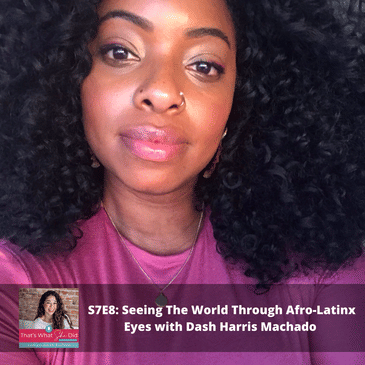
Dash Harris Machado is a Peabody-award-winning multimedia journalist and entrepreneur currently based in Panama. She is the producer of NEGRO: A docu-series about Latino Identity, a decade-long, ongoing web-based docu-series that explores AfroDiasporic identity, colonization, the historical and present-day class, and color complex, and hierarchy among Latinxs throughout the Americas. She is also the co-founder of AfroLatino Travel, a travel and community-building resource for the African Diaspora in Latin America, led by Black Latin American locals. Dash has been featured in "50 Shades of Black," USA Today, Latina Magazine, Remezcla, Vibe, CNN, People Chica, Hip Latina, For Harriet, & The Root.
In This Episode:
- The unexpected journey a "girls trip" to Brazil that led to founding AfroLatinx Travel
- AfroLatinx Travel - why it was founded
- Why using the word "Latino" when describing one's identity can be tricky
Episode Details:
01:30 - Where did the idea of AfroLatinx Travel come from?
11:00 - It's often the whitest person representing the country
23:00 - What did Dash experience when she founded AfroLatinx Travel?
28:00 - What legacy does Dash hope to leave using Afro Latino Travel?
33:00 - Is AfroLatinx Travel a movement?
Follow Dash:
https://www.instagram.com/diasporadash/
https://www.afrolatinxtravel.com/
https://www.instagram.com/afrolatinotravel/
Support The Show ---> BuyMeACoffee
Listener Perks:
---> Enter Our Giveaways! - Go to www.Thatswhatshedidpodcast.com to enter to win our season giveaways. Each season we pick listeners at random to win cool FREE stuff like books and show merch. Don't miss out!
---> FreeBodySociety.com - On a mission to make sure all women feel powerful and free in their bodies. The Free Body Society has you covered with the super soft hoodies and t-shirts you can't wait to rock. Use Code: SheDid at check to get 15% off your first purchase.
---> Our listeners get 10% off at The Feminist Shop! Use code SheDid at checkout.
Follow The Show:
Contact the Show: ThatsWhatSheDidPodcast@gmail.com
Website: That'sWhatSheDidPodcast.com
[00:00:02] Hey friends, its me Tangia Renee with Thats What She Did Podcast and I am excited to introduce
[00:00:08] you to our episode sponsor History Colorado. I love a great museum and History Colorado
[00:00:15] is one of my favorites. At 8 museums across Colorado including the Center for Colorado
[00:00:21] Women's History in Denver, the team at History Colorado wants you to discover a personal
[00:00:26] and powerful connection. Plus their incredible Bold Women Change History series is coming back
[00:00:33] this fall of 2021. Their members support local artists and designers after school programs
[00:00:40] for working families and educators working with At-Rescue. Find your history at HistoryColorado.org
[00:00:50] Hey there inspiration junkies, its me Tangia Renee and before we get to the show I am
[00:00:56] going to quickly ask for a favor. If you are a fan of the show we could really use your support.
[00:01:01] We have a big goal of building resources that will help more women of color and non-binary people
[00:01:06] amplify their work and leverage the power of their stories through guest blogging and
[00:01:11] blogging and storytelling and PR training. We need to do two simple things to make that happen.
[00:01:18] Continue to grow our audience so we can get more stories into more ears
[00:01:22] and fund a new website that makes blogging, logging and training possible and easy.
[00:01:27] Now there's two simple ways that you can help us out right now and help make that happen.
[00:01:33] First if you're listening on an app like Apple Podcasts that allows you to leave a review
[00:01:38] please give us a five star review. Reviews actually do go a really long way in helping
[00:01:43] our show get discovered by new listeners and if you want to go the extra mile and leave
[00:01:48] us a written review they help even more. The second thing you can do is go to
[00:01:55] buymeacoffee.com forward slash Tangia Renee and simply buy the show a coffee. It's not simple.
[00:02:04] All proceeds from Buy Me A Coffee go towards amplifying the voices of more brilliant women.
[00:02:10] Really simple easy peasy just the way I like it leave us a review and consider buying us a
[00:02:15] coffee. Thanks so much for your support and for continuing to share our work. Smooches!
[00:02:25] You're listening to That's What She Did Podcast. I'm your host Tangia Renee.
[00:02:30] That's what She Did Podcast is a show about the women leaders, innovators and rebels you probably
[00:02:35] don't already know and I'm crazy excited to have you here because this is season seven,
[00:02:40] The Movement Makers Edition. All season long we're bringing you incredible impactful women
[00:02:47] who are finding cool and innovative ways to move their communities forward. They're creating
[00:02:53] movements one way or another. I'm so excited to have you here if you find value here please
[00:02:58] consider sharing this show with your friends because that helps us grow and head over to
[00:03:04] buymeacoffee.com forward slash Tangia Renee and you can buy the show a coffee. All proceeds
[00:03:11] for this show go to amplifying the voices of more impactful women. Thank you for joining us
[00:03:18] and let's get started. Hey friends it's me Tangia Renee dropping in with a quick reminder.
[00:03:28] Season seven is almost coming to a close we only have two episodes and I've enjoyed it so much
[00:03:34] I hope you have as well but that means that we are getting ready to start production for
[00:03:39] season eight of the show. Yes season eight I can hardly believe it it's got to be some
[00:03:43] kind of milestone but every season I love to come to you for help because I need to know who we
[00:03:50] should be talking to on the show so the theme for next season is she knows money. We're talking to
[00:03:57] women of color across the globe who know all aspects of money that means that we will be
[00:04:04] talking about how to get money what to do with that money when you get that money
[00:04:09] and how to get more of it. The entire season is geared towards building generational wealth
[00:04:15] so we need to know who to talk to if you or someone you know is an expert on making money
[00:04:22] getting more money and building generational wealth then we want to know about it. Send your
[00:04:27] pitch to that'swhatshedidpodcast at gmail.com and if we have a slot for you on the show
[00:04:31] we'll let you know and we will reach out and set that up. Now I want to introduce you
[00:04:36] to this week's guest Dash Harris Machado. She's a multimedia producer, doula consultant and
[00:04:44] entrepreneur based in Panama. She's the co-founder of Afro Latinx Travel and the producer of Negro,
[00:04:51] a docu series about Latino identity exploring Afro diasporic and black identity in historical
[00:04:58] and present day class race and color complex among Latinx's. She's also co-producer of two
[00:05:05] podcasts, Cumbia Afro Diastories and Radio Caña Negra. She also offers trainings workshops coaching
[00:05:14] on dismantling anti-blackness in Latinx communities. I love talking to Dash on the show and she was
[00:05:22] maybe the guest I was most excited to speak to. We had an interesting conversation about the
[00:05:27] word Latina that I think we should all be thinking about so let's get to it. Welcome back to
[00:05:37] That's What She Did podcast. I'm so so thrilled to introduce you all to Dash Harris Machado. She is
[00:05:43] the co-founder of Afro Latino Travel among other things. She's an award-winning journalist, a
[00:05:50] podcaster and activist, a docu series producer, so so many things and I doubt we're gonna have time
[00:05:58] to get into all of that today but nonetheless I'm so happy to have you here with us today
[00:06:03] Dash thanks so much for making time. Thank you for inviting me but I think we will get to everything
[00:06:09] I do because it's all connected. Okay, good. Everything is if it informs one another.
[00:06:14] Okay, perfect. That's always great. Perfect. So this season as you know we are have the pleasure
[00:06:22] of bringing women on the show who are creating movements in some form or another across the
[00:06:31] globe and I've been following Afro Latino travel on Instagram for a little while now. I don't recall
[00:06:38] how it came to my attention. It might have been a listener so I crowdsource guests quite often
[00:06:44] and usually listeners will tag me like on Instagram maybe like you should follow this person
[00:06:49] and so I'm pretty sure that's how I became aware of Afro Latino travel and was just really
[00:06:55] interested in the idea of combining one's love for travel with learning about the diaspora
[00:07:04] and all that that entails. So I'd love to hear where the idea for Afro Latino travel came from
[00:07:11] and what was sort of the process or catalyst moment for co-founding it?
[00:07:18] I don't know if there was one particular moment. I think more so for Afro Latino travel.
[00:07:27] It was that I wanted to you know the saying I could show you better than I could tell you right
[00:07:34] well heard that saying at least you know in our communities right I could show you better
[00:07:39] than I can tell you as it related to Afro descendant and Black people within the Latin
[00:07:46] American and Caribbean region. Afro Latino travel came about after starting my Daki series
[00:07:52] Negro. Daki series about Latinx identity which is a little over 10 years old by now and so that
[00:07:59] series centers Black people in Latin America. It talks about the colonial heritage and foundations
[00:08:07] of the racial hierarchy that is in the region, racial politics, the pigmentopathy
[00:08:15] and the history of the African diaspora and contemporary lives of Black people in Latin America
[00:08:21] and I made a bunch of connections, lifelong friends, colleagues, teammates, collaborators,
[00:08:27] co-conspirators that I have kept in touch till today 10 years later and so in traveling throughout
[00:08:34] these different countries the first few countries that I went to when I embarked on my Daki series
[00:08:39] were the countries with the highest percentage of Afro descendants which so I went to Colombia first
[00:08:46] I went to Dominican Republic, Puerto Rico. I didn't go to Cuba until way later because it was just
[00:08:53] it was a little bit harder 10 years ago. I mean people still went and it was possible it was
[00:08:58] just a little bit harder or challenging and so throughout my travels and I'm Panamanian
[00:09:04] U.S. I live in Panama my parents my both of my parents are Panamanian both of them are Black
[00:09:08] Panamanian I grew up with a very strong foundation in my Blackness particularly from my mother my
[00:09:16] mother was very adamant about us knowing about our history and being able to stand on our two feet
[00:09:22] as Black people in this world and being our full selves and so when I decided to
[00:09:29] I was working in mainstream news I was working at one of the media corporations and
[00:09:36] I started the Daki series because it was something that I had wanted to do for
[00:09:40] a long time since I was a kid and so the first place that I went to before I decided
[00:09:48] to do the Daki series was actually a vacation. Hello girl shrimp me and my best friend we went
[00:09:54] to Brazil and I because I worked in news because I worked the media and just I just always had the
[00:09:59] habit of carrying around a video camera that was before the phones had all the video and all
[00:10:04] the capabilities so I had my little mini camera and I remember Black Brazilian man engaging us
[00:10:09] in the street about race politics in Brazil and I thought that was very interesting and
[00:10:13] very strange because it was carnival like it's carnival why why like everybody's getting lit
[00:10:18] everybody's turning up like why are we talking about this right now right although my my I and
[00:10:24] my friend were game for it like that's fine we can talk about it but I noted that it was just so
[00:10:30] important for him to talk to us about it in that moment that I'm like wow okay things that I have
[00:10:35] always felt and thought and talked about other people are feeling and talking about as well
[00:10:40] whether in the US or outside of the US and so he was our he was my first interview where he
[00:10:45] was impromptu and he was saying how he identified or he was proud that Obama was the president of
[00:10:52] the United States and he said that he doesn't think that they that he would see a black president
[00:10:58] in Brazil in his lifetime and so all of the the problematics of Obama aside because that's a
[00:11:04] whole nother podcast sure he was speaking to the symbolism of a black person in an authority
[00:11:10] or sort of authoritative position and he said that he just doesn't see that happening in Brazil
[00:11:17] and so I edited that first video and I decided to go and interview black people in other countries
[00:11:23] that's simply what it was I had already I my family maintains ties to Panama my mother's
[00:11:29] entire family still lives here my father too and so I was always going back and forth to Panama
[00:11:36] again I live here this is the second time I'm living here as an adult and so when I went to places like
[00:11:42] Colombia and and I was seeking out the neighborhoods the regions the areas where black people live
[00:11:49] predominantly for example when I went to Catahena I wanted to go to the self-emancipated African
[00:11:57] town Afro-descendant town of San Basilio de Palenque and I would ask people in Catahena what are
[00:12:02] the instructions to get to the town because I need to get there so directions that everybody was like
[00:12:10] everybody everybody every person that I asked about it said ooh why do you want to go there
[00:12:17] ooh it's dangerous ooh it's crime-infested being a black person I already knew these were
[00:12:23] code words for there's too many blacks over there I already knew that very intimately because
[00:12:29] these are the same words and terms that people say about my parents hometown in Panama and so I
[00:12:36] already knew what that was and so I ended up you know getting on a bus um I was on I was actually
[00:12:43] with my best friend again she's been with me throughout my travels and I got on the bus
[00:12:49] that they said they sent me to take this bus I got on it and I'm like okay that's great so
[00:12:55] this bus goes to San Basilio de Palenque but I don't know what to do once we get off the bus because
[00:12:59] my my intimate knowledge of Latin America is the bus doesn't take you exactly to where you need to go
[00:13:07] the vicinity right right and so I'm like I need to know the steps and also I'm a Virgo so I'm like
[00:13:12] I need to know the steps before then you know and so what I did and this is exactly how it
[00:13:17] happened I saw a black woman on the bus and I went next to her and I said excuse me hi
[00:13:24] introduce myself I'm like hey so we want to go to this town can you tell us how to get there
[00:13:29] and she was like yeah my my cousin is a tour guide like let me call him set it up because
[00:13:34] black women resolve things like that's just the bottom line and so I already knew by going and asking
[00:13:40] her that I was gonna get I was gonna achieve my goal because it's it's always that humanity
[00:13:46] and that community and that kinship and that assistance and love so anyway I was like long
[00:13:52] story short but I'm making the story long but long story short I went to these various places
[00:13:57] in Latin America every single time I needed directions to get to these black areas it was
[00:14:02] met with these very anti-black beliefs specifically in Colombia people would say oh you want to go
[00:14:09] there I'm like do you know what people say about Colombia as a whole and here you are
[00:14:14] punching down right and so I'm like yeah okay so so with the the various connections
[00:14:22] that I made and the the things that I observed the practices and the beliefs rooted in anti-blackness
[00:14:28] I said okay black folks everywhere have stories to tell we have history to share we are everything
[00:14:38] right and so I'm like it would be great to get more to get black people to these black areas
[00:14:44] just and whatever that means to turn up to have fun to see other black people
[00:14:51] it could be to learn the history whatever it is and that's why that's the place that I started from
[00:14:57] yes absolutely I am very much history I love history I love learning about it I love sharing
[00:15:02] about it I love the cultural aspects all of that is amazing and sometimes you just want to hang out
[00:15:08] with your people you know what I'm saying like sometimes you just want to chill right and so
[00:15:13] I understand that as well whether it's we do a presentation on the history of the drum for example
[00:15:21] the history of the the Bata drum in Cuba that's great and also the fellow it's the fellowship
[00:15:26] that the afro-descendants have we have with one another and so next my docu series led me into
[00:15:34] afro-lethium next travel because I tapped into that same network of people that I interviewed
[00:15:40] that I kept in contact with and some of them became guides on the tourism that we that we were doing
[00:15:46] pre-pandemic and these are people who are traditionally left out of the tourism sector
[00:15:51] in their countries the major reason being that the country is anti-black it's racist and all
[00:15:57] of any type of opportunity that makes a decent amount of money is not reserved for black people
[00:16:05] period and so who better to tell you about their country and their customs and their language and
[00:16:11] whatever culture than people who live it because you're not going to go to let's say you go to the
[00:16:16] states or really anywhere actually anywhere to learn about culture and you're going to learn it
[00:16:21] from a white person that just doesn't it just does it too it's not adding up right it's two
[00:16:28] plus I don't know what number because it's not adding up and so for too too often when people travel
[00:16:36] and that's anyone from the states from the from Europe it's often the whitest person representing
[00:16:42] the country yeah that's just what they choose it's not a coincidence we know it's not a coincidence
[00:16:48] they have an agenda and a face to sell right and so black people only come into play in the
[00:16:54] tourism sectors in Latin America for folkloric stuff for food for those prescribed roles of blackness
[00:17:00] and never anything beyond that black people are not represented as multi-dimensional right as
[00:17:06] multifaceted and the thing is I said this I have I say this often I did not learn about most of
[00:17:14] the anti-black stereotypes and stigmas until I reached into adulthood till I went to or
[00:17:22] I guess maybe the later years of high school and college that those type of stereotypes like
[00:17:27] black people can't swim I was like I didn't know I didn't know that I didn't know of them I didn't
[00:17:32] hear it everyone that every black person that I know can swim yeah it's not to say that it's
[00:17:37] not to essentialize blackness either it's to show that there are different experiences various
[00:17:42] experiences of blackness throughout the globe and so with people folklorizing black people
[00:17:50] that was very foreign to me because like I said I had a very conscientious a conscious
[00:17:56] upbringing specifically for my mom my mom was very adamant and so I wanted to show people
[00:18:03] my normal I wanted to show people my norm is black people doing whatever whatever fill in the
[00:18:09] blank right um whatever it is we're there and when we talk about Latinos in the US again
[00:18:17] my norm are Latin Americans that are black period so when people were confused growing up when
[00:18:23] people were confused oh you speak Spanish all your parents are from Panama you could see the
[00:18:29] the wheels turning and people to understand and I didn't feel that I got tired of explaining
[00:18:35] myself explaining my existence and so anyway all of that to say negative documentaries
[00:18:42] about Latinx identity and Afro-Latinx travel they are linked in many ways they one led to the other
[00:18:49] and all of that at its center it was in centering black people and our experiences
[00:18:57] I'd like to introduce you to one of my favorite places on the internet the free body society
[00:19:03] an online apparel store that creates empowering t-shirts hoodies tank tops and accessories
[00:19:09] to inspire women to be bold and embrace their bodies no matter their size the free body society
[00:19:16] is on a mission to ensure all women feel powerful and free in their bodies from the perfect breathable
[00:19:23] tank for your next workout to a cozy crop top hoodie for those days when you want to make a
[00:19:29] statement or simply lounge it out the free body society has you covered personally the
[00:19:37] super soft hoodies are my favorite in fact I'm wearing my curvy af hoodie right now
[00:19:44] I've never felt anything softer on my skin any time I wear it out I get a ton of compliments
[00:19:50] and I love wearing the hoodies to the gym or out running errands because they just make
[00:19:55] a statement and draw people in any of the tops can be dressed up with a cute full skirt
[00:20:02] jeans and a blazer or just throw on a tank and be work out ready the options are endless for being
[00:20:11] a listener of that's what she did podcast you get 15 off your first purchase plus free shipping on
[00:20:17] any order over $35 all you have to do is use code she did at checkout and the discounts are all
[00:20:26] yours that's code she did at checkout don't forget to head over to free body society dot com today
[00:20:34] and hit that discount code smooches I feel like we need that in the in the united states as well I
[00:20:45] mean I can't you know it makes me think of Louisiana and specifically norlands and my
[00:20:55] husband and I went to norlands for my birthday one year like earlier in our marriage so it was like
[00:21:01] not long after I had graduated from college and at that point I was aware of anti-blackness but
[00:21:10] not at the level I am now I'm mixed I'm black and Latina and so I was always aware of it right
[00:21:16] on a certain level but have probably be the level of education or the language around it
[00:21:21] that I have now we went to norlands and we wanted to do a history tour of the city and we could not
[00:21:28] find a black tour guide there just weren't any it was all white guy literally white guys and we thought
[00:21:36] that was weird but didn't really give it that much thought we were just like well okay I guess
[00:21:42] we'll do this tour and then they do the plantation tour is down there and we were looking at some
[00:21:48] of the pamphlets and they were characterizing the plantation tours is like come see the beautiful
[00:21:54] grounds and we were like this is these were slaveholders why what's beautiful about that
[00:22:00] and there were no tours that we could find anyway at that time this was several years ago that were
[00:22:06] about the actual history about what actually happened in this region and on these properties
[00:22:12] and we were just like how no we ain't going to no plantation so they can talk to us about
[00:22:20] carriages and trees and like silverware or whatever when we know that probably under in that shed
[00:22:26] over there they were killing people it was just outrageous to me and so and it's still I think
[00:22:32] there's probably more consciousness happening but I don't think it's I don't think it's that
[00:22:37] common honestly yeah it's it's basically take a tour of a concentration camp
[00:22:44] and I don't need to see a concentration camp I don't need to be in these spaces
[00:22:49] I think now you said you you went a few years back there's more now as people start to speak up
[00:22:56] louder right because I feel that black people have been in these spaces they just were not
[00:23:02] they were stifled and muffled and hidden right because my co-founder Javier Wallace he is from
[00:23:08] Austin he's he's Panamanian US and he gives black Austin tours and so he's been doing a damn thing
[00:23:14] very proud of him he's great his family has lived in the Austin area for hundreds of years
[00:23:20] he was part of Africans that were trafficked into Texas through Mexico and his mother's
[00:23:26] family is from the Freedman's colony and so he has hundreds of years of knowledge and family ties
[00:23:33] to the area and it's amazing that he gets he's telling his history you're talking about history
[00:23:38] he's also talking about his family history and I think that is extremely important
[00:23:43] that people speak from their own experiences from their own histories and so that's why
[00:23:50] it's important that we have when you go to any of these countries that is actual black people
[00:23:56] from there that live there that can tell you what goes on what doesn't go on so on and so forth
[00:24:02] and so yeah I think you said something interesting where you said that you're black and latina
[00:24:08] and I often say to people you said a race and you said a geographic
[00:24:14] yes I know yes I struggle with these curves
[00:24:21] but I do this for a living that's this is exactly what I do for a living because we give workshops
[00:24:26] on exactly this we give workshops on history Javier and I give workshops on his black history
[00:24:32] and contemporary life in the Americas and then also with my collective that Yocanya Negra
[00:24:37] which is comprised of us it's three women who are Central American Black Central Americans
[00:24:42] and we also give workshops on anti-blackness among Latinx people and so when people say yeah
[00:24:49] I'm black and latina I'm like so do you mean that you're you're black and then the Latin American
[00:24:54] parent is non-black so then and then it's like the breaking it down yeah like okay so you meant
[00:25:00] to say or rather no you don't do it like that we say so isn't that you have one parent who
[00:25:06] an example you have one parent who is African-American from the US and you have a parent who
[00:25:12] is white mestizo or indigenous descended from Latin America and we just go through the steps of that
[00:25:17] because it's always this and I understand I understand there are certain habits that
[00:25:23] that are just normalized right and so so when people say like for example
[00:25:28] in one of the people I interviewed from my docuseries his mom is Chilean she's from Chile
[00:25:33] she's a white woman uh and her his dad is I believe a mixed-race Mexican person I never met
[00:25:40] his dad I met his mom and he was telling me that when he was little and his mom used to push him
[00:25:45] in the shoulder he has today he has an afro he has a big curly hair and people would say oh is the
[00:25:53] it's his dad black because he's the white woman pushing this I guess brown baby and she would say
[00:26:00] no he's Mexican and he told me that story and I'm like she didn't answer the question
[00:26:05] mm-hmm you know what I'm saying she is saying the country he's descended from right
[00:26:13] and the thing is his name is Ivan he's in the docuseries and we were still friends till this
[00:26:18] till this day and he was he got put in my docuseries accidentally because I was in Canada I was in
[00:26:24] Toronto for a film festival and I went to his restaurant he was a restaurant myself in Toronto
[00:26:29] which is amazing shout out to my son and so he has this big curly hair right and he said we met
[00:26:37] and he's like yeah I'm Mexican and I'm like okay are you afro-mexican and he paused and
[00:26:47] it was great because he met that question with curiosity and that's something that encouraged
[00:26:52] people to do like with any type of emotion and I saw this as a quote on Twitter actually
[00:26:59] meet your emotions with curiosity rather than pathologizing them and so when I asked him he
[00:27:06] he paused and he tilted his head and he was like hmm maybe my grandma is from Oaxaca
[00:27:12] and she had an afro it's just that in his family his father's side of the family they never spoke
[00:27:17] about anything to do with blackness because I'm not going to say they didn't speak about race
[00:27:21] because they did you don't have to specifically say I am speaking about race to speak about race
[00:27:26] you know what I'm saying there's been many ways to speak about race and many ways you can speak
[00:27:30] about race without speaking about it at all and so he actually said that was the first time he
[00:27:36] reflected on that and so right now he now goes to a Jamaican woman woman that does his hair
[00:27:43] because he likes to keep it in an afro he grew it out and has an afro and he's like wow now
[00:27:47] he's investigating his family history and all of that and so it's just one question
[00:27:52] that prompted him to study his family history and that's what we like to do
[00:27:56] yeah no I appreciate the conversation I say that because it's the path of least resistance
[00:28:02] on that it's that's the truth I it's like this thing where you don't want to go through
[00:28:10] yeah I got your identity every single time right
[00:28:15] what does it mean right I'm a peach whatever you want
[00:28:20] and I find that the alternative to that that people actually understand and I would never
[00:28:26] refer to myself this way but I see or I hear people saying this is they don't want to go into
[00:28:33] the explanation they're like oh I'm a mutt and I'm like I'm not referring to myself in that way it
[00:28:39] feels so disrespectful as a dog yes and I'm like don't ever don't ever and so I'm like yeah I'm mixed
[00:28:49] and then I feel like I have to qualify that right for the benefit of the other person so I'm mixed
[00:28:55] I'm black I'm Latina because they understand I guess in in a box what each of those terms mean but
[00:29:02] not the full brand of what that actually means so I think it's an important conversation so I
[00:29:09] appreciate that you you called that out but but yes I hear you it's those those things together
[00:29:19] yeah like you're saying you're going to qualify because people will say Afro Latino right okay
[00:29:23] that's cool and that's fine and then say a non-black Latino is just Latino right and I'm like
[00:29:29] say the race of the other if you're gonna say I'm Afro Latina say the race of the white one
[00:29:33] say white Latina say it because I do right like when I'm going through day to day life in Latin
[00:29:40] America we use these words we we talk about race we say it it's normalized but people have this idea
[00:29:45] and yes it's been a lie peddled by actual Latin Americans but also it shows how very little
[00:29:51] the US knows and cares to know about Latin America and this is you know this is from hundreds
[00:29:57] of years and so the the easiest way to to like you said put people in a box is to oversimplify
[00:30:06] what actually happens and so with these really bizarre ideas of Latin America I'm always there
[00:30:13] to be the thorn in someone's side and then say no no no finish your sentence no no no what does
[00:30:18] that mean wait I have questions wait explain this further yes yes I appreciate it I think it needs to
[00:30:27] happen right we so often don't question the words that we use we're just like we're just walking
[00:30:34] around saying these things without any understanding what does that actually mean and what is the
[00:30:39] impact of that history and those words where did they come from so I think it's really important
[00:30:44] when you all founded Afro-Latino travel did you get pushback around this idea of we're gonna
[00:30:53] organize these groups to go into these sort of quote-unquote forgotten places or overlooked
[00:30:58] places or ignored places and bring that history forward no not really we since the beginning
[00:31:07] we have always had positives in commentary around our tours I mean the tours themselves
[00:31:15] the content also the content that we post on our social media and we have we there's always going to be
[00:31:23] the one or two or ten anti-black scumbags that say whatever they're saying but I don't really care
[00:31:29] about that because we've been listening to their opinions for the past 500 years so we don't make
[00:31:37] any space for anti-blackness or any type of hegemonic points of views we center blackness
[00:31:44] and that's that if you don't like it which I'm sure a lot of people don't like it
[00:31:49] there are millions of accounts to follow there are thousands of tour companies to go to
[00:31:56] and you have your choice of the marketplace and we've had people who have requested for example
[00:32:01] a tour in Cuba and they'll say I want the Afro-Cuba tour but I don't want to learn anything
[00:32:07] about the religion the Yoruba religion or some people know it as santeria we don't want
[00:32:12] to know anything about we don't want to know anything any ritualistic information that's how
[00:32:18] they said it which I was like huh because I'm like everything is a ritual like brushing your teeth
[00:32:21] is a ritual but anyway I don't have that kind of time on an email so I was like girl let me tell you
[00:32:27] something you cannot understand afro-cuban history without understanding the spiritual
[00:32:33] that's just what it is if you would like a tour with us there will be aspects of
[00:32:38] spirituality and if you don't want to see it there are a ton of other tour companies that you
[00:32:46] can utilize but it's not going to be us we're not compromising on that so see you later
[00:32:54] I may need your money but I don't want your money we're not we're not compromising on our goals
[00:33:00] and our mission and really in representing our own selves because when we're talking about
[00:33:07] black history anywhere we are talking about ourselves it's not something we talk about 500
[00:33:13] years or in the past the past is now history is now everything that we do comes from a root
[00:33:19] comes from a norm or a custom that was established and so I am I am standing in
[00:33:27] what I want the world to be and I think it's very you know it's cliche right but if I am claiming
[00:33:34] or purporting to center of blackness I am not going to waver at any point in time I don't care
[00:33:40] if you're waving five trillion dollars in my face because what and this is for my church days
[00:33:46] what prophet a man to inherit the earth I pushed that part of my life down I said
[00:33:51] but I still remember I still remember certain things from Sunday school right if I'm not doing
[00:33:58] right by my communities that is the ultimate fail for me I'm not looking for approval from whitey
[00:34:06] because that is exactly the approval that keeps us subjugated so nah I'm you can get afro keep
[00:34:12] in tour without the spirituality portion but it's not going to be what I for let me next travel
[00:34:16] so I'll see you later girl no hard feelings I'll catch your pitches on instagram right but she came
[00:34:22] back and she said no no no okay we'll take the tour as is and let me tell you something she went with
[00:34:27] family members and it was Javier actually and my husband who did the tour I wasn't in Cuba at that
[00:34:33] point so they did the tour and they said that that group stayed over like the tour ended let's say
[00:34:39] ended at 3 p.m that group stayed until 5 p.m but their jaws were on the floor about this asking
[00:34:47] questions about the spirituality aspect the same thing that they wanted us to cut out they were
[00:34:52] the ones that were extremely interested in it and I'm like and so I think it's extremely important
[00:34:58] to stick to your guns extremely important to stand in integrity to stand in your mission to
[00:35:02] stand in your goals especially as it relates to to black folks that that's what we that's
[00:35:08] what we owe to ourselves so yeah absolutely you said that all your work is connected clearly
[00:35:16] that is I think that that comes through very clear so with all of the things that you're working on to
[00:35:22] dismantle anti-blackness what is the legacy that you hope to leave behind that's a good question
[00:35:32] obviously I it's it's that I am simply adding to the body of work I am just another iteration
[00:35:40] I am not the end all be all or no at all I often say to people you don't have to listen to me
[00:35:46] because there are millions of other people who are saying the same thing that I'm saying
[00:35:51] who have been saying the same thing I've been saying I'm like in in comparison I am an embryo
[00:35:58] I am a fetus I'm a zygote in all of this I am a baby because we have people who came before us
[00:36:07] that was that we're doing this work and so I think it's in continuing that African African
[00:36:14] deity afro descendants cultural manifestations and really I think the biggest part of any of
[00:36:22] the work that I do that more and more comes to the forefront is in humanizing humanizing afro
[00:36:29] descendant people because when we talk about blackness we're not just talking about race we're
[00:36:33] talking about a social categorization a social condition that has material realities tied to
[00:36:41] blackness and so I'm actually talking about this a lot this week about the habit the norm
[00:36:49] to humanize white people and those approximating whiteness in every way shape and form
[00:36:55] oh they made a mistake all they didn't know all give them another chance all they're just a boy
[00:37:02] right all they were having a bad day right which on one hand that is humanity right we are not
[00:37:10] perfect we have flaws we have challenges we have the obstacles so on and so forth and so humanity
[00:37:18] by and large in the white imagination has only been extended to white people and the people who
[00:37:24] can closely approximate it everyone else and specifically black people and like I said I speak
[00:37:31] specifically to anti-blackness because everything whiteness has built itself on is rooted in
[00:37:36] anti-blackness and that's what I have to be specific when I name it and so anything that
[00:37:42] has to do with blackness is dehumanized is degraded every negative adjective you could
[00:37:47] ever think is accorded to black people and afro descendants and Africans so on and so forth and
[00:37:54] so for me the legacy is continuing that human the human project as it relates to black folks
[00:38:02] and this was said actually by more than a few people that I interviewed in my docu series
[00:38:08] the aspect of humanity one of the professors that I interviewed black afro columbian the
[00:38:14] idea of afro columbian is a political notion because everything to do with afro or black in columbia
[00:38:20] has to do with every negative adjective black means theft black means and he went on and on
[00:38:27] I'm not going to repeat the words because I don't think there's any benefit in repeating these
[00:38:31] insults that we hear on the daily and in understanding that words matter and so we don't
[00:38:36] always have to keep repeating it because we understand what it is and so he said what
[00:38:41] is this work if what is this work of identity if not reconstructing and reimagining humanity
[00:38:48] and that is I always try to keep that at the forefront of my mind when I tell certain well
[00:38:55] everything and all the histories that I share it's adding dimension for two and four black folks
[00:39:03] that people in the mainstream may not see no or care to know and my thing is I'm not trying to
[00:39:13] convince anyone of black people's humanity that's not my job because when you dehumanize others
[00:39:20] you dehumanize yourself my job is just to facilitate amplify boost our histories in any way shape
[00:39:29] or form that I can using the access that I have using whatever networks I have I am just a vehicle
[00:39:36] and I keep that very centered I am not the expert of x y if you want to call me an expert that's your
[00:39:43] problem but I know what I know and I don't know what I don't know right and so I think the legacy
[00:39:48] is always in forging toward black liberation and to me liberation and freedom means me and other
[00:39:57] people like me after the sun is why people can be free to be their full whole self without threat of
[00:40:05] danger or violence or a threat to their safety and we are still not there yet and so I would love
[00:40:15] to think and to imagine that it could be possible in my lifetime but I'm also a Virgo like I mentioned
[00:40:22] and I'm also cynical and I'm also realistic and so I am just another another student another
[00:40:30] facilitator in this project of humanity and so I don't I guess that is the legacy that I want to
[00:40:37] continue on because it had that that legacy had already been established
[00:40:42] do you think of your work specifically with Afro Latino travel as a movement maybe perhaps
[00:40:51] I think it's like I mentioned I think it adds to the body of work
[00:40:56] ongoing work and yeah I think wherever you have Afro-descendant people and thinking about the
[00:41:05] word movement we are a very nomadic migratory peoples whether that is forced in traffic
[00:41:15] right whether that is looking for opportunities to better our material conditions whether it's
[00:41:22] being in contact with other Afro diasporians we've always been a movement and so I would say yeah
[00:41:31] it's part of the larger movement of Afro-descendant Afro-descendant existence right quite simply
[00:41:41] and yeah I guess that's a short answer it's part of the movement it's not the movement
[00:41:47] sure I would be extremely arrogant me to say that right like like who are you right
[00:41:55] but it's definitely part of the larger Afro-descendant movements which are plural right
[00:42:01] now I think that's fair I think it's very accurate when I again when I first learned about
[00:42:07] Afro-lethion travel and I was like what is this thing and I started looking at it I went to the
[00:42:12] website went to all the different connected profiles and and looked at everything there's a lot going
[00:42:20] on. Mad links, yes lots of links I was like oh this is this is a movement this is like part
[00:42:27] of the whole the larger whole right and I loved it because I it's unique in its approach I think
[00:42:36] to a lot of other ways of approaching specifically anti-blackness work and I think it's a thing that
[00:42:42] people don't think of as work you hear travel you think this is vacation yeah I'm gonna go sit
[00:42:49] somewhere on a beach with you know an umbrella in my drink and not do anything that hurts my brain
[00:42:57] yeah and see that's the thing that's exact that's the thing right because we understand people
[00:43:02] want to get some sun to me sun is normal for me like it's sunny year round in Panama they call
[00:43:08] oh no that's that's Guatemala the land of eternal summer let me not in front because my colleague
[00:43:13] Evelyn she's from Guatemala and I'm like let me not infringe on her little her country saying
[00:43:18] but we understand people want to take a break when to take a load off whatever the case is and
[00:43:24] I think it's important when people travel to prioritize people that look like them
[00:43:31] and maybe they don't even look like you right because we have a range of looks right but to
[00:43:36] prioritize afro-dispendence in wherever whatever country they go to because I often say to people
[00:43:44] when you go on vacation look at who is laboring and look at who is leisureing because those
[00:43:50] that racial divide is very stark and very visible you will see who are the people cleaning who are
[00:43:56] taking out the trash and who are the people that are the front facing sitting in the air conditioned
[00:44:01] offices right and so at this time we are not doing any in-person trips we are building up our
[00:44:09] virtual portion and that's what we're concentrating on right now in the future when it is safe to
[00:44:17] do so we will reconsider in-person tours I know that in some instances have yet he does his
[00:44:24] black awesome tours he can social distance outside and you know so on and so forth but
[00:44:29] our community the communities that we work with are hardest hit by COVID because they're talking about
[00:44:33] black communities that are intentionally marginalized and intentionally left without clinics without
[00:44:39] health centers there are certain instances where people may have to choose between buying soap
[00:44:46] and paying a bill there are communities that don't have running water and we know that black
[00:44:51] communities are seldom high on the priority list of the states and so we actually are not
[00:45:00] we're discouraging people from traveling in this moment if it's a necessity because life happens
[00:45:06] people travel for certain family obligations right just to be as safe as possible because
[00:45:11] if for us it's not it's more so the health and safety of those communities that we are in community
[00:45:23] with right I cannot say I cannot sit here and be like well yeah we're gonna have a trip this month
[00:45:30] knowing full well that black folks for example in Panama are they're they're
[00:45:38] they're going to be the last to get the vaccine right and we know that the vaccine
[00:45:43] hasn't been dispersed globally in any type of equitable fashion and so I would be the biggest
[00:45:50] immigrant to sit here and be like yeah we're gonna have a group trip this year absolutely not
[00:45:55] absolutely not and it's been difficult to navigate because the people that we work with
[00:45:59] and in many of these Latin American countries tourism is a huge portion of their GDP and
[00:46:04] it is a way that people make money so we have been pivoting doing virtual classes doing mutual aid
[00:46:10] with organizations that we work with and so and so for the travel piece I am still gonna stick with
[00:46:18] only essential travel that's really all I have to say about that right because everyone does what
[00:46:22] they want right we're all we all make our decisions everyone makes your decision and
[00:46:28] but in keeping in mind the most vulnerable of us the essential workers right and we see it in the
[00:46:35] US as well essential workers those who cannot stay home or social distance are usually afro-descendant
[00:46:41] people we know that we understand that and so it's in also understanding that those essential
[00:46:48] workers in the US who tend to be by and large afro-descendant and black people
[00:46:52] that is the same formula that you have throughout Latin America and the Caribbean
[00:46:56] like they're it's a consistent thread because of white pathology if anything it is consistent
[00:47:03] yes it is and you're walking the talk right now with so makes things difficult but
[00:47:12] sounds like you're figuring out a way to navigate that right and I think that's the best that we
[00:47:17] I think that's what we do right as black folks we pivot all the time we reinvent things we are
[00:47:23] re-imagined things we create new things and because we've always had we've had to do that
[00:47:28] too yep great agreed well dash thank you so much for joining us on the show today I know you have
[00:47:36] a super busy schedule and you made time for us so thank you from the bottom of my heart
[00:47:42] right look I make time for black folks that's just like if I can't make time for black folks who am I
[00:47:47] gonna make time for like what am I doing with this right yeah I hear you I hear you
[00:47:56] for inviting me on yeah I'm always here to fellowship with my my community so
[00:48:03] definitely my pleasure and folks you know how we do every episode we link in the show notes
[00:48:10] to our guest dash what is the best place for our listeners to check out to connect more with you
[00:48:17] and your work and everything that you are involved in so here's the so many links
[00:48:24] because we just have so many resources yes people really need to check it out but the thing is
[00:48:28] all of the links are always connected so when you get to one you'll see the other so
[00:48:32] to follow us on social media I am diaspora dash or diaspora dash on instagram afro-latino travel
[00:48:41] our website is afro-latinx travel I am also part of the collective value of canya negra or radio
[00:48:47] canya negra and you will see that also on my personal page any really like if you google dash
[00:48:54] harris the thing is there's a man that has that name and he's a basketball player he had his
[00:49:00] name is dash harris so if you like search for me it's either gonna be him or it's not him or it's
[00:49:05] gonna be the other one and so you can check out check check us out on afro-latinx travel
[00:49:11] diaspora dash on instagram afro-latinx travel on twitter we on facebook we're not on tiktok
[00:49:18] tiktok is too chaotic for me like I have a little account and I always go in there to
[00:49:23] check things out and I run screaming out of tiktok because it's so freaking chaotic extra
[00:49:28] there's like all the extra people are on tiktok it's sensory overload maybe because I'm like
[00:49:34] nearing a geriatric millennial and I just don't know how to function but we have a ton of workshops
[00:49:40] and events that we do with um radio canya negra with afro-latinx travel we have summer courses
[00:49:46] history courses and so any of those names that I mentioned follow one and you'll see the
[00:49:53] trail of crumbs the bird crumbs to the next one and also check out black austin tours and it's exactly
[00:49:58] like that and afro resistance afro resistance that is another organization that we are family with
[00:50:06] that speaks to live black lives lived black experiences in the america is the biggest one
[00:50:12] being black migration and immigration and also bronx rebirth which is the organization for
[00:50:18] another one of the machet data is evalence organization which they give they they collect
[00:50:25] donations of baby products whatever it is diapers milk formula and they distribute it in the
[00:50:31] bronx to parents who may need these basic supplies so yeah that told you about the links
[00:50:38] yes like on one of them and you'll find the rest so we will connect in the show notes to make
[00:50:44] it easy so that you're one click away and I encourage you all to do the learning do the work
[00:50:51] to do the learning wherever you are in the world we've been really grateful to have built a global
[00:50:57] audience so if you were listening to this from ira knowledge is power baby so learn some learn
[00:51:03] something new unlearned unlearned to relearned to learn thank you all so so much for showing up
[00:51:11] season after season week after week to listen to this show please continue to share that's how we
[00:51:16] have grown and there are three simple ways that you can support this show you can head over to buy me
[00:51:22] a coffee forward slash what is our forward slash that's what she did podcast that's what it is
[00:51:29] you can virtually buy us a coffee to support this show i'm not actually drinking coffee with it
[00:51:34] it's actually supporting the production of the show and uh you can share this episode on social
[00:51:40] media or you can leave us a review on apple podcast any of those three ways is a great way
[00:51:45] to help this show continue to grow thank you so much for your support i love you i love you i love
[00:51:50] you from the bottom of my heart and until next time be out