
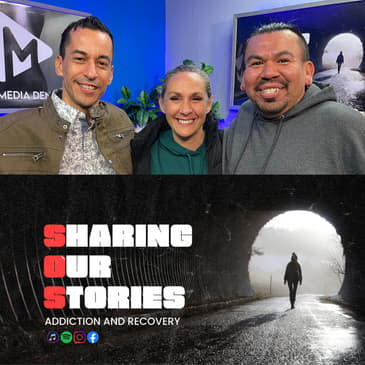
Our show today is about Rock Kihega.
See Privacy Policy at https://art19.com/privacy and California Privacy Notice at https://art19.com/privacy#do-not-sell-my-info.
[00:00:00] The views, thoughts, and opinions expressed in the following program belong solely to
[00:00:04] the host and guest and do not necessarily reflect those of this radio station, our parent
[00:00:09] company, advertisers, or affiliates.
[00:00:11] Welcome to Sharing Our Stories.
[00:00:12] We share stories of support for individuals in recovery from substance misuse and mental
[00:00:17] health-related issues.
[00:00:18] There are numerous pathways to recovery, and each week we welcome powerful leaders and
[00:00:22] role models who have struggled in drug and or alcohol addiction, have found a pathway support that family member and you can watch them do it. You can watch them recover. So thanks for being here. Nani, before we get started, how are you? I'm doing really well. Yeah, we got us on all cameras. Okay, cause you know, the camera deal around here. I want to make sure everybody can see you. How you doing? I've been good. Things are going really well. Tribe's doing really well. We're very excited about everything going on.
[00:01:41] Just tell everybody what it is,
[00:01:43] a real little rehash on what your job is
[00:01:45] at Tribe Recovery Homes.
[00:01:46] Yeah, so I, probably had an eye roll to that one because he's like yeah I hear this all the time.
[00:03:03] But he has an answer to it. When we go there. Had to go there. Rock Kahiga from Oklahoma is our guest here on Sharing Our Stories, and we turn it over to you. Thank you so much. Awesome. Thank you so much for having me. Yeah, so, yeah, humor is a big part. I like to laugh now because just,
[00:04:23] there wasn't much laughter growing up
[00:04:26] and throughout my use.
[00:04:28] So I like to laugh now. I can only speak for my father. My father was a hardworking man. As far back as I can remember, he always had a job. However, he also had a problem with alcohol as well.
[00:05:41] My mom left when I was three.
[00:05:44] I've never seen her since. weren't displayed. Back in my day, it was always like, you want something to cry about? I'll give you something to cry about kind of thing. So growing up was kind of rough. Always had that feeling of not being good enough, not being smart enough. I remember getting letters from our schools
[00:07:02] and estates that I was in.
[00:07:04] You're in a top 10 percentile of readers
[00:07:06] and mathematicians and nobody to wrestle. So that's the only way I lettered is because I had no opponents whatsoever. So I lettered in high school wrestling. So high school was, you know, high school was fairly, you know, trying to fit in. I never saw, growing up in New Mexico,
[00:08:22] you know, my dad again was really abusive
[00:08:25] and I always thought that that she didn't want you. And that was all I was ever told. And so growing up, and that's kind of what everybody in my family says, like, she didn't want you, she didn't want you. That compounded with, you know, never being good enough, never being smart enough, never being enough for my father, kind of had me battling with low self-esteem issues
[00:09:42] all through high school, plus being built like a sick girl.
[00:09:44] Dad's like, oh, you gotta go lift weights and stuff.
[00:09:46] I was like, everything there is so heavy.
[00:09:47] Why would you lift everything there? cigarettes and enveloped into drinking. And when I drank, I remember back when I started drinking, it was like, you know, your dad would give you 20 bucks, drop you off at the rolling rink, and that would be the night, you know, they didn't give a crap where you were before cell phones and all that. So I would take that 20 bucks and we would go to the projects in Bernalillo, New Mexico,
[00:11:01] and have our older friends buy us alcohol,
[00:11:05] and we would just drink all night long. And it evolved into skipping school, missing school, grades dropping. And through all this, you know, it was never a problem with my dad. But like once he stopped drinking, he turned into his career and I kind of fell by the wayside.
[00:12:20] I kind of got to do whatever the hell I wanted to do.
[00:12:23] No curfew, none of that stuff.
[00:12:25] And it was just, I got to a population of 3,000 people. And so the culture shock there was just huge. And I never ran into racism until I moved to Tonkwa, Oklahoma. In Oklahoma is predominantly made up of Native Americans. So going back to Oklahoma, it was like being told,
[00:13:41] you're nothing but a drunk and you're a paint sniffer
[00:13:43] and you're all of these things.
[00:13:45] And I've never done inhal some friends and I remember smoking and drinking just every, and it became, it used to be just Friday through Sunday.
[00:15:00] And then it became Friday through Tuesday,
[00:15:02] then Tuesday through,
[00:15:04] and it just became a constant thing going to school,
[00:15:06] drunk, missing school because I was too drunk.
[00:16:02] okay, this is cool, this is great, this is wonderful. I can, I can, you know, function and being drunk
[00:16:06] kind of faltered when you're, when I was on cocaine.
[00:16:10] So Coke really did the trick for me for a while as well.
[00:16:14] And, oh, it was Coke and then mixing Coke with weed
[00:16:19] and then mixing Coke with weed and alcohol, you know,
[00:16:21] doing stupid teenage things.
[00:16:23] And that lasted for a few years. So I started out as sorting lines and then smoking. And I always told myself, I'm never gonna shoot up. I'm never gonna shoot up. I'll never became to the point to where I was like, okay, hell, why not? So when I started sorting, wasn't doing what it was supposed to be doing anymore. Smoking, it wasn't doing it anymore. And plus I like my teeth, even though they're jacked up. I still like my teeth.
[00:17:40] And so I was like, I'm gonna shoot up.
[00:17:41] And so I started shooting up.
[00:17:44] And I just remember the feeling the last like semester and a half of my senior year to where I went into his office and I had to sit his office where I did my schoolwork from- While you were shooting up- Yeah. Math. Yeah. So I'm there and I was doing all of my studies and thinking that math was making me be able to concentrate
[00:19:00] and do better and do all of these things,
[00:19:02] thinking that this is what a normal high school student does.
[00:19:07] While everybody else is out being able to other than the obvious, that I can't have a mom, you know? And that's something that's always plagued me throughout my whole entire life. And so, no, I remember throwing my cap up in the air at my graduation, saying bye to three people, walking to my friend's car, getting in the car,
[00:20:20] going and had a handle of vodka in the car
[00:20:22] and just slamming it to numb those feelings
[00:20:25] of inadequacy that I've always had. campus van going down to Tijuana or to Juarez, Mexico on a weekends and picking up cocaine to sell to the students at NMSU. And thinking that this is normal, this is the life, this is what everybody wants. And I graduated that and went back, worked for my tribe for a while and I didn't think
[00:21:44] there was anything wrong with my alcoholism.
[00:21:45] I didn't think there was anything wrong with into play. And I get pulled over at like 19 or 20 after I think it was a high speed chase. And getting out of the car, being as belligerent as I am and, you know, weighing like 100 something
[00:23:03] pounds.
[00:23:04] I didn't break 100 pounds me anymore and so it was more meth and then
[00:24:22] introduced that I could start making meth and
[00:24:26] Not buying it
[00:24:27] Get out of the way so I started getting pulled over more and more drinking, stuff like that, but I was able to get this job as a wildland firefighter for the US Forestry Service. So while I'm on meth, I'm working at this government job and every time I would get pulled over,
[00:25:43] I would have meth, I would have like a meth lab
[00:25:45] would have backseat of my car, I thought I was happy because my dad was really proud of me. Um, so I was still functioning, still doing these jobs, um, traveling throughout the United States. Um, started going to school to become a paramedic and did that with the US forestry service, I was saving lives and running around in the back
[00:27:01] of rig and, um, putting rigs in my arm at the same time, um, doing that.
[00:27:06] And it's just things just started going out of control to where it's inside your house. You know, it was, it started turning me into a person I didn't like, but I didn't know it at the time. Looking back in hindsight, you know, but I was insane running around on meth, staying up for days on end and thinking that was normal, picking up my face, you know, all the, all the horrible stuff that we do
[00:28:21] when we're losing our minds.
[00:28:25] I lost my father in 2007. without drinking, without any substances or anything. And I believe the day after we buried him, I found myself with my friends, so-called friends again, putting a needle in my arm and not wanting to feel that. And I left Oklahoma and went to Kansas
[00:29:44] and stayed in Kansas for about six years And knowing that this is not normal people don't do this. And so I drove back down to Oklahoma where I had some family and was asking, you know, it's like, hey, I need help. Some of my family at this time, they were just like, I hope you find it, shut the door in my face. Went to some friends and they were like,
[00:31:02] why don't you just stop drinking?
[00:31:05] It's like, FFI no, you know, I don, okay. And I went to a detox in Oklahoma that my brother had arranged for me. So I detoxed, got out and went back to my place, packed up everything that I thought was important clothes and drove here to Denver on a women of prayer and
[00:32:23] a little bit of hope that what I had been doing wasn't working anymore.
[00:33:23] a friend at a coffee shop basement
[00:33:29] and went to my first meeting the next day, I think,
[00:33:32] and here in Denver. And I got sober here in Denver
[00:33:34] and I got about five years under my belt,
[00:33:38] four years, five years, and I moved to Chicago.
[00:33:40] I got a great job offer to go to Chicago.
[00:33:42] So, and I remember I'm employable and I'm here for a reason. And so I stopped going to meetings, stopped doing, um, stopped doing everything that I was supposed to do. Stop making myself available, stop calling the people that I had known in Chicago. And the next thing you know, I'm
[00:35:02] back to putting a needle in my arm. And I was like, no, no, no, I can work from home. Like, no, you have a team to manage and I can manage it from home. And I lost that argument. So I ended up going back to work and then I started trying to find ways out of work, FMLA, all of that good stuff.
[00:36:20] And I tried to use FMLA on my teeth of all things and it didn't work.
[00:37:22] I was going on my farewell tour is what I called it. And I was ready to end it all.
[00:37:26] I went back to Oklahoma,
[00:37:28] burned all those bridges in Oklahoma.
[00:37:30] Every bridge that I could burn, I burned.
[00:37:33] Every person, every person that could hurt emotionally,
[00:37:38] I hurt them.
[00:37:41] I just didn't give a crap anymore.
[00:37:47] I was done.
[00:38:45] I remember calling my first sponsor and smoking a cigarette and telling myself, well, that meeting has already started. I can't go in late.
[00:38:47] Oh, that meeting has already started. Let me call my sponsor.
[00:38:49] Let me do every excuse to go into the meetings.
[00:38:53] But finally I made it into a meeting and I ran into a friend and she had had a
[00:39:00] couple of years before me when I first moved here years ago.
[00:39:04] And I remember just feeling so for a couple of days. Lasted in Stout Street for a couple of days. And that's common. It's okay. Yeah, that's okay. So- Not a sign of failure at all. Right. So I went to Stout Street for a couple of days, lasted there. Great place. Yeah. No knock, Stout Street.
[00:40:20] Do you think?
[00:40:21] No, they're a great place for real.
[00:40:22] So went there for a couple of days
[00:40:23] and then that didn't still attended the meetings. I still go to meetings. I have a sponsor. I do, you know, I sponsor people, you know, and it's funny.
[00:41:45] When people look at me and they come in And, you know, I share my story with people. And I can sit across from people and tell them wholeheartedly and honestly that I know where they are because I've been there. I go to meetings. I just lost my mother, my biological mother.
[00:43:01] I call her my carrying case because I've never met her.
[00:43:05] So I've just lost, I was able to realize that, you know, my dad was just a man. He was just a human being. Doing the best that he could. And, you know, he was battling his demons. I was too young to see that, but I see that now he was battling his demons just as I was battling my demons.
[00:44:21] He was doing what he,
[00:44:22] he was doing the best he knew how.
[00:44:24] And when I saw my mom in a habitual area,
[00:44:25] you finally put a face to this void through the trudges and the ditches, and you don't have to, your rock bottom doesn't have to look like mine. It doesn't have to be horrible. There's hope out there. There's people that love you. Even if they don't know you, I love you, you're human beings. You're capable and you're worthy of love. I'm worthy of love.
[00:45:42] It is something that I struggle with today
[00:45:45] through my upbringing is telling myself
[00:45:46] that I'm just a dude who got lucky, um, who found the rooms of AA and A. I now attend CMA. Go ahead. Why do you say I got lucky? Cause I, when I heard your story, you put in work. Yeah, you did. So I mean that that's not luck.
[00:47:02] So why do you say you got lucky?
[00:47:03] I got lucky by saying I got lucky by getting into the rooms, um,
[00:48:03] Like a horrible, mean person that sounds like a scary guy. Yeah, so I hurt a lot of people.
[00:48:06] And so I like, now, I like to laugh.
[00:48:09] I like to be able to make people laugh
[00:48:11] and find humor in things.
[00:48:14] Even if it's, you know, you shot up last night, cool,
[00:48:17] at least you're here.
[00:48:18] You know, people come to me all the time
[00:48:19] and you're like, oh, I effed up.
[00:48:22] I relapsed.
[00:48:23] And being somebody that's relapsed,
[00:48:25] like it's not a eff up, it's a mess up. for and you're protected by your higher power, whoever that may be, God, Wakanda, whatever you choose to call them, that person is always looking out for you. Even when looking back and all my addiction, being homeless, running the streets, I never went without.
[00:49:40] I had food, I had a way to shelter myself, I had and it got me through and coming back again to these rooms. All I had again was a little bit of faith that this is going to work this time. Because everything else quit working. The needle quit working. The bottle quit working. Everything else quit working except for the faith that I had and my higher power.
[00:51:01] Looking back, my higher power is always there, making sure that I was taken care of.
[00:51:06] Even when I was out screwing up. And it's for the first time, it's been really awesome to be able to feel and to mode and tell people I love them and tell people that I care about them and really genuinely mean it. And yeah, it's been amazing. And so the least I can do is give back
[00:52:21] a little bit anyway I can.
[00:52:23] So that's it for me.
[00:52:26] And all I'm there though, stationed Monday through Friday. If I'm not there, you can find me at Second Chance Center. Second Chance in the city, which is at 1391 Delaware Street.
[00:53:41] So that little legal block is where I'm usually at.
[00:53:45] So come and see me, come and talk to me.
[00:53:46] I'll be more than happy to help and listen.
[00:53:48] Thanks. We would love to have you share in your recovery, share and be transparent about your life. We believe that this program, by doing it, we have a hope that it reaches at least one person in our community, and hopefully that person can say, you know what, I related to what The Rock had to say. The Rock. I related to what Rock had to say, and it made me think about myself,
[00:55:01] and it told me that, you know what, I can do this too.
[00:55:04] Maybe you've struggled with relapsing,
[00:55:06] and you go, you know what, I just relapse,