
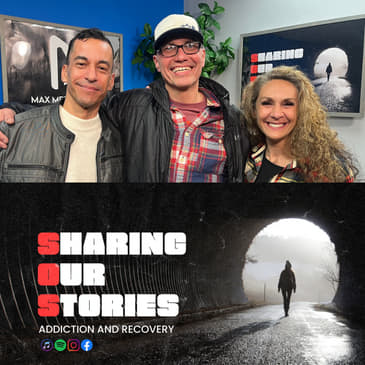
Today our guest is Lelan Harry.
See Privacy Policy at https://art19.com/privacy and California Privacy Notice at https://art19.com/privacy#do-not-sell-my-info.
[00:00:00] The views, thoughts, and opinions expressed in the following program belong solely to the host and guest and do not necessarily reflect those of this radio station.
[00:00:08] Our parent company, advertisers, or affiliates. Welcome to sharing our stories.
[00:00:12] We share stories of support for individuals in recovery from substance misuse and mental health related issues.
[00:00:18] There are numerous pathways to recovery, and each week we welcome powerful met was somebody who he works with, Tanya Wheeler, who is she's been on this program long ago. She is amazing. She is just awesomeness. And the people she surrounds herself with are
[00:01:44] amazing and awesomeness. And so we have go visit my dad on the res, as this little buddy, Fat Kid, that kind of looked Indian, kind of didn't, I wasn't allowed to participate in a lot of things. I was shunned, the other kids hated me, they'd pick on me, bully me, because I wasn't one of them.
[00:03:00] And then I'd go back home to my mom
[00:03:02] and into the, you know, the white school.
[00:03:05] And I was only there for like three years and then moved away as soon as I graduated high school. I've been back for some friends' weddings but it's not a place that I have roots there.
[00:04:23] But that was the longest term of my life of living somewhere.
[00:04:26] So that's where I would start dating people, I would date the ones that had a really strong family connection, kind of latch onto them, like a circuit family, because I didn't have one, I didn't have anything, and I would use all of that to shove down and have more pity parties inside my head,
[00:05:41] feeling that, you know, people just didn't understand
[00:05:44] that they couldn't belong, didn't have a purpose, mom didn't want me around. I was bouncing around everywhere. And then all of a sudden I've got people who wanna hang out with me to do things that was conducive to anybody's wellbeing. But I had friends, I had a family.
[00:07:04] When the holidays came around,
[00:07:05] I had somewhere to go for Thanksgiving and Christmas.
[00:07:08] I didn't have that before. they belonged, they had a purpose. And so yeah, I dove in and I used that, I guess self-hatred from an early childhood. I would use that as fuel for my addiction. Not with everything else, you know, I blame everybody else.
[00:08:21] Bus driver, guy at the grocery store,
[00:08:24] everybody was the reason as to why I was stopping
[00:08:27] at the liquor store, calling my plug. tables and there was more in the green room of anything and everything you wanted. So it was right there. It was to be expected in that lifestyle and that's what I identified as. I would tell people all the time, I'm a musician, I'm doing this, I'm a bartender whenever I'm in town. And that's how I lived.
[00:09:41] I lived that I was supposed to sex drug and rock and roll.
[00:09:45] I was supposed to be. I didn't have any money. So I would sell them or pawn them and forget that I had to show the next night and I'd show up to the summit or the marquee and be like, anybody have a guitar I can use? Because I don't have one right now. But I'm supposed to perform. But I'm, yeah, exactly. And I, in my mind, I didn't even think that.
[00:11:01] I was just like, I need instant cash right now
[00:11:03] to get my fix.
[00:11:06] And it went like that for years, for years.
[00:12:06] All you could really do is go to a detox for a couple days, maybe be lucky to do a two-week program at West Pines.
[00:12:09] But generally what would happen is I would catch a case.
[00:12:12] I would do something stupid.
[00:12:13] DUIs, fighting, something to where I would end up behind bars opposed to end up in treatment.
[00:12:20] And it was tough because I had the Medicaid and I would call places and nobody would take
[00:12:25] it.
[00:12:27] And I didn't have where I was. I didn't know anything of what had happened. I found out that I would wake up behind random dumpsters on Colfax. I lived on Colfax, but why behind dumpsters? I don't know, but I could point them out still. Well, yep, we'll go up there, we'll go up behind that one. I don't know about landmarks.
[00:13:41] They are, yeah, exactly.
[00:13:43] They were, apparently.
[00:13:46] I have no idea. but inside it was still turmoil, exactly. So I would wake up in the hospital. I would have 72 hour holds a lot of times. I had the turtle jacket on many times, but it was just kind of a pattern that kept going on. I would do well, then I'd get really depressed.
[00:15:00] I'd break everything down.
[00:15:02] If I was successful in something, I'd destroy it
[00:15:05] and then use that as more fuel to use
[00:15:08] and why shouldn't be here. But in my mind, I was doing the right step to get out of there. I was on this medication, a doctor was giving me. I wasn't behind the bar, but the suicidal thoughts didn't stop. My August 21st, 2017, I woke up floating in the Platte River downtown right in front
[00:16:21] of the REI.
[00:16:23] My head was on the bank.
[00:16:24] I was wearing a suit, tie, suspenders even.
[00:16:26] That looked good. for free and it was just hoping that I would fall off that ledge. Somebody actually pulled me off and the next thing I know, I'm waking up floating in the river. I have no idea how I got there, how I ended up in the river, how I got all beat up. I woke up, went home, stopped at the liquor store beforehand of course, but went home,
[00:17:46] took a shower and I felt horrible. out of control. I was in fights on a regular basis. I was blacked out. You know, I didn't know what was going on most of the time. And I just hated everything and everybody. So I was looking for fights. And I knew something bad had happened. So when I was leaving my house, I lived in Park Hill at the time. I had $2, $2 bills. That's it. And I was like,
[00:19:02] all right, I can get the bus, she would come in and wake me up,
[00:20:21] check my vitals, and I would ask for an I-B pro from something
[00:20:26] because going through the alcohol, benzos, which now looking back, I'm kind of glad that happened. Because if it would have been an easy detox, something that would have been like all my other criminal experiences, the attorneys would fight and be like, this was just a one off. He's not this type of person, which in reality I was. I mean, I can't do it.
[00:21:41] I know.
[00:21:42] Gotcha.
[00:21:43] Yeah, exactly.
[00:21:44] But I'd be like, I gotta go back and take care of my kids,
[00:21:46] which I was paying child support, I promise I'll go to church tomorrow. That type of parade I would do on a daily, but this was a different one. I went in and I remember laying in my bunk and just saying thank you. You will take me off the streets. I will never be around another person because I thought I was going crazy. I couldn't control my thoughts. I didn't know who I was. I thought, I even got to the point where I thought I was possessed.
[00:24:08] every night. So a couple months later, they dropped it down to 64 years. And then I was ready to sign. It was like, give it to me. Let's do it. I'm done. Let's go. And then
[00:24:14] the next time I went, they dropped it down to 10. And I signed a 10 year. So from 164,
[00:24:21] 10.
[00:24:22] Yeah.
[00:24:23] Somebody's looking out for somebody. Well, it's down. That was my first experience when we walked in. And that's when the, oh, shit moment kicked in. I don't want to be in here for 10 years or 164 years. I made a mistake. Come get me. And it was just like writing notes like, yeah, yeah, yeah, yeah, yeah, you have no idea what you're talking about. Get out of here. I moved to a different facility and tried that process all over again. And the same thing happened. She was just like, yeah, you got situational depression. Like deal with it, do something. Get out of your bunk, go do something. And I'm like, I want to get out of my bunk.
[00:27:03] And it's the thing that changed was,
[00:27:06] I was walking to chat one day
[00:27:07] and I saw these guys in a medium facility. So, you know, I couldn't open my door,
[00:28:20] I had to get buzzed out out of wet cell.
[00:28:23] Anytime that they would buzz it and I could get a pass,
[00:28:25] I would go to the time to understand that. So that's why they would put those fights up. And people in my own pod would judge me when I'd come in with a book on, you know, why are you reading that? Exactly, yeah, and jump all over me. And I'm like, why aren't you? Yeah, you switch religions every week.
[00:29:42] I'm like, how can you say it's wrong
[00:29:43] if you've never like learned anything about it?
[00:29:45] Like, how can you out for an hour. You can get out of yourself for an hour. And I'm like, don't sign me up. I want to get out of myself for an hour. I didn't like my cell. So I was all about it. When I went, I just went my first time to get out of the cell.
[00:31:06] When I had gotten multiple DUI's in a blackout fight and nearly killed one of them. So I knew that it was bad. I don't remember anything from that night. The only thing I remember is seeing a bunch of feet.
[00:32:21] And I don't even know why, but that's the only go to, I'd soon as I got there, I was like, I teach yoga, I taught it at this place, can I teach it here? And I would get into the AA meetings,
[00:33:40] because after that first meeting, I was like, had both and they're kind of hit or miss.
[00:35:01] So I was looking forward to something.
[00:35:05] I was passionate prison. I didn't get letters. I didn't get money on my books. I didn't get anything from anybody. To be honest with you, people were probably happy that I was gone. So I was in there by myself, and I didn't have outside resources.
[00:36:20] I didn't get letters.
[00:36:21] I got my set of yoga.
[00:36:22] I would get a letter from his church every year,
[00:36:25] and my sponsors. that I was inside. I was fortunate enough to get on the swift firefighting crew, so I was a squad leader on that and I learned a lot. I learned a lot of discipline, connection. I was in such good shape that I would run the PTs every morning and I'd run circles around those 20-year-olds. And it was honestly the meditation in yoga because I would focus on my
[00:37:44] breath. I'd get out of my head. I wouldn't bringing these guys booze, cigarettes, which found out later that most of my guys are drinking hand sanitizer anyway. And that's a completely different drug. You don't want to see that, but they started bringing them to us. So there was one day that I took everybody up over this,
[00:39:01] this ridge to go check for hotspots where these houses is burned down
[00:39:05] and told everybody to take a and I remember walking into my room and as soon as I dropped my bag down, they are in door closed, one of them out of tech and I was scared. I mean, because normally I wanted to get into fights because to be honest with you, I was hoping somebody would take me out. I didn't want to at this time, but it turned around and went on with my face and said,
[00:40:22] we've got mad respect for you for doing that.
[00:40:24] We're out of you.
[00:40:25] Wow.
[00:40:26] Yeah, yeah. I was doing my time. When I first got there, one of the old timers was like, you do your number. Do your number. Don't worry about all these other fool's numbers. And I still carry that to this day. I used to talk to the participants at the treatment scenario I worked at when they'd come in and be like, oh, this fool over here. And I'm like, yo, do your number.
[00:41:40] Like you're doing you right now.
[00:41:42] Don't worry about those guys.
[00:41:45] Still, there's a honey bun? Because I love honey mons. I still love honey mons. I had
[00:43:00] one a day. And it was tough, you know, 86 cents the house until somebody gets here. And I sat on the couch, didn't move for probably six hours. I had to go to the bathroom, I was starving and didn't move and one of the housemates came in and he's like, oh, yo, you're the new guy, huh? And I'm like, yeah, yeah, when's the officer gonna be here? And they're like, I want to keep talking. There ain't no officer here.
[00:44:22] And it was like that step back into reality scared me.
[00:44:27] I went to King it, I'm going
[00:45:40] to do it way better than you would have ever expected.
[00:45:42] Sometimes that's negative.
[00:45:43] Sometimes it's the worst way. I don't care, I need a job. And I was able to buy a car whenever I got out on my JPA card. Crazy. So I started out doing well. I put down my deposit in first month's rent with the money I made in DOC. And started working at the construction place and going to meetings.
[00:47:00] I went to a meeting anywhere, everywhere.
[00:47:02] Didn't matter what meeting it was, CACMA.
[00:47:05] If there was a meeting going on, I was there.
[00:47:07] That was one of the first things the office and start you know lay another story And I'm like I get it and then tell them part of my story and they're like no BS. What are you talking about?
[00:48:24] Especially those who had either been in DOC or facing that I things. And I'm thankful for every single thing that happened in there because I learned from it. I allowed myself to learn from it. And I used that when I got out. You know, when I, at first people were bumping into me in the store and I was like, yo, you know, hold up a second. We need to talk like what you do. And I had to get into use, that Medicaid piece, the facility that I worked at accepts all rays of Medicaid. So the people who are getting told to know everywhere, the ones who don't have shoes, who don't have anything, that was me oh, I can't do this because of this. Awesome, let's go to this. You were a bartender, have you heard a child? Let's go to a child. And I had the ability to be like, get in the van, we're going. And I would, I'd take them to all kinds of meetings.
[00:52:20] Recovery darm it, everything.
[00:52:22] And allow them to choose themselves
[00:52:25] instead of saying, you have to go to AA, experience and what she talks about a lot is that community aspect. Being around like-minded individuals. That's why it does not matter what kind of events going on. If there's people who are clean or wanting to be clean or even thinking about it, like, I will be there. I'm there all the time. I'm crashing all those parties. And I wake up and I remember it the next day, but
[00:54:48] I get to work for this amazing organization that's grassroots, nonprofit, like there is never anyone that they turned down. It does not matter.
[00:54:50] And they are there for their best interest.
[00:54:54] When I was in the treatment industry, there was times that were tough because, again, it's black and white.
[00:55:00] And I saw telling a story earlier
[00:56:21] that I originally applied for advocates beforehand
[00:56:24] and got turned down because of my criminal history. the whole like all community, you know, that I was talking about earlier is that that's what we really talk about all the time. We support all pathways. You know, we're, we want you to experience what's best for you. There ain't one way to do it. No, not at all. Not at all. There's one way to do it. Damn. You know, it's a blessing.
[00:57:42] And then I get to do amazing things like this.
[00:57:44] Like I've seen some of your episodes,
[00:58:42] Veen experience that can relate. I mean, not lived.
[00:58:44] We're still living, right?
[00:58:45] Yeah.
[00:58:46] That's what's gonna be crucial in helping people
[00:58:49] in recovery right now.
[00:58:50] I hate to do this, but we have to wrap up.
[00:58:52] Our guest today is Leland Harry from Missouri,
[00:58:55] works for advocates for recovery.
[00:58:57] Please do check out advocates for recovery
[00:58:59] at advocatesforrecovery.org.
[00:59:01] Google them and pull up a phone number, give them a call.
[00:59:05] Nani from Tri-Recovery Homes,