
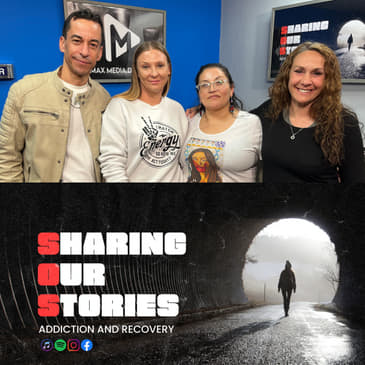
Our guest today is Laura Perez
See Privacy Policy at https://art19.com/privacy and California Privacy Notice at https://art19.com/privacy#do-not-sell-my-info.
[00:00:00] The views, thoughts and opinions expressed in the following program belong solely to the host and guest and do not necessarily reflect those of this radio station. Our parent company, advertisers or affiliates. Welcome to Sharing Our Stories. We share stories of support for individuals in recovery from substance misuse and mental health related issues. There are numerous pathways to recovery and each week we welcome powerful leaders and role models who have struggled in drug and or alcohol addiction, have found a pathway to recovery and who thrive as positive community members
[00:00:30] on going vision of success. Join us as we share our experiences, strength and hope when the world says give up. Hope whispers, try it one more time.
[00:01:00] I'm not going to say that. I'm not going to say that. I'm not going to say that. I'm not going to say that. I'm not going to say that. I'm not going to say that. I'm not going to say that. I'm not going to say that. I'm not going to say that. I'm not going to say that. I'm not going to say that. I'm not going to say that. I'm not going to say that. I'm not going to say that. I'm not going to say that. I'm not going to say that. I'm not going to say that. I'm not going to say that. I'm not going to say that. I'm not going to say that. I'm not going to say that. I'm not going to say that. I'm not going to say that. I'm not going to say that. I'm not going to say that. I'm not going to say that. I'm not going to say that. I'm not going to say that
[00:01:30] I'm not going to say that.
[00:02:00] I wonder if everybody who watches this program
[00:02:02] to spend some time with us someday
[00:02:05] so you can see the things that we won't talk about.
[00:02:07] Yeah, on the air.
[00:02:08] When we're going to show.
[00:02:09] So no, and the reason why I call her Farrell
[00:02:13] is not he was so honest when she was talking about
[00:02:16] her addiction.
[00:02:16] Every time she talks about it with anybody
[00:02:18] and she used the word to describe herself
[00:02:21] in her addiction as Farrell.
[00:02:23] Yeah.
[00:02:23] And I had never heard that word used by anybody
[00:02:25] especially a woman when it comes to describing their addiction
[00:02:29] and I just had this rabbit wild cat with foam at the mouth
[00:02:32] and while her nails climb,
[00:02:34] I'm going, give me a fix.
[00:02:35] Give me a fix.
[00:02:37] And that's what I picture.
[00:02:39] And I was like, there's nothing
[00:02:40] that nails addiction more than Farrell.
[00:02:43] Yeah, like a Farrell cat.
[00:02:44] Yes.
[00:02:45] Yes.
[00:02:46] Just running.
[00:02:48] And so girl, I love it.
[00:02:49] I love you.
[00:02:50] And thank you for using that word.
[00:02:52] You, I guess.
[00:02:54] Putting it in my vocabulary.
[00:02:57] So we always talk about like, what are we going to,
[00:03:00] how are we going to start the program?
[00:03:01] We got to do some small talk.
[00:03:03] And now he's like, yeah, go for it.
[00:03:04] She's never expecting things like, hey,
[00:03:06] you're going to call me Farrell
[00:03:07] to start this one on.
[00:03:09] My apologies.
[00:03:10] This program today as always is all about addiction and recovery.
[00:03:13] We share stories of what it's like to suffer in our addiction
[00:03:18] and to let you know that we can make it in our recovery
[00:03:21] and that yes, we do recover.
[00:03:23] And there's endless ways to recover.
[00:03:27] There is not one way that is the only way to do it.
[00:03:30] So we bring in somebody each week
[00:03:33] to talk about their recovery.
[00:03:34] And this week, I call it, you know
[00:03:37] this is Women's History Month.
[00:03:38] It is Women's History Month.
[00:03:39] So it's women's recovery day right now, right here.
[00:03:44] And you brought your good friend, right?
[00:03:47] And Laura, her name is Laurie.
[00:03:49] Laurie.
[00:03:49] So since she's also in recovery and I said,
[00:03:52] it's Women's Recovery Day, Laurie, come sit.
[00:03:56] Come sit.
[00:03:57] Will she fit in the camera?
[00:03:59] Will, what, do I have to move over?
[00:04:00] Dan?
[00:04:01] Let's get her in here.
[00:04:02] I'm moving forward.
[00:04:03] Dan's like, Dan's like, you totally...
[00:04:05] We didn't expect any of this.
[00:04:07] Our engineer just jumped up.
[00:04:09] He was now moving cameras.
[00:04:10] He's like, he's like, he's like, what the hell?
[00:04:14] Did you just do slams?
[00:04:15] I'm so like this.
[00:04:17] But I'm in.
[00:04:18] So this is Women's Recovery Week.
[00:04:20] And my name is Slay.
[00:04:23] And I'm here with all of my ladies.
[00:04:27] No, but you're also in recovery.
[00:04:30] And Laura is our guest.
[00:04:31] Laura Perez, sitting next to me, she works for Empowerment
[00:04:35] and LDR.
[00:04:37] Yes.
[00:04:38] And you brought your good friend, Laurie, who is in recovery.
[00:04:40] And of course, Nani.
[00:04:42] So now it's Women's Recovery.
[00:04:43] Now this is officially Women's Recovery Meeting
[00:04:46] with a man's Sydney.
[00:04:47] Yeah.
[00:04:48] So Nani, I'm going to pass it on to you
[00:04:51] for the big introduction for Laura.
[00:04:53] Yeah.
[00:04:54] Because it's Women's Recovery Day.
[00:04:55] Laura, welcome to sharing our stories.
[00:04:58] Thank you so much for being a guest on the show today.
[00:05:00] We are very excited to have you.
[00:05:02] So tell us about your story.
[00:05:05] Well, I'm Laura Perez.
[00:05:10] I'm from Denver.
[00:05:11] I grew up here.
[00:05:14] Where do I start?
[00:05:15] I mean, I grew up in a house where addiction and crime
[00:05:20] and it was the norm.
[00:05:24] I grew up watching the people that were
[00:05:28] supposed to encourage me and guide me just
[00:05:33] do their thing.
[00:05:35] I'm the oldest granddaughter out of 2025 grandkids.
[00:05:40] What?
[00:05:41] Yeah, holy cow.
[00:05:42] 20 years.
[00:05:43] I was going together in the holidays.
[00:05:45] Oh, we all lived in one house.
[00:05:47] No way.
[00:05:48] Yes.
[00:05:49] Wow.
[00:05:50] That's really cool.
[00:05:51] And being the oldest, I was made responsible for everybody.
[00:05:55] And so from a young age, I've always
[00:05:58] taken care of everybody.
[00:06:00] And so my addiction started when I was the first time
[00:06:07] I tried any kind of drug.
[00:06:09] I was maybe about eight.
[00:06:13] The life that my mom led, she did her thing.
[00:06:19] And she had large quantities.
[00:06:23] And my brother found her stash in the Kirby vacuum.
[00:06:28] Remember the old Kirby vacuum?
[00:06:29] Yeah, remember those things?
[00:06:30] With the zip-ups, the bake.
[00:06:33] And he's like, this is what mom does.
[00:06:36] You know?
[00:06:37] Yeah.
[00:06:39] That was my first try of Coke at that age.
[00:06:43] And it was just normal.
[00:06:45] Like there wasn't any, I don't know.
[00:06:51] Like it was normal.
[00:06:53] There wasn't the only time that there
[00:06:55] was some kind of different environment
[00:07:01] is when I would go with my grandmother
[00:07:03] with both of my grandmother's either my paternal or maternal.
[00:07:10] And that's when I was allowed to be a kid.
[00:07:15] But with my mom, I was the mom.
[00:07:19] She worked and she did her thing.
[00:07:21] But we never wanted for anything material.
[00:07:25] But we wanted our mom.
[00:07:28] So when I was 12 or 13, I met my kids' dad.
[00:07:38] And I was with that guy for 20, 20-settom years.
[00:07:43] And it was just crazy toxic relationship
[00:07:48] and throughout all of that time I was using.
[00:07:54] And I would justify it.
[00:07:57] Well, I'm at home with my kids.
[00:08:01] But what's worse, leaving them or being there with them.
[00:08:06] You know?
[00:08:09] And it was just normal.
[00:08:11] Like I didn't see anything wrong with anything
[00:08:15] that I was doing because I compared my life to my mom.
[00:08:22] And so I wasn't like her.
[00:08:24] So I'm better than her, you know?
[00:08:29] But yeah, going to prison was what saved my life, really.
[00:08:33] Because I learned so much about myself.
[00:08:39] Because for all my life, I had been made responsible
[00:08:45] for everybody else.
[00:08:46] I'd be taking care of little cousins
[00:08:48] while everybody's partying.
[00:08:50] And I could always remember when something would happen
[00:08:53] to one of them, it would be my fault.
[00:08:56] Like where the f*** are their parents at?
[00:08:59] You know?
[00:09:03] But I don't know, just now fast forward to now,
[00:09:13] I'm really grateful for the life that I have.
[00:09:17] It's took in some time to get where I'm at.
[00:09:23] I went to prison in 2015.
[00:09:28] And what got you there?
[00:09:30] What got me there?
[00:09:33] I was a booster.
[00:09:34] I don't know, do you know what a booster is?
[00:09:37] No.
[00:09:38] And I do not.
[00:09:40] I would take from the stores, high priced items.
[00:09:48] I got caught with gathering all your items
[00:09:51] to sell it for your happy.
[00:09:53] No, not for my habit.
[00:09:55] That's how I took care of my family.
[00:09:57] For everything.
[00:09:58] Yeah.
[00:09:58] Because throughout my life, my kids' dad would go to prison.
[00:10:03] I would be stuck with the kids, having
[00:10:06] to figure out how to take care of them
[00:10:08] because he was the sole provider.
[00:10:10] And somebody came along in my life that I knew
[00:10:15] and was like, I'm going to show you how to hustle, girl.
[00:10:19] Why you say in here broke?
[00:10:21] And took me to the stores and showed me what to do.
[00:10:26] And after that, it was a wrap like I couldn't stop.
[00:10:30] It was an addiction.
[00:10:31] It was not only did I have my addiction to cocaine,
[00:10:38] but now I have this addiction to I could walk in the store
[00:10:41] and walk out with anything I wanted whenever I wanted.
[00:10:44] It became fast money.
[00:10:45] Fast money.
[00:10:47] And my kids weren't without.
[00:10:51] They were only kids in the projects with good stuff
[00:10:55] and closet full of clothes with tags on them.
[00:10:59] So you feel like you're doing it right?
[00:11:01] Yeah.
[00:11:02] Well, yeah.
[00:11:02] I mean, when it's all around you.
[00:11:04] It's very kids, yeah.
[00:11:05] And in the life of crime and hustling
[00:11:08] is all that was ever around me.
[00:11:10] So it's a come up.
[00:11:15] And everybody was eaten.
[00:11:17] Everybody had clothes, everybody in my family.
[00:11:22] I always made sure that I fed the house.
[00:11:25] I paid the house.
[00:11:29] And just always I didn't justify it,
[00:11:34] but I didn't steal from people.
[00:11:36] I didn't take from my family.
[00:11:38] I wasn't doing other things that other people were doing.
[00:11:43] So I'm better than them, right?
[00:11:47] Isn't it funny?
[00:11:48] Like we always think that because I don't do what you do
[00:11:54] or I just snort and you smoke.
[00:11:58] So I'm not as bad.
[00:12:00] I'm not as bad.
[00:12:01] You know?
[00:12:04] That was like the insanity of it.
[00:12:08] Was that I knew that it was wrong
[00:12:13] but it was getting me to where I needed to be.
[00:12:17] It was paying not only for my habit, it was taking care of everything.
[00:12:27] You already said that you're a family-based woman.
[00:12:31] You've come from so many grand.
[00:12:33] You have so many fellow cousins.
[00:12:36] Yeah, that your family base.
[00:12:38] So your motivation there isn't just getting high.
[00:12:41] It's, hey, I want to take care of my family.
[00:12:43] And taking care of my family, when you're succeeding at that,
[00:12:47] you never feel like there's anything wrong at it.
[00:12:49] You got to do what you got to do is what you say, right?
[00:12:51] Yeah.
[00:12:52] And you can justify it too because your Sam Lam's
[00:12:54] taken from corporate corporate.
[00:12:56] And that's how I justified it.
[00:12:59] That's how I justified it because, you know,
[00:13:03] like they have insurance, right?
[00:13:08] All those things.
[00:13:09] They're going to get it back.
[00:13:10] They're covered.
[00:13:11] They're covered, you know?
[00:13:13] Just by and minimize it.
[00:13:15] Yeah.
[00:13:16] Yeah.
[00:13:17] And when I'm going to rewind a little bit,
[00:13:25] when I was about in seventh grade is when
[00:13:30] I started selling dope.
[00:13:33] You know, a certain person in my life had already
[00:13:41] had a drug case and who better to hold their dope than a kid?
[00:13:47] You know, they ain't going to check them.
[00:13:50] They ain't going to.
[00:13:51] So here I was going to school.
[00:13:54] After school, here's my dope.
[00:13:56] Go sell it.
[00:13:58] And so that's all I knew.
[00:14:00] Like, that's my life was hustling.
[00:14:05] And when I got pregnant when I was 16 with my oldest son,
[00:14:14] dropped out of high school.
[00:14:16] And I was working at McDonald's.
[00:14:18] And I could remember like thinking to myself,
[00:14:23] I got to get it.
[00:14:24] I got to get us out of here.
[00:14:25] You know?
[00:14:25] Got to get us out of here.
[00:14:26] And so I started selling dirt weed and just doing anything
[00:14:35] to make money.
[00:14:37] And ended up having another son in another relationship
[00:14:46] and ended up just being in the cycle of abuse.
[00:14:54] And stood with that person until the boyfriend
[00:15:00] that I met when I was 12, got out of prison.
[00:15:04] And I left my husband to go back to him, the worst mistake ever.
[00:15:12] And it was like when I went to prison
[00:15:16] and I finally found myself and understood
[00:15:23] that I was broken, that I needed.
[00:15:26] I was trying to fill a void that I couldn't fill
[00:15:30] because it was, you know, I had to heal that little girl
[00:15:38] that never had that love, you know?
[00:15:41] And so those relationships, you know, one of them,
[00:15:49] he almost took my life, you know?
[00:15:51] And now I could look back at it and real and reflect
[00:15:58] and see like what was wrong, you know?
[00:16:04] What I needed.
[00:16:06] And so I try to instill in my daughter that she doesn't
[00:16:14] need to depend on the man.
[00:16:16] You know?
[00:16:18] Because she's 13 and I'm just so glad she's nothing like I was.
[00:16:24] You know?
[00:16:27] But all those life experiences that I went through,
[00:16:31] I mean, if I go through my whole life,
[00:16:34] which means in every day, you know?
[00:16:38] But I'm just really grateful for where I'm at now.
[00:16:44] Prison, like I said, it saved my life.
[00:16:46] It took me away from my kids those five years that I did.
[00:16:54] I got out and I relapsed one of my little cousins
[00:17:01] had got murdered the next day after I got out.
[00:17:06] Like I was at the halfway house.
[00:17:07] I got a phone call or no, I used the phone to call home
[00:17:11] when I was able to after you know, you go on a hold
[00:17:15] and they let you use the phone.
[00:17:17] And I called home and my aunt was like, have you
[00:17:22] talked to anybody?
[00:17:23] You know?
[00:17:24] And I'm like, no, like what's going on, you know?
[00:17:27] And she told me my little cousin was murdered
[00:17:29] the night before.
[00:17:32] I lost it, you know?
[00:17:33] Because he was like my kid.
[00:17:36] You know, I grew up raising them.
[00:17:38] And so like we were, I was a kid raising kids, you know?
[00:17:41] And so I couldn't handle death.
[00:17:46] Couldn't handle the emotions that came with loss.
[00:17:51] And I bounced.
[00:17:54] I bounced from the halfway house and got caught up
[00:18:00] and went back to prison.
[00:18:02] I smoked out, you know?
[00:18:06] And I was sitting and I could remember like when
[00:18:12] I finally realized that like something's got to change,
[00:18:15] something's got to give.
[00:18:18] I was in my cell on my bunk and I could hear this lady out
[00:18:23] in the pod.
[00:18:26] And she's mad and she's going off on the phone
[00:18:29] and she's like, my kids won't answer because somebody
[00:18:31] asked her like, what's wrong?
[00:18:33] You know?
[00:18:33] She's like, my kids won't answer.
[00:18:35] This is like, she goes into her story
[00:18:37] and she's her six time back in prison.
[00:18:40] And this time she's back and she had her leg amputated
[00:18:44] because she was out on the streets just, you know,
[00:18:48] doing the most, not taking care of herself.
[00:18:52] And I'm listening to her story, listening to her.
[00:18:54] And I just have this thought like, is that what you want?
[00:18:59] Is that what you want for your life?
[00:19:02] See, because before I got out of prison the first time
[00:19:05] I fought with the director of TC.
[00:19:09] So let me put my papers into the halfway house.
[00:19:12] She's like, no, you're not ready for it.
[00:19:15] You need to graduate.
[00:19:16] You're not ready.
[00:19:17] Because while I was in TC, I was selling pills.
[00:19:19] I was selling pills to all the girls.
[00:19:21] I was still doing the most.
[00:19:22] Still hustling.
[00:19:24] Still hustling.
[00:19:25] I was selling them.
[00:19:26] Blue, salinum.
[00:19:28] Salinum.
[00:19:29] Figuring it out.
[00:19:30] Pins, you know, selling stuff to general population
[00:19:33] that they couldn't get.
[00:19:34] That we could get because we're in treatment.
[00:19:37] And I sit here and I think now it is for stamps, you know?
[00:19:43] For stamps, for coffee, because nobody was taking care of me.
[00:19:48] You know, I didn't have that family support out here.
[00:19:51] And so yeah, I was still hustling in there.
[00:19:56] So when I went back, I had to go and redeem myself
[00:20:03] with the director of TC and ask her to let me back in.
[00:20:09] And she's like, why should I?
[00:20:12] Why should I?
[00:20:12] You're not ready.
[00:20:14] You're not ready for change.
[00:20:16] You're not ready to put in the work that it takes.
[00:20:19] She's like stay in GP for a while.
[00:20:22] And we'll think about it.
[00:20:26] And I talked to one of the coordinators,
[00:20:33] the senior coordinators in the program.
[00:20:36] She's like, she's testing you.
[00:20:38] She wants to see what you're about.
[00:20:40] If you're she's going to see if you're
[00:20:42] going back to mental health to get back on pills.
[00:20:46] She wants to see what you're doing and your level of acceptance.
[00:20:50] Yeah.
[00:20:51] And so I bust my ass to get into whatever programming
[00:20:57] they had to get a job within the prison.
[00:21:01] You know, I got in for my GED and like I started.
[00:21:07] And I would go to every house meeting
[00:21:10] and then finally about three months later she was like,
[00:21:15] I got a I got room.
[00:21:16] Somebody graduated I got room.
[00:21:18] Let me back in and just my mindset was different.
[00:21:28] When the first time I was in prison I was OK with being there.
[00:21:33] Because my ex and my mother-in-law, she kept money on my books.
[00:21:40] He kept money on my books until he found somebody else
[00:21:43] and went on his way.
[00:21:45] And he threw out that sentence.
[00:21:49] The first sentence he left my kids and I didn't know this.
[00:21:53] I didn't know where my kids were for six months.
[00:21:57] I thought my kids were with their dad.
[00:21:59] I thought he had our house.
[00:22:02] I thought everything was cool, you know?
[00:22:06] And then finally I got through to my mother-in-law on the phone
[00:22:09] and she told me I can't lie to you anymore.
[00:22:14] Like he's with somebody else and I'm like,
[00:22:18] where's the kids?
[00:22:19] She's like, I have the kids.
[00:22:21] I've had the kids.
[00:22:23] And I can't do this anymore.
[00:22:25] I'm sick.
[00:22:27] I need you to ask your mom or somebody in your family
[00:22:32] to take them.
[00:22:34] And so there I was trying to figure out from inside who's
[00:22:42] going to take my babies.
[00:22:45] And I'm wishing very bad things on this man just saying,
[00:22:50] sorry.
[00:22:51] Yeah.
[00:22:54] And so it was just that first sentence, I was cool.
[00:23:01] I was putting myself back in prison before I even walked out.
[00:23:07] I was telling myself, yeah, when I get out,
[00:23:10] I'm going to make sure that I do this and that.
[00:23:14] I'm going to work, and I'm going to put money away
[00:23:17] for my just-in-case fund.
[00:23:19] And she's like, you're just-in-case fund.
[00:23:21] What's that?
[00:23:22] I was like, just-in-case, I come back.
[00:23:25] I ain't going to be hungry like this no more.
[00:23:28] And she was like, why would you say that?
[00:23:30] You know how dumb you sound right now?
[00:23:33] But I did it because I didn't see any other way out.
[00:23:37] I didn't see any other way other than what was in front of me,
[00:23:42] other than what I thought was normal.
[00:23:48] You know?
[00:23:50] So-
[00:23:52] And your path to a sleaze back to prison is what you were thinking.
[00:23:55] Yeah.
[00:23:57] Because see, I'm the middle child.
[00:24:00] I have an older brother.
[00:24:02] And he started doing time when he was 12.
[00:24:07] And he's on his way back to prison right now.
[00:24:12] And you know, that's all I ever knew.
[00:24:19] You know?
[00:24:20] And my mom had been to jail.
[00:24:23] And that's when all my problems started
[00:24:25] is when she went to jail, you know?
[00:24:28] Because here I am now at the mercy of my grandma
[00:24:32] or whoever's going to take me in.
[00:24:35] And that's when I started like running away
[00:24:38] and just doing whatever as a child.
[00:24:41] I look out my kids now, the ones that are the age,
[00:24:46] like every-I have eight kids.
[00:24:48] So I have three adult sons.
[00:24:53] I have three teenagers.
[00:24:56] I have a eight-year-old daughter and a two-year-old son.
[00:24:59] And so every phase of their age groups, I'm like,
[00:25:06] damn, I remember when I was that age.
[00:25:10] And I didn't have the positive role model, you know?
[00:25:19] Other than my grandmother's, you know?
[00:25:23] And one of them, you know, she had went to church
[00:25:27] from for like ever all my life, you know?
[00:25:31] And I just thought church was boring.
[00:25:33] So I didn't want to follow those footsteps, you know?
[00:25:37] But so yeah, I ended up getting out of prison.
[00:25:41] I did TC graduated and I had to bust my...
[00:25:46] I had to...
[00:25:48] So the second time that I went back to prison
[00:25:53] is after I left the halfway house
[00:25:56] and I was on the run for about three or four months.
[00:26:01] And I left...
[00:26:04] I went back to my kids' dad in that time.
[00:26:06] I went back to him thinking all he needed was me and the kids
[00:26:11] and he would get it together.
[00:26:13] And we would be a family and, you know,
[00:26:16] all the fairy tale love story.
[00:26:20] And it was just worse because by that time
[00:26:24] we had so much animosity towards each other.
[00:26:28] And I couldn't get over the fact
[00:26:29] that he walked away from our kids, you know?
[00:26:33] I couldn't understand how could you just leave my babies
[00:26:38] or babies like they were nothing, you know?
[00:26:42] And yeah, I was gone
[00:26:45] but I couldn't help being gone like I was, you know?
[00:26:50] But if I had any chance to be there, I would be there.
[00:26:53] And that was my weakness every time I got out
[00:26:56] to the halfway house, I would run because my kids, you know?
[00:27:01] Because there's nobody to take care of my kids.
[00:27:04] And so when I was in there the second time
[00:27:12] I had to find again somebody to take care of my kids
[00:27:16] because my mom was like, I can't do this.
[00:27:19] Because that's why I ran from the halfway house.
[00:27:21] That was another reason why I ran from the halfway house
[00:27:24] when I got out the first time.
[00:27:26] Was she called me and she's like,
[00:27:28] you need to come get your kids?
[00:27:29] I'm like, I'm in the halfway house.
[00:27:32] Do you not know what that means?
[00:27:34] Like, I can't leave, you know?
[00:27:37] And so I left, I went to take care of my kids
[00:27:41] because I'm not gonna have my kids
[00:27:43] where they're not wanted, you know?
[00:27:45] But behind those walls when that happened
[00:27:48] when I called home to check on them
[00:27:50] and she's telling me, you gotta find somewhere
[00:27:53] for them to go.
[00:27:55] You know, nobody in my family would take them.
[00:27:59] And, you know, that hurt, that hurt.
[00:28:02] And I called a really good friend of mine
[00:28:06] and it wasn't, there was no questions asked.
[00:28:10] There was no nothing.
[00:28:12] She's like, tell them to have all of them ready.
[00:28:15] She said, all of them.
[00:28:16] She said, tell her to have all four of them ready.
[00:28:19] I'll be there for him.
[00:28:21] And she only ended up with two,
[00:28:24] but she, you know, like nothing, you know?
[00:28:31] And she made sure they were there for visits,
[00:28:35] you know, through that, through both prisons,
[00:28:38] both of my times in prison.
[00:28:44] Nobody would even take them to see me, you know?
[00:28:48] And the only time I seen him was during mom and kids' day
[00:28:52] when they could be dropped off
[00:28:55] and that happened quarterly.
[00:28:58] So every four months.
[00:29:00] So here I am trying to catch up on a whole four months
[00:29:06] in eight hours, you know?
[00:29:09] And it was rough.
[00:29:13] And I feel for women that are, for parents' period
[00:29:18] that are in there and don't know where their kids are.
[00:29:21] Yeah, you know?
[00:29:22] It's tough.
[00:29:23] It's hard.
[00:29:25] And that's one pain that I don't wish on anybody.
[00:29:32] Not knowing you know they're out there,
[00:29:35] but you don't know if they're okay,
[00:29:37] if they're eating, if they have clothes, if, you know?
[00:29:44] And I don't know the second time
[00:29:48] when I went back to prison,
[00:29:50] I just, I was ready for something different.
[00:29:55] And I trusted the process and did the program
[00:30:02] and graduated.
[00:30:04] I stood there in the aftercare program
[00:30:09] and I got out and I had to find a sober living to go to
[00:30:14] because I didn't have nowhere to parole to.
[00:30:18] I had to cut one of my little cousins, let me use his address.
[00:30:21] But you know he had his family and his lady was like,
[00:30:26] I don't want nobody staying with this.
[00:30:30] And I'm like, cool, I don't even care.
[00:30:32] Just get me out of here.
[00:30:35] I need to get out of here, you know?
[00:30:37] And D.O.C., like six months before your
[00:30:43] going to be released, they have reentry panels
[00:30:47] and they have different,
[00:30:50] they have different community organizations come in
[00:30:53] on different days and different resources.
[00:30:58] And I met my case manager there from empowerment.
[00:31:02] Oh yes, the empowerment program.
[00:31:05] And they were signing up people for the Wagees program.
[00:31:13] And somebody had told me who to look for.
[00:31:19] She's cool, she'll help you.
[00:31:21] Like she don't think she's better than like her attitudes
[00:31:24] good, she'll be cool with you.
[00:31:27] So I went in there and I'm like,
[00:31:29] I just remember walking up to her like, can you help me?
[00:31:33] Like they said you could help me.
[00:31:35] I need help.
[00:31:36] Like I need to find somewhere to go with my kids
[00:31:40] when I get out of here because I didn't,
[00:31:42] I knew I wasn't gonna have,
[00:31:43] I knew if I went back to the environment I grew up in
[00:31:48] that I wasn't gonna succeed.
[00:31:51] You know?
[00:31:53] I wasn't gonna have the support, none of it.
[00:31:57] And so she worked with me,
[00:32:02] she took housing applications every week.
[00:32:06] She would bring me a stack.
[00:32:08] Fill them out, I gave her permission to talk on my behalf
[00:32:13] to all these places.
[00:32:15] And you did all that while you were still alive.
[00:32:17] While I was still in prison.
[00:32:18] Mm-hmm.
[00:32:19] And she, we found a sober living for me to go to.
[00:32:26] And that's when I met Laurie when I got out
[00:32:29] the second time.
[00:32:31] But I found a sober living to go to.
[00:32:34] So my cousin let me use his address.
[00:32:39] I got out and there was an organization called
[00:32:44] No More Lockdoors.
[00:32:49] And she had been incarcerated,
[00:32:53] she was previously incarcerated
[00:32:55] and she would bring back packs with all the stuff
[00:32:59] that she wanted while she was in prison
[00:33:02] like the hygiene stuff, the good hygiene.
[00:33:05] And toothbrushed longer than your pinky, you know?
[00:33:10] And she would come and get the girl,
[00:33:12] she would come and get us from prison, pick us up,
[00:33:14] take us to eat, take us shopping for clothes
[00:33:18] and just walk a month's back, you know?
[00:33:21] So none of my family knew I was getting out.
[00:33:23] I kept it a secret because I figured
[00:33:26] if they couldn't be here for me at my worst,
[00:33:29] why am I gonna let them harm me on my best?
[00:33:32] That was my mindset at the time
[00:33:34] because I had so much resentment towards them, you know?
[00:33:39] And so I got out, she took me to the parole office
[00:33:46] and I checked in and already had a plan
[00:33:49] that I was gonna just call and switch locations
[00:33:53] and go to the sober living.
[00:33:55] And so that's what I did.
[00:33:57] And I was there for about six months
[00:34:00] and then COVID hit.
[00:34:03] And me and my little sister, we had a disagreement
[00:34:07] and I told her to just bring my daughter to me, you know?
[00:34:13] And so she did, she did what I asked her to do, you know?
[00:34:17] And so I had to leave, I had to leave
[00:34:19] because I didn't have nowhere to keep my daughter.
[00:34:22] And so throughout that time that I was
[00:34:26] when I got out at the sober living,
[00:34:28] that's when I met Laurie and my sponsor
[00:34:32] because I left prison with my sponsor,
[00:34:34] like I had a plan.
[00:34:36] Like I was gonna go back, you know?
[00:34:38] And my sponsor connected me with Laurie
[00:34:43] and Laurie was my mentor the first six months when I got out.
[00:34:49] What kind of treatment did you go through
[00:34:52] while you were in prison?
[00:34:53] A cognitive behavioral treatment.
[00:34:55] Okay. And how did you like that?
[00:34:58] I loved it.
[00:34:59] I loved it.
[00:35:00] So when you came out of prison,
[00:35:01] you were interested in sober living.
[00:35:03] It wasn't necessarily just something forced on you also.
[00:35:05] No. I wanted it.
[00:35:08] I didn't want to go back to the chaos of my family.
[00:35:16] Me and my mom, I love my mother.
[00:35:21] She's my queen but we can't do life together.
[00:35:26] We're too much alike.
[00:35:28] And I get really frustrated with her.
[00:35:33] And so I just keep my distance, but I love her, you know?
[00:35:41] But yeah, I ended up leaving the sober living
[00:35:45] and I had to go back to mom's.
[00:35:47] I didn't have nowhere to go.
[00:35:49] I was trying to get into a shelter,
[00:35:51] but because of COVID they shut down.
[00:35:55] We couldn't go in.
[00:35:57] And so the agreement was,
[00:35:58] I'm gonna stay here until I could get into a shelter
[00:36:02] and then I'll take all the kids to the shelter with me
[00:36:06] because my two boys were still with my friend.
[00:36:10] And my mom had kept my baby.
[00:36:12] I went to prison the first time when my daughter
[00:36:15] who's eight now was six months old.
[00:36:18] So my parents raised her.
[00:36:22] My stepfather and my mom raised her
[00:36:24] from when she was six months till she was six years old.
[00:36:28] And trying to rebuild those relationships
[00:36:35] with my kids, when I first got out the first time
[00:36:39] when I wasn't ready for it,
[00:36:42] was really hard because I was trying to,
[00:36:46] one thing growing up through my whole life,
[00:36:49] like I was a people pleaser.
[00:36:51] Like I had to keep the peace
[00:36:53] because of how chaotic my household was.
[00:36:56] And there were so many of you.
[00:36:58] Yeah, and so I always,
[00:37:00] and I didn't wanna get blamed for everybody all the time.
[00:37:03] So I always was trying to keep the peace
[00:37:05] and always trying to fix everything for everybody.
[00:37:08] And the first time I got out of prison,
[00:37:14] I found now I could look back and see where I went wrong.
[00:37:17] I was trying to fix somebody that didn't wanna be fixed.
[00:37:23] Somebody that didn't want what I wanted.
[00:37:30] And so I had to,
[00:37:34] the way that that relationship ended is really sad.
[00:37:41] But I'm thankful that it ended
[00:37:43] because I found somebody that values me.
[00:37:48] And I don't know, I found somebody that I value.
[00:37:56] But yeah, the second time I got out of prison
[00:38:00] is when I was ready to change.
[00:38:05] I didn't know how I was gonna do it with four kids,
[00:38:08] but I knew I had to do it.
[00:38:10] And I just utilized all the support in the community.
[00:38:18] I stood connected to the Empowerment Program.
[00:38:22] And I graduated the Wageee's Program.
[00:38:28] And my case manager, she had been telling me
[00:38:31] since prison when she met me like,
[00:38:33] you should be a peer specialist.
[00:38:36] And I'm like, what's up here?
[00:38:37] Like what is that?
[00:38:40] And she's like telling me what a peer specialist is.
[00:38:42] And I'm like, ain't nobody gonna trust me with people
[00:38:46] to help them.
[00:38:48] Do you know who you're talking to?
[00:38:50] And she's like, nah, that's why I low higher you.
[00:38:54] Like exactly why?
[00:38:55] That's why they want you.
[00:38:57] And I'm like, nah,
[00:38:59] because I was so used to that self-talk,
[00:39:00] that negative self-talk, talking down on myself.
[00:39:03] Yeah.
[00:39:04] And so throughout that,
[00:39:10] when I left, the sober living
[00:39:12] and went back to my mom's, I was doing good for a minute
[00:39:15] and then I quit working at Wendy's
[00:39:21] and got hired at 7, 11, Graviarts.
[00:39:25] And I started getting high again.
[00:39:28] I ran into somebody from my past
[00:39:32] and I was thinking that I couldn't
[00:39:36] provide for my kids with this minimum wage job, you know?
[00:39:41] And I started selling again.
[00:39:46] But this time I started selling fentanyl,
[00:39:49] but I didn't know I was selling fentanyl
[00:39:51] because fentanyl hit the streets
[00:39:53] when I was in the joint.
[00:39:54] Oh right.
[00:39:55] It hit the streets when I was still in prison.
[00:39:59] So I'm thinking I'm selling perksets.
[00:40:05] I thought I was selling 30s.
[00:40:07] And people are telling me you're selling fake pills.
[00:40:10] What the hell's a fake pill?
[00:40:13] Then I try them.
[00:40:15] And then I get stopped, you know?
[00:40:19] And I lied to my partner at the time,
[00:40:23] we're still together, but at the time I was lying to him
[00:40:27] and he's like, nah, what's going on, you know?
[00:40:34] I OD'd in my room and nobody knew
[00:40:39] my two adult sons came and they found me.
[00:40:43] And they brought me back, you know?
[00:40:50] And my husband showed up after time he was
[00:40:54] and my husband, we were just seeing each other,
[00:40:57] but he showed up and he knew something was wrong,
[00:40:59] like something was off.
[00:41:00] Everybody was quiet.
[00:41:02] Nobody was saying anything.
[00:41:04] He's like, what's going on?
[00:41:06] Came out and he didn't approve it, you know?
[00:41:12] And so slowly I stopped selling.
[00:41:15] Slowly I found out I was pregnant.
[00:41:17] By the time I found out I was pregnant,
[00:41:20] my case manager from empowerment was still there
[00:41:24] to support me.
[00:41:25] She helped me get on methadone
[00:41:27] and get off of fentanyl.
[00:41:31] And I have three years clean now
[00:41:34] from fentanyl and all men.
[00:41:39] And you know, but some tragic things happened
[00:41:45] in that time of me finding out I was pregnant
[00:41:50] and getting clean
[00:41:54] and I just realized that I had to either stop
[00:42:00] what I was doing all the way
[00:42:05] or my kids were gonna lose me again to DLC.
[00:42:12] And so, you know, with the choices that my husband made,
[00:42:18] it opened my eyes
[00:42:21] and I just realized that I wanted something different.
[00:42:26] I ran into, I started doing programs
[00:42:29] that my case manager was, you know, suggesting
[00:42:32] that I would do.
[00:42:34] And so I went to this program
[00:42:37] and I ran into one of the girls
[00:42:40] that I was in prison with.
[00:42:42] I met her when I was in the county jail
[00:42:45] and we reconnected
[00:42:49] and she's a big part of why I am
[00:42:53] where I am because she believed in me.
[00:42:56] She's seen what I was trying to do with my life
[00:43:00] and she shared her knowledge
[00:43:05] of becoming a peer specialist.
[00:43:10] She created a curriculum
[00:43:13] and asked me if I'd be willing to follow the curriculum
[00:43:19] and it was gonna be hard
[00:43:22] because I wasn't connected to any nonprofit
[00:43:25] or to anywhere for them to pay for the trainings.
[00:43:29] It would all be out of my pocket, you know?
[00:43:32] And she's like, but we're gonna believe in God
[00:43:35] and we're gonna believe in God, we're gonna trust in God
[00:43:37] and I'm like, all right, I'm down.
[00:43:42] Let's do this.
[00:43:44] And so by that time I was living in a transitional housing
[00:43:48] because I had went, I finally went to a shelter.
[00:43:52] I went to a shelter and got into a transitional housing
[00:43:57] and worked on the peer curriculum
[00:44:01] that whole time I was there
[00:44:03] and ended up getting hired at the empowerment program.
[00:44:09] And so I have been there now for two years
[00:44:13] as a case manager.
[00:44:15] I'm now certified by the state of Colorado
[00:44:18] as a peer specialist, a peer and family specialist.
[00:44:23] I'm a full-time student at MSU.
[00:44:26] That's awesome.
[00:44:27] I'm going from my bachelor's in science
[00:44:30] and you know, I still have, I still have struggles
[00:44:36] but my struggles are different now.
[00:44:39] And they're doable.
[00:44:42] It's not doom and gloom in my world isn't gonna end, you know?
[00:44:47] There's hope and I'm helping women that are where I was
[00:44:54] and it's like redemption work for me
[00:44:58] because I'm not, I'm not conceded to the point
[00:45:05] where I'm like, I'm not conceded at all but...
[00:45:09] I'm not, you know, I'm not, I don't think that I'm above anybody.
[00:45:14] I remember where I came from.
[00:45:16] I remember that all it takes is one,
[00:45:19] one bad day, one bad argument,
[00:45:23] one bad something for me to say,
[00:45:28] if it all and just walk away,
[00:45:30] and go back.
[00:45:32] It's a powerful thing to have relapsed and be where you are.
[00:45:38] And I think it says a lot, like, you know, for people that are like,
[00:45:41] I don't know if I can do this, you know,
[00:45:44] or I'm gonna fail at this,
[00:45:46] you have the ability to tell them,
[00:45:49] I've failed at this but also I'm succeeding now.
[00:45:55] And I think that's one of the only positive
[00:46:00] ever actually from a relapse.
[00:46:02] Is the ability to say, hey look I did that,
[00:46:05] I'm still here.
[00:46:07] I was able to survive that.
[00:46:09] Yeah.
[00:46:10] Otherwise there is no positive.
[00:46:12] Yeah.
[00:46:13] Yeah.
[00:46:14] I mean, and I give all the credit to...
[00:46:17] not all the credit but a lot of the credit to my treatment in TC
[00:46:22] because had I not,
[00:46:24] I was just talking to my best friend about this last night,
[00:46:27] had I not had those skills of knowing like, okay, you know,
[00:46:34] you gotta get out of this.
[00:46:36] You know, I probably went in to ask for help.
[00:46:39] That was another big thing I never asked for help
[00:46:42] because I didn't want nobody throwing nothing in my face.
[00:46:46] And so TC helped me ask for support.
[00:46:51] And so when I knew that I needed to get clean,
[00:46:54] I called my case manager and I was like, does that offer still stand?
[00:46:59] And she's like yeah, yeah it does.
[00:47:02] Like why I need help.
[00:47:04] And here I said no, you know,
[00:47:08] I work with her now, you know.
[00:47:10] And life isn't, you know,
[00:47:14] there are still things in my life that hurtful things,
[00:47:19] things that are difficult to deal with.
[00:47:23] But I get through them, you know.
[00:47:26] My significant other, he has a life sentence
[00:47:30] and he hasn't had the chance to meet our son in person.
[00:47:36] He's only knows him over video through a glass.
[00:47:41] And it's hard but I truly believe had I not did that time,
[00:47:51] had I not went through,
[00:47:53] not knowing where my kids were not being able to see them.
[00:47:58] I wouldn't be able to support him emotionally.
[00:48:03] Yeah, I wouldn't be able to do the things that I do now
[00:48:07] for myself or for anyone else.
[00:48:09] Right, yeah, you can relate the ability
[00:48:12] to empathize with what he's going through.
[00:48:14] Yeah. And for the people that I work with,
[00:48:17] the people that I serve, like I get so frustrated sometimes
[00:48:21] because I'm like you could do this,
[00:48:23] like you got this everything in you.
[00:48:27] You could do it, you know.
[00:48:30] And it's just sad.
[00:48:34] Like I drive around Denver and I see people
[00:48:37] that I grew up with and my heart hurts for them.
[00:48:42] And that's how I know I've changed
[00:48:44] because before I didn't care about anybody,
[00:48:47] I didn't care about not even myself.
[00:48:50] I was okay with being in prison.
[00:48:53] You know, I was okay with three hots and a cot.
[00:48:55] And so now I just try to lead by example.
[00:48:59] And for my kids like I just try to be what I didn't have.
[00:49:04] But I have to remember that they're not me.
[00:49:08] They're not that little girl.
[00:49:10] And I got to listen to them and figure out what it is they need.
[00:49:16] So life's good now though.
[00:49:20] Life is good.
[00:49:22] And what motivates you every day the most do you think?
[00:49:25] My kids.
[00:49:27] Yeah, your kids.
[00:49:28] My kids, my grandkids.
[00:49:32] And you know.
[00:49:35] What's the relationship with your kids having been away from them
[00:49:39] for five plus years and dealing with addiction?
[00:49:42] How do they deal with that with you?
[00:49:46] The ones that are old enough to understand what you've gone through.
[00:49:50] They're just really honest with me.
[00:49:52] And I let them be honest.
[00:49:54] I let them tell me how they feel.
[00:50:00] We still have our ups and downs, you know.
[00:50:05] But I just like the fact that I'm able to be here for them whenever they need me.
[00:50:13] Even my adult kids, you know, they're grown with their families and they live on their own.
[00:50:20] But I'm not strung out.
[00:50:23] I'm not stuck in the bathroom.
[00:50:26] They know they could come to my house and they're not going to find me.
[00:50:32] They're all dead on the floor.
[00:50:35] There really be a relief for those two boys that did find you like them too.
[00:50:39] And there's no animosity, there's no issues.
[00:50:44] Not for me.
[00:50:45] I don't know if they harbor that.
[00:50:48] They don't tell me.
[00:50:50] They're really supportive.
[00:50:52] My older boys are really supportive of me.
[00:50:55] I try to just let them do life.
[00:51:00] If they need me, they know I'm here.
[00:51:03] I don't really try to be the mother in law that's all in their mix
[00:51:08] and tell them how to raise their kids.
[00:51:11] Instead of like, you know, I just let them live.
[00:51:17] How have you managed to stay sober every day?
[00:51:20] What do you do?
[00:51:22] For all of us who work in recovery and who are in this field,
[00:51:28] I know that we, everybody has kind of that pathway to recovery.
[00:51:32] What is it that you do for your own?
[00:51:35] So I still dose.
[00:51:39] That's a big...
[00:51:41] Like that helps me be accountable.
[00:51:46] Just today I have to go take a UA and have a bottle count.
[00:51:51] So I think that's connected to though.
[00:51:54] I'm so used to answering to somebody from being in prison and being on paper.
[00:52:01] But I still do that and support, support in self-care.
[00:52:07] And just looking at my kids and my grandkids and remembering where I...
[00:52:14] Like I don't put prison too far behind me.
[00:52:18] I still keep those memories fresh and those experiences in the heartache.
[00:52:25] I keep it fresh for a reason.
[00:52:28] And I do the opposite of what I used to do even when I don't know because there's times when...
[00:52:34] Especially as a college student, you know, I dropped out when I was in a freshman in high school.
[00:52:43] So now I just reach out for support.
[00:52:48] You know, I utilize whatever support is available to me.
[00:52:53] And people, you know, some of my clients at the agency they're like,
[00:52:58] You still have a therapist?
[00:53:00] I'm like, yeah, girl, you think I could do...
[00:53:03] You think I could help you without one?
[00:53:06] Right.
[00:53:07] You know, we should all have therapists.
[00:53:10] Two.
[00:53:11] You know, but yeah, my kids, my kids are...
[00:53:17] And my grandkids are my motivation.
[00:53:21] Yeah.
[00:53:27] So Lori's here and best friends?
[00:53:30] Yes, my best friend.
[00:53:33] When you met her...
[00:53:36] Who did you meet when you met her?
[00:53:39] Where was she when you met her?
[00:53:41] She was in a sober living house.
[00:53:44] How a baby girl.
[00:53:46] What do you see now?
[00:53:48] It is a total transformation.
[00:53:51] This woman is so strong and so courageous.
[00:53:56] When people say that they can't do it, it's hard for me because that's my best friend.
[00:54:02] Right?
[00:54:03] So when people come to me and say, I don't know how I'm going to do this,
[00:54:06] I'm like, miss me with all that.
[00:54:09] Yes, I'm pretty cutthroat, but she's got eight kids.
[00:54:12] She works two jobs.
[00:54:14] You know, she's going to school full-time.
[00:54:17] Like, that's how God made her strong.
[00:54:21] She's a faithful woman.
[00:54:23] You know, she's a God-fearing woman.
[00:54:25] She is so strong and she overcomes any obstacle thrown at her way.
[00:54:30] I'm serious.
[00:54:32] She does it with grace and kindness, and she shows empathy to everybody and understanding.
[00:54:39] And it doesn't matter where you're at in life.
[00:54:41] She'll show you love.
[00:54:42] I've been on the phone with her at times, and she'll see somebody on the street pick them up,
[00:54:46] get Marietta.
[00:54:47] Where are you going?
[00:54:48] I'm just going to work.
[00:54:49] They needed a ride.
[00:54:50] I found him at the bus stop.
[00:54:51] I'm like, all right.
[00:54:52] You know?
[00:54:53] But I just see big things happening for Laura because she does not give up.
[00:54:58] And she is my best friend.
[00:55:01] I think that said it.
[00:55:02] That's got to be awesome here, you know, and deserved.
[00:55:07] It is.
[00:55:08] It's uncomfortable sometimes.
[00:55:09] Of course.
[00:55:10] Of course.
[00:55:11] Because what I do, you know, my life, I'm not intentional about getting like my actions are intentional for the people I'm helping, but I don't do it for praise or for acknowledgements.
[00:55:29] I do it because I want them to have hope that changes possible.
[00:55:36] It's not easy.
[00:55:38] Sure, and the hell isn't easy, but you could do it.
[00:55:42] That's right.
[00:55:43] You know?
[00:55:44] Women in recovery here, okay?
[00:55:46] Yeah.
[00:55:47] That's why we brought Laura up.
[00:55:48] If you think it's sitting in the back and be another woman in recovery, I'm outnumbered.
[00:55:53] It's women in recovery day.
[00:55:55] That's how it's going on to.
[00:55:56] Mark your calendar.
[00:55:57] That's right.
[00:55:58] We just made it, all right?
[00:56:00] So it's in March, whatever day you decided to listen to this.
[00:56:03] It's a day.
[00:56:04] Yeah.
[00:56:05] Anything you want to say specifically to women suffering in addiction or maybe somebody that's listening that has a family member that's a woman that's suffering in addiction, something you want to say to women out there and men too, but women recovery day.
[00:56:21] Yeah.
[00:56:22] Don't give up.
[00:56:24] Like, don't give up on what your dreams are.
[00:56:28] Remember your dreams and you're valuable.
[00:56:32] And I know that your loved.
[00:56:35] Somebody loves you.
[00:56:36] Right.
[00:56:37] You know?
[00:56:38] That's valuable.
[00:56:39] Yeah.
[00:56:40] Right.
[00:56:41] You're not replaceable.
[00:56:44] You know?
[00:56:45] And if you're still using like they need you, somebody needs you.
[00:56:51] You know?
[00:56:52] You're currently working at Empowerment Program.
[00:56:55] The Empowerment Program.
[00:56:56] Be Empowerment Program.
[00:56:57] Do you have a contact there that people if they wanted to reach out to you and learn more?
[00:57:02] They could go to our website.
[00:57:03] The Empowerment Program.org.
[00:57:05] On there, there is a tab that says get started.
[00:57:11] You hit that tab and do the pre-intake form.
[00:57:16] And if you do it on a Monday, you'll be hearing from me.
[00:57:20] But yeah, they'll be connected to a case manager by the second phone call from us.
[00:57:25] Okay.
[00:57:26] Yeah.
[00:57:27] Well, Laura, I want to thank you for having me.
[00:57:29] Thank you for coming in.
[00:57:31] Congratulations on your three years.
[00:57:34] Yep.
[00:57:35] It's awesome.
[00:57:36] Three years and it'll be two months on the 27th.
[00:57:39] Yes.
[00:57:40] It's very awesome.
[00:57:41] I'm very proud of you and I look forward to swatching more time go by.
[00:57:47] Yep.
[00:57:48] Thank you for coming in and speaking.
[00:57:50] Hi, this is Sharon, our stories.
[00:57:52] Our guest, Laura Perez from Denver.
[00:57:54] She works at Empowerment and LDR stands for Live Different Recovery.
[00:57:58] Live Different Recovery.
[00:58:00] I volunteer there on Fridays.
[00:58:02] Okay.
[00:58:03] What's their contact information?
[00:58:04] So they're...
[00:58:05] And what do they do?
[00:58:06] Recovery.
[00:58:07] So they're a recovery program from that was created by the alumni of Cross Purpose.
[00:58:13] Okay.
[00:58:14] So it's out...
[00:58:15] So they are based out of Cross Purpose.
[00:58:17] They meet every Friday night at 3050 Richard Allen Court.
[00:58:23] We serve the community food.
[00:58:25] Good dinner, it's not something, you know?
[00:58:28] Oh, Friday night dinner and we're talking about meeting.
[00:58:30] I like this outfit.
[00:58:32] We have different community organizations come in and do workshops and it's really good.
[00:58:40] You can find us on Facebook, yeah.
[00:58:44] You live different recovery.
[00:58:46] Recovering.
[00:58:47] All right.
[00:58:48] Write that down, Maul Hai, and look that up.
[00:58:50] You just heard dinner, company, workshop, friends, free childcare and recovery on Friday.
[00:58:57] So long, Alessandra.
[00:58:58] Good time.
[00:58:59] Fill your belly and enjoy.
[00:59:02] Thank you so much.
[00:59:03] Yes.
[00:59:04] Laurie, thank you for coming along with her.
[00:59:05] You're never having me.
[00:59:06] Non-eferral algeleo.
[00:59:07] Yes.
[00:59:08] I love it.
[00:59:09] I love you.
[00:59:10] I love you.
[00:59:11] Okay.
[00:59:12] This is Sharon R. Stories.
[00:59:13] You can find this program on our Facebook page.
[00:59:15] It's luckily some of you are here right now.
[00:59:18] Please like, share, subscribe on our Facebook page.
[00:59:20] On our YouTube page.
[00:59:22] You can find us wherever you listen to your podcasts.
[00:59:24] So subscribe to our podcast on your favorite podcasting network.
[00:59:28] And please share this program with somebody who may need it or a family member who you just want them to learn more about recovery and that yes, it happens.
[00:59:39] You'll find us here every weekend on the radio Sunday morning 7 a.m. on jamming 1-1-5 and a flow 1071 here in Denver.
[00:59:48] And of course, like I said, where are you?
[00:59:51] Where are you?
[00:59:52] Wherever you find your podcasts.
[00:59:54] Thank you so much to our guests, Laura Perez.
[00:59:56] Thank you.
[00:59:57] Laurie, thank you.
[00:59:59] Nonny, thank you.
[01:00:00] This is Sharon R. Stories and we will see you again.