
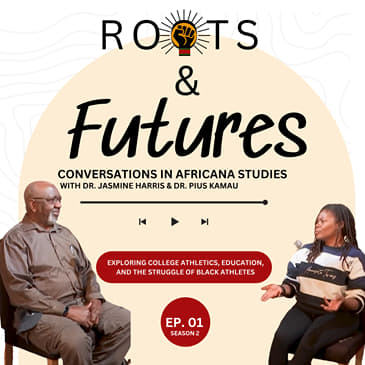
Join Dr. Jasmine Harris and Dr. Pius Kamau as they discuss the complex world of college athletics, and the lives and challenges of Black student-athletes. This episode unveils the ethical dilemmas and systemic inequities facing not only the athletes but educational institutions themselves. Issues such as prioritizing profit over education, the questionable genuineness of scholarships, and the potential long-term impacts on athletes' health and future careers are examined. Explore the dynamics and disparities between athletics and academics and the broader implications for the value of education in America. They share insights from the history of college sports to the current debates around compensation and educational outcomes, and how these issues affect the larger Black community.
Subscribe on YouTube, Apple Podcasts, Spotify, iHeartRadio, Amazon Music or wherever you find podcasts!
Presented by Metropolitan State University Africana Studies
Check out Dr. Harris' book here.
Check out Dr. Kama's book here.
See Privacy Policy at https://art19.com/privacy and California Privacy Notice at https://art19.com/privacy#do-not-sell-my-info.
[00:00:00] This podcast is powered by The Plug. Welcome to Roots and Futures. I am Dr. Jasmine Harris, Department Chair of Africana Studies at Metropolitan State University. This is a platform for amplifying local and global Black experiences. We're going to be talking about Black communities. We're going to be talking to Black people and trying to understand the connections and
[00:00:28] disconnections across the diaspora. So join us. Welcome back to Roots and Futures Season 2. This is a podcast about all things Black people, Black communities, Black issues. This podcast is also a student lab associated with the Department of Africana Studies at MSU Denver where I am the department chair. I'm one
[00:00:56] of your co-hosts, Jasmine Harris. And I have with me... Paris Kamau, Dr. Kamau. I am happy to be here, happy to be a co-host. And it's been wonderful so far. And I'm sure this year is going to be incredible. It's going to be an incredible season. As you can see, we have a different set. We're moving on up with our upscaling and we have lots to talk about. Before we jump into our topic today,
[00:01:26] I want to say one thing and that is that we see your comments on our YouTube channel and we want to do a full episode where we address some of those comments. So if you haven't commented already on videos from Season 1, please feel free to do so for Season 2 and stay tuned for that special episode. I think that's a wonderful idea because I think it's important to have a discourse. It's important
[00:01:56] to have a to and fro between those who listen to you, watch you, and yourself. And that's the democracy, really. Yeah, absolutely. And it's my favorite part of being a professor, right? I'm not a lecturing professor. I like to have discussion. So I want to say something. I want to hear what other folks say back. I love talking to you, Pius. I love talking to you too.
[00:02:20] But we want additional content and conversation. So please, if you haven't done so already or if you want to do so again, communicate with us via the comments on YouTube and we will get back to you. I forgot to mention one thing, which is I just had a book published in July, Running with the Lions, which is out there for you to enjoy and get a copy. I think you have a book too.
[00:02:50] Yes, I do. Yes. It hasn't come. My second book hasn't come out yet, but I do have my first book, Black Women, Ivory Tower, Revealing the Lies of White Supremacy in American Education. You can get that book anywhere and you'll hear me reference it often as well as the new books that I'm working on. They're busy people. Very good. Yes. Very good. All right. For today, we're going to be talking about Black student-athletes and student-athletes in
[00:03:17] general, but in particular, Black student-athletes at D1 colleges and universities in the United States. And as always, we do like to start each podcast with a quote and I have one for us today. This is from Mark Emmert, who is the president of the NCAA. He's been the president of the NCAA for almost 30 years now. And so he is deep in all of this conversation about the sort of changing
[00:03:45] aspects of student-athletes in college. And this is a quote from him around the NIL policies that were introduced a few years ago to the NCAA. Making some important decisions and trying to figure out how to operate in this. Oh, actually, I'm sorry. That's not the quote. Okay. This is the quote. They're not playing the game for a paycheck. They're playing it as part of
[00:04:13] their experience of being a student at a university. And this change doesn't alter that fundamental principle. So Mark Emmert is saying, yes, student-athletes can now benefit from their own name, image, and likeness. But that doesn't change their experience of being a student-athlete.
[00:04:41] And we just want to have a conversation about that today. So Pius, do you want to start? Yes, yes. I have some rather wide impressions about American athletics, especially at the college level, which I think everybody will agree with me, which is that there's a lot of money. There's so much money in college athletics. And for the longest time, which has puzzled me, because here, once again,
[00:05:11] I'm from Africa. And I played sports when I was growing up in school there. But it was really secondary to what we were doing. The central purpose of going to school, for me, and I think should be for everybody, is to get an education and to come out an educated person. And of course, we can talk
[00:05:35] about what education means and the greater implications of education. So the point I'm trying to make is, though, is that I didn't think that there should be that much money in college education. And that there is, is a fact that the college athlete did not get paid anything. He spent so many hours of his day in a
[00:06:01] college without getting any remuneration or getting anything back out of it was unfair. Absolutely. Yeah. So from that point of view, I think maybe what the new arrangement maybe is a fairer one. You're absolutely right. And college athletics didn't start as a business, right? College football
[00:06:24] starts at Harvard in the early 1900s as an extracurricular activity, as a way for the guys, because women weren't allowed to go to Harvard at that time, right? For a way for these men to bond and to develop a sort of camaraderie outside of the class. And the general thinking at that time was
[00:06:47] that for higher education, the classes were the most important part. But also, now we have this new system and structure where students are living on campus with one another. And how can we allow them to develop close relationships outside of the classroom, right? So like, that's how it starts.
[00:07:11] But starting in the late 1980s, I would make the argument that it starts with Magic Johnson and in college and people start making college athletics and the games associated with them primetime viewing, right? What happens in those games becomes conversation for later in a way that we
[00:07:38] hadn't seen in the 60s and 70s and early 80s, right? I think you just said something very interesting there. People paying to watch. Yeah. So you're injecting the concept of television. I think when television became an integral part of this board, then money clearly had to come into it.
[00:08:01] Yeah, absolutely. By the 1990s, you have individual conferences and schools developing contractual relationships with television conglomerates, right? ABC, ESPN. They're developing their own networks like the SEC network. And that's when you start to see the sort of influx of money come in. When TV
[00:08:26] starts to come in, then you get brand deals. Now Nike wants to pay money to outfit your whole team in athletic wear so that it's seen on TV and people associate Nike or Adidas with this team, especially if they're good, right? And so that exploded into pre-2020, pre-COVID pandemic. The March Madness
[00:08:54] tournament, which is NCAA basketball, generated a billion dollars in revenue in 2019 as a result of the players' labor, right? People are paying to go see these teams in person. They're paying to fly to the sites. They are paying to watch it on TV. They're paying for jerseys. They're paying for swag.
[00:09:21] In the late 1990s, we start to see college sports video games that are using the name, image, and likeness of players without compensating them in any way, right? There's a Supreme Court case, Ed O'Bannon versus the NCAA, where Ed O'Bannon was a star basketball player at UCLA in the 1990s,
[00:09:46] and he was also in the college sports video games. And he sued to say, I should get some of the revenue that's generated on my name and image. And that is how we get to the place that we are. And so I think it's really interesting that the sort of concept of student athlete wasn't born out of
[00:10:13] capitalism, right? It was born out of something much more grassroots. But in this sort of late stage capitalist economy that we're in 2026, it's become such big business that we've lost sight of the student part of that student athlete moniker that the NCAA loves so much.
[00:10:38] The way in my mind, the way I think when somebody talks about money and college athletics, I think of football usually. But I think we need to include the other sports also. In other words, basketball. In other words, field and track also. I think that also comes into the equation. And swimming, I'm sure, also.
[00:11:02] See, there's a difference between, and I think that this is actually a really important part of an understanding of college athletics that people don't always understand. College football and college basketball are the money makers. No other sports make money for schools. Soccer doesn't make money for schools. Swimming isn't making money for schools. Swimming is a really interesting one, because you have to
[00:11:29] build entire Olympic-sized indoor pool. At the University of Minnesota, where I did my PhD, we also had a separate diving pool with, I think it went up to 25-foot platform, 24-foot platform, because we had a really accomplished diving team, right? That's tens of millions of dollars that you have to put in,
[00:11:52] the institution has to put in, simply to have a swimming program that doesn't make any money in return, right? When was the last time you went to a college swim meet? And how much did you pay to get in? Yeah. So you have to take money from football and basketball to finance the less financial sports. Yeah. Yeah. Tennis, lacrosse. Yeah. So you want, there's this tension, right? Because we want
[00:12:21] athletics and school to have a relationship. There's a lot of sociological and psychological research that says students who engage in sports, especially team sports, develop all of these important, useful social skills, how to work together, how to solve problems in a group, how to handle loss, right? How to handle winning. And at the middle school level, at the high school
[00:12:49] level, at the college level, right? There's always a positive correlation between athletic participation and academic success. So we want those things together, right? And you don't want to tell students, you can't play tennis in college because it doesn't make any money, right? You can't swim in college. You can't run cross country in college because it doesn't make any money. But in order to maintain
[00:13:16] that system, you have to do it on the backs of the labor of football and basketball players. And a majority of football and basketball players on all D1 teams in the United States are black. Yeah. Another interesting thing too is the Ivy Leagues, for example, don't excel as well or as much as
[00:13:41] some other more financially, you know, well-endowed schools. So how do we compare those two buckets of schools? It's interesting because you're right, but it's really about the admission standards, right? Stanford has this problem.
[00:14:05] Northwestern has this problem. University of Michigan has talked about having this problem. University of Wisconsin as well. Really highly rated, highly selective. But in the case of Wisconsin and Michigan, public school, Michigan's not public, but Wisconsin is, but Wisconsin is public schools versus these private schools who want to have athletics,
[00:14:31] but also need to maintain their highly selective status to maintain their ranking, you know, in the Princeton review rankings of colleges. So you can't lower the academic standards to let in athletes, right? Even though you have athletic scholarships that you need to give away.
[00:14:56] And so what you end up finding is that, yes, the Ivy League schools have more difficulty competing against the non-Ivy League schools, but that's because the non-Ivy League schools in many cases are not necessarily paying as close of attention to whether or not this student is ready for the academic rigor of this institution.
[00:15:22] And honestly, for the beginnings of college athletics as a sort of capitalist endeavor in the early 90s, late 90s, that was really on the back burner. People weren't really thinking about that. But the more money college athletics started making, the more willing schools were to cut corners to get the best players, right?
[00:15:50] And that then devolves into paying players under the table, right? Cam Newton famously got caught doing this at Florida, and so he had to transfer to Auburn. Reggie Bush lost his Heisman when he was found to have accepted gifts from USC to himself and to his parents to encourage him to play for the team.
[00:16:18] One of the reasons that the NCAA has moved to this new NIL policy about being able to make money from your own image is because the under-the-table money from rich boosters directly to players and their families was getting a little bit out of control.
[00:16:39] What I would argue, though, is that allowing players to make money, go out, sign their own contracts, make money for themselves based on their membership on a college sports team,
[00:16:59] is not the same thing as schools or the NCAA itself sharing the revenue that it is generating. That billion dollars that I talked about, the students don't touch that. It used to be that part of that billion dollars went under the table to students to encourage them to go to particular schools.
[00:17:22] Now that money has shifted into potential NIL deals, although schools are increasingly saying we don't have the money to do that. But it's asking the students to do additional labor. Now you've got to go out and find a sponsor. You've got to go out and find a contract yourself.
[00:17:43] You've got to go out and find a contract yourself when they are giving so much of their bodies and themselves without a lot of time to be the student, right? To put academics first in the way that you were talking about at the beginning.
[00:17:56] And so we haven't really moved anywhere by adding the NIL policy in because we are still allowing institutions to generate insane amounts of revenue based solely on the labor of one particular group of student athletes.
[00:18:19] But I think at the end of the day, this is a fairer state of things being as opposed to what there was before where people had to resort to giving money things under the table. So this is fairer.
[00:18:40] But we also have to consider whether there has been an improvement in the education that the student is actually receiving. And what I know from following the news, et cetera, is that, for instance, there was at one point where a student had to maintain a 2.0 GPA.
[00:19:07] To me, that's not much of an education because how are we going to get engineers out of this athlete or teachers for that matter? Then another thing which is also, I think, worthwhile sort of thinking about and talking about is what happened to these people after they are done their four years in college? What happened to them? What is the product? What is it?
[00:19:31] And maybe you as a professor, you can tell us about what happened to these people after they are done their four years or five years or six years. Or one or two, right? Depending on that. If they get injured too, which is another issue. So maybe talk about that a little bit. Yeah, you're absolutely right. We set these low standards.
[00:19:53] And that is the first signal that even though the moniker is student athlete, we actually mean athlete and then student. Right. And it is difficult for a lot of players to hit that 2.0 threshold, even with all of the dedicated tutors and mentors and coaches that are supposed to be there supporting them.
[00:20:21] A lot of the actual work of being a college student gets left by the wayside, right? This is interesting too to me personally because I was a student athlete and I understand that it doesn't have to be that way, right? I played Division I rugby at a D3 school. I went to Vassar College as an undergrad. It's D3 sports with the exception of women's rugby. When I was there, we competed D1.
[00:20:52] Now they compete D2. And there are lots of reasons for that I won't go into now. But if you have a question about it, drop it in the comments and maybe I'll talk about it later. But we were competing D1, but none of us were on athletic scholarships. Vassar doesn't have athletic scholarships. None of us were making any money from participating in the sport. Our team wasn't selling tickets, right?
[00:21:19] It was about developing athletic skill in particular areas and relationships with the women that you were playing with. And that is more in the mold of the original idea of college athletics for students.
[00:21:39] But once you inject money into it and that money is directly tied to particular labor, then even if that's not what the student wants, the academics end up falling by the wayside. So I did my PhD at the University of Minnesota. It was the first time that I was at a big – I did a master's at Syracuse. It's also a D1 school.
[00:22:04] But these were my first times interacting in a professor capacity, right? So I was ABD. I was working as a graduate instructor. And I taught a section of Introduction to Sociology. 175 students in a big lecture hall. I had three TAs. I had to wear a mic. It was like that kind of teaching environment.
[00:22:26] And I remember on the first day, these young men came down to the front of the sort of theater and introduced themselves to me. And they said, we are on the men's basketball team. And our coaches require us to introduce ourselves individually to all of our professors. And they require us to sit in the first two rows of the classroom.
[00:22:55] So we just wanted to do that and let you know this is where we're sitting. And I was like, oh, this is great. Amazing, right? It's nice to meet you. Welcome. I'm thinking they're going to have to be really engaged. And this is a class that starts at 930. I should tell you. So first week, things are fine. By the fourth week, they're showing up late, sparingly, not all of them.
[00:23:24] And they're falling asleep, which would be fine. We've all fallen asleep in a class before, right? But it would be better if they were in the back of the room instead of in the front of the room. And so I pulled one of the students aside after class one day. And I said, listen, it seems like y'all are really tired, which I get. I'm not a morning person.
[00:23:45] But it's distracting for me as the professor to see a bunch of you, a handful of you, like asleep. Asleep, exactly. Forehead on the desk asleep in the middle of class. And he apologized profusely and he said, we're so tired because we're coming directly from practice. And I said, practice? Class starts at 930. And he said, yeah, practice starts at 7.
[00:24:14] Practice for two hours. We shower. We come to class at 930. And that was the first time that I had this sort of inkling that there was this disconnect between student athletes and their classes. Then after I defended my dissertation, I got a job at Wake Forest University in Winston-Salem, North Carolina, another D1 school in the Athletic Coast Conference, the ACC.
[00:24:45] And again, I'm teaching an intro to sociology course. And I've got all of these athletes. Interestingly, I have lots of athletes. I have basketball players. I have football players. But I also have swimmers, tennis players, like lots of athletes. Almost every student in the class was an athlete, which was difficult to manage because they all have games. But it was only the men's football and basketball players that had difficulty in my classes.
[00:25:14] And it wasn't that they had difficulty understanding the material. When they were there, they were relatively engaged, but they were almost never there. And they would do poorly on assessments because they weren't in class to really unpack the material. And my suggestion would be come to my office hours. Right. That's what professors say. Oh, you're confused. Come to my office hours.
[00:25:42] And I had a student and he was like, I cannot meet during your office hours. The only time I can meet is 730 a.m. On Wednesday. Whoa. I'm not a morning person. This is like a one o'clock in the afternoon class. And I'm like, OK, that's fine. Because I was really concerned about his ability to pass the class. And so he comes in.
[00:26:06] And before I can really get into my spiel, he says, listen, Dr. Harris, I really want to do well in this class. But I'm having difficulty because I have so many other things going on. And I said, what do you mean? I know you play a sport, but explain it to me. So he pulls out of his bag his schedule. And it was the first time that I had seen like a D1.
[00:26:35] This is a football player. He was a redshirt quarterback. He was like the fourth redshirt. So he wasn't playing. Redshirts don't travel when the team travels. But they have to do all the practices and team meetings and all of that. So he shows me this schedule. And they have film sessions. They have team meetings. They have team dinners. Then they have regular practices. Then they have weightlifting practices.
[00:27:03] There are these sort of small windows that are reserved for classes. And that's when I realized, oh, you can only take classes that are in these windows that are like being offered in these windows. So that really narrows the student experience that you're going to get. And I was shocked because this isn't even a starter. Right. This isn't someone who is also being asked to do media interviews. What if they make it to the playoffs?
[00:27:29] Now they've got to do interviews either in person or via satellite with ESPN, with the local networks, with their in March Madness. I remember watching the March Madness tournament once and they had a video of the kids in the locker room studying for their exams. And I was like, this is not a heartwarming. As a professor, I'm like, this is awful.
[00:27:51] I do not want my students studying, preparing for a midterm exam at the halftime of their nationally televised basketball game. Right. And so as a professor and as someone who is just really into education and think that's a really important piece of American society.
[00:28:15] It was distressing for me to realize that while in theory, going back to Mark Emmert's quote from the beginning of the podcast, why in theory, when we say student athlete, we mean a college student that also plays sports. In practice, they are akin to professional athletes.
[00:28:42] And academics is not just secondary. I'd say it's tertiary. Right. It's like it's the third most important part of these people. Yeah. Yeah. For for football and men's basketball players in particular. And that is the fact that colleges and universities have allowed this to happen. Right.
[00:29:06] Understand that this is happening and haven't sought to make a change to pull back from the athlete part of it a bit so that students can fully also be college students. And that is a referendum on how much we prioritize money over education in the United States. So I have a question, which is the numbers we are talking about.
[00:29:33] Regular students being X and athletes being Y. I wonder what the comparisons are between those two. And the reason I'm bringing that concept to our discussion, are we sacrificing this number of X students who are athletes for the good of the X plus Y? Yeah. Yeah.
[00:30:00] Because it seems to me, and this is I think it's very important, that for example, the Duke basketball coach who I think retired last year or whatever. He was really like a hero. He was a hero, a national hero because of how well his team was doing. And he was paid a lot of money for that, which is also true of other coaches in other universities.
[00:30:29] And they are remunerated according to how well they do. Some of them get fired if the teams lose. So there's this confusion that we have in this America of ours where you have to do well. But at the same time, the academics are really a sacrifice to your doing well in the field. You're absolutely right.
[00:30:58] And there is a sociologist. He's at USC now. Actually, is he at UCLA? He used to be at USC. Anyway, his name is Sean Harper. And he has done two, one in 2012 and one in, I think that one came out in 22, two very big studies comparing D1 football and men's basketball players to regular students at their respective institutions.
[00:31:25] And the grade disparities are great, right? Meaning that the regular, quote unquote, regular students are doing well. And the football and men's basketball players at the same school. So this is like Ohio State, Michigan, Alabama. Those schools are doing considerably worse academically. Many don't graduate.
[00:31:51] And that's problematic because fewer than 2% of those players are going to go pro. Most of them are going to need to find something else to do later.
[00:32:05] But because we've injected so much money into college sports, so much so that the institutions themselves really depend on that revenue to keep the entire institution going. They're not just college men's football, men's basketball and football players. They're not just paying for the other smaller sports, golf, tennis, swimming, right, that we've soccer, that we've talked about.
[00:32:34] They're also paying the coaches' salaries. They're paying the athletic director's salaries. They're paying for new dorms that are being built, right? That is the biggest pot of money for most D1 schools. Behind the grants and stuff that medical schools get, if you have a school of aerospace engineering, those schools generate some money.
[00:32:55] But aside from that, college athletics in 2026 is where most of the revenue for the entire university is coming from. And so we saw this during COVID, right? I don't know if you remember this during the lockdown. So the lockdown started, what, March 10th, 11th, something like that, March 2020. Two weeks before March Madness is supposed to start. That's a billion dollars in revenue just for the NCAA.
[00:33:24] And then individual schools also set to make hundreds of millions of dollars, right? And it had to be canceled. The football season in 2021 was supposed to be canceled. And institutions looked at their books and they said, we have to get these players on the field. Even if we can't sell tickets, we need the ad revenue. We need the merchandise revenue.
[00:33:52] And so they rushed these players back to the field. Before we had a clear understanding of the efficacy of the vaccines, before the lockdowns had really ended. We saw this at the professional level too.
[00:34:12] Professional teams, basketball and football, were playing in empty arenas simply to satisfy the desire for the revenue that comes from those sports. And in my mind, if you have an institution that cannot function unless your basketball players and football players are playing every week of the year, then you are in a failing institution.
[00:34:40] And I think that if we reframe our understanding of higher education and institutions that prop up sports first, then we can be on the same page about the failures of that, right? Especially in a moment where the desire for higher education in the United States is waning.
[00:35:09] Yeah, and that's the misfortune. I think where my mind goes is to tell me that maybe we should be honest enough with ourselves that our college athletes are not going to necessarily get the education that was quote unquote promised.
[00:35:32] And then in addition to compensating them for those four years that they go to school, then maybe we should take some time after they are no longer eligible where we can actually train them for a given trade. Yeah. Those who don't go to the professional section of sports. Sports. But is that possible? Theoretically, I mean, that's what I would do. Okay.
[00:36:01] We know that 98% of you are not going to go into professional teams, but we are going to devise a new way so that we can prepare you to become electricians. Yeah. Anything really. But something meaningful. So you have, and those of you who get injured playing, we are also going to take care of you. Yeah.
[00:36:30] Otherwise, we have just a group of students who are like gladiators. So once you fail, we kill you. Yeah. No, honestly, that is sort of the system. It's a gladiatorial and sort of way of looking at sports.
[00:36:50] And the institutions really don't want that responsibility for taking care of the athletes that are injured, making money for them. Right. And they've actively, the NCAA has actively blocked attempts to do just that. So Northwestern University's football team attempted to unionize in 2021. Okay. 21 or 22, one of those years.
[00:37:16] And what they were advocating for at the foundation, their argument, was about long-term health insurance and support post playing on the team. Especially in football, where we just had a piece come out a few days ago. The close. Yeah. The three-fourths of all the brains of NFL players that have been donated. So the studies had CTE. Right? Absolutely. Absolutely.
[00:37:45] And so who is supposed to foot the bill after that when they have, the reason that they have these ailments is because they were playing to generate revenue for your school. And the NCAA and Northwestern did everything they could to squelch that unionization attempt. And I think that you're absolutely right.
[00:38:07] But I also think that would require colleges and universities to be, and the NCAA, to be willing to say, we actually recognize that what we are asking of our student-athletes makes it very difficult for them to get the most educationally out of their scholarship.
[00:38:34] Because the argument against, there's always viewers, excuse me, who have been watching college sports their whole lives. And they say, you can't pay college athletes because that ruins the nature of the sport and blah, blah, blah. Silly. Exactly. No, I agree with you. But the argument that they make about that is the education is the payment. The tuition is the payment. Have you seen how high tuition is these days?
[00:39:01] And the response should always be, that only matters if you believe, and if in actuality, the student-athletes are given the time and space to take advantage of the education they're being gifted or compensated with. Absolutely. But we know that they're not. The NCAA knows that they're not. The institutions know that they're not.
[00:39:28] But to introduce that idea to say, okay, maybe you play now and then we pay for your tuition when you're done playing. Or we help you get into a vocational trade apprenticeship when you're done playing. That would prioritize both the education and the athletic experience.
[00:39:52] But that would require admitting that the way that the system works so far means that most of our football and men's basketball players aren't actually getting an education at all. Do you think it reflects our concept or our thinking as a society of the importance of education? Yeah.
[00:40:20] In other words, it's like I who, Joe, whatever, watch football. I watch both college and professional football. It really makes no difference to me what happens to these people. They're just objects. They are objects of my desire. My desire is to have a nice three hours, whatever. To be entertained. To be entertained. Yeah. Yeah. These people are just there.
[00:40:46] They entertain us in the same way that, you know, the comedians entertain me, etc. And then being honest with ourselves in terms of you people are there merely as an entertainment. What happened to you is of none of my concern. And I think that you're right. But I think that's fine when we're talking about professional athletes that are being paid millions of dollars. It's like, you know what? You're my entertainment.
[00:41:15] You're being compensated fairly for that. You're going to make more money than I'll ever make in my life. Right. And so it feels like an even trade-off, right? Where we're both getting what we want out of the situation.
[00:41:29] College athletics, it feels like that and it is structured like that while also still being talked about and organized by the NCAA as though there is some big difference between those types of entertainment. Because the athletes are also going to class. Exactly. Exactly.
[00:42:09] No, exactly. And then they're going to be 10 years old. And then they continue. You're talking about the CTE, for example. Who used to say that the brains of college graduates who have played football all their lives are not affected? Yeah. And that's why maybe they are unable to participate so well in the classes you're talking about.
[00:42:38] We don't somehow, we don't want to connect the dots. And I think our job is to try and connect the dots and have logic. Yeah. Follow the logical reasoning to where it is going to lead us. Because then we're going to be able to find solutions to that which we have to do as a society.
[00:43:01] And it feels like those solutions, they're there, right? Oh, sure. But we, and I think this is in part because we're mostly talking about black people, right? That would require to be willing and interested to engage in more solution-driven reactions to this.
[00:43:25] Would be to acknowledge that these are humans with lives and families. And we are making them susceptible to long-term brain injuries for our entertainment. While also saying that we don't think that they should be compensated for the brain injuries that they are.
[00:43:50] And other physical injury, physical beatings that their bodies take, especially in football, right? Where I read something that a tackle, like a tackle in football has the force of a car crash. Right? And so there are some positions in football that, you know, especially in the offensive lines, they're doing that 50, 60, 70 times a game. Yes. With the force of a car crash.
[00:44:21] And we watch that. We are entertained by it, right? We've developed these subculture fandoms around all of these teams and simultaneously say, but I don't think that they need to be compensated because they're going to school. Oh, yeah? Going to school? Doing what? Right? When I was a professor at Ursinus College, which is outside of Philadelphia, I had a student once, and this is a female student, she was a soccer player.
[00:44:50] D3 soccer player, right? And she had her fifth concussion in two years. And the coaches reached out and let me know she's got a concussion. She can't look at screen. She can't do this. She can't do that for a couple of weeks. And then we'll get back to you. And the student eventually came in to talk to me. And I said, she explained to me that she'd had five. The team didn't tell me that. She told me that. This is her fifth one.
[00:45:20] And she said that the coaches were trying to encourage her and the trainers to quit. She was a senior. And she was like, I really want to play. Soccer is my life. And I had to say to her, what are you going to be after this? How do you think that your brain is going to function after this? If you've had five concussions in two years and you're pushing to get back on the field, what if you have a sixth concussion or a seventh? You are going to continue to deteriorate.
[00:45:49] And again, this is a D3 women's sports athlete. And she was like, I want to play this sport. This is where I find my joy. And the injuries are just a part of it. And I have to trust that my brain is going to be okay. And so I think that there is this part of it too, where we, in the United States especially, we treat sports participation as a part of our identities.
[00:46:17] And there is this separate tension besides the one between the institution and the players that is the players and themselves, right? And how do we help shield these athletes from long-term injuries, again, that are being inflicted for our entertainment at the cost of zero?
[00:46:44] Like there's no money for their families or their, later on. If you get hurt in college and then you're just done, right? And you have long-term chronic health issues. No. And most of these people become unemployed. Most of these people, they really have no life at all. Yeah. Because they don't have a profession. They do not learn any skills to be able to fall back on.
[00:47:08] It's a difficult problem that, you know, that our society foists on these poor people who, if they don't, if they're not in sports, then they don't have a chance of even pretending that they were in a college. Yeah. Maybe if they do finish their four years, they can go out there and say, I did four years. Here's a certificate I can show you.
[00:47:34] And that does give them a bit of something to fall back on. Yeah. I think that a bigger, a big part of this, not bigger, but certainly a big part of this is also this waning interest in higher education more broadly, right? And so people might hear us talking about this and say, what's the big deal? College is a waste of time anyway. At least they get to play their sport and they get to be seen and maybe they develop a following
[00:48:04] or get an NIL deal and they can make money that way. And that's, as a professor, that's a bigger concern to me. It's that I am constantly pushing the student part of the student athlete label because I think that long before American society became disinterested in higher education, athletes did.
[00:48:29] And now that has spread beyond athletics and is in the minds of many Gen Z and Gen Alpha students. College is too expensive. It absolutely is. It feels like even if you have a college degree in this economy, you're going to be competing with hundreds of other students that also have college degrees. That doesn't make it worthless.
[00:48:57] It just raises the value of a graduate degree, which you can't get unless you have an undergraduate degree. Right. And we still have this economy that mostly serves at the behest of people who have college degrees, meaning that those are the jobs that have the highest salaries. Those are the jobs that have the longest longevity and security. It's not a job that you have to worry about.
[00:49:25] You're going to be fired from at a moment's notice. But increasingly, we're seeing this public discourse that is trying to weaken or lessen how much people care about higher education. And I think that's a direct offshoot from college athletics. Maybe not. But I think that's one of the many contributing factors. Yeah, there are other factors. For sure. I think that's one of the many things we have to do.
[00:49:55] And I think, really, both of us coming from a level where education has been so important to us, I think maybe we should carve out a little time and discuss the value of education and how much the nation is losing by not emphasizing education.
[00:50:16] It is unfortunate that we are importing our computer engineers, our PhDs in sciences to our universities and the industry from elsewhere. I think national security does depend on that, truly depends on that, if we care about national security. If we care about America's tomorrow, we need to talk about education and where we need
[00:50:46] to retool and reestablish the value of education. Yeah, absolutely. We can all do something about it. Absolutely. I think that you're completely right. And I think that it is unfortunate where we are at this moment because we clearly have an administration in 2026 that their Department of Education is actively dismantling itself, right?
[00:51:14] With the idea of trying to retool higher education, but not in the way that we're talking about, right? They're trying to reframe it as something that is only about, quote unquote, career readiness, right? And not about the sort of broader liberal arts philosophy of learning to think critically, learning to understand how to exist in society, right?
[00:51:42] Learning to debate constructions of history and to challenge positions of authority, right? Those are the sort of fundamentals of a democratic society, but also an educated populace. And I think that this administration in particular is very concerned with creating an uneducated
[00:52:11] populace, right? Because there are the people who are going to vote for that class of a politician to be the rulers. Yeah. They're easier to control if they don't have the critical thinking skills to properly criticize the authority in front of them. Yeah. And so therefore, I think it behooves all of us to start trying to reverse that because that needs to be reversed. Yeah.
[00:52:38] And as a writer, I just wrote a piece about how rural America needs to be a part of the discussion of politics, a part of the discussion of not just voting for one particular party, which, you know, which watches one particular TV station, which discourages education. We need to care for these people too. And not just regard them as the income pumps.
[00:53:08] They know nothing. You have to take the person who doesn't care for education and show him the value of an education. Yeah. And I think the rural example is a good one because I think the same thing is happening with college athletes, right? Where it's like, oh, they don't really care about education. They're getting it free anyway. We don't have to worry about how much they're being educated. Absolutely. Yeah. I think it's really wrong.
[00:53:38] The thinking and the argument and the conclusions are wrong. We need to write them. Yeah. They're wrong and they allow us to create a societal structure that then privileges destroying your body for the entertainment of others under the guise of an athletic scholarship. And that is a problem for the entire society. I'm glad that you said it like that.
[00:54:07] And the other thing that I think also we need to begin talking about is if the majority of these athletes that we are discussing are black, then I think the black establishment, the black political machine, whatever, the church and the people who are taking care of our inner
[00:54:36] cities need to become a part of the discussion and they need to become more active. Yeah. As opposed to leaning back and just watching. Yeah. Or pushing them towards it, right? I think that's the other part of it as well. You're absolutely right. This is bigger than just college sports. Absolutely. And it's something that our communities need to be more aggressively and purposefully a part of the conversation.
[00:55:04] Maybe what we need to do in future sessions is to invite people who are in the middle of, I don't know, taking care of the black community and see what the points of view are. Yeah. And see what they think tomorrow might be. Yeah. Or should be. Yeah. And I think there's a lot to be talked about. And I agree with you. And I would love to hear from the athletes too. That's a really good place to say.
[00:55:34] If you have thoughts and you want to add them, please comment on this video and we will hopefully address it later. This is a really great conversation, Pius. I didn't think it would be, but good. We started, you're like, sports? I don't know. I was like, I got this. So thank you so much. Thank you all for watching. We'll be back again with another episode of Roots in Future 2. This podcast is powered by The Plug.