
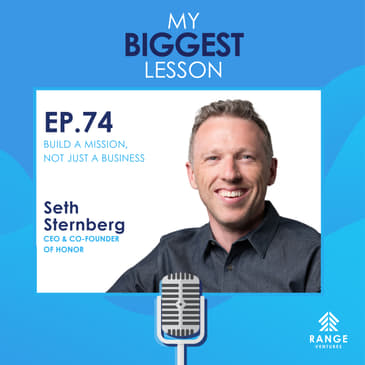
This week Adam speaks with Seth Sternberg, the co-founder and CEO of Honor, the largest in-home senior care network in the United States. Seth has become an influential figure in the Colorado startup scene since moving to Boulder. Before Honor, Seth co-founded Meebo, an instant messaging platform which was acquired by Google. On this episode, Seth shares his experiences on the differences in the entrepreneurial ecosystem between Colorado and Silicon Valley- plus his lessons learned on how building a company around a core mission helps sustain motivation and attract top talent.
Listen now on: Amazon Music (Alexa) | Spotify | Apple Podcasts or wherever you get podcasts!
Connect with hosts Adam and Chris and the Range VC team on LinkedIn
https://www.linkedin.com/company/range-ventures/
Check out more about what we're up to at Range.vc
See Privacy Policy at https://art19.com/privacy and California Privacy Notice at https://art19.com/privacy#do-not-sell-my-info.
[00:00:01] Hello and welcome to My Biggest Lesson, the show that brings you the key learnings from the most influential founders, executives, and investors in the Colorado tech community. My name is Adam Burrows. And I'm Chris Erickson. Together we are the co-founders of Range Ventures, an early stage venture firm based in Denver. You can find out more about what we're up to at range.vc. This week our guest is Seth Sternberg.
[00:00:27] Seth is the co-founder and CEO of Honor, the country's largest in-home senior care network, serving more than 60 million hours annually under the Honor and Home Instead brands. Prior to Honor, Seth was the co-founder and CEO of Miibo, which brought instant messaging to the web and reached close to half the internet population in the U.S. That company was acquired by Google, where Seth worked for many years on the Google Identity platform and then within Google X. Most notably though with Seth is he moved to Boulder a few years ago and has already become
[00:00:56] an instrumental and involved part of the startup community. Seth, thanks so much for joining us today. Yeah, Adam, it's great to be here. Well, let's just start by you introducing yourself to the audience. I'd love to hear a little bit about you and the company that you run, Honor. Yeah. So my name is Seth Sternberg and I'm co-founder and CEO of Honor. Started Honor 10 years ago. The goal was to change the way society cares for all their adults.
[00:01:22] So we recognized that our industry, the tech industry, hasn't done much around how do we help people as they age. Turns out that society in general has not done a very good job figuring out how to help people as they age. And where we started was what's called home care. So helping people stay in their homes as they age and helping them live comfortably in their homes and not have to move into a facility if they don't want to. We're now the largest in-home senior care network we think in the world, but definitely in the Western hemisphere.
[00:01:49] We'll visit about 20,000 homes today in the United States alone, spend about six hours per visit on each of those visits in those homes. And I'm looking forward to it's 10 years in, but there's so much more to do around how do we really kind of bend the curve for society here. So really interesting area and interesting business. I know you've gone through a number of twists and turns, making a big acquisition along the way, for example. Love to hear a little bit about that and how things have changed from what maybe your original vision was.
[00:02:19] I actually have a rule, which is basically I care about the outcomes. The how is just are we being ethical and are we maintaining quality? And as long as we're being ethical and maintaining quality, I don't care about the how. I care about achieving victory, which in this case is changed the way society cares for older adults. And so when we first launched, we just knew, hey, this market never scaled. It's still just mom and pop. It creates horrible employment experiences for the care professionals, horrible care for older adults. Why? Why?
[00:02:48] So we just launched a local agency in SF Bay Area and said, like, let's see why these things never scale. At about 10 million in revenue. I thought, oh, my God, like this is not a tech tractable problem. I can see all the reasons it doesn't scale and it's impossible. But fortunately, we had just enough data flowing through the system. This is now 2016 where we could start applying real machine learning to the problem. And then that helped us kind of decode why are the humans behaving the way they are.
[00:03:17] That then we took that system that we built for ourselves, this kind of AI based system around delivering care to actually be able to scale and start handing it to third party agencies and letting them run themselves on our system, basically. And then I said, look, I want our own brand. I don't want to just do this for third parties. And I also need a really large network if I'm going to have impact quickly. And so then I went and I bought the largest franchise network in the world back almost four years ago now. So, you know, to us, it's been the same thing all along.
[00:03:47] It's how do we change the way society cares for older adults? And I'm just always looking for more and more impact and the ability to move as fast as possible. And it turned out the best way to do that was one part build an AI system really early, like before most people were thinking about AI that allowed you to actually scale care and then to pick up a consistent brand and a consistent high quality network by doing acquisition. Great. Great. Thanks. Thanks. That's an incredible set of experiences.
[00:04:15] And obviously, like every entrepreneur, you've got to go pivot and attack the opportunities to accomplish your original mission. So pretty cool that you've stayed true to that despite zigging and zagging along the way. Yeah. Well, I think zigging and zagging is pretty much part of the course if you're an entrepreneur. But, you know, having that vision and having that mission that you really want to execute to, if that changes a lot, it's just it's fundamentally a different company then, right? Which is totally fine. Like you should do that. You know, the guys, one of the two co-founders of Instagram worked at my previous company,
[00:04:45] which we had sold to Google. His name is Mikey Krieger. And when he left to go found what became Instagram, it was originally a completely different idea. It was it was kind of four square for the web. And then he and Kevin pivoted into this thing called Instagram. And then that one worked. Right. So different company. You know, I always just as an aside, I always find it interesting talking to other investors if they you're taking taking taking a lot of credit for a company that they backed in
[00:05:13] one iteration completely pivoted and ended up being successful. And to which I ask the question of, is that a good investment or was it lucky? Right. Which will never be. And certainly at range, if we make an investment like that, it's a good investment. Hey, it's quite a good investment for range. Yeah. So many, you know, I mean, Slack was the same deal, right? Stuart was working on a gaming company. It became Slack. And at the early stage, I think you're just really investing in the team. Right. And and in very to a very large degree, the way I think about it is, you know, when you
[00:05:42] do a startup, you're going to hit a hundred walls. And the question is, are you investing in a team that can smack a brick wall, get up and keep going and then smack the next one and be like, you know what? This one I'm going to have to like fly over. And then the next one you smack, you're going to have to tunnel under whatever it is. But you need teams that keep the energy to be able to keep getting back up after you smack that wall. And if you've got one of those teams, they will ultimately be successful. Right. But but you just got to have that kind of energy.
[00:06:12] One of one of the founders of our portfolio, one of my favorite founders in Colorado is a guy named Kyle Bertine from Two Boxes. And we asked him what his what his superpower was. He said the ability to take pain. Right. And he is somebody he's pivoted, I think, three times now into a very successful iteration. So your point is, well, take it. Yeah, no, I mean, a bunch of my friends more. We're all cyclists. And, you know, this is a bunch of my both Colorado friends and California friends. And most of these people are entrepreneurs or VCs who were entrepreneurs.
[00:06:40] And there is this thread of, you know, if you know cycling well, you take pain when you bike. It's kind of like how far into the pain can you go before you give up? So, yeah, I think that's a common thread. Well, one thing I know that that did change a lot, too, during the journey of honor is you moved from California to Colorado. I'd love to hear a little bit about that decision and how that's been for you. Yeah. So it was one part, you know, honor is is like what I would think of as a real world company.
[00:07:08] Like we're trying to solve a real problem for society. And I'm in a weird way, like a real world person. Like I like going to cities around the world and not just like the high flying like Londons and Parises. But I like, you know, I like getting into like Leon, Mexico. Right. And and frankly, Silicon Valley is a bubble, right? It's like really, really a bubble. And I saw coming to Colorado as it's more kind of real to be blunt.
[00:07:38] It's like more of a reflection of how the majority of people live their lives. And I thought that was both, you know, kind of refreshing for me. Frankly, I've been in the Valley for 20 years, but I also wanted that for my kids. I wanted my kids to experience like, look, this is what life is like with actually having cold weather, actually having to shovel snow, actually, you know, having friends that are not only in the tech industry, you know, where the parents are only in the tech industry, which tends to happen in Silicon Valley.
[00:08:06] So, you know, I saw it as one part get into the real world. And then there's another part where Colorado has a lot of really good traits as a place to grow a business like geography is great. If you go to New York and California a lot, both of them are really close. It has talent here. It's an attractive place for people to move to. You know, it's a beautiful place, obviously, and so that really helps in the moving. The cost of operating here is not a lot lower than California, but lower than California.
[00:08:35] So I also saw it as a potentially really, really great place for businesses to be able to build infrastructure successfully and more efficiently than California. I think that that's generally proven out to be true, albeit what's happening right now in the Colorado legislature around the AI regulation that they passed, unfortunately, is like a big it's not even like a yellow flag is a big red flag. And we need to make sure that we help the legislature understand that the impact of what they have
[00:09:04] done literally will kill jobs in Colorado, which is like not even in tech industry, just full stop companies, both in the state and out of the state will avoid hiring people in the state of Colorado if this legislation actually becomes active. So I really hope we're, you know, a bunch of us are working with the legislature and legislators to help them understand that that's really, really critical. And hopefully by the time this podcast is released, there'll be some positive developments on that front. I really hope so. I hope that this whole segment's irrelevant by a townless fee. Yeah.
[00:09:32] And so I love your point around Denver and being, you know, one example of more real world than Silicon Valley. One of my favorite anecdotes when I was working at HomeAdvisor was I went to a conference, tech conference in Silicon Valley one week. My boss or CEO went to Disneyland or Disney World with his family. We both came back and he says, yeah, I'm sure you learned a bunch at the tech conference, but I promise you, I learned a lot more about our customers this week than you did. Yeah, no, I'm Disney World. I actually, you know, the finding is I was there was my last trip right before COVID because
[00:10:02] actually it was already COVID. I was there in January 2020. We did a family trip there, still in number. And when I visited, I was like, wow, you know, because I was coming from Silicon Valley, I was like, this is much more real world. Valley. No doubt about it. And particularly being in, you know, I was in a real world industry as well that was local oriented, just like you are. And we often saw a lot of crazy ideas come out of Silicon Valley and being very disconnected in how 95% of the country operates.
[00:10:32] Yeah. I mean, I think that, you know, you've got to ask yourself what motivates you and what kind of company do you want to build? For me, it really is how do you solve pains for society, right? Like things that masses of people are experiencing that, you know, where, you know, using technology in some way, you could potentially make their lives better at scale. And actually, interestingly, when we started on or we actually started from the workforce. So we actually started from the care professionals.
[00:10:59] And how could we make service labor's life better? And then we narrowed it out oddly into senior care because that was a real application of how do we make service life better? I know we can make the lives of seniors better. And then we, you know, realized we had this, you know, huge, you know, kind of portrait that we could paint around. How do we help older adults will stop? But, you know, real world problems are really motivating, right?
[00:11:25] And you can see in people's faces day to day, you can go visit homes that you're serving where you can talk to the care pros. Like, you know, I, when I meet care pros, it's amazing, right? I just did it in the UK recently. I just did it in Omaha recently. It's amazing when you talk to real people who, who are like benefiting because of what you've built and they tell you how their lives are better. That's great. Well, Seth, since moving to Colorado, right, you've been able to draw on a lot of this experience and did really, you know, a great job.
[00:11:53] We really appreciate you getting involved in the local ecosystem. What's a company here that you're particularly excited about? Yeah. I mean, honestly, and I'm not saying this just because we're talking, it's actually range. Thank you. The real thing. First day. First day. First day. First day. Found that one. No, really? It's right. The reason is Colorado, you know, when I, as I have a very direct comparison between Silicon Valley, you know, I, I operated there for 20 years and, you know, when you were operating back in 05, you knew everybody, cause not, not many people were doing much. Right.
[00:12:22] And the thing that really is different between Silicon Valley and Colorado that's in Silicon Valley's favor is the ecosystem. There is just, right. Like all the things you need as an entrepreneur are there. And the reality is that that is not true in Colorado. It does not have the level of infrastructure and ecosystem that helps an entrepreneur truly be able to kind of bust through some of these early brick walls that are just like already kind of taken care of in Silicon Valley.
[00:12:50] And so, so in Colorado, we need infrastructure, right? We need an ecosystem. And part of that, that really matters is how do you not just raise funding in the ecosystem, but, but the people who deploy the funds are highly incented to help build the infrastructure, right? To help build the ecosystem because you've got multiple companies in your portfolio.
[00:13:15] And if there are not enough real estate agents who understand how to work with a company that's going to go bankrupt before their lease expires, except if they raise their next round, no one can get office space, right? But you guys have to solve that for your portfolio companies. So, you know, I, I get oddly more excited about the things that build the ecosystem and it tends to be that a fund is highly incented to do that. And so I'm actually really excited about range.
[00:13:44] It's one of the reasons I became an LP in range, like immediately when I had the opportunity. Well, thank you, Seth. Really, really appreciate that. And we'll continue to work hard and help to be deservative of that, of that praise. And certainly want to give credit to the folks that came before, right? I mean, Foundry Group and Brad did a great job setting some of that foundation. And, you know, we just hope to carry on and build on to what they've, you know, they've set in place. I want to move on to kind of main topic here, which is your biggest lesson. You've, you know, had a ton of experience, both with honor and before seen a lot.
[00:14:12] Love to hear what's, what's the biggest lesson you've learned in your career? Yeah. I mean, I kind of cheat and do two. Sure. Sure. You know, cause I was thinking about what are the, you know, if you look at me, I've got more gray hair than like, you know, a lot of entrepreneurs at this point. And I think there are two that just like really will matter a lot. So the, the first one is you have to, as an entrepreneur, learn to love hanging out with
[00:14:41] people who are not like you. It is so important. So like the natural human instinct is to hang out with people who are like you, like you walk into that cafeteria at a high school and the jocks are sitting with the jocks and, you know, the kids who are into like science are sitting over there. There it's just like it, and it's just, it's so in your face. I mean, even, and I swear to go, go look at this. The tall kids are hanging out with the tall kids and the short kids are hanging out with the short kids.
[00:15:10] It's that bad because it's ingrained in the human kind of psyche. But the thing is, is if you want to solve a big world problem, you want to build any kind of company. You need people with skill sets and perspectives. They're not your own. Right. Like, you know, I all the time have these founding teams come to me and they're like, hey, we want to, you know, found this new company. And like, well, what is it? And I said, well, you know, it's this new consumer thing. I said, great. But the three of you are all MBAs. Who's going to build the product?
[00:15:40] And they look at each other and they say, oh, well, we'll get, you know, undergrad new. And I'm like, well, your company is dead. Right. Because you don't have, you know, equal share of voice in the co-funding team with someone who can actually build that product and who is actually going to, you know, really bring that perspective. So if you want to build something big, if you want to innovate, you've got to have partners who complement you as opposed to are just, you know, kind of replicants of you. So hang out with people and love learning from people who are not like you.
[00:16:10] So that's kind of lesson number one. Lesson number two, I think equally as important is only build a mission first company. Like so important. So my first company, Mebo, like we launched it and, you know, we were 24, 25 at the time and it got really big, really fast. It was web instant messaging, basically about any kid in any school and turned out a lot of soldiers in Iraq, let them log on to instant messaging from a web browser.
[00:16:38] That turned out to be a big deal back in like the day when web browsers were just static. But, you know, when by the time we hit like year five, I didn't care anymore. Right. Like I just didn't care about the mission because we weren't really changing the world. We weren't like what I care about. My mission really is to make the world a better place for people who are less fortunate than I am. And so I just stopped caring. And as we were hitting those brick walls, it was harder and harder to get back up and keep on going. Right.
[00:17:08] But if you do a mission first company, there are basically two just massive advantages that you get that are just like almost like the winning formula to succeed as an entrepreneur. The first is if you really, really care about the mission, you will have the energy to get back up and keep going. Right. You'll get knocked down, you'll hit the brick wall, you will get back up and keep going because you actually care about solving that societal problem. So that is advantage number one.
[00:17:36] And that is, you know, it's what we talked about earlier in this in our little chat here. That's like what I look for in entrepreneurs. And if they're working on an idea that they're actually passionate about, it adds to that energy as opposed to subtracting from it. So the second like mega benefit you get is you can surround yourself with better people much earlier than you have the right to do. So, you know, if you go back to what I said before, you can't build an amazing company unless
[00:18:06] you find people who are not like you. And that means you are acknowledging that you are honestly like the expert in nothing. There are always people who are better than you are at something right no matter what you're doing. And the question is, can you find them? Can you get them to work on your project, your mission that you care about? And if you are a mission driven company, if your mission first way more really amazing
[00:18:31] people who should not join a company at your stage will get excited and say yes, because they get attracted to that mission. And then that will help propel a thing that maybe should have died in the first place. But like the energy was there because you kept busting through those brick walls and that unbelievable team of a whole bunch of people who are not like you joined it. Right. Because they were so passionate about that mission. These are both incredible lessons.
[00:18:57] I mean, generally the things that we think about and talk about all the time as well said, particularly the first one. I mean, you hear a lot of people say, hey, you've got to be as a founder willing to go out and spend time with your customers. Don't just spend time with other founders. But I think the nuance you put on it is specifically around your team and making sure your team is actually diverse is one that I haven't really heard articulated that often. So I think that's great. How do you think about that when you set up Honor? Yeah. So the way I approach this is actually really simple.
[00:19:26] I literally look for people who have completely divergent but relevant skill sets and perspectives from my own. So, you know, a great example would be the one of the very first people we hired was this woman named Phaedra Ellis Lampkins, who is now on our board. And she at the time, she was actually working for Prince, the singer, and she was the person who had negotiated for him to get his rights back from Warner.
[00:19:54] And she was running his media empire for him based on those rights that she negotiated for him. Before that, she was literally the kind of the union person in SEIU who had called Obama versus Edwards. Right. And so she was kind of in the unions and politics, and she was actually the youngest CEO of an AFL CIO. So she both had a kind of union labor background that then became a entertainment and actually labor because entertainment is a lot of labor background.
[00:20:25] And when I was interviewing her, trust me, like she did not come from tech. But I was trying to start a labor company around how do we care for older adults? And she had a lot because, you know, SEIU often deals a lot and in the elder care home care space. So she had experience both in elder care home care and with labor. And I was like, I know I need someone who understands labor super well. And there was a point in the interview where, you know, I asked her some question. I don't remember what it was.
[00:20:52] And Phaedra just like laughed for like a minute based on my question. And then the first words out of her mouth were, you are so ivory tower. And I hired her, right? Because she was so mission aligned and she is so smart about areas that I just had no clue about. And I swear, I don't want to die if I didn't hire Phaedra. Right. She was amazing. And years later, after, you know, she was here for years and then she started her own
[00:21:20] company, which is now super successful called Promise. And then at some point she helped us out again. And I asked her to join our board. Like, I literally just look like I know what I'm not good at. So when you're an early stage entrepreneur, there's so much you have to do and you just have no clue because your expertise are X and like you have to do ABCDFG. And you're just hiring people and finding people who are better than you are at things that you're just not naturally great at. And that's your job.
[00:21:47] Like, find that team, build that team and empower them to go work on your mission. Even in later stages, though, and I actually think that this is something that truly separates the kind of founder CEOs who continue on into the later stages versus the ones who kind of ultimately have to exit. You know, I bet my things that I'm traditionally like, quote, unquote, good at. Right. Like, you know, I'm good at going out and maybe talking to customers or selling people on a vision.
[00:22:14] But for every single thing I'm good at, I guarantee you there's someone out there who's actually better. And I am constantly kind of thinking about, OK, what's the part of my job I'm still doing where I'm it's the part that I'm still doing it. But it's like the least I'm the least good at it or the least passionate at it. And and I'm going to go find a person to replace me on that, too. Right. So that's the way I think about it. Look for people who fill in things and have knowledge and experiences that you don't have.
[00:22:42] And what's amazing about that is you end up with what people kind of tend to think of as a diverse team. You know, you you look at that team you end up with and it looks really diverse kind of in a picture. But but my goal is really diverse in people's brains. And if you truly search for that kind of diversity, then you just get people from different backgrounds who grew up in different places and went to school in different places and had different family structures.
[00:23:06] And you just get all that because you're truly looking for the best human to fill a need that you have in the company. And I think your point around that, Seth, combined with the mission, I mean, I love that these two lessons are intertwined because the you know, the mission driven aspect of the company is what's going to attract people from diverse backgrounds and experiences that share that and had that commonality of the shared mission. Yeah, no, these are like, you know, that's the reason I kind of cheated and gave you two, because the reality is the two are actually one. Right.
[00:23:36] The reality is if you are just I said at the very beginning of this podcast, for me, it's about the outcome. It's it's and the outcome to me is fulfill on the mission. The mission changed the way society cares for older adults. How you go about that. Remember, I said meet quality, meet ethics. Well, it turns out like the number one way you do it is you get the best people possible who are usually going to be not like you.
[00:24:04] You can both attract them and you need them because you're doing something that's so big. And in the other just neat thing about, you know, say this too, because I missed it before, but mission driven companies, they almost always just have infinite running. So like when we were trying to figure out what we wanted to work on, we said, look, we want to work on a company that's going to be a legacy company. And what we meant by that is a company that could outlive us like that had the right to
[00:24:31] outlive us because it was trying to solve such a big problem that it would continue on past my useful life. And the way I think about what is that company is it's something where like a simple phrase catches in people's minds about what it's trying to accomplish, like Uber tries to get your ride somewhere. Google's how you look for stuff honors, how you care for your parents. Right. It's just that simple. And those all of those are end up being mission companies. Right. Because it's a mission company is usually like a very simple.
[00:25:00] I want to change the world in this simple and important way. Turns out it's really hard and complicated to do. You need an amazing, diverse team to get it done. But then, boom, you've done something really meaningful with your life. Seth, I totally agree. And I've been fortunate myself to see companies like that up close. And you're 100% right. This is how it works. And it's a massive advantage if you're a founder and you can do it. So thanks so much for coming on. Great lessons. Where can folks get in touch with you? Yeah.
[00:25:28] I mean, you can find me on, I guess now X, I think of it as Twitter, SethJS. You can get me on LinkedIn, SethJS. So, you know, you need to get me in either place. Cool. Thanks so much, Seth. Appreciate your time.
[00:26:02] The RODECaster Pro 2 is the world's most powerful all-in-one audio solution for all types of creators, including podcasters. Graffiti and Julius use one at the plug. It offers studio quality audio and revolutionary features for creators. While being incredibly easy to use, RODECaster Pro 2, all-in-one production solution for podcasting. It's on sales for $690 right now. And there's a link in this episode description. Check it out.