
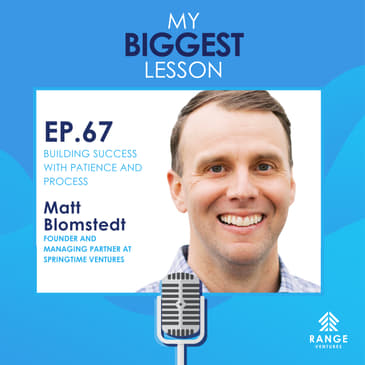
This week Adam speaks with Matt Blomstedt, Founder and Managing Partner of SpringTime Ventures, a venture capital fund focusing on early-stage tech startups in Denver, Colorado and Atlanta, Georgia. With a background in the energy sector, Matt transitioned into venture capital after moving to Boulder, Colorado. He founded SpringTime with Rick Patch in 2016 and has invested in 50+ early stage technology companies since inception. In this episode, Matt shares how fortunate encounters led him to the world of venture capital. He emphasizes the importance of storytelling for founders and his biggest lesson involving the delicate balance between patience and urgency when investing or running a business.
Listen now on: Amazon Music (Alexa) | Spotify | Apple Podcasts or wherever you get podcasts!
Connect with hosts Adam Burrows and Chris Erickson and the Range VC team on LinkedIn
https://www.linkedin.com/company/range-ventures/
Check out more about what we're up to at Range.vc
See Privacy Policy at https://art19.com/privacy and California Privacy Notice at https://art19.com/privacy#do-not-sell-my-info.
[00:00:00] Hello and welcome to My Biggest Lesson, the show that brings you the key learnings from the most influential founders, executives, and investors in the Colorado Tech community. My name is Adam Burroughs, and I'm Chris Erickson.
[00:00:14] Together we are the co-founders of Range Ventures, an early stage venture firm based in Denver. You can find out more about what we're up to at range.vc. Our guest this week is Matt Blomstedt. Matt is the founder and managing director at Springtime Ventures, another early stage
[00:00:32] fund based here in Denver. Even though they're only on their second fund, Matt and Springtime have already backed some incredible companies including the Denver-based unicorn Sondermind and Vejo just to name a few. Matt, thanks so much for joining us. Adam, thank you so much for having me.
[00:00:52] Love to start out by just hearing about your journey into VC. How did you come to start Springtime? It's a great question, Adam. And it's quite a random story. I was actually in the energy business, I guess mostly in Houston, Texas after I graduated college for almost 10 years.
[00:01:09] During that time I also spent two years in Oklahoma City but I ended up moving up to Boulder back in, I guess it was late 2015, early 2016 just for a lifestyle change. You spend your time in Houston, it's hot, it's flat.
[00:01:23] All there is to do really is eat and drink and I want to get back in shape and live near the mountains. And so I made that move. During that time, after that move I was climbing mountains, running a lot and eventually was
[00:01:36] sitting in a restaurant called The Med which is not closed, I guess closed during COVID. But I was sandwiched between two entrepreneurs, one man and woman, into each other and who were raising capital for their early stage tech ventures.
[00:01:47] And I always called them, they became my first two new friends in Boulder and they were in the tech scene and therefore via those two people I got immersed in the tech startup scene. Met a ton of founders, entrepreneurs, met David Cohn and Techstars, Brad Feld at Founder
[00:02:01] Group and at the time, this is just a little bit before when Range got started but at the time there wasn't a lot of funds in Colorado like there are today. There wasn't range ventures and Natty with Matchstick although Natty was there with Techstars.
[00:02:14] Stout Street Capital, First Mile, Hannah Gray and now us. So one thing led to another and over the next few months there in early 2016 I was really lucky to meet two of my partners really early on Rick Patch and Rich Maloy.
[00:02:27] I thought to myself man, there seems to be a lot of smart people here in Colorado and a lot of opportunity and they're having to go to the coast or Austin, Chicago to get funded and the thought that I had was connecting private equity investors,
[00:02:40] bankers, lawyers, people I'd done deals with in the energy business to early stage tech investing via a small fund and it was really just kind of lucky that all the stars aligned and the people aligned at the right time to make this
[00:02:50] a reality and so we raised that first fund during 2017 and started investing in January of 2018 and that's kind of how we got going. So when you moved up here Matt, were you thinking I want to be in the tech
[00:03:02] business? Were you thinking I want to be in the investing business? Like how predispositioned were you to what you're going to be doing when you first met those two folks in Boulder? Yeah, that's a really good question because I was not necessarily looking
[00:03:14] to leave the industry I was in energy. In fact, that's why I chose Boulder because it was close to Denver and I could very easily hop back into the private equity back management team there
[00:03:24] in Denver and the energy space that I needed to and I would have had to have done that eventually just because I was going to run out of money at some point so I had to figure out something to do.
[00:03:34] But everyone thinks tech is cool or most people do, I do. And I had read a lot about it. I actually was very familiar with Brad Feld because of his blog and I'd read that over the years now. Did I really know anything?
[00:03:48] I still said, I don't know how much I know even today. But back then I certainly really didn't know anything. I just what I would say is that those first few months I was meeting everybody. I had so much fun.
[00:04:01] The passion entrepreneurs have, you know, when they're building something and telling you about it, it's contagious. And also, you know, having come from one industry, I've read about plenty of industries in Bloomberg and on TV and, you know, watch different things.
[00:04:15] But it really was fun to learn and still is fun to learn every day about different problems within different industries, you know, across the world, across the country. What surprised you about VC maybe actually having now done it for seven plus years versus your idea going in?
[00:04:30] Yeah, well, there's a there's a couple of things. The first thing, you know, the first thing that came to mind, which I may have not thought of was so I came from a world in private equity where, you know, we were very acquisitive.
[00:04:42] The last company I was at, we were very acquisitive and we'd spent hundreds of millions or maybe even billion plus on acquisitions in certain cases. The amount of data or the depth of the data you have when you're looking at an acquisition, just the Excel model, you know,
[00:04:57] discount cash flow models alone. And then going to pre-seed or like early stage investing where it's all black magic, you know, you got a founder with an idea, you'd run in some numbers on market size and when they think
[00:05:09] they might be able to actually bring in revenue and the timing of that, it's you're going for having a ton of data to make a decision. It's almost nothing. And now that was one of the first things that kind of hit me in
[00:05:21] the face. The other thing is just the speed, right? Like if you want to be a good investor early on, you have to be able to come up with processes and be able to make decisions in kind of a quick manner, right?
[00:05:34] Like you have to make quick decisions because things get competitive and you only have so much data to begin with. So it shouldn't take you months and months to make a decision on an investment at this stage. But those two things, just because of the early nature that
[00:05:49] drives those two things, I think are the first two that come to mind. One of the things I've told you this I really admire about you is just your knack for kind of interesting for just assessing a good founder.
[00:06:01] Really knowing who that founder is that really can go all the way and build something great. How did you establish that? You're not coming from the tech world, not seeing a lot of great entrepreneurs to pattern match to. Where do you think that came from?
[00:06:12] You know, it's a good question. I wonder myself sometimes. I like to give credit to mentors, people that I've been able to work with. Is it this also includes people like you had a mother investors that we'd co-invested with, people on my
[00:06:25] own team like Rick and John and Jeff Gardner? Because I can tell you people have decided that if I didn't have them early on, if Richard had to have them, we would have done a lot of what I would call bad deals.
[00:06:37] But as far as the people go, we try our best even today to put pen to paper on this and say what are the exact traits in because there's a lot of them. Obviously the typical ones like grit and perseverance,
[00:06:50] but they've also got to have a certain level of intelligence and I'll credit you like high IQ. Like they've got to have that. And that's a term you and I've talked about a lot recently. And but there's a couple of examples I want to
[00:07:01] give you some of the best founders that we've seen and they have this ability to story tell. They can story till this like 30 to 40,000 foot level and tell you exactly what they want to build over the next one, two, five, 10 years.
[00:07:15] And then they can also jump down into the weeds exactly how they're going to do that because there's so much to ask to go on. It's like, oh yeah, we're going to build the next big, big company in the ad space or the logistics industry.
[00:07:28] But in order to do that, a lot has to go right and a lot will go wrong. And for them to be able to speak very coherently, both through the challenges that they're probably going to face, you they've already identified these challenges.
[00:07:40] They know they've done so much work on this market and this problem that they're going after that they've thought through everything. That's that's the one thing I can pinpoint is like, you get a pitch deck. You know, we're looking through 10 12 slide pitch deck.
[00:07:54] But then these founders, they have 120 plus page pitch deck that they have answers to all these questions that, you know, they just come in prepared at a level that we haven't seen before. So we're still trying to figure the exact thing out.
[00:08:08] So like, when we see one, we know it right away because it's so hard to identify. But I do feel like going back to my previous role, like I've had to talk to people for a long time in my career. Like that's basically what I've done.
[00:08:20] And so I've had to assess them, both their capabilities and their genuineness and all these other things, their integrity. And I'm not always right, but I do hope that with each person I meet that I get a little bit better each time. What's something that is interesting when
[00:08:36] you talk about the founder who's a great storyteller, right? Is that the thing that you guys think you look for uniquely? That's maybe a little contrarian or a little different than other other firms or anything else you look for? Yeah, I think it's I think it's like just
[00:08:49] one it's one thing that but it is a very important thing. And it's like us when we're raising a fund, we have to be able to tell our story, the range story and the springtime story. So for them, that's like what they're doing when they pitch us there.
[00:09:00] They're pitching to investors, but they also have to story tell to their customers. And this is where where I struggle, we struggle if a founder can't tell their story to us, then how are they going to tell it to their customers? Right? That's a really big problem.
[00:09:16] And so it's I think that it is a very especially early on in a company you know, has stories money, not just at the C-Stage, but can they raise the next round when they're supposed to be raising in series A. Can they sell to their customers, whether it's
[00:09:30] SMBs or an enterprise sale, this person has to be able to connect with that buyer on the other side. And they have to do it well. And so it is I think one of the most critical things that at least we look
[00:09:43] for when we're looking at a founder that said you can be too salesy, right? Like there's founders that are just too good at sales, but have everything else maybe a weakness for them. And then that's a problem. And so one of the things they also
[00:09:58] have to story tell with it that we this is something we reference check and back channels like they have to be able to story tell to potential employees as well in order to acquire talent. And that is huge, right? So raising money, that's important. Acquiring talent.
[00:10:10] All these things are so important in creating a big business when your adventure. And so it is it's up there. I don't know if I would put it number one, but it's it's certainly high on the list of capabilities that I think top
[00:10:23] founders have to have because we've seen some pretty interesting businesses fail to be able to raise money or fail to sell their customers when there's really no other explanation for it. The end that they are a poor storyteller. No, it's great. We always call it
[00:10:36] the you got to be the company's best salesperson. But I think storytellers even more. Yeah. More. It's really to everyone. Everyone. Yeah. Absolutely. Every single person they're talking to, even their family, you know, they're hey, Mom, Dad started a business like even their parents are probably skeptical
[00:10:52] of what they're doing in some cases. And so you've got to be able to sell and win people over, you know, all around you when you're when you're that early. Just as a side, isn't it amazing? Now I didn't get an MBA,
[00:11:03] but I tell you in law school and I could tell you an undergrad. And I think MBA actually programs. There really wasn't there was no class that taught you how to sell. No, it's crazy. It's crazy. I, you know, I didn't think about that till later on.
[00:11:18] We took these, you know, I got me to be at University of Texas and I remember marketing class. It was not one of my favorite classes, but a lot of stuff we did. It was like a simulation game. Like if we increase this ad, you know, marketing
[00:11:32] channel this much, what will happen to sales or if we decrease price and stuff like that. But how to actually talk to people? I mean, it's one of the reasons I think you it's and I'm bringing this up only because they just knocked on my door earlier today.
[00:11:44] We've had a couple of Mormon missionaries come by two times in the past week. And I always enjoy talking to him. And I think that's going door to door sales, whether you're, you know, you're pitching your religion or selling encyclopedias like they used to do
[00:11:59] back when we were kids. Like having that experience is huge because I don't know any place other than online sales like classes like where do you learn this other than doing it? It's kind of crazy. No, it's mind blowing, right? It's my most important skill. Yeah, most important.
[00:12:17] It's so it is. All right, man, I'm going to put you on the spot here for a second because I know you have a ton of founders locally that you think highly of you get a lot of local companies, your portfolio. But what's one Colorado company
[00:12:28] that you want to call it and highlight here today? Yeah, I'd like to I'd like to highlight Kiel K E L it's led by Stephen Thiesfeld. And this is a this is a very, very early opportunity. It's and he's going after a very,
[00:12:41] very tough problem in health care. It's burnout for doctors, nurses within the United States Health Service system. And we probably did more diligence or discovery on this problem than any other specific problem that we've ever we've ever looked at. And one of the things that we've
[00:12:57] determined is we actually don't think that software alone can solve this problem. And a big part of it is because it's in many cases, it's organically driven and it's rooted in all sorts of all sorts of things that can vary from organization to organization.
[00:13:11] And Steve is a second time founder of his previous company he's still on the board of is called Kara Loup and the serious stage. And he rolled out of there a few years ago. And there's a lot of learnings from that business that he's applying here.
[00:13:25] However, the reason I want to shout this out is because it's going to be very difficult. And what they do is it's a combination of software with communication tools, training and then there's custom content that they'll have built. And then there's an organizational assessment
[00:13:41] that you know on the front end, like I said, it's so important to identify what exactly is causing these people to leave their jobs at these hospital systems. And the other pieces is coaching and mentorship. It's kind of a three-pronged approach to the problem.
[00:13:55] And he's gone through a pilot and he's signed up another another pilot that they're getting going with. And the reason I highlight it is because we all love founders that are solving really large problems. And this is one of those. We have no idea how this
[00:14:09] is going to play out. Obviously, we hope it's a success. It's too early to tell, you know where the where the business is going. But I wanted to highlight these traits like Steven did so much work on this ahead of time and knows how
[00:14:21] challenging it's going to be. But he's he's going head on with it. He's raised a small amount of money. He's bootstrapped it. And we'll see where it goes. But those are the other types of traits aside for storytelling. He's going to have to be damn
[00:14:33] good at that, too. But that we like to see when we invest in somebody and that's solving one of these problems. I love love Steven. So pretty pretty cool one highlight. Thanks, Matt. I want to segue it to why we're here. So biggest lesson. Yeah.
[00:14:46] We talked a little bit about lessons and we got some bonus lessons. And what you look for in founders. But what's the biggest lesson that you've learned so far in your career with springtime? I want to highlight this the topic of patience. And specifically, I want to talk
[00:15:01] about patience within processes because it's so important. I'll admit it. Lee, I've had my daughter who's five now. I've gotten better. My patience has gotten better. But I still if you take me to an amusement park and I see a ride with a 10 minute
[00:15:16] long way versus one that's not there's zero weight. I'm going to go to one with no weight. I just don't have much of it. Aside from my daughter, I think Venture has taught me that you have to be patient in order to see any success.
[00:15:28] And that's just one thing like building anything of notice that's going to be special. It's going to take a really long time. You know, this isn't these scams online get rich quick like you really whether it's a business or a venture fund or a private equity fund
[00:15:44] or if you want to build it, it's going to take time. And well, what goes into that? You're going to have a ton of people or maybe maybe in a partnership like this is just a few of us. It range a few of us at spring time.
[00:15:56] But you've got to be patient with people. You've got to be patient with your processes and a couple examples I think that I'd highlight specifically that we've seen with portfolio companies for instances is hiring. Right. You raise a lot of money and maybe it could be the first
[00:16:11] round. I mean, it's all relative. Right. You could raise one two three million dollars seed ready could raise 10 15 million dollar series around and you got this money kind of burning a hole in your pocket. You've got so many people you want to hire, but you don't
[00:16:25] want to make bad hires. And so you have to balance this this sense of urgency that you know you're facing is a as a founder CEO and as a business with also getting it right. You don't want to take two years to hire your VP or
[00:16:42] Avenue, but you don't want to hire that person within a week either after you open up the job online. So it's finding this balance within all of your processes, whether for us it's managing your deal flow and making decisions on new investments, whether it's a follow on
[00:16:58] investment decision, whether it's raising money, which is really hard. I mean, you could you could speak to that a lot right now and the patients that took you out of that patients. I think that it's very, very hard to be successful both in venture and just in
[00:17:11] business and in general. How do you as a great point Matt, how do you though? Strike the right balance that you kind of alluded to between being patient and with a lot of you and zoom out, but being hyper urgent and aggressive on the day to day. Right.
[00:17:27] Yeah. How do you look like what do you look for in founders, for example, and making sure they can strike that right? Yeah, it's a it's a that's a great question. And I'll tell you that I intuitively like you get better at this over time as
[00:17:39] you as you see more and more. However, for me, I would recommend to people in what I try to do is is I lean on the people close to you, whether it's teammates or your partners or your family, whoever that is, you know, make
[00:17:53] sure talk to them and explain the situation for you to them if you're if you feel like you're struggling to find that right balance because it can take time to dial in. I'll use our. I'm going to use our decision making process for a new
[00:18:08] investment going back to like when we first started the fund versus today is an example here. And I just remember the hell that we put founders through that first year or so that we were in business. One founder would meet me, you know, in Boulder one day,
[00:18:23] he would meet Rick Patchin like Union Station one day, meet Rich Malloy and Golden. I mean, I'm making this up a little bit, but the story is real. And then we would all circle up and we'd all met this person individually, but not together.
[00:18:36] And then we'd want to have a meeting. It was horrible. And we got feedback that it was horrible when we knew we had to fix it. And so it was an iterative process that we use just to get it to where it is today,
[00:18:46] where it's there are some one off beings, but really like there's a set 30 minute intro meeting another hour after that another hour plus after that with the full team and operating partners. And the whole thing takes two to three weeks max to get to decision. We've made decisions
[00:19:00] within five to seven days. That's rare. It's hard to do that. But having a team or somebody or people you trust in order to help dial that in considering all the variables and play, right? Like so we know we can't take months to make a decision
[00:19:16] here because we'll never want a good deal. Any competitive deals going to get away from us. At the same time, we still have a fiduciary responsibility to our investors to do the amount of work that we need to do to feel comfortable to make this investment.
[00:19:28] And you kind of box that in and just tighter it gets tighter it gets tighter. And we work together until until it's in. And once that process is set, everyone trusts it until you see a problem with it and we need to address it. And we talk about
[00:19:41] it again and then we just keep working through it as a team. I definitely can't give credit to just my own self and getting better with patients within these processes. It's really relying on people around me too. At one of the particular decision points, I think that
[00:19:56] is so hard on this patience question. And all of us have been wrestling with over the last couple years as venture and early stage tech startups have become a lot harder. And it's the fundraising environments a lot tighter. When does the company give
[00:20:09] up? Right. When does the company say this isn't going to work out time to return money or shut down or try to sell whatever they can do versus OK, let's let's cut again. Let's extend runway again. Let's try to raise a little bit of money again.
[00:20:23] I've talked to just last week talk to a founder who's wrestling with this exact question. Curious to get your take on that. Yeah. And we've seen this is a really tough question and it's way more way more tough a million times tougher on the
[00:20:35] founder than it is for us as an investor because that's their their soul, their baby. Right. And so, you know, we've we've seen a couple of examples. There have been one or two times where we had we had founders that what I would say is they
[00:20:49] saw their writing on the wall pretty early on and wanted to shut the business down gracefully. And so they came to us, you know, this is six plus months before they were going to be out of money and relayed their concern that they wouldn't be able to make
[00:21:02] a business out of it. In those cases, I think that the businesses like it was easier for the founders to see because there was always a question of whether that market was even there in those two cases. It was like, well, we're going
[00:21:16] to go compete to see if we have a better mousetrap than some pretty well funded established competitors in the space. They gave it their all. But when they they still had some money in the bank and they realized, well, this isn't going to work. They came to us.
[00:21:27] However, it becomes in my experience like it because much more challenging when you have a company that's actually making money and maybe they've had some hiccups and they just didn't get to that next. They didn't hit the metrics or milestones they needed to get
[00:21:41] to the next stage of funding. They that's really challenging because, you know, a lot of times the founders feel like they're almost there. They've got the learnings they need and they just need a little more money. Sometimes they're probably right. Sometimes they're wrong.
[00:21:56] And it's, you know, for us as investors, we try to give the best advice we can possibly give considering everything we've seen over the course of time with that investment. The patients there, I feel like we are have been as venture investors when we first
[00:22:11] invest. We know that the best investments are going to take seven, eight, nine, 10 years to see, you know, the types of returns we want to see in venture. It's going to take that long to build a special business. So we go in with a pretty,
[00:22:25] I'd say patient mindset on the long term. But in the in the instances where we just don't see the business going anywhere and it's been, you know, year or two years of flatter like mediocre growth and we just don't have the confidence that they're going to
[00:22:42] be able to hit the milestones that they need maybe ever or without spending way too much money. Like, well, they have to put $5 in to get $1 out type thing that, you know, you have to have some pretty challenging conversations at that point and sit down with
[00:22:57] the founders and relay. And here's here's our perspective of it because they can be so in the weeds and so, you know, almost blinded at a certain point, especially if they're getting really close to running out of money can be very difficult. And I feel for
[00:23:08] during that time. Yeah, it's one of those tough balances, Matt, when you're backing a founder too, we all want to back people. You talked about more of the qualities we all look for is grit, right? You want, who's gritty, you want to, today's just you want
[00:23:18] someone who's never going to give up. I want someone who's never going to give up, right? They're going to fight to the bitter end. But I also don't want someone who's, you know, really going to fight necessarily to the bitter end and not not acknowledge
[00:23:28] right on the wall. It's hard. I mean, because we've also where they don't and they like, you know, we find out after the fact this is a couple years ago, we find out after the fact that founders not hadn't paid the vendors or as employees a long
[00:23:40] time. And we're like, what? Like that's not that's not acceptable. It's not okay to do that. And I understand they get stressed and everything. But like, you know, it's we'll lose patience real fast with with actions like that. Yeah, yeah, yeah, absolutely. Well, I think it comes down
[00:23:55] to also, you know, as I think about it, it's how much patience we have as investors or advisors in a company. How to do a lot with what the founders shown us to date, right? If it's a founder who yes, if it's a founder who seems
[00:24:08] like they are really always making progress and really doing great stuff for solving challenging problems overcoming them. Sure, you get them the grace of time and keep trying keep trying. Exactly. Exactly. The founders who don't have that sense of urgency, don't do things, you know,
[00:24:23] potentially ethically the right way. Yeah, throw in the top quickly. Yep. 100% out of you said it very well. It's another great great point, man. Well, thanks, Matt. Really appreciate awesome awesome lessons and really appreciate the insights working. Listeners, follow along with what you and springtime are up to.
[00:24:41] You can follow our website obviously www.springtimementures.com. We post our any any careers that are open with our portfolio companies. I think you can also book office hours with one of us on there still. And if you want to reach me
[00:24:55] directly, it's Matt B M A T T B at springtimementures.com. I replied almost all emails. I do not advise using my legs in. I'm pretty poor at responding there, but you can email me directly anytime if you want to chat. You have any questions? Awesome.
[00:25:08] Thanks so much, Matt. Thanks for coming on.