
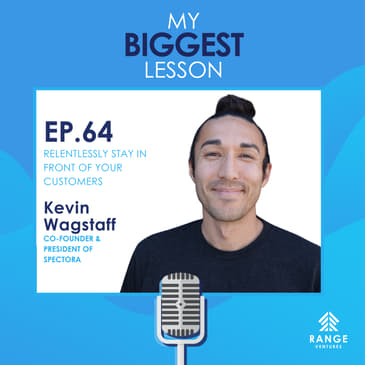
This week Adam speaks with Kevin Wagstaff, co-founder and President at Spectora, a top rated home inspection software. Kevin, alongside his brother, bootstrapped Spectora to an impressive 8,000 current customers on the platform! Previously he held positions at Charles Schwab, HomeAdvisor (where he met Adam), and in real estate. On this episode, Kevin shares his backstory on switching from finance to tech, the value of running a company with his brother, why Denver is an under the radar startup city, plus his lesson involving the importance of customer engagement to understand their needs.
Listen now on: Amazon Music (Alexa) | Spotify | Apple Podcasts or wherever you get podcasts!
Check out more about what we're up to at Range.vc
Connect with hosts Adam and Chris and the Range VC team on LinkedIn
https://www.linkedin.com/company/range-ventures/
See Privacy Policy at https://art19.com/privacy and California Privacy Notice at https://art19.com/privacy#do-not-sell-my-info.
[00:00:00] Hello and welcome to my biggest lesson, the show that brings you the key learnings for
[00:00:06] the most influential founders, executives, and investors in the Colorado Tech community.
[00:00:10] My name is Adam Burrows, and I'm Chris Erickson.
[00:00:14] Together we are the co-founders of Range Ventures.
[00:00:17] An early stage venture for a based in Denver.
[00:00:20] You can find out more about what we're up to at range.vc.
[00:00:26] Our guest this week is Kevin Wagstaff.
[00:00:28] Kevin is the co-founder and president of Spectora, the leading software for home inspectors.
[00:00:34] Kevin is brother Bootschrepp Spectora from nothing to over 8,000 current customers in
[00:00:39] the platform and a recent successful exit to private equity.
[00:00:42] Kevin has a fascinating background that merges tech, entrepreneurship, and real estate.
[00:00:56] Kevin, thanks so much for joining us.
[00:01:05] Of course, thanks for having me, man.
[00:01:07] I'm pumped.
[00:01:08] Yeah, would love to start out just hearing a little bit about your background, how you
[00:01:13] came to go found Spectora and what you're doing with it today?
[00:01:16] Yeah, absolutely.
[00:01:17] So I took a windy path like many.
[00:01:20] I was a finance major in college thought I wanted to be an investment banker, got into
[00:01:24] finance, found my way into tech at HomeAdvisor where we met.
[00:01:30] Which is really cool.
[00:01:31] And we were approached really with the idea of the home inspection software space because
[00:01:35] my brother, he's my co-founder as well, we knew we wanted to do something in SaaS but
[00:01:40] the idea found us because our friend's dad was a home inspector and he said his software
[00:01:45] was left in the past.
[00:01:47] There was no real dominant SaaS player into 2016 in vertical software for home inspectors.
[00:01:54] So for anyone that's bought a home knows it's very kind of forgotten about part of the
[00:01:58] home buying process.
[00:02:00] So he brought the idea to us and we looked at it and we said, huh, this is an approachable
[00:02:05] vertical niche that needs technology.
[00:02:09] No one's really focused on it because it was too small for the huge players to really
[00:02:12] dive into it.
[00:02:14] And so we thought it was a good approachable vertical to go into.
[00:02:19] What were people using it in time?
[00:02:20] What were the inspectors have any software at all?
[00:02:23] Believe it or not, some were still using pen and paper like literally writing on a yellow
[00:02:27] carbon copy handed to you when you're buying a home.
[00:02:31] Others were using a lot of downloadable software so the days of hey, here's a DVD download
[00:02:36] this onto your computer runs locally.
[00:02:40] And so that was a majority of the industry was still using downloadable pretty antiquated
[00:02:44] software that was maybe built 20 years ago, not a ton of updates since.
[00:02:48] Wow, it's incredible.
[00:02:50] But think back way back in 2016, right?
[00:02:53] Yeah, exactly.
[00:02:54] 2016, we thought SAS 8th the whole world by then.
[00:02:56] So we are like, really, what are we missing?
[00:02:58] We kept asking ourselves, what are we missing about this, like the slice?
[00:03:03] And we learned why it was hard and all that but that's some of our lessons.
[00:03:06] But in hindsight, an amazing opportunity to modernize an industry that's kind of marginalizing
[00:03:11] forgotten about.
[00:03:12] Yeah, absolutely.
[00:03:13] That's fantastic.
[00:03:14] And how did you really break it?
[00:03:16] I mean, you and I know from working at Home Advisor, it's incredibly hard to get all these
[00:03:20] little small businesses to do anything.
[00:03:23] How did you get so many home inspectors to change what they're doing and come to you,
[00:03:27] Spectora?
[00:03:28] Many things but to notably pick out a few.
[00:03:31] So I was also a Reelter for years while I was also working on the SEO team at Home
[00:03:36] Advisor.
[00:03:37] So I was learning firsthand what home inspectors were doing via being a Reelter.
[00:03:41] So I was side by side with a lot of home inspectors.
[00:03:43] I saw the end product that was lacking.
[00:03:47] So I had a number of contacts to reach out to, to say, hey, can you talk to me about your
[00:03:51] software?
[00:03:52] What are your pain points?
[00:03:54] And it was a very hands-on kind of approach, Mike and I took where I begged inspectors to
[00:04:00] get coffee with me.
[00:04:01] I bought them $5 star bucks on their way to an inspection just to sit down with me and
[00:04:05] show me what they were using.
[00:04:07] So I just sat there watching them click around, asked them what they didn't like about
[00:04:10] it.
[00:04:11] And it was just from day one, the deep product questions of solving pain points one by
[00:04:16] one.
[00:04:18] And sometimes it took months to get one guy to even try it because a lot of them are 50
[00:04:23] plus don't like change like most humans.
[00:04:26] So it took a relentless, like kind of we showed up, we committed to showing up every single
[00:04:31] day for two years to solve one guy's problem and hoping we would get 10 that would turn
[00:04:38] into 100, turning the 1000.
[00:04:40] So staying in front of them and just asking relentlessly, what could be done better?
[00:04:45] What are you solving for?
[00:04:47] Ken, what was the work with your brother?
[00:04:51] I mean, did you ever have any trepidation going into it?
[00:04:53] People say don't work with your family members.
[00:04:55] Don't work with your significant other.
[00:04:57] Don't work with your best friends, but it's worked for you.
[00:05:00] It has worked.
[00:05:01] Everyone says that and we've heard that hundreds of times and we have not had that experience.
[00:05:05] But I think we have enough complimentary skill sets to where our lanes were very known
[00:05:11] like our swim lanes going in.
[00:05:14] And we really got along.
[00:05:16] I mean, we've always gotten along for the most part.
[00:05:19] Yeah, we thought when we were young but I think not having that checking our egos at
[00:05:24] the door was something we talked about early of saying, like if there's a tiebreaker,
[00:05:28] we're going to look at the data, we're going to talk to customers.
[00:05:31] We don't think we know better than each other on any given matter unless it's informed
[00:05:35] by experience or data.
[00:05:36] And so we've had our time where you could tell, we dig in a little but at the end of
[00:05:39] the day, we were both just so focused on what the end goal was which was to build a good
[00:05:45] size company, have a good exit, a good outcome for ourselves and that anything that's not
[00:05:51] in service of that is our ego talking.
[00:05:53] And so it helps his background as in counseling psychology also.
[00:05:57] So he was a therapist for a few years.
[00:05:59] So there's that.
[00:06:00] So we talk about our feelings which is very healthy, especially sometimes it's male co-founders,
[00:06:06] investors whoever you are sometimes it comes out in other ways if you're not talking
[00:06:09] about it.
[00:06:10] So we have a good community dynamic like that.
[00:06:14] That's great.
[00:06:15] And one of the cool things about your story is you guys never raised money right?
[00:06:18] You bootstrap it all the way until recently when you raised growth equity around and
[00:06:22] recap the company.
[00:06:24] What was that like where you always in agreement you didn't want to do?
[00:06:27] Did you try to raise money?
[00:06:28] I'd love to hear about that thought process.
[00:06:30] Yeah, great, great perspective.
[00:06:32] Great question.
[00:06:33] So we read a lot about the venture world before we even started the company together.
[00:06:38] We were very I guess well read in terms of the paths to companies.
[00:06:41] We followed all the big companies that went through rounds and growth and understood
[00:06:45] that that was one path when we decided on vertical niche SaaS.
[00:06:48] We thought we could we liked it because we could start with $2,000 each to buy the domain
[00:06:53] name, start building an MVP and do it very lightweight.
[00:06:57] So I believe we liked the idea given the industry.
[00:07:01] Now if we were going after something with a huge tam, maybe we would have thought differently
[00:07:04] and said we got to raise money, we liked that we could get some traction just two guys
[00:07:08] in a basement, create content, cranking out code.
[00:07:12] So we knew that was the path initially.
[00:07:14] We didn't know how big the vision could get.
[00:07:18] We had a hunch that this could lead into home ownership and a bigger tam.
[00:07:23] But at that point we would have the recurring revenue from SaaS to fund it.
[00:07:27] And so we almost thought we could be our own investor for many years and we really
[00:07:31] liked being in control of our destiny in that way.
[00:07:33] But niche SaaS again allows you to get traction, reinvest your profits.
[00:07:38] But I mean we were raised by frugal parents, you know, military dad put water in the orange
[00:07:43] juice to make more of that kind of thing.
[00:07:44] And so we never spent money, we didn't have, we often didn't spend enough for growth
[00:07:50] early on.
[00:07:51] So I think that there's a flip side to it but we're glad, you know, we went seven years
[00:07:55] without taking a dollar because I think it is a value of cruise to use an owner.
[00:08:00] Now, it's really inspirational.
[00:08:01] I love when I hear that and obviously is we meet with so many founders there's a time
[00:08:05] and a place in a situation for venture capital, right?
[00:08:08] And then in most cases, it's not the right situation.
[00:08:11] I think what you and your brother did in being really upfront and honest with yourself
[00:08:16] is what are we looking to achieve, particularly in the face of tech media that glamorizes
[00:08:20] all the big phone raises, right?
[00:08:22] We did feel like we were missing something.
[00:08:24] There was a firm, oh, many years of you read headlines, you read companies like service
[00:08:28] tighten or something that are just growing like crazy and there was definite fomo of feeling
[00:08:33] like, man, are we taking like the slow and steady wins the race approach too much?
[00:08:37] Like should we have raised to accelerate growth?
[00:08:39] So there's always two sides to it, man.
[00:08:41] Absolutely.
[00:08:42] What's it been like building the company in Colorado?
[00:08:45] We love Colorado.
[00:08:46] We were mostly raised here.
[00:08:49] Just the environment and the Denver startup scene in particular has been really cool to see
[00:08:54] Denver startup week grow here, to see some flagship companies really grow here.
[00:08:59] The kind of people that Colorado attracts very work life balance, very nature involved
[00:09:05] in nature don't live to work.
[00:09:08] And I think that's good in some senses than other senses you want to create that urgency
[00:09:12] and you want to find those people that really want to carve out their path.
[00:09:15] And so just the active lifestyle, man, it just breeds good people, good workers.
[00:09:20] It's bringing in a lot of talent from across the country.
[00:09:22] We know post COVID.
[00:09:23] You and I have seen the boom here, but a lovely place to build and grow and would do it
[00:09:28] again because I think it's one of those under the radar startup cities.
[00:09:32] I think in some ways it doesn't, it still doesn't get talked about in the breath of
[00:09:35] an ostentomy.
[00:09:36] I mean, whereas it quietly has its place, I think.
[00:09:39] Absolutely.
[00:09:40] And I think it's because like you said, we're all, we're heads down doing our thing and
[00:09:45] not hosting Southwest, you know, so you know, they could build parties in Miami.
[00:09:52] We're just doing it and building great companies here.
[00:09:54] Kind of blue collar in a way here.
[00:09:56] Yeah.
[00:09:57] I got to follow up on one point you made though which is something that we do get asked
[00:10:00] about, hey, can you really build successful companies in Colorado when people just want
[00:10:04] to go take off on Friday and go skiing and your reference work life balance being important
[00:10:08] for finding, you know, it's important to find those people who are willing to kind of
[00:10:11] do what it takes to build a successful company.
[00:10:14] You clearly found those people to do what you guys did.
[00:10:17] How'd you do it?
[00:10:18] Well, we took chances on people early on, second, third, fourth, fifth employees and we tried
[00:10:23] to make it clear that hey, this is not an 80 hour a week sleep under your desk kind
[00:10:28] of vibe and culture but it's also not do your 30 to 40 hours and check out and don't
[00:10:33] care if we get results.
[00:10:34] And so being very clear that we have a hill to climb in a vision, we're trying to get
[00:10:40] to and it's going to take above and beyond effort and time and energy but differentiating
[00:10:45] it from Silicon Valley culture of the toxic kind of like burn yourself out all in favor
[00:10:51] of say the founders or some outcome.
[00:10:53] So we tried to find those young hungry people that said, hey, well, we'll teach you everything
[00:10:58] about our industry and how we want to do things.
[00:11:00] That worked out, a lot of those people were hungry to put in the effort and the time
[00:11:04] and relentlessly show up for customers day in and day out.
[00:11:07] And I think people do work for founders when they see you doing it as a founder and Mike
[00:11:12] and I, you know, for years showed up every day and did put in those 60, 70 hour weeks
[00:11:18] and answered customers at any minute of the day.
[00:11:20] It's kind of contagious and you start saying like okay, I can believe in this vision.
[00:11:25] And then when we told people like hey, if you're starting to feel burnt out, yeah, go
[00:11:27] hit the mounts.
[00:11:29] But like let's talk about it and decide when we're shifting gears.
[00:11:33] And so like I think mindfulness around shifting gears was big.
[00:11:36] And then you've been head down, build this thing for a long time but any companies in the
[00:11:40] local tech scene that have you excited?
[00:11:43] Yeah, so I'm in an entrepreneur group in Denver that has been wonderful for connecting
[00:11:48] with other entrepreneurs.
[00:11:49] One of them, Poppins payroll.
[00:11:51] He's in one of my groups and doing cool things in the payment space which isn't, you know,
[00:11:57] everyone's cup of tea, but lots of cool things are happening in the payment space.
[00:12:00] And there's a number of other companies in there that are escaping people.
[00:12:04] We meet every two weeks and we just talk through founder problems and what's going
[00:12:08] on.
[00:12:09] But I have found through these entrepreneur networks.
[00:12:11] There's dozens and dozens and dozens of companies that are quietly building monsters
[00:12:17] and I think it's a special thing.
[00:12:19] Absolutely.
[00:12:20] Cool.
[00:12:21] Well, let us segue Kevin to the meat of our conversation today which is your biggest
[00:12:25] lesson.
[00:12:26] Obviously, a lot of ups and downs and ultimately great outcome with Spectora.
[00:12:30] If you had distilled it down, what's the one biggest lesson you've learned?
[00:12:34] It would be relentlessly staying in front of your customers and there's a couple different
[00:12:40] flavors of that and that sounds obvious right?
[00:12:42] But I think as builders, creators, investors, whatever class and tech we are, there's the
[00:12:47] tendency to want to have the answers or provide the solution or know as opposed to continually
[00:12:54] just asking people and doing the hard work of distilling that information on the product
[00:12:59] side.
[00:13:00] So to me, on the product side, it's never assuming we know the tech answer for non-tech
[00:13:06] people because most people in this world are non-tech people.
[00:13:10] They experience technologies like anyone else and so one huge lesson on the product side
[00:13:14] was taking time to ask do focus groups, do mastermind groups.
[00:13:20] We have a Facebook group literally dedicated to just product feedback that we lived in for
[00:13:24] years and just said, hey, does this make sense for a workflow here?
[00:13:28] Okay.
[00:13:29] What do you do after you click that button?
[00:13:30] Hey, when you're at the house and you're ready to wrap up with the agent, what does your
[00:13:33] workflow look like?
[00:13:36] And then on the content side was kind of my world where I think I've written probably 500
[00:13:42] articles and created 300 YouTube videos over the last seven years.
[00:13:46] And I just put my hard hat on it, did that every day even before we launched to keep my
[00:13:51] face and my voice in front of our industry?
[00:13:54] And it didn't seem like it was going anywhere for years.
[00:13:58] I just kept creating content, kept finding, just like you're doing here, creating content.
[00:14:03] It's a beautiful thing.
[00:14:04] But it kept us in front of our customers and they heard our voice and then they got asked
[00:14:08] questions about the product.
[00:14:11] And I think that built a certain kind of loyalty in our space that has propelled us
[00:14:15] and it doesn't work until it does and then it kind of snowball.
[00:14:20] So now everyone says, oh, how do you crack out so much content?
[00:14:23] It's like, well, in eight years.
[00:14:25] That's how?
[00:14:26] Do you think it's the accessibility?
[00:14:29] They felt like you were real people and not just some corporate entity.
[00:14:33] Is that was that the key?
[00:14:34] Yeah, that's a great point.
[00:14:35] I think they, when they talk to founders or early employees consistently, when they have
[00:14:40] your phone number, when they can shoot you a text, when they, when you answer the email
[00:14:43] same day, and then they hear and see your voice, they see, you know, I'm where hoodies
[00:14:49] I show up to work and I hit record, doesn't matter what I'm wearing or how I'm feeling.
[00:14:53] I think that helps show people that you're showing up and you give a shit.
[00:14:56] And I think when you show up and care for an extended period of time, it's just like
[00:15:00] any relationship that builds trust and let some know that like, I'm actually rooting
[00:15:04] for you.
[00:15:05] I don't want to be your customer.
[00:15:06] I'm like rooting for you.
[00:15:07] And we've, that kind of loyalty we've had employees come in and say, this is weird.
[00:15:13] Like they're like cheering for you and defending you.
[00:15:17] Yeah, that's amazing.
[00:15:18] I mean, we saw this at Home Advisor Kevin where I always went in with the idea that your
[00:15:22] customers had to love you and be to be in it.
[00:15:24] Home Advisor you and I know like great business.
[00:15:27] Generally speaking, the customers didn't, didn't love the product.
[00:15:30] Right.
[00:15:31] So it was an interesting learning for all of us that you could build a great company where
[00:15:34] the customer kind of didn't love your product but reluctantly felt like they had to use
[00:15:37] it.
[00:15:38] Right.
[00:15:39] Yeah, they needed it right?
[00:15:40] And it seems like you, you want a different, different way.
[00:15:43] Just love to hear your, you're thinking about that given you're learning at Home Advisor.
[00:15:47] Right.
[00:15:48] It's a love, hey, relationship and it's hard and it's hard fought loyalty and trust
[00:15:53] that was built because for years it was not that.
[00:15:55] It was skepticism.
[00:15:57] It was you're charging too much.
[00:15:59] You know, like hate this hate that and there's still some of that.
[00:16:02] You know, it's like there's a, there's a couple percent of crazy in any industry, right?
[00:16:06] I think continually solving a pain point, making their life better, keeping that human
[00:16:12] connection.
[00:16:13] And so, I think we're going to do our best to be mindful of that and keep those humanizing
[00:16:18] connections and we're intentional about some of the content we create to put our people
[00:16:39] front and center to show that like, hey, we're showing up to work just like you guys are
[00:16:44] every day.
[00:16:45] And I think continually champion being a champion for the industry.
[00:16:50] And so I think we're going into an era where we're going to be creating products and even
[00:16:54] sharing some of that revenue with our home inspectors.
[00:16:56] So let them know that like this is not all about us gobbling up every single penny and
[00:17:00] cent.
[00:17:01] We are going to do better as we do better.
[00:17:03] And I think that, and we wouldn't mean it really say it.
[00:17:05] So I think that's helping a lot.
[00:17:07] How do you balance being in front of customers, making them realize you care about them?
[00:17:13] Being accessible with inevitably, you can't solve everybody's problem.
[00:17:17] You can't create every product feature that every inspector is going to want.
[00:17:20] You're going to have angry inspectors and angry customer.
[00:17:23] It's never one of them are how great a product you have.
[00:17:25] How do you walk that line?
[00:17:27] Prioritization and getting them to prioritize because I think that's the hardest thing
[00:17:31] because whenever we would do product surveys and we do mastermind groups and I'd run
[00:17:35] them, all their features must have game changers.
[00:17:39] Have to have it right?
[00:17:40] And you're just like they can't be true.
[00:17:43] And it just takes hours and hours and hours of conversations to say okay if you couldn't
[00:17:48] if you could only have one of these two features which one would you pick and asking them
[00:17:54] pushing them to quantify to say how many minutes would that save you?
[00:17:59] Oh only two a day.
[00:18:00] Okay well what about this other feature?
[00:18:02] Like what are we talking here like 30 minutes an hour?
[00:18:04] How much headache would that save your wife or your admin person?
[00:18:08] And so it's like drilling down into the product's questions and layers deeper to really discover
[00:18:14] true priorities.
[00:18:15] It's freaking hard because there's so much noise now.
[00:18:19] You know you have thousands and thousands of feature requests in the backlog.
[00:18:23] Yeah, you inevitably turn a few people off that say I'm going to go somewhere else to get
[00:18:28] that personalized attention and I think we've lost maybe 10 or so customers lifetime.
[00:18:34] To an upstart that maybe would give them that personalized attention.
[00:18:38] And that's just the nature of the beast but the rest I think we do show them our product
[00:18:43] roadmap and say this is what we're dealing with on a given month.
[00:18:48] And it's not their job to wear to like have awareness of everything we're dealing with
[00:18:52] but it helps them understand why something's not getting built when we say hey look I get
[00:18:58] why that's important to you.
[00:19:00] But that only benefits a small subset of our users and we have to kind of prioritize
[00:19:04] based on impact.
[00:19:05] So really it's the true it's getting in front of your customers and it's being open and
[00:19:09] transparent with them.
[00:19:12] Open and transparent and at times not letting yourself get what we call feature blackmailed
[00:19:16] because a lot of them will say I'm going to go somewhere else if you don't build this
[00:19:19] feature for me and we used to laugh about that phrase feature blackmail because it's like
[00:19:23] we did it at times and there's times we have you know and we have features and a little
[00:19:28] bit of like bloat at times because you just build custom stuff when you start becoming
[00:19:33] custom to everybody you start losing your appeal to the masses and to new customers.
[00:19:37] And so it's kind of there's no secret there's no what you know secret way to do it.
[00:19:42] You said it's sometimes it's founder intuition and gut of okay I don't get the sense this
[00:19:47] is going to impact or help the broad user base.
[00:19:50] So I got to say no on this one and that doesn't feel good to hear but here's why.
[00:19:54] I think it's absolutely right Kevin you tell you guys built a culture of caring of trust
[00:20:01] with your customers of you know for your for your folks on your team making sure that
[00:20:05] they're putting the customer first it's obvious.
[00:20:07] The downside of that and it sounds like you're you manage as well is you're going to get
[00:20:12] customers especially those in the front line especially those employees in the front
[00:20:14] line deal with customers were like hey I thought our value was that we care deeply about
[00:20:18] customers I've got this customer here who's going to quit right because we're not
[00:20:21] here and he said we're ruining we're ruining his life so it's not just managing externally
[00:20:27] how do you manage that internally keep that that culture tight.
[00:20:30] It's really hard to I think manage that the art part of empathy and service and giving
[00:20:38] your people context as opposed to can't do it not a priority then they feel shut then
[00:20:44] customers feel shut down.
[00:20:46] And so at the stage we're at 65 employees now like inter department communication becomes
[00:20:53] a thing and I know hyper scale companies will probably laugh and say that's cute you
[00:20:57] know wait till you get to hundreds and thousands but I think it does get to a point where people
[00:21:02] are not getting maybe communicated to internally like they used to they don't just hear you
[00:21:07] don't just roll around and tell someone hey this feature is watching here's a nuance
[00:21:10] of it let me show it to you.
[00:21:12] It's now in a remote world all it got in a lot harder so to me it's the process of how
[00:21:17] we communicate is now a focus.
[00:21:21] How do product releases get put out are we doing video over just an article because no
[00:21:25] one reads and how in that video needs to be like two minutes so they can watch it real
[00:21:29] quick understand and then communicate.
[00:21:31] So it's all these little communication points that I didn't appreciate when we were at 10
[00:21:38] or 20 people and now I'm like organizational communication is a thing for a reason and
[00:21:44] I get it now because if you're frontline people don't have the empathy or the context
[00:21:50] they communicate it poorly customer gets pissed doesn't understand is a risk churn risk
[00:21:55] so we're still figuring it out it has not been the most fun part of this phase.
[00:21:59] Well, it sounds like you can overall navigate with the laws possible and done a great job
[00:22:04] so great story and congrats on all that you built with spectora we're kind of listeners
[00:22:09] follow along with what y'all are up to.
[00:22:11] We have a podcast spectora spotlight it's an industry podcast but I'm also on LinkedIn
[00:22:16] Instagram Facebook all the usual places under Kevin Wagstaff and I share a little bit
[00:22:20] of company journey stuff.
[00:22:22] Thanks so much Kevin really appreciate your time and lesson.