
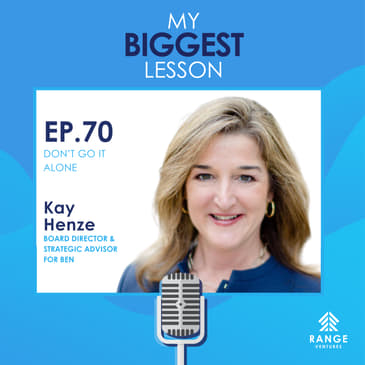
This week Adam speaks with Kay Henze, Board Director and Strategic Advisor for Blackstone Entrepreneurs Network (BEN) and a prominent figure in the Colorado entrepreneurial scene. Newly transitioned from her executive role, she discusses the evolution of Colorado's tech ecosystem and her experiences from her board work and the strategic challenges faced by tech startups. Kay emphasizes the importance of collaboration and strategic guidance for entrepreneurs and how founders can effectively leverage personal and professional advisory boards to support their growth.
Listen now on: Amazon Music (Alexa) | Spotify | Apple Podcasts or wherever you get podcasts!
Connect with hosts Adam and Chris and the Range VC team on LinkedIn
https://www.linkedin.com/company/range-ventures/
Check out more about what we're up to at Range.vc
See Privacy Policy at https://art19.com/privacy and California Privacy Notice at https://art19.com/privacy#do-not-sell-my-info.
[00:00:01] Hello and welcome to My Biggest Lesson, the show that brings you the key learnings from
[00:00:06] the most influential founders, executives, and investors in the Colorado tech community.
[00:00:10] My name is Adam Burrows.
[00:00:12] And I'm Chris Erickson.
[00:00:13] Together we are the co-founders of Range Ventures, an early stage venture firm based in Denver.
[00:00:19] You can find out more about what we're up to at range.vc.
[00:00:25] Our guest this week is Kay Henze.
[00:00:27] Kay most recently was the CEO of BEN, formerly the Blackstone Entrepreneurs Network, where
[00:00:33] she built advisory boards for over 200 local scaling companies.
[00:00:37] Prior to BEN, Kay has an incredible track record as a board member and executive for a number
[00:00:42] of fast growing companies, including Ent Credit Union, Sector 7, Zayo Group, and Verizon.
[00:01:03] Kay, thanks so much for joining us.
[00:01:05] Kay Henze Oh, I'm so happy to be here, Adam.
[00:01:06] Great to see you.
[00:01:07] Kay Henze Well, to start out, love to hear what you're
[00:01:10] up to now.
[00:01:11] And then I know you recently left your role leading BEN.
[00:01:14] We'd love to hear a little bit about that experience.
[00:01:16] Kay Henze Yeah, you bet.
[00:01:17] So I've been the CEO and executive director of BEN Colorado, the Blackstone Now Bridge Entrepreneurs
[00:01:24] Network.
[00:01:24] It was an amazing experience working with really the best of the best of the Colorado entrepreneurs,
[00:01:30] and we have so many.
[00:01:31] Kay Henze And so I have recently turned those reins over, and I'm now the CEO emeritus and
[00:01:36] board member.
[00:01:37] And part of the reason for that transition was that the whole time that I was at BEN, I
[00:01:43] was also serving on a number of paid private company boards of directors, and I really enjoyed
[00:01:48] that work and the strategy aspect of that.
[00:01:51] And so I'm very much focused on my board work.
[00:01:55] Today, I serve as the chair of the governance committee of a $10 billion financial services
[00:02:01] company.
[00:02:02] And I'm in some conversations about some other opportunities to expand service via boards.
[00:02:09] Kay Henze Fantastic.
[00:02:09] We'd love to hear your experience at BEN and give you a really unique view over the Colorado
[00:02:15] tech ecosystem and how it's evolved.
[00:02:18] Just love to hear how you found that experience and how you found the ecosystem evolved over
[00:02:23] your tenure there.
[00:02:24] Kay Henze Yeah, you bet.
[00:02:24] I mean, so I actually joined BEN originally as an advisor in 2016 and really enjoyed it,
[00:02:31] really enjoyed working with the entrepreneurs and tackling their strategic challenges and
[00:02:35] helping them get to the next growth stage.
[00:02:37] And it's not really a place I ever necessarily envisioned myself.
[00:02:41] My background's all in technology and telecommunications, and 60% of the BEN portfolio is in technology.
[00:02:46] So it wasn't a big leap, but a very different world than being an operator.
[00:02:51] And so I joined as the CEO in February of 2020.
[00:02:55] So it was an amazing first couple of years.
[00:02:59] And what I'll say is that in that pandemic year, boy, you know, the entrepreneurial grit
[00:03:05] and spirit and ability to pivot was on massive display.
[00:03:09] It was incredible.
[00:03:10] And they really needed support and they really needed assistance.
[00:03:15] And so from that period of time, I've really seen the ecosystem grow and expand, not only
[00:03:21] from the number of companies that are started here, but the resources available to them.
[00:03:26] The capital structure continues to change and grow with companies like yours, the Greater
[00:03:32] Colorado Venture Fund.
[00:03:33] And it was a weekly occurrence to field calls from other capital providers who may not be
[00:03:40] based here, but we're like, we're in Florida, but we'd like to get more involved, right?
[00:03:44] So we've really seen it grow and expand, which is super exciting.
[00:03:48] And then the last thing, just because I think this is another important element, you know,
[00:03:51] last three years, four years, I think in a row, you know, Colorado has also been voted the
[00:03:57] number one place for women to start a business.
[00:04:00] And we're seeing that in the ecosystem.
[00:04:02] So in the four and a half years that I led it, we onboarded over 50% of all new advisors
[00:04:09] were women.
[00:04:10] In one of our partnership programs, 68% of the entrepreneurs that we supported were women.
[00:04:15] So we're really also seeing kind of the ecosystem expand in a really beautiful way.
[00:04:22] That's great.
[00:04:22] And, you know, you see it reflected in the data too.
[00:04:24] My partner, Chris, recently posted the recent pitch book data on venture funding.
[00:04:29] And if you look at Colorado, while it's still way too low and anemic, we were 3x the national
[00:04:34] average in funding going to female founded companies.
[00:04:37] So hopefully we all continue in the right direction there, but we continue to be the
[00:04:40] leader on that dimension.
[00:04:41] Yeah, it's great to see, you know, change takes time.
[00:04:43] And as long as we're moving in the right direction, it's really encouraging.
[00:04:47] We're seeing the same thing on the BIPOC side, right?
[00:04:49] Like access mode is now here, right?
[00:04:51] We're seeing it also in founders as well as in advisors and a continued increase.
[00:04:57] And so I'm super excited about that because in the end, a more diverse ecosystem will provide
[00:05:02] a better outcome for all of us.
[00:05:04] Absolutely.
[00:05:05] We spoke about this a little bit before we started recording, but, you know, it's interesting
[00:05:08] in it, Ben, you guys would help companies that were high-flying venture-backed companies
[00:05:14] all the way to bootstrap founders who never raised a dime and never intended to.
[00:05:18] Just curious, how did you straddle those extremes?
[00:05:22] Yeah, it's fascinating.
[00:05:23] First of all, I mean, the ecosystem is just, you know, flush with so many amazing people.
[00:05:29] You know, the core of how Ben works is it's really all driven by what are the needs of
[00:05:34] the founder and the entrepreneur.
[00:05:35] The whole process starts with what are the strategic challenges they face?
[00:05:39] And so capital may be one.
[00:05:42] Navigating their own board of directors may be one.
[00:05:45] Moving into a different market might be one.
[00:05:49] You know, expanding into the market where they are.
[00:05:51] And so it really starts with what do they need?
[00:05:54] And then we create a non-traduciary advisory board that takes different forms, but it's
[00:06:00] all based on that need.
[00:06:02] So the difference in terms of whether they're bootstrapped or whether, you know, they're at
[00:06:07] a series A or series B certainly comes into the conversation, but doesn't come in in regards
[00:06:13] to how we support them other than the advisor groups that we select to work with them.
[00:06:19] That makes sense.
[00:06:20] I'm going to put you in a tough spot here, which I know you've worked with so many great
[00:06:23] companies in Colorado and your job was to support the whole ecosystem.
[00:06:27] Now that you're not officially at Ben anymore, you can answer this question, which is if
[00:06:31] there's one company you want to highlight that you're particularly excited about locally right
[00:06:34] now.
[00:06:35] Oh my gosh.
[00:06:37] You know, there are so many.
[00:06:38] There really are.
[00:06:39] I mean, from a SaaS perspective where you guys really focus, you know, Workbrite is amazing
[00:06:45] right now.
[00:06:46] They're growing.
[00:06:48] They've got great leadership.
[00:06:49] They've got a great infrastructure.
[00:06:51] They're filling a need that is definitely needed.
[00:06:55] Spectora obviously has just had, you know, an amazing acquisition.
[00:07:01] Poppins Payroll also comes to mind.
[00:07:04] A husband and wife team who continue to lead that forward.
[00:07:08] The other thing, you know, Inc.
[00:07:10] 5000 came out a couple of weeks ago.
[00:07:13] There's about 10 Ben companies on that list.
[00:07:16] Some of them are early stage.
[00:07:17] So, you know, Mom Juice, which is not in your space, but isn't on the list, but it's a super
[00:07:22] fun, you know, and they're coming out with a non-alcoholic version.
[00:07:26] So there's many.
[00:07:29] Absolutely.
[00:07:29] Well, I think one of the cool things about this ecosystem too that you're alluding to
[00:07:32] is it's so diverse.
[00:07:33] People ask us all the time.
[00:07:35] Okay.
[00:07:35] What's the area, the vertical that Colorado is strong in?
[00:07:40] And I think one of the beautiful things is we've got an incredible SaaS ecosystem, as
[00:07:44] you alluded to.
[00:07:45] We've got defense.
[00:07:45] We've got natural foods, right?
[00:07:47] We've got some consumer products.
[00:07:49] You get Crocs is, you know, the original, you know, company there, but a lot have spawned
[00:07:52] from that.
[00:07:53] And so we've got such a diverse ecosystem, which I think must have made it fun for your role
[00:07:57] too.
[00:07:58] And all the different advisors and mentors that you got to work with.
[00:08:00] It was super fun.
[00:08:01] And I'll just add one to that, which is aerospace, right?
[00:08:04] I mean, you know, second largest aerospace economy in the country, advanced space, which,
[00:08:10] you know, just has a couple of satellites on the dark side.
[00:08:14] I mean, just amazing, amazing things that are going on right here in Colorado.
[00:08:18] No doubt.
[00:08:19] No doubt.
[00:08:19] And robotics too.
[00:08:20] Yeah.
[00:08:21] Some great companies.
[00:08:23] Great companies.
[00:08:24] Yeah.
[00:08:24] There's no shortage of new stuff.
[00:08:26] And quantum.
[00:08:26] Quantum.
[00:08:27] Yeah.
[00:08:27] Yeah.
[00:08:28] Okay.
[00:08:28] I want to shift to the main focus of our discussion today, which is your biggest lesson.
[00:08:34] Obviously you've seen a lot, both in your career pre-BEN and been in all the different
[00:08:39] companies.
[00:08:40] What's your biggest lesson you learned?
[00:08:42] Yeah.
[00:08:42] You know, the biggest lesson I've learned and I learned it early on, but it just gets reinforced
[00:08:47] literally like every day and certainly in the BEN ecosystem as well is don't go it alone.
[00:08:52] Right?
[00:08:53] Like it's really sometimes easy.
[00:08:55] I think especially when you're the CEO or you're the founder, right?
[00:08:59] And people are looking to you for all of the answers to feel like somehow you're supposed
[00:09:07] to be able to provide everything to everyone.
[00:09:10] And it just isn't realistic.
[00:09:13] And so, you know, that's really the core of BEN is about don't go it alone.
[00:09:18] Right?
[00:09:18] Like there are hundreds of people in Colorado, literally, who are willing to volunteer their
[00:09:25] time to work with a founder or a CEO or really anyone.
[00:09:30] And, you know, I also have to say, Adam, it's a lesson I relearn almost every day.
[00:09:37] It's not like a one and done, but that's really kind of my biggest lesson that again,
[00:09:42] has stayed with me forever and continues to be with me.
[00:09:45] I love that.
[00:09:46] And it is so hard for founders because it is a lonely job, right?
[00:09:50] Being at the top.
[00:09:51] And especially as a first time founder, I think you have a little bit of this insecurity
[00:09:55] complex where you say, I've got to present confidently all the time, right?
[00:09:59] I'm always selling my investors say, always be selling and never show, you know, show
[00:10:03] vulnerability or weakness.
[00:10:05] But then you can take that too far.
[00:10:08] You can, you can take it way too far.
[00:10:11] And, and, you know, it, it comes in all different forms.
[00:10:13] I clearly remember, you know, I started my career, spent 23 years at Verizon Wireless.
[00:10:18] I left as the chief marketing officer of the largest division.
[00:10:22] We had 28 million customers and we're generating over 25 billion in revenue.
[00:10:29] And in that role, right?
[00:10:31] Like, you know, you were supposed to always be representing the brands.
[00:10:35] And I remember, honestly, the chief, the chief HR officer making a comment, almost exactly
[00:10:43] what you just said, right?
[00:10:45] Which was don't, don't ever let them see you be weak, right?
[00:10:50] Especially as a woman in technology, right?
[00:10:52] Don't ever let them see you be weak.
[00:10:54] And so, you know, you're like, oh, I have to have this persona.
[00:10:59] I have to be larger than, than life.
[00:11:02] But the only way that you can even do that for eight, let alone 12, 15 hours a day is
[00:11:08] if there is a whole ecosystem and environment around you, that when you're not up on that
[00:11:14] stage, when you're not in front of the investors, when you're not raising capital, that you can
[00:11:18] actually go to and say, I'm not really sure that that pitch went well.
[00:11:23] And how do I make it better?
[00:11:24] And will you help me do that?
[00:11:25] Right?
[00:11:25] It is a very humanizing aspect, I think, of kind of some of those big jobs, especially
[00:11:31] when you have that external pressure from wherever it's coming from, right?
[00:11:36] To somehow be larger than life.
[00:11:38] I love this topic because it is something that we see with nearly every company in every role
[00:11:45] executive too, right?
[00:11:46] It's make sure you have, I think somebody's called it your personal board of directors.
[00:11:49] That's one way of phrasing it to make sure you've got people that you can go to and be
[00:11:54] vulnerable with.
[00:11:55] I think some of the challenge though, I'd love to hear how you think people should approach
[00:11:59] this.
[00:12:00] We do see, okay, a founder does recognize, I do need to bring on advisors.
[00:12:04] I do need to have people around me, but they bring on the wrong advisors.
[00:12:07] They bring on people who are, for lack of a better word, people who are kind of out for
[00:12:13] themselves, are leeches we see trying to just grab equity or any angle for themselves.
[00:12:19] Yeah.
[00:12:19] How do you think founders make sure they find the right advisors who they should actually
[00:12:23] listen to?
[00:12:23] Yeah, it's a great question.
[00:12:25] And I think it's a journey, right?
[00:12:27] Like, I think you've got to be very thoughtful about who you're going to share your business
[00:12:33] with.
[00:12:34] And, you know, in Colorado, because there's organizations like Ben, right?
[00:12:38] Like, you can do some things before you actually get into a whole conversation about equity.
[00:12:43] But I think fundamentally, it has to start with a connection.
[00:12:47] It has to start with a really robust kind of conversation that hopefully is about open-ended
[00:12:56] questions, right?
[00:12:57] And a dialogue that ensues on both sides.
[00:13:02] It has to come from both sides, right?
[00:13:05] And what I always would ask the entrepreneurs after some of those initial conversations with
[00:13:10] potential advisors was another series of questions.
[00:13:13] Who resonated with you?
[00:13:15] Who challenged you?
[00:13:17] Who made you think about something that you've been ruminating on?
[00:13:21] And maybe you've kind of got some clarity, right?
[00:13:24] Who did you feel aligned to?
[00:13:26] And I think the other mistake that is made when you're building an executive team, when
[00:13:31] you're building a board of directors, when you're seeking advisors, is you actually want
[00:13:35] to find the people that aren't necessarily like you.
[00:13:38] You want to find the person that is happy and excited about doing the work that makes you
[00:13:46] tired, right?
[00:13:47] Like, you want to round yourself out.
[00:13:49] And it's the same thing with your board of directors.
[00:13:51] And the last thing I'll say is that sometimes if a board is already in existence and you have
[00:13:57] an independent to fill or you have some seats to fill, you also have to look at what's the
[00:14:02] configuration and the skill set on the existing board and where do I need to fill a gap?
[00:14:07] So if the board is mostly financial investors and there's not a product person or a marketer
[00:14:15] or a chief technology officer, right?
[00:14:17] Those are gaps that you need to fill.
[00:14:20] And so you might have to really stretch beyond your own ecosystem or your own network to find
[00:14:26] those right people.
[00:14:28] I think that's a really great point.
[00:14:30] There's a couple of points there I want to parse out.
[00:14:32] But that point around making sure you find people who complement you, particularly we see this
[00:14:38] when somebody is going to hire an executive role.
[00:14:42] Hey, I'm a product person.
[00:14:43] I'm a CEO.
[00:14:44] That's my background.
[00:14:45] I'm going to go hire a head of marketing, right?
[00:14:48] And anybody who comes in as a candidate is going to sound like they know a lot about
[00:14:51] marketing to me.
[00:14:53] Making sure you have that advisor like you or a background like yours or somebody else
[00:14:57] who's really done this for many years at the highest level, who's seen and interviewed
[00:15:00] lots of people who can really say, hey, this person really knows their stuff or this person
[00:15:05] doesn't.
[00:15:06] I think it's super critical.
[00:15:08] Yeah, absolutely.
[00:15:08] And that's a great example, right?
[00:15:10] Don't go it alone.
[00:15:11] If you're about to hire a role that you've never hired for, you're not exactly sure.
[00:15:16] Like, how do I smoke?
[00:15:18] How do I see through the smoke stream?
[00:15:19] Bring some people in to help you, right?
[00:15:21] And again, they'll be willing to do it in various stages along that journey.
[00:15:26] The other point that you said that I wanted to double click on was about people who challenge
[00:15:32] you.
[00:15:32] And this is another, I think, kind of common mistake and temptation that we see founders.
[00:15:37] Again, their job is so hard.
[00:15:38] They feel like they're getting beat up by customers, investors all day.
[00:15:41] It can be really tempting to just want someone who's a cheerleader, right?
[00:15:45] And I think that can play a role.
[00:15:46] We see this to the detriment of them sometimes too.
[00:15:49] If they get someone who is only a cheerleader, founders will always gravitate towards who's
[00:15:54] telling them what they want to hear.
[00:15:55] How do you give it?
[00:15:56] Have you given advice to founders to rebut that?
[00:15:58] And also maybe mentors as you guys train mentors for Ben, how do you serve as an effective
[00:16:03] mentor to make sure that you're not just acting like a cheerleader?
[00:16:05] Yeah.
[00:16:07] You know, from both perspectives, they will both gain so much more, right?
[00:16:13] By actually leveraging the skill sets that are around the table.
[00:16:17] And so I think that's really where a lot of that conversation starts.
[00:16:21] When we onboard advisors, so first of all, all of the advisors in Ben are fully screened
[00:16:29] and are all referred.
[00:16:30] So you can't go to the website and sign up to be an advisor, right?
[00:16:33] The first step is somebody in the ecosystem has to refer you.
[00:16:36] And then there's a full vetting process.
[00:16:38] And part of that vetting process is to understand their skills and abilities, but also understand
[00:16:43] their intent, right?
[00:16:45] And is that intent really about giving first and paying forward or not?
[00:16:51] And if it's not, then they're just not invited, quite frankly, to move forward.
[00:16:57] But we also go, I'll also go back to, we meet around specific challenges.
[00:17:05] And so it starts with the problem statement.
[00:17:08] And so that starts to eliminate, I'm just going to cheer you forward, right?
[00:17:14] Because there's a real problem that has to be solved.
[00:17:17] And I think that's also really important for the entrepreneur, because if the entrepreneur
[00:17:22] can't articulate what the real problem is and what the strategy is, not the tactic, but
[00:17:30] the strategy, then there's a whole nother series of conversations that have to happen to start
[00:17:36] off with.
[00:17:37] And so it's very similar when you're building a board of directors or you have a board of
[00:17:42] directors.
[00:17:43] The strategy is what the board is going to help you with first and foremost, and then
[00:17:48] the governance.
[00:17:48] And so that strategy alignment is absolutely critical.
[00:17:53] And the CEO has to have it, the board has to have it, the advisors, everybody has to
[00:17:57] have it.
[00:17:57] And if you can't ever get there, it's not going to be very productive.
[00:18:02] I totally agree.
[00:18:03] And just to pick up that thread about board of directors, I know you mentioned that's the
[00:18:07] phase of life that you're transitioning into right now full time.
[00:18:10] And you've been on a number of boards.
[00:18:13] How do you think about the most effective way to be a board member yourself and be part
[00:18:17] of that strategic team?
[00:18:19] Yeah, I'll take it back to, you know, don't go it alone, right?
[00:18:22] The role of the board is very well defined.
[00:18:26] And the role of the board is about helping guide the strategy, helping ensure that there's
[00:18:32] resources to fulfill the strategy.
[00:18:35] They're there to represent the stakeholders and the shareholders of the company and ensure
[00:18:40] that there's good governance.
[00:18:41] So the role is clearly defined.
[00:18:45] It, you know, it varies based certainly on the company and the size of the company and,
[00:18:50] you know, all of those aspects of it.
[00:18:52] And sometimes it's hard.
[00:18:54] I'm an operator, right?
[00:18:55] I have, I'm a former CEO of a $10 million scale up company myself, right?
[00:19:01] Like I'm used to being in the weeds.
[00:19:03] And so I do have to check myself sometimes and be like, you're not the operator.
[00:19:10] You're here on strategy.
[00:19:12] And the other thing that's really important is the rest of the board, right?
[00:19:16] Like really great, high performing boards will check one another in addition to making sure
[00:19:24] that whether it's in the room or whether it's the call before the call, right?
[00:19:28] Or any of those elements of it.
[00:19:29] And they'll invest in their own entity as a board of directors in their own culture, right?
[00:19:36] And in their own identities.
[00:19:38] So, you know, I, it is a challenge sometimes to make sure that you're in the role, but that's
[00:19:44] what makes a great board is that it's clearly defined and they're not in the day-to-day.
[00:19:49] In a smaller company, they also need to be willing to do a little bit more than in a bigger
[00:19:54] company, especially in regards to opening up their network, but they're still not the
[00:19:57] operator, right?
[00:19:59] That belongs to the founder and the CEO.
[00:20:01] Okay.
[00:20:02] Thanks.
[00:20:02] I'm really excited for you to transition to the next phase of your career and any company,
[00:20:06] you know, would be lucky to have such a thoughtful strategic leader to help them, you know,
[00:20:11] build their own personal or company board of directors.
[00:20:13] So thanks again.
[00:20:14] Where can our listeners get in touch with you or follow along with what you're up to?
[00:20:18] Yeah, you bet.
[00:20:19] Thanks so much, Adam.
[00:20:20] It's been so much fun.
[00:20:21] So I'm active on LinkedIn at Kay Henze.
[00:20:24] And then you can also find me at email, Kay at Kay Henze.com.
[00:20:28] Thanks again, Kate.