
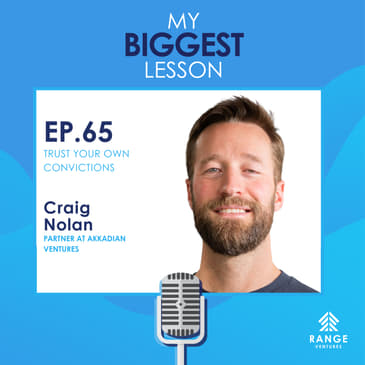
This week Adam speaks with Craig Nolan, a Partner at Akkadian, a venture secondaries investment firm founded in 2010 with over $750M assets under management. Craig has been instrumental in deploying investment strategies that focus on B2B software within tech while also being a co-producer of the RAISE Conference, the premier launchpad for emerging VCs. On this episode, Craig shares his unique experiences as an investor and Colorado native watching the rise of Denver's tech ecosystem. He provides insights on investment trends for secondary markets, plus examples in his journey on the power of believing your own convictions.
Listen now on: Amazon Music (Alexa) | Spotify | Apple Podcasts or wherever you get podcasts!
Connect with hosts Adam and Chris and the Range VC team on LinkedIn
https://www.linkedin.com/company/range-ventures/
Check out more about what we're up to at Range.vc
See Privacy Policy at https://art19.com/privacy and California Privacy Notice at https://art19.com/privacy#do-not-sell-my-info.
[00:00:00] Hello and welcome to My Biggest Lesson, the show that brings you the key learnings from
[00:00:06] the most influential founders, executives and investors in the Colorado Tech community.
[00:00:10] My name is Adam Burroughs and I'm Chris Erickson.
[00:00:14] Together we are the co-founders of Range Ventures, an early stage venture firm based
[00:00:18] in Denver.
[00:00:20] You can find out more about what we're up to at range.vc.
[00:00:26] Our guest this week is Craig Nolan.
[00:00:28] Craig is a partner at Acadian, which is a leading firm for venture secondaries.
[00:00:32] The fund was founded in 2010 and now has over 750 million of assets under management and
[00:00:38] is a co-producer of the Raze Conference, which is the premier launchpad for emerging
[00:00:42] VCs.
[00:00:43] Craig, thanks so much for joining us today.
[00:01:05] Craig Nolan, Co-Producer, Range Ventures
[00:01:06] Excited to be here.
[00:01:07] Thanks for having me.
[00:01:08] Craig Nolan, Co-Producer
[00:01:09] Tell us a little bit about your background and then Acadian Ventures.
[00:01:11] Craig Nolan, Co-Producer
[00:01:12] Yeah sure.
[00:01:13] So Colorado Native went to Denver University for undergrad and business school and
[00:01:18] after business school I ended up at a local valuation firm called Arcstone Partners,
[00:01:23] which is founded by Bo Brusker.
[00:01:25] Do you know Bo?
[00:01:26] Craig Nolan, Co-Producer, Range Ventures
[00:01:27] You know what?
[00:01:28] I've met him before but it's not been a while.
[00:01:29] Craig Nolan, Co-Producer
[00:01:30] Yeah, he's a great entrepreneur here in Denver.
[00:01:32] I think he would be like a great guest for this.
[00:01:35] Anyway, he started this firm Arcstone Partners, which focused on valuation,
[00:01:40] which for me mostly meant pricing the stock options for venture backed companies,
[00:01:46] for nine days.
[00:01:47] It was there for a few years and when you're there doing those kinds of analyses,
[00:01:52] you get really good at modeling out the capital structures for venture backed businesses.
[00:01:57] And so this was, I joined in 2009 and then in 2010, 2011, the direct secondary market
[00:02:06] for shares and venture backed companies kind of exploded.
[00:02:10] And it was because Facebook and Twitter were pre-IPO around then.
[00:02:14] And so secondary being trading shares between other shareholders rather than a primary growth
[00:02:21] equity round.
[00:02:22] And so that market was around before 2010, but it was pretty small and relatively unknown
[00:02:28] and Facebook and Twitter kind of put it on the map.
[00:02:30] And trading in these assets really exploded and it was chaos.
[00:02:36] People were unscrupulous, people were selling shares more than once.
[00:02:39] These companies had no control over their cap tables and it was kind of nuts.
[00:02:44] And in the midst of that, a couple entrepreneurial guys set up shop in facilitating exchanges for
[00:02:50] this.
[00:02:51] So around then it was second market and shares post where it was kind of a centralized place
[00:02:56] for buyers and sellers to come together and trade these assets.
[00:03:00] And we had the idea at Arcstone to help them out with maybe what would look like
[00:03:04] an equity research product but for the private equity markets using the skill set that
[00:03:10] we developed at doing valuations.
[00:03:13] We tried a few iterations with all of them.
[00:03:16] It was shares post, with second market and had some kind of trials with a few
[00:03:21] issuances and it just never quite got off the ground.
[00:03:24] There were problems with information sharing and business model issues.
[00:03:29] And it was a great idea that kind of ultimately failed.
[00:03:33] But through that effort, I got to know a bunch of players in the secondary world
[00:03:39] and that is including Acadian.
[00:03:41] I met Ben Black, who was the founder.
[00:03:44] And at the same time, many of our Arcstone clients were Bay Area clients
[00:03:49] and I had sort of a personal interest in living in the Bay Area.
[00:03:52] So I asked Bo, can I head out to San Francisco and do my job from there?
[00:03:57] He was like, absolutely.
[00:03:59] Ben Black offered a seat in their office in Soma in San Francisco at the time.
[00:04:04] So I worked for Arcstone in the Acadian office for a year or two.
[00:04:10] And then when the equity research thing didn't quite land,
[00:04:14] I decided to move on and Ben said, why don't you just stay here
[00:04:19] and start working for us?
[00:04:21] And so that was 2013.
[00:04:24] And so now I've been with Acadian for over 10 years.
[00:04:28] Wow. And how much of what you do today is still secondaries?
[00:04:32] It's still primarily what we do.
[00:04:34] So roughly 80, 20, so 80 percent of dollars out the door are secondary and 20 percent
[00:04:41] are primary slash kind of special situations.
[00:04:46] And so Acadian is now we're investing out of our sixth fund,
[00:04:49] which is 275 million pursuing that strategy,
[00:04:53] that over 750 million under management.
[00:04:55] You know, Acadian in that period going back to 2010,
[00:04:58] Ben had saw the chaos that was going on and he set out to do it in a better way.
[00:05:05] Like we can do secondaries in a professional,
[00:05:07] discrete manner working with companies, management teams
[00:05:11] and earn good returns while we're at it.
[00:05:13] So he and his co-founder Pete Smith had some really great successes
[00:05:18] before I joined in companies like Splunk and DocuSign.
[00:05:23] And then I joined in 2013 and have helped build the firm from there.
[00:05:28] And operate on the investment team.
[00:05:30] So mainly focus on deploying into interesting venture-backed businesses,
[00:05:36] broadly within tech, but with a focus on kind of B2B software.
[00:05:39] Yeah, what's a target kind of archetypical deal look like for Acadian
[00:05:44] right stage or who's selling it?
[00:05:45] How does that work?
[00:05:46] Yeah, so a good question.
[00:05:48] So growth stage is where we operate.
[00:05:52] But we we are very flexible in how we build exposure to these companies.
[00:05:58] And so with the guideline being that we like to build exposure over time.
[00:06:02] So what might that look like?
[00:06:04] It could be, you know, participating, you know,
[00:06:08] something to the tune of like five to 10 million in maybe a series B or a series C.
[00:06:14] A couple quarters later help the founders out with some secondary
[00:06:18] to the tune of another five to 10, maybe more.
[00:06:22] And then maybe a couple quarters later, do kind of a broad company wide tender.
[00:06:26] So maybe add lean into the tune of like maybe 10 or 20 million facilitating
[00:06:31] option exercise or liquidity for directors, VPs, executives, anyone who needs it.
[00:06:38] Working with management all the time, of course.
[00:06:40] And then potentially maybe later on buy from another institution,
[00:06:44] which could be one check but a lot of dollars.
[00:06:49] And so the idea is you get to watch the company perform over time
[00:06:53] and purchase that and be able to purchase at times when traditional VCs maybe can't
[00:06:58] at pricing that they can't.
[00:07:00] And so you can move the dials on how much exposure you gain
[00:07:04] and when and at what price. Does that make sense?
[00:07:07] Absolutely. And you've seen a bunch of cycles now, right?
[00:07:09] In 13 years already, we've seen a bunch of cycles in the last three years.
[00:07:11] It's a lot of them consolidated into a short period.
[00:07:15] So what I know it's super hard to generalize and depend on the companies.
[00:07:18] But I'm curious, what's the range of either discounts or premiums
[00:07:22] that you've seen in your time doing this?
[00:07:24] And is there kind of an average either overall or today?
[00:07:28] Yeah. Just like you said, in the last three years, we've seen the whole range.
[00:07:33] I think we've bought at anything from, I want to say 70% off
[00:07:38] the last round to last round.
[00:07:41] You know, and it's for us, it just does it underwrite to our required return.
[00:07:45] And where it sits today.
[00:07:47] And there's some great data providers for this.
[00:07:50] You know, Forge has a great quarterly update and the median is still,
[00:07:54] I think close to 50% off the last round.
[00:07:56] You know, I think for some of these companies, you know, they just haven't
[00:07:59] raised yet again since 2021.
[00:08:03] You know, to get to get a deal done, you sellers have to accept 50% off.
[00:08:06] And that's the median, you know, and they show you kind of 75th percentile,
[00:08:09] 25th percentile.
[00:08:10] I think, you know, for the upper percentiles, it's getting back
[00:08:13] to like close to last round.
[00:08:15] Yeah, that's that's kind of what the marketplace looks like right now.
[00:08:18] Super interesting.
[00:08:19] What have you seen happen over the last year just to double click on that?
[00:08:23] Last year or two, I guess, since this last correction, any new trends
[00:08:26] you've observed in the secondary market, just kind of more the same,
[00:08:30] you know, just with slightly different valuations.
[00:08:33] Yeah, I think activity is picking up and I'm not yet.
[00:08:39] I think maybe it's just barely showing signs that that means pricing
[00:08:42] is picking up.
[00:08:43] Maybe I think it's that's unclear, but I'm hearing
[00:08:47] from the intermediaries that we work with, there was a group
[00:08:50] that told us that we were the only buy side client they had in all of 2023.
[00:08:54] But now just, you know, a little over one quarter in this year is looking different.
[00:08:58] Like there's more, there's just more bidders out there.
[00:09:02] Bid ask whether narrowing and activities picking up.
[00:09:06] But I haven't I'm not sure that I've yet seen that show up in pricing.
[00:09:11] But maybe that's not too far off.
[00:09:13] I think it's a lot like the real estate market, right?
[00:09:15] Where people have an emotional attachment to a number they may have seen on Zillow
[00:09:19] in 2021 or a number they saw at their last round.
[00:09:22] And it's really hard to emotionally let that go, even though you know
[00:09:26] it's not accurate anymore and you don't really actually sell until you have to.
[00:09:30] That is exactly right.
[00:09:32] You know, I think it just takes time for that to sink in.
[00:09:36] I think early 2022 we had trouble getting deals done.
[00:09:39] And I think we we certainly went in and maybe kind of slightly burned
[00:09:44] the bridge with some executive teams where we said, Hey, look, 2021 was 2021.
[00:09:50] Here's where we are.
[00:09:51] We showed them the math and we said like, Hey, look, we're we're underwriting
[00:09:55] to a growth stage required return.
[00:09:58] And for us to get that, we got to buy here.
[00:10:01] And you know, for some of them that was like 65% off for a company
[00:10:04] that was great, lots of runway growing over 70% annually.
[00:10:09] You know, they didn't they didn't love hearing that.
[00:10:12] But I think we would say the same thing, maybe second half of 2022,
[00:10:16] early 2023, and it just the receptivity was there.
[00:10:20] You know,
[00:10:22] makes a lot of sense.
[00:10:23] So you're doing deals all over the country, maybe even globally as well.
[00:10:27] Yeah.
[00:10:27] North America, Europe and Israel.
[00:10:31] OK, cool.
[00:10:32] And but you live here in Denver, which is great.
[00:10:34] We love to we love to see that.
[00:10:35] Right.
[00:10:36] What do you think of your experience in seeing the ecosystem here
[00:10:40] versus the ecosystems elsewhere all over the world?
[00:10:43] You know, it's been great to see it grow so much.
[00:10:47] Yeah, I think back when I worked at Arcstone, you know, sort of called
[00:10:52] like toward 2009, 2010, I would go to venture conferences here in Denver.
[00:10:58] And and it was relatively kind of sleepy, you know, and moved away
[00:11:04] to San Francisco, came back in 2020, like so many people.
[00:11:08] And so went to the exact same conference and it was thriving.
[00:11:12] And, you know, it's it's absolutely like a valuable thing to go to.
[00:11:16] I would tell it be something I'd recommend my Bay Area colleagues.
[00:11:19] Like they ought to be here.
[00:11:21] I've root for that in Colorado, so I'm really happy to see it.
[00:11:25] Awesome. Glad glad to hear that.
[00:11:26] Is there a company here in particular that you're excited about right now?
[00:11:30] Well, very timely.
[00:11:31] It's, you know, I bought it.
[00:11:33] It's it's so cool to see them going out and and successfully.
[00:11:38] Executing, you know, in the public markets.
[00:11:41] And so I remember hearing about them early 2010s and and just being thrilled,
[00:11:46] even excited for them then and to see that they've that they made it happen
[00:11:50] in this market right now.
[00:11:52] Yeah, absolutely.
[00:11:52] So I mean, we're recording this in the day they they successfully went public.
[00:11:55] And I think the mark cap of the company is maybe north of three billion
[00:11:58] as we speak today.
[00:11:59] Hopefully that that holds up and continue to grow for Denver.
[00:12:02] But regardless, it's a huge win for the ecosystem.
[00:12:05] Read that, you know, well over 100 millionaires created.
[00:12:07] And this is exactly the type of stuff that we need to get that that
[00:12:11] wheel continuing to spin.
[00:12:12] Yeah, exactly.
[00:12:13] You know, speaking to your colleagues, you know, they told me like there's
[00:12:17] there's so much Colorado is like a coiled spring with all the
[00:12:22] the entrepreneurial activity that it should kind of happen as a result
[00:12:26] of companies like I bought and others in that generation succeeding and exiting.
[00:12:33] And so I'm just I'm really excited to see it.
[00:12:35] And I think you guys are really well positioned for it.
[00:12:38] Absolutely. We appreciate that.
[00:12:40] Well, let's jump into the main topic, which is the biggest lesson.
[00:12:43] Love to hear Craig.
[00:12:44] You've seen a million companies now from all sides, right?
[00:12:47] I'm sure you've had had some some ups and downs in the investments
[00:12:51] you guys have made, something all that up.
[00:12:52] What's the biggest lesson that you've learned?
[00:12:55] You know, for me, the biggest thing was honestly just learning
[00:12:59] to hold conviction of my own.
[00:13:01] And so, you know, that sounds pretty standard.
[00:13:05] But I came into VC in a pretty non-traditional path.
[00:13:08] Like valuation is it's kind of a service provider business.
[00:13:12] I would almost liken it to sort of like kind of accounting.
[00:13:15] You know, you come into VC and everyone has the pedigree like they went
[00:13:19] to Stanford and maybe did the investment banking route
[00:13:23] were at Goldman Sachs and went through that grinder.
[00:13:26] And, you know, I kind of came in a different way.
[00:13:28] And I had, I frankly came in with a little bit of imposter syndrome.
[00:13:32] Right? Like who am I?
[00:13:34] Like how can I have a different view than, you know, brand name firm
[00:13:38] who made this investment?
[00:13:40] There's many stories here that unfortunately I had to like go through
[00:13:43] to sort of learn this lesson over time.
[00:13:45] You know, it manifested in getting talked out of deals
[00:13:49] that we should have done, you know, like we our diligence involves
[00:13:53] talking to a lot of experts.
[00:13:54] And sometimes you get someone on the phone
[00:13:56] who for whom you have a ton of respect and you know to be more successful
[00:14:00] than you and they with great conviction, you know, trashed this company
[00:14:06] that we were looking at, you know, it didn't mince words.
[00:14:10] And we otherwise had kind of a pretty positive view on it.
[00:14:13] But that that swayed us and we put a little too much weight on it
[00:14:16] and passed on the investment, which would have been
[00:14:20] which would have been a triple for us in less than nine months.
[00:14:23] And that would have been it would have been like the first investment
[00:14:25] out of our, I think, 2017 vintage.
[00:14:28] You know, and that's that's just a bummer, right?
[00:14:30] Like we had it.
[00:14:32] We were in full position for this.
[00:14:34] And then it happens on deals that you end up doing, you know,
[00:14:38] you've got unfortunately, you know, in past ventures,
[00:14:40] a few examples where so-and-so partner at one of the giants,
[00:14:45] you know, the name that we all know has been around for decades.
[00:14:48] You know, they're on fund 18 and they're multi-billion.
[00:14:52] And this guy says, this is the company we are most excited about.
[00:14:56] And so, you know, that we put a ton of weight on that.
[00:15:00] And, you know, that that company went to zero, zero, which,
[00:15:05] you know, humble little Craig back then was like, I can't believe it.
[00:15:09] You know, like I with a little more work,
[00:15:12] I could have gotten to a different view there, but I let this guy
[00:15:15] sort of taught me into it, which, you know, like these are smart people.
[00:15:20] They know what they're doing and this business humbles you,
[00:15:24] you know, all the time and even the best of the best has this happened to them.
[00:15:27] So that's saying like they're wrong or stupid, but you got to
[00:15:32] you got to do your own work and form your own convictions.
[00:15:35] And that's been that's been the difference for me moving from kind
[00:15:39] of like a junior analyst into like a contributing
[00:15:42] to the investment decision making of the firm.
[00:15:44] This is such a good lesson.
[00:15:46] I absolutely love it.
[00:15:47] And it's one that we having started our own fund over four years ago,
[00:15:51] talk about all the time.
[00:15:53] Right. We've learned this hard lesson ourselves already with some anecdotes.
[00:15:57] I have a lot to double click on here.
[00:15:58] This is great.
[00:15:59] The first one where you talk about that example
[00:16:01] where you were doing diligence, you talked to an expert and the expert
[00:16:05] really crapped all over the deal, right?
[00:16:06] And convinced you not to do it.
[00:16:09] How do you balance that with what's the point of diligence
[00:16:11] in the first place if you're not going to listen to the experts?
[00:16:14] What's the point of calling the experts if you're not going to listen to them?
[00:16:16] But yet, yeah, it's everybody's not always right.
[00:16:18] The experts are always right.
[00:16:19] How do you strike that right balance and how do you know who to listen to
[00:16:22] and how much weight to put on?
[00:16:23] Yeah, that's a great question.
[00:16:25] You know, after doing this for a while, I've now done a lot of these
[00:16:28] channel check due diligence calls.
[00:16:30] And it's you have to do many of them to form a holistic view.
[00:16:35] And it's a little bit of it's kind of an EQ thing.
[00:16:39] You kind of have to be in the conversation and read it a little bit.
[00:16:42] Like what's there's at this point,
[00:16:44] I kind of feel like there's sort of tones of voice that I can pick up
[00:16:48] that tell me like I think that was sort of flippant.
[00:16:51] I'm not sure that was great insight.
[00:16:55] I think he just said that off the cuff or, you know,
[00:16:58] I think I think this guy might have a chip on his shoulder.
[00:17:00] Like people talk about something, even if they don't say so,
[00:17:03] like this person has it out for this company for some reason.
[00:17:06] And there's I think there's maybe a personal angle here
[00:17:09] that that he's not explicitly talking about.
[00:17:11] But there's a lack of objectivity coming through in the language
[00:17:13] that he's using to tell me about this company.
[00:17:16] After a while, you pick up patterns like that
[00:17:19] and you really have to pay attention and learn the lessons.
[00:17:22] You know, something that we have noticed too is a lot of times
[00:17:26] when you're calling experts is OK, is there do they have another
[00:17:29] not explicit made me but but a little bit of an implicit agenda?
[00:17:33] Right. Because they don't really want to see this thing
[00:17:35] succeed in the industry for some reason.
[00:17:37] Right. Or, you know, they had championed something
[00:17:40] before their own company that didn't work.
[00:17:42] And they really don't want to advocate for something else.
[00:17:45] I mean, there's those type of dynamics that we run into all the time.
[00:17:48] The flip side where you talk about the poor investment
[00:17:50] you all had made following another well respected VC.
[00:17:54] I wonder how you think about that too, because it's interesting
[00:17:56] on one hand, absolutely even the best VCs
[00:18:00] have companies go to zero all the time.
[00:18:02] Right. And a shoeing group think is really one of the hallmarks
[00:18:06] of this business, right, being contrarian and being right.
[00:18:08] On the flip side, it is important for your companies
[00:18:12] to be able to attract follow on capital, to be able to attract talent,
[00:18:15] having a name partner, name firm does help and maybe gives them
[00:18:18] a little bit of an advantage.
[00:18:20] How do you think about that balance?
[00:18:21] Yeah, I mean, it does for for many of those companies.
[00:18:26] I mean, from the standpoint of the founder, you know,
[00:18:29] like it's there's there's value in it for sure.
[00:18:32] From the standpoint of someone like us, like, do we
[00:18:36] do we follow them?
[00:18:37] Do we listen to their praise about the company?
[00:18:40] You know, a couple of things.
[00:18:42] There's a lot of reasons why you can maybe discount what they're telling you.
[00:18:46] I think for like a prominent VC partner, sort of what the most frequent stuff is
[00:18:51] these guys, like they are practiced at being champions for their founders.
[00:18:56] And so, you know, that there you probably kind of have to discount it,
[00:19:02] you know, no matter what, like they're going to love their baby
[00:19:05] and they're going to tell you how great they are.
[00:19:07] You know?
[00:19:08] And so, you know, in those conversations, sometimes you can parse through like,
[00:19:12] OK, well, there was a lot of praise, but you know, how much
[00:19:16] how much substance was in there?
[00:19:17] Like, sometimes they'll provide some examples where you're like, OK,
[00:19:20] well, that's really compelling, you know, like that's this is a hard
[00:19:23] number or just a hard kind of case study that shows this company
[00:19:27] is is going to be a winner.
[00:19:29] And if it's sometimes they're just kind of like a lot of fluff,
[00:19:31] like surely they love it.
[00:19:33] And because it's this name saying they love it, that's very compelling.
[00:19:36] But there actually wasn't, you know,
[00:19:39] it is something to anchor to in there that that should that gives them more credibility.
[00:19:45] Does that make sense?
[00:19:46] Absolutely. I mean, everybody's going to talk their book, right?
[00:19:49] And the key is figuring out how do you still gather useful information?
[00:19:52] I mean, that's certainly something that we've been trying to suss out as well.
[00:19:56] Because I do think it's important to talk to the VC, even though,
[00:19:59] you know, when you call them, they're going to be advocating hard.
[00:20:02] I think for us, what we found, Craig,
[00:20:05] and I don't know if this resonates with your experience, by then we've usually
[00:20:07] formed somewhat of a perspective of where we think the strengths of this
[00:20:09] business are or where the weaknesses and the risks potentially are.
[00:20:12] And just hearing somebody who's been closer to it opine on
[00:20:15] are the things that they're praising the same strengths that we have seen so far
[00:20:19] or are they something different?
[00:20:20] Right. And our the weaknesses or risks that they'll tell us
[00:20:23] because we'll ask that question and they'll give some sort of an answer.
[00:20:26] Right. Are they something that we hadn't identified yet
[00:20:28] or are we all, you know, thinking along the same lines?
[00:20:31] Like that's been useful to us so far.
[00:20:33] Yeah, that's really well put.
[00:20:35] Like as you go through the process, you start to see common themes or threads
[00:20:40] and different people will talk about it in different ways,
[00:20:43] but it'll it'll reinforce other data points.
[00:20:46] And, you know, when that starts to kind of build a consensus around
[00:20:50] a theme or a principle or kind of a characteristic of the company
[00:20:55] that you're looking at, that's that's a good sign.
[00:20:59] It's no different really than a candidate reference, right?
[00:21:01] For an interview.
[00:21:02] Yeah.
[00:21:02] And when you call up a reference and you want to make sure that
[00:21:06] sounds like they're talking about the same person.
[00:21:08] Right.
[00:21:09] Yeah. We've all had that experience.
[00:21:11] It's, you know, exactly.
[00:21:12] We've all had an experience where you do a reference call
[00:21:14] and you're like, wait, is this we're talking about the same person?
[00:21:17] OK, something's not feeling right here.
[00:21:18] Yeah. Well, Craig, this is awesome.
[00:21:20] I think it's super interesting, the lens that you all get
[00:21:22] to be the world from at at Acadian and super happy
[00:21:26] that you're doing it from here in Denver.
[00:21:28] Where can people follow along with what you and Acadian are up to
[00:21:32] and get in touch with you if they've got a relevant opportunity?
[00:21:34] Yeah. Feel free to just reach out to me over email.
[00:21:37] And this is Craig at Acadian dot B.C.
[00:21:39] Website is a Cadian dot B.C.
[00:21:42] You know, we also do we also do a conference called
[00:21:44] Rays Global, which is actually kind of like a YC for emerging
[00:21:48] venture capital firms.
[00:21:49] So that's RaysGlobal.co and on Twitter slash exits
[00:21:55] at Rays Conference.
[00:21:56] And so yeah, feel free to reach out or just hit me up on LinkedIn.
[00:22:01] Thanks, Craig. Appreciate the time. Yeah, this is fun.