
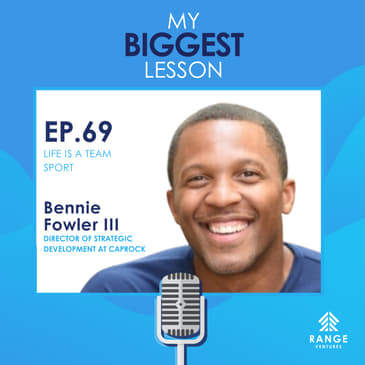
This week Adam speaks with Bennie Fowler III, a former NFL player and Director of Strategic Development with Caprock. Bennie is a Super Bowl 50 Champion with the Denver Broncos and has transitioned to a successful career in wealth management. On this episode, Bennie shares why he chose to remain in Denver after retiring. his insights on the importance of communication, the parallels between professional athletics and entrepreneurship plus his biggest lesson the value of a strong support system.
Listen now on: Amazon Music (Alexa) | Spotify | Apple Podcasts or wherever you get podcasts!
Connect with hosts Adam and Chris and the Range VC team on LinkedIn
https://www.linkedin.com/company/range-ventures/
Check out more about what we're up to at Range.vc
See Privacy Policy at https://art19.com/privacy and California Privacy Notice at https://art19.com/privacy#do-not-sell-my-info.
[00:00:01] Hello and welcome to My Biggest Lesson, the show that brings you the key learnings from
[00:00:06] the most influential founders, executives, and investors in the Colorado tech community.
[00:00:10] My name is Adam Burrows.
[00:00:12] And I'm Chris Erickson. Together, we are the co-founders of Range Ventures, an early stage
[00:00:17] venture firm based in Denver. You can find out more about what we're up to at range.vc.
[00:00:25] Our guest this week is Benny Fowler. Benny is a former NFL player who played in the league
[00:00:30] between 2014 and 2021. He spent time with our Denver Broncos, with whom he won Super Bowl
[00:00:36] 50. Since retiring, he's made an interesting segue into financial planning and wealth management
[00:00:41] for family offices, having worked at Michael Best and now at Caprock. He's become really
[00:00:45] active in the Denver community and we're lucky to have him on the show.
[00:01:00] Benny, thanks so much for joining us today.
[00:01:03] Adam, man. I really appreciate you having me on, man. This is going to be fun.
[00:01:06] Great. Well, a lot of our listeners may recognize your name or know you from when you played for
[00:01:12] the Broncos and won some Super Bowls for us here. But you've been doing a lot of really
[00:01:17] cool stuff since then. So I'd love to maybe catch people up on what brought you to Denver
[00:01:20] in the first place and why you decided to stay and what you're doing now.
[00:01:24] Yeah. Well, that's a great way to open up the conversation. What brought me to Denver
[00:01:28] was the Denver Broncos. So coming out of Michigan State, it always been my dream to be a professional
[00:01:34] athlete. I wouldn't say it was always my dream to be an NFL player, but always my dream to
[00:01:38] be a professional athlete. And because of my mom, she helped steer me in the right direction.
[00:01:44] It went along with my dad and a couple of other friends like, hey, you know, football might
[00:01:47] be a better path for you, even though I wanted to be a basketball player. Went to Michigan
[00:01:51] State, had some success there, wanted to be drafted. Didn't get drafted. And, you know,
[00:01:56] after the draft, you know, you're going through a tough moment. Like, okay, my dream hasn't been
[00:02:00] realized. And my dad told me in real time, right then and there, you can either look at the teams
[00:02:04] that didn't draft you, or you could look at the 16 teams that want to have you as a preferred free
[00:02:12] agent. So Denver was at the top of that list. The Lions offered me the most money, but they aren't
[00:02:17] the Lions who we know today. They were the Lions of the past. So I chose to come to Denver.
[00:02:21] And if I could play with Peyton Manning, I could play in the NSL. And that turned out to be true.
[00:02:26] So that's the reason why I came. And the reason why I stayed is because, you know, I would say
[00:02:32] 60% of people who play for the Broncos after three years or three or four years, they end up coming
[00:02:39] back here or staying here because of the quality of life, the type of people, the business ecosystem,
[00:02:44] and things that can be done here. I mean, the incredible seasons that you have here, the people,
[00:02:50] the city is growing, you know, entrepreneurial ecosystem is growing. So I just think there's
[00:02:55] so many incredible opportunities. And I met my incredible wife out here. And then also when I
[00:03:00] saw Peyton retire, anybody, he can live anywhere in the world and decides to stay in Colorado.
[00:03:06] It piqued my interest and made me pay attention to the city more. And I don't think there's a better
[00:03:10] place to live. That's great. We agree. After retiring, what have you been up to and how'd you make
[00:03:16] the transition away from football? Yeah. So transition is, I think is always tough. And
[00:03:20] I would say that I'm still in a transition. I don't think transition is just a year or two years.
[00:03:24] I think it's a multiple year process and it's no different than Adam, as you know, as an entrepreneur,
[00:03:30] when you leave a business, when you exit a business, there is a transition period. When you exit the NFL,
[00:03:36] there is a transition period. There's a, okay, I was the CEO at such and such company, or Hey,
[00:03:42] I was always a professional athlete or I played for the Broncos. So I always talk about the LOL syndrome.
[00:03:47] It's the loss of logo. And I think that's one of the hardest things that athletes go through
[00:03:52] is that everywhere I walked and sometimes where I, you know, I still get recognized as a former
[00:03:57] Bronco, but when I, you know, I was currently playing and it's like, Oh no, he played, he plays in the NFL.
[00:04:01] He is the 1% of the 1%. It's only 1500 guys. And you, you miss that as, as, as you transition and,
[00:04:10] and it becomes tough because everything had been done for you. I think you and I were talking,
[00:04:16] you know, a few weeks back or a week back and you know, I didn't make my first, I don't know if I
[00:04:21] share this with you, but I didn't make my first doctor's appointment. Like me actually personally
[00:04:24] calling a doctor's office until I was 30 years old. You know, your parents do it for you for a while.
[00:04:31] I went to college. The training staff does it for you. When you go to the pros, you don't have to
[00:04:35] do anything. You just, Oh, I'm sick. You call the trainer and then they, or whatever it may be,
[00:04:40] they call the doctors or the doctors are actually in the office. So, you know, a transition is tough
[00:04:46] for athletes. You literally have to reinvent yourself. And you're like, if you do get to the
[00:04:50] professional athlete level, everything's been done for you since you were 14 or 15, because you've
[00:04:54] been that good. So definitely transition is tough. What I'm up to now, I work at Caprock.
[00:05:00] We are a multifamily office and it's an exciting opportunity for me to help people that I know in
[00:05:07] terms of the investment landscape, how we can, how we can help serve families in terms of them
[00:05:13] exiting their companies or taking their family to the next level, passing on the values, not just
[00:05:19] their wealth. So incredible opportunity. And I got to that opportunity by just trying to show up and
[00:05:25] got an executive and leadership coaching first year out of sports. And then I was at Michael Best,
[00:05:30] who you may or may not know, incredible law firm here, Sean Stigler, M&A law firm. And I was on the
[00:05:36] consulting side, co-leading the family office practice with him. And everything's come full
[00:05:40] circle now to where I can serve people at the highest level with the life coaching expertise,
[00:05:45] the leadership coaching expertise in the strategy piece.
[00:05:49] Why did the family office world and the investment world have particular interest to you?
[00:05:56] They're long-term games. So when you think about the game of life, when it comes to family offices,
[00:06:02] entrepreneurs, investing, it's a long-term play. And when I look back at my professional career
[00:06:08] in the NFL, you, you think it's just eight years. We never talk about the 22 years of life that it took
[00:06:15] to get there. And that was a lot of investments from my parents standpoint, in terms of investing into
[00:06:21] my siblings and myself, from education number one, to resources and trainers and tutors,
[00:06:30] to, you know, other coaches outside of the sport. So when you think about that, you know, life is a
[00:06:35] long-term game. And I think the private investment world is definitely like that, as you, as you know,
[00:06:41] you know, when you think about venture funds and companies, you know, it's a 10-year life cycle
[00:06:45] on a venture fund. Or, you know, when we were talking, you know, it takes a while to build your
[00:06:51] exit success, but not the sleepless nights, or how do I put this deal together, reading the sub docs,
[00:06:57] whatever it may be. So I think that, and then when you, when you think about exiting the company,
[00:07:02] and then you think about these families, now they have come into sudden wealth. Now, what does it
[00:07:07] really look like? And you think as an athlete, you know, those are the most popular people that,
[00:07:14] you know, you see this light on, but how do you answer these questions? Like, what does money mean?
[00:07:20] Or where do I want to take my family, the legacy piece? How do I want to pass the money on to my
[00:07:27] kids? How do I want to pass the values on to my kids? What does it really mean? Am I better than
[00:07:32] other people just because I've made this type of money? There are the questions that you have to
[00:07:35] answer as an entrepreneur, but also as an athlete. You make it to the 1%, then you do it at 21,
[00:07:41] 22 years old, and you got $80 million. What does this all mean? And then how do you figure it out
[00:07:46] from there? And how do you help people navigate life? Because wealth is complicated and life is
[00:07:51] complicated. Absolutely. Do you think that this is still, you know, the financial literacy aspect
[00:07:57] and some of these basic questions that are, that are really hard to, you know, easy to ask and hard
[00:08:01] to answer, right? What is the purpose of money for you? What does this mean? Did you, have you seen that
[00:08:06] change in the pro athlete world? Is that something you were aware of when you were on that side of the
[00:08:10] equation of, as you said, a 22 year old coming into a bunch of money, were they equipped for it?
[00:08:16] The resources at their disposal, or were, you know, some of these horror stories that we've seen on
[00:08:20] ESPN, right? Of these athletes that have made all kinds of, Antoine Walker, whoever else,
[00:08:24] ended up broke. You know, what was your experience like that when you were playing?
[00:08:29] You know, I had really good experience. I think the NFL has done a good job of putting resources
[00:08:33] around it. I think players, you're starting to see more educated decisions in terms of the
[00:08:39] investment landscape or the advisor that they're picking or how they're thinking about, okay, this money
[00:08:44] will help me make even more money. You're starting to see that go and trend in a positive direction.
[00:08:52] I think some of the times when you hear athletes going broke, a majority of that percentage of
[00:08:58] athlete will play two years or less, but they are still considered a professional athlete, but they
[00:09:03] didn't make much money. They made a lot of money to help them get started. But if I just talked about
[00:09:09] my first two years in the NFL in terms of what I took home after taxes was $250K, like, yeah,
[00:09:18] that's incredible. But that's not going to last me a lifetime. And if I were to go broke, like,
[00:09:24] I would be a part of that statistic. So I think we have to pay attention to that. Now, the Antoine
[00:09:29] Walkers of the world who have made hundreds of millions of dollars, that is a very sad case.
[00:09:33] And sometimes I think, yes, that is a case of picking the right wrong person and making bad
[00:09:40] investment decisions, but also the emotional control and keeping up with the Joneses. Yes,
[00:09:48] but more so the emotional control of I've done all this work to make this money. Now you're going to
[00:09:53] tell me what to do with it. And you're chasing after something. You're constantly chasing after
[00:09:59] something because now you don't have that sport or that release that you used to have.
[00:10:03] And I think it's more of an emotional control because I think guys really understand that,
[00:10:07] hey, I need to save more than I'm spending. But, you know, you're sitting next to somebody who's
[00:10:12] spending a couple hundred thousand and you technically can spend a couple hundred thousand,
[00:10:16] but he's made better decisions and he will continue to make better decisions in life. And then
[00:10:21] your bad decisions will catch up with you. So, you know, it's a very loaded,
[00:10:25] loaded answer, but, you know, it's a very loaded question in terms of, you hate to see it, but
[00:10:30] I think some of those percentages are skewed because, you know, you have a guy that made 500K
[00:10:37] over six years and people are like, oh, well, how did he go broke? It's like, well, 500K,
[00:10:42] he can't make it last for the rest of his life.
[00:10:44] Makes a ton of sense. Makes a ton of sense. You know, one of the things that I was struck by when you
[00:10:49] and I were chatting a week or so ago was just the parallels between your experience operating at the
[00:10:55] highest levels of sport and the same psychology, right? That those athletes have with people at
[00:11:01] the highest level of business and entrepreneurship. And so that'd be really, really interesting to hear
[00:11:05] from your experience and all the work you've done. What's the biggest lesson that you've learned that
[00:11:11] you'd want to share?
[00:11:12] You know, that's, it's a really good question. And I have a couple of lessons that, that I would share.
[00:11:20] I think the biggest lesson that I would share just in terms of my career and then where I'm at now is
[00:11:26] nobody has it all figured out. I think that's one thing that I have. I've had, I had imposter
[00:11:33] syndrome when I got to the NFL. And then when you start playing, it's like, okay, like we're pretty
[00:11:38] much all on the same page in terms of athletic ability. I mean, you're going to have your freaks
[00:11:43] of nature. Like the guys I play with, like a Demaryius Thomas, the late great Demaryius Thomas,
[00:11:47] or a Odell Beckham or Saquon Barkley. Like, you know, those are just guys that, but everybody else
[00:11:53] is pretty much on the same playing field and everybody else is trying to figure it out.
[00:11:58] But even those players ask questions or would ask me things about how I would go about my business.
[00:12:05] So no one has it figured out. Nobody has all the answers. That would be one of the biggest
[00:12:10] lessons I learned. I think another lesson that really sticks out to me is the life is a team
[00:12:16] sport. Life is a team sport. I don't, I hate the saying that people are self-made. That's impossible.
[00:12:23] I think in venture capital, I think in private equity, I think in sports, it's all a team sport.
[00:12:31] In marriage, even in, well, I don't have any kids, so I could say in raising my dogs with my wife,
[00:12:37] life's a team sport and we have to help one another. We have to be able to communicate at,
[00:12:43] at a level where we're both understanding, but to, to do incredible things, you're going to need the
[00:12:49] help of other people. And I have the helps, the help of a lot of trainers, a lot of tutors in school,
[00:12:56] a coaches, you know, just so many people, my, my family, that, that life is a life really is a team
[00:13:02] sport in all aspects of life. Who are the people that are going to help you or that can support you
[00:13:07] in those elements of your life where you're going to need to perform at the highest level or just be
[00:13:12] better or, you know, just hold the mirror up to you sometimes. And I believe in that
[00:13:18] everything can be fixed with communications. One of the things I learned from Kyle Shanahan,
[00:13:24] I am very big on that. Just communicating expectations, the standard, whatever it may be in
[00:13:31] terms of, you know, your personal life, your relationships in business with family communication,
[00:13:39] everything can be fixed with that. People who don't communicate or don't communicate their
[00:13:43] expectations. That's where, that's where poor performance comes in or, Oh, he didn't show up
[00:13:50] on time. Or, Hey, I thought we had a five minute buffer after the, you know, when the meeting started,
[00:13:55] the things like that don't work like that in the NFL. And, you know, you can get fined,
[00:13:58] some serious money, you know, you 30 seconds late, that's technically considered late. That
[00:14:02] could be upwards of $30,000 for 30s being 30 seconds. So everything can be fixed with communication.
[00:14:10] And I think that's, I mean, that that's all really well said, Benny. And I think, you know,
[00:14:16] to sum it all up, I think you're a hundred percent right. This idea that nobody hasn't all figured out,
[00:14:21] you know, you get to the highest levels of anything, you get behind the curtain and you find out
[00:14:24] everyone's just human, like everyone else and trying to figure it out as we go along and that
[00:14:28] you need that in order to, to muddle through that mess, right? You, you need that group around you
[00:14:34] that can support you and kind of fill in those gaps and, you know, you need to communicate to get
[00:14:38] through it. So I think that's fantastic. I'd love to just hear, you know, maybe if there was a moment
[00:14:42] or time or experience you had getting to the, you get on the big stage, the NFL with people that,
[00:14:48] you know, you, you, you probably even idolized growing up or watching on TV where you kind of
[00:14:53] had that realization of, you know, and they're just trying to figure it out just like the rest of us.
[00:14:59] Yeah. I would say that moment for me was the second, my second year in the NFL is the year we
[00:15:06] won the Superbowl, but Peyton had got benched. And at the time he's the most decorated quarterback
[00:15:11] of all time at that time. And yeah, he got benched middle of the year. He had a little bit of an injury,
[00:15:17] but he just wasn't playing well. And he was trying to figure out like, how do I still support
[00:15:22] the team? How do I get myself better? And you, you just saw him trying to figure it out. Cause
[00:15:29] this had never happened to him in his life. And he was number one pick in high school,
[00:15:32] number one pick coming out of college, number one pick coming into the NFL. And here he is in the
[00:15:37] last year of his career, trying to figure out something new that he, in something that had,
[00:15:42] he hadn't figured out yet. And just watching him navigate through that and still
[00:15:46] consistently saying the same person, watching him navigate through that was just like, Oh,
[00:15:52] like he's figuring this out just like everybody else. Like this is a moment where he's having
[00:15:56] this moment and he's, you know, he's got to navigate this just like life. And you know,
[00:16:00] there isn't a playbook for this one. You know, he's got to, got to figure it out.
[00:16:05] And I think you probably see this and we talked a little about this. You probably see this
[00:16:08] with your family office practice too, right? You've got these super successful entrepreneurs
[00:16:13] that everybody sees on the outside. They've got it all figured out. They've made all kinds of money
[00:16:18] and they're still, you know, they're still stressed. They're still got all kinds of,
[00:16:22] all kinds of issues they got to work through too.
[00:16:25] I think that yes. When I, when I think about the family office world, I think a lot of people do
[00:16:32] think just because these people have money, that life is easy and they don't have to worry. Yeah.
[00:16:37] They don't have to worry about their day-to-day bills or the house or where their next meal is
[00:16:41] going to come from. But in terms of them being parents and trying to figure it out and make sure
[00:16:46] that their kids are okay and not taking the, you know, this type of life for granted or,
[00:16:51] hey, where do my investments go? Now they have huge trust issues, which a lot of athletes have as
[00:16:56] well when they come into this money and now everybody's asking them for something or they
[00:17:01] can actually do a lot more. How do you really help them navigate that? So you see it on all different
[00:17:07] types of levels, regardless of the thing, you know, success is hard when you get there. I think,
[00:17:14] yeah, that's another lesson I learned. When you win, winning again is very hard and success
[00:17:18] and staying successful is very hard. Are these some of the lessons, I mean,
[00:17:22] you talked about your family office clients now. I mean, are these some of the applicable lessons
[00:17:25] from sports that you bring to them in terms of the communication and kind of building your team
[00:17:30] around you? Absolutely. Absolutely. That's one of the fun parts about my job is that, you know,
[00:17:37] these families, they appreciate the sports element and they appreciate my background. Number one,
[00:17:43] my parents both being high-performing executives, my mom being an entrepreneur and my dad being in the
[00:17:47] C-suite at Ford for a decade plus. They appreciate that background, but then they also appreciate the
[00:17:53] background of being an NFL athlete, which is the 1% where you are trying to figure it out. You have
[00:17:58] to communicate with people. You have to communicate with people who don't look like you. You have to
[00:18:02] have the standards set. You have to have the investment policy. I mean, there's just a lot of things
[00:18:07] that you have to communicate and talk to them about. Some are very sophisticated in terms of their
[00:18:12] understanding and then some are still learning. And then how do you make sure that you respect where
[00:18:17] they are and meet them where they are? And that's no different than when you come into the NFL is
[00:18:21] that you have a level of performance and then now you have to take it up a notch and it's on the
[00:18:26] coach's job and the supporting staff to bring you up to that level of standard of performance
[00:18:32] as soon as possible. Yeah. One of the interesting things too that you mentioned, it seems like
[00:18:37] a level of, when you're understood all this is having a level of humility, right? You get to the NFL
[00:18:41] or you sell a business and admitting to yourself, I don't have all the answers. I can't do it alone,
[00:18:47] right? I've got to communicate. I got to work with others. Have you seen either entrepreneurs
[00:18:52] in your current business or athletes that you ran into in the NFL who came in and felt like,
[00:18:57] I'm the man. I've been successful. I can do this all myself and run into problems.
[00:19:03] Of course. You see it a lot and you don't always see it right away, but life, I think, always has a
[00:19:10] way of humbling you. And I ran into that myself. The successful first four years here in Denver,
[00:19:17] winning a Super Bowl, catching Peyton's last pass, and then going to free agency and then
[00:19:22] signing with a new team, thinking I had it all figured out. And then getting cut from that team
[00:19:26] before the season started. Like, oh, I got my supplements. I got my routine. I know this.
[00:19:32] Talking and then going to a new organization and talking about how we used to do it in Denver.
[00:19:37] One of the biggest mistakes that I have made. And I think people do that in companies too. Like,
[00:19:42] don't talk about what you used to do at that previous company because that's not this company
[00:19:45] and we are not those people. Huge mistake I made. And, you know, thinking you had it all figured
[00:19:50] out, life humbles you. And then you have to reset, reflect, and then try to move forward.
[00:19:55] And hopefully it works out. But I've seen it on the entrepreneurial level.
[00:20:00] And I've definitely seen it at the athlete levels.
[00:20:03] Awesome. Yeah, the parallels are striking. So,
[00:20:06] Benny, really, really appreciate it. Caprock and their family's really lucky to have you and
[00:20:11] the wealth of experience that you have and the highest levels of athletics.
[00:20:15] Where can, you know, folks that listen, follow what you're up to or get in touch with you?
[00:20:20] Yeah, I would love for people, if, you know, the listeners out here reach out to me.
[00:20:23] I'm always on LinkedIn, you know, LinkedIn messages. And then, you know, yeah, we're
[00:20:29] caprock.com if people are interested in those types of services, but try to meet people where
[00:20:33] they are. I'm always active on LinkedIn and would love to connect.
[00:20:38] Thanks, Benny. Really appreciate it.
[00:20:39] Thanks, Adam. Appreciate you.
[00:20:40] Thanks, Benny.
[00:20:41] Thanks, Benny.
[00:20:41] You