
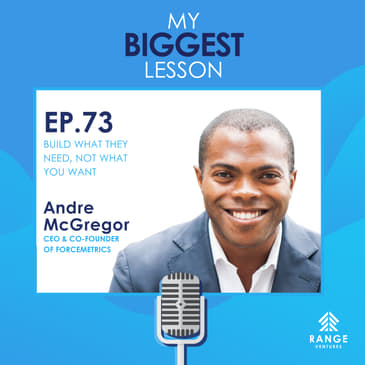
This week Adam speaks with Andre McGregor, CEO and co-founder of ForceMetrics, a platform that empowers law enforcement with precision policing tools and innovative tech solutions. His experiences growing up in a marginalized community and as a former FBI Special Agent (in cybercrime and counterterrorism), shaped his commitment to creating safer, more informed interactions between police and the public. On this episode, Andre shares insights on user experience in real-world scenarios, the challenges/opportunities for startups in the GovTech space, and the importance of quickly adapting to feedback to meet customer demands.
Listen now on: Amazon Music (Alexa) | Spotify | Apple Podcasts or wherever you get podcasts!
Connect with hosts Adam and Chris and the Range VC team on LinkedIn
https://www.linkedin.com/company/range-ventures/
Check out more about what we're up to at Range.vc
See Privacy Policy at https://art19.com/privacy and California Privacy Notice at https://art19.com/privacy#do-not-sell-my-info.
[00:00:01] Hello and welcome to My Biggest Lesson, the show that brings you the key learnings from the most influential founders, executives, and investors in the Colorado tech community. My name is Adam Burrows. And I'm Chris Erickson. Together, we are the co-founders of Range Ventures, an early stage venture firm based in Denver. You can find out more about what we're up to at range.vc. Our guest this week is Andre McGregor. Andre is the CEO and co-founder of Force Metrics,
[00:00:31] a technology provider to law enforcement agencies that helps enhance situational awareness, de-escalate conflicts, and support community-driven law enforcement. Prior to starting Force Metrics, Andre was a special agent with the FBI where he tackled high-profile cases in cybercrime and counterterrorism. Andre, thanks so much for joining us today. No, thank you for having me. So you've got a fascinating story yourself, but before we go into that,
[00:01:00] for those who aren't familiar, maybe share with the audience, what is Force Metrics? Sure. Force Metrics is a decision-assist platform specifically designed for patrol and dispatch to be able to make better decisions in the moment. You think of it in the perspective of surfacing safety social needs on a personal location or situation in seconds on their smartphone and kind of this Google meets Zillow experience. So we take the approach of when an officer is interacting with someone, the first thing top of mind is, are they going to kill me? The second is, are they going to kill someone else? The third is, are they going to kill themselves?
[00:01:29] And then why am I here? What's your social truths? Are you deaf, hearing impaired, have a military background of PTSD, autism, dementia, domestic violence, victim, homeless? We surface that on their smartphone so that they can make decisions in seconds and have a positive outcome. So this is going to get a little bit into who you are, but how did you come up with the idea to start this company? Yeah, I joke. And I say that I, when I was a kid, I never said I wanted to play with local law enforcement data, but a confluence of a lot of things happened. I'm a Denver native, rare as we
[00:01:58] are, but great to build a company back in the Denver metro area. Brown University, Goldman Sachs, until I was recruited by the FBI after Quantico and the FBI Academy, they stuck me in Manhattan. They worked counterterrorism, Italian organized crime and cybercrime for much of that time. Hacking was a big thing from nation states, China, Russia, Iran, North Korea, and there was no one really to investigate. So we built a squad to do that. And so I got deep into sort of databases and how we look up information. And what I realized over time was it's actually really hard to pull out information
[00:02:27] very quickly. And so in a crisis of consciousness in 2020 with George Floyd and my, my academy classmate was shot and killed in Miami and around the same time as well, I wanted to do more. I wanted to be part of the decision-making problem. And so we built force metrics on the heels of two disasters and said, how do we surface the information that someone going into to respond has all the information they need at their fingertips? You know, it had great benefits from a lot of agencies that opened
[00:02:57] their doors and said, we want to solve the problem too. We don't know how to solve it, but we're willing to allow your engineers in. So you're a first-time founder, how's the experience been and how is it different than what you expected? Yeah, no, I'm a first-time founder. For people that can't see, I would guess I'd be considered one of the marginalized groups that are seeking money. I'm a, I'm an engineer, I'm a law enforcement officer. I never expected to create a startup. What I will say is I had great mentorship. When I,
[00:03:25] this entire process started when I got a random LinkedIn message from one of the partners at Sapphire Ventures, Elizabeth Patterson and random out of the blue, I wrote an op-ed that CNN picked up and she reached out. She said, Hey, I just want to talk to you about this op-ed. And as we were talking again, random during COVID, she said, I think you could make a business out of what you're trying to solve. And I'm like, I've never done this before. She's let me connect you with someone in Colorado
[00:03:51] that started a business conversant, Steve Foster, his CEO, Patrick, and just have a conversation. And so I sat on a coffee out in Park Hill and learned a little bit more about how they built their businesses. The need of course is always capital, but the idea is just as important. So we fleshed out of a pretty decent business plan. My, my first investor was Melody Hobson, chairwoman of Starbucks and Ariel Investments. And I remember pitching to her and we were on Zoom
[00:04:19] because again, COVID and I'm 15 minutes in and she says, I'm going to stop you right there. I will give you whatever money you want. And I'm like, what? She's like, you are actually trying to solve a problem. Other people are just admiring. And I'm like, wow, that's, but she's like, I can't give you less than a million dollars because that's, Oh, that's a lot of money. And I'm like, so actually I can give you all of it. I'm like, no, I need to keep space for other people. So reminder to entrepreneurs out there, don't go to Andre for fundraising. This is not how it
[00:04:46] works for most people. But what I didn't, what I didn't say is that prior to that, I've had, I had several no's that kind of led me to craft my message and how to pitch. And I think the thing I've learned over time, and this was a very important lesson that I didn't respect at the time was you have to understand and care about your LPs. These people are putting money in to a venture expecting an outcome and they deserve that. And so when you are taking in this fundraising money,
[00:05:12] it's just as important to think about that exit, whatever that is, as long, as far as it is, I didn't really understand that right away. But over time, multiple fundraising rounds, you start to understand that the purpose of business is business to quote the movie back to school with Ronnie Dangerfield. I love that movie. Love that movie. I love that back to school quote on this podcast. That's amazing. And I would say just as a founder, having mentorship that can help me navigate the landmines,
[00:05:38] it's hard to raise money. It's hard to raise money in general. It's definitely hard to raise money in GovTech because cybersecurity, AI, both are very sexy. GovTech, they're like, oh, boring. Or do they even buy technology and all this other stuff? And I have to go back to them and say, do you not realize that your taxpayer dollars, all of our money goes to these police departments? And when you look at a city's budget, 40 to 70% of your taxpayer money go to the police department. Why? They're
[00:06:08] open 24 hours a day. They pick up the phone when you call and they send someone to those are all very expensive things. So it's actually one of the best opportunities because their budgets when they don't run out of money. Absolutely. It's interesting. You probably know another founder in Denver, Adil Khan, who has magic school, son of K-12 schools. Same thing, right? Same thing you hear about GovTech, education. And it's so great to see the two of you building such awesome companies
[00:06:35] in those spaces here in Colorado. On that note, and you as a Denver native specifically, what's it been like to build a company here? Have you been able to get the mentorship that you need? Yeah. It's interesting starting a company during COVID. So first off, you're trying to transition from in-person Zoom to the real world. The mentorship is there. So I have some really good contacts and advisors and people that are on my board that are from here and understand the space. We're in nine
[00:07:01] cities and counties in the metro area. So we actually power half of the metro area in terms of force metrics and decision-making. And so when I look at it, it's like my home, the home I remember from when I left, the home I came back to and I want to make better and I get to be a part of that. So I'm very blessed that the metro area embraced our technology and didn't necessarily look outside to
[00:07:25] Silicon Valley or other places, but rather saw that we can build here in house and serve our citizens. That's great. Any other companies here in Colorado that as you've gotten to know the scene better that you're particularly excited about right now? Yeah. I would say if I go back to that advisor mentorship side three, four years ago when I was just coming with this idea and people connected me with John at Iterate AI, they're like, Hey, maybe we can help with our technology with what you're doing and a variety of stuff like that.
[00:07:53] We still didn't even know what we were building at the time, but it was great to stay in touch, watch the progress of their company. Obviously they were spouting AI before AI was an acceptable term. So bravo to them for staying the course and having such great technology. And the thing that kind of linked us up together was we were trying to solve public safety issues. They were solving similar issues with private sector. So they had companies that were having thefts,
[00:08:23] injuries to employees and a variety of stuff. And they were using that data to help them make decisions of how to automatically secure a door that is detecting that there's a gun walking up to it at a convenience store, right? Or some of the largest brands that are constantly dealt with shoplifting. How do they use that data that's collected through IOT devices to support investigations? So they were doing this stuff. They were privatizing security before many people even knew that. So
[00:08:49] that's number one. Number two, I'd say the godfather, at least for me in my short time of building company is Ibotta. Brian Leach is a great friend at this stage. He's opened his Rolodex, his cell phone, his advice and guidance on patents, on how to navigate lawyers in general. He was a lawyer, how to not spend too much money. He's someone that I could pick up the phone right now, asking a question. And somehow in three minutes, he was able to cover 30 minutes of a conversation.
[00:09:17] Shout out to both John and Brian, who are really involved with us on the AI legislation here in Colorado too. And I think embody what you're talking about, which is people who really don't just care about their company, but really care about the broader ecosystem and helping the next generation of entrepreneurs. Awesome. Glad that you're part of that group. Audrey, I want to segue to the main topic of discussion, which is biggest lesson you've learned. You've got an incredibly unique set of experiences from high finance and Wall Street to FBI and crazy stuff that you've
[00:09:45] done there to now building a tech company. So from all that, what's the biggest lesson you'd like to share? Yeah. I wish we had the time to talk about some of the cases on the FBI because sometimes I forget how we had the subway bomber case and NASDAQ got hacked and a variety of stuff to work on or be a part of. My biggest lesson I would say is quickly adapting the feedback. And really from my perspective, how do we prioritize the user experience? And I say this because my team and myself included,
[00:10:14] we're engineers. We tend to want to tinker and add and iterate. Our users are not. Our users are regular people. And when I mean by regular people, they are doing their job from the vantage point that they have. And it may be from the point of a police officer. It may be a dispatcher. It may be a social worker. It may be an animal control officer. And when you're building into that environment,
[00:10:38] you're recognizing that you have to take in feedback and you have to allow for the critical feedback to come in. Because if you let an engineer build what an engineer wants to build, they build what they want to use. And I think the success for what we've had really comes from the fact that we have a simplified sort of user experience UI and in UX. And so when people look at our application, they ask the question, especially like new users that come in, they're like, how did you build this?
[00:11:05] How did you like, this is exactly what I'd want to use. I'm like, I put engineers in cop cars around the country. And I said, go pull people over, go to the domestic violence call, actually answer a 911 call in a dispatch center and understand what the problem is because you have to see it and smell it and hear it. If you're just taking in the requests with a little bit of user story, you still don't really understand maybe how all that melds together. And then you may not understand
[00:11:32] the dynamic nature of law enforcement. I could say there's the kind of be crass for a moment. If you've had someone at gunpoint, the last thing you're doing is thinking about pulling out your smartphone and holding it up while you have one hand on a gun. So you recognize that, how do I now think about getting that information before you get to gunpoint? How do I get that information to the right people? So they can relay it that even if you're at gunpoint, you can still hear it.
[00:11:58] You're not going to really know that unless you're in that environment. It's a little bit bad for HR in some capacity because you're putting people into the things that they see on television, but instead of it being solved at the end of 60 minutes, there's still human suffering there. They have to also want to be in that space because it's a little intimidating being around a bunch of officers that have guns all the time. They're people that used to getting their way. They're
[00:12:25] the officer in a room of 20 people and they have to have control. They're going to want to push their ideas out on you and expect that you do it. How do you feed that in? And I would just say, once we get feedback, quickly adapting it. And then when we adapt it, test it. Really fascinating. When did you, at what point of the company's inception evolution, did you decide, Hey, we're going to put everybody in a cop car. We're going to make sure people have that kind of experience. Was that something that came out of some misses you saw or was like from day one, you realize that had to be the case? Yeah. Yeah. I would say when we've,
[00:12:55] it's funny when you, when I look back at the original pitch deck that we had back in 2020. And I look at today, we actually haven't veered too far off for what we wanted, which is amazing. Cause I, I hear oftentimes that there's significant pivots, but you know, what we did notice is that we, we definitely changed sort of the perspective that we started. So when we started the company in the world of everything that was falling apart in 2020, we were saying, how can we get the right responder to the right situation at the right time? And we were very focused on, Hey, how do we get
[00:13:24] Andre? Who's the best trained person for this situation to that call until we talked to one chief that says, I don't have enough officers. I got to send whoever's the closest or whoever's free. I don't get the luxury of saying, I want this particular officer or that particular officer. When that came up, I said, I don't really understand all the nuances. I was a firefighter for 12 years. And I still don't have a good idea of all the different facets of local law enforcement as a
[00:13:50] fed. And so we got invited to come out to an agency out in Abilene, Texas. He was like, Hey, can I get you on a plane to come out here and understand what's going on? And brought a couple engineers with me. And he was like, yeah, let's do some ride alongs. And then we said, okay, let's do it again in another city. Let's do it again in another city. And then we did the Venn diagram of, of what overlaps. And it's interesting is it's almost 98% of the time, everything overlaps
[00:14:16] because policing is roughly the same in all jurisdictions. It's just frequency that's different. So New York has more, more calls than Tampa that has more than Davenport, Iowa. How you police your community, very different, but what actually happens is roughly the same. So as we started to ride in cop cars around the country and continually do that, we started to realize they're all the same. Tampa has the same problem with homelessness as Denver. They just
[00:14:42] have it as a different time period. Denver doesn't have it right now because it's winter and cold. People are inside. We have the same problems in the summer that they have year round. Then we're starting to be able to adapt that to make sure that we are not a custom development shop. I think oftentimes we want to say that this is a problem that's specific to this community. And yeah, don't get me wrong. How you police your community and how you interact is different, but the problem is the
[00:15:08] same. And so once we figured that out, we created essentially a universal data model because we could take in data from all these agencies. We then started to create a universal platform. And now we are able to sell it with gross margins in the 80% and higher because now it's, you know, when we build to a problem in Tampa, it's easily applicable to Aurora, Colorado. That's phenomenal. But I love that you talked about not wanting to become a custom data shop,
[00:15:37] because even though I hear you that the majority of the data model and usability is translatable across the country, no doubt that different police departments are going to say, I need this one specific feature or I'm unique in this one way. How do you balance that with your team of, Hey, we really got to be vigilant about listening to customer feedback about doing what the customer says and yet not falling into that trap of being that custom data shop. How have you done that so well? It's been very hard because again, go back to the comment of saying you're dealing with a bunch
[00:16:05] of officers with guns that are used to controlling a scene or so used to getting what they want because they're in the room and they have to do that. So for us, we have to be the ones that say no, or we take the lawyer approach, which is no, but tell me why. And then once they start to tell us why, we start to say, okay, I'll give you an example. We hear a lot around like ingesting other applications into the data points into our application. And one of which is license plate
[00:16:33] readers, which has become a popular thing. And so we got one of our agencies out in Castle Rock. They said, Hey, we want to have license plate reader data in force metrics. And I said, what does that mean? You want a million data points that are generated weekly just to be searchable? No. What I'm looking for is we get about 3000 hits a day for vehicles that are on this hot list. And we're a small department. We can't chase all 3000. We need to prioritize. We need to know it goes to a certain case at a certain priority level. That's different. It's not that you just
[00:17:01] want data in for the sake of data. You have a problem. So for us, we almost see ourselves as advisors. Hey, let us in, let us understand the problem where I know that you're used to vendors lying to you because let's be honest, like vendors tend to lie. Like you go to a conference. I was a cyber guy and you go to any of these conferences. How is it? Every application can solve every one of my problems. Wait, you're an email application. I don't understand how you're solving my Kubernetes
[00:17:29] issues. Don't know. But you're saying yes, right? But I'm an engineer. I can at least debunk some of this stuff. If you're not that you might be taken. So you're constantly saying I need this way because it has to be this way. And for me, we need to schism some of this because when we look at the why it's okay. Why are we doing it this way? Someone taught me 20 years ago. They taught me 20 years. So is it still relevant? I don't know. We just always did it that way. So we want to be the ones
[00:17:57] that come in and educate and say, there are other ways with this work. And oftentimes they say yes. So it sounds like 200, you guys, the way that you've been focused on feedback has built a lot of trust with police departments in a unique way is what it sounds like versus other companies come before it. How have you done that? Was that something you purposely set out to do and felt like this industry and the buyer had been ignored or had been lied to over and over. And you really set out to proactively change that. Just wondering if there's any lessons in there that are applicable to other folks starting
[00:18:25] companies. Yeah. This particular industry is very insular. They trust within. So there is, there's a, they call the blue line for re like, Hey, like we're all together. And while I'm out, I'm still in, I've still been in a fight on the side of the highway, pulling my gun, expecting to shoot until someone else came in and got cuffs on the guy, or I've been in situations where I can understand why you take that certain action. So it's not that their guard goes down. It's that they're able to
[00:18:54] have an open conversation that normally can often have some level of resistance with who they're talking to, or they have to over-explain. And so I built a company, a lot of law enforcement people that are also engineers. We talked about Venn diagrams. That is like the smallest overlap that possibly exists is you're an engineer and you carried a gun and badge, like it's super small, but we're now able to be almost translators in the room for some of their problems. We're able
[00:19:21] to empathize and understand some of the things that they're going through. And then quite frankly, I just front loaded a bunch of security stuff with the company. Like my SOC 2 type 2 audit was one of the first things I ever did. Who as a startup spends tens of thousands of dollars on a SOC 2 type 2? We do. Because now when I go talk to a city and they're like, you're a startup, you're not really mature. It's like, wait a second, you have your SOC 2 type 2? You're audited? Okay. We're going to,
[00:19:48] maybe they have their shit together. Right? So you start to get these little piece of trust points. And then these departments, if something works, they love to tell their friends. If it doesn't work, they also love to tell their friends. So you have to think about customer success as much as sales. And you want to have the wins, which again, last year we found three suspected school shooters with our application. That's pretty amazing. On top of kidnapped kids
[00:20:13] and missing autistic kids and homicide suspects, things like that. Software did that. That's pretty cool. They want to also share that knowledge, that wisdom, that great story. So unlike other industries where maybe JP Morgan Chase doesn't want to tell Citi that they're using certain technology and definitely Walmart and Amazon, police departments, they want to tell everyone like when something works. And because we actually work and I actually say, Hey, I actually just did a
[00:20:40] demo this morning to a big consortium. I said, Hey, don't trust me. I'm a vendor. Even though I've carried the badge, I can still be lying to you. Back channel me. Give you a list of it. Don't even, you know, just asking either it works or it doesn't. Awesome. What a great story, man. I'm glad that you guys are doing this and glad that you're doing it right here in Denver. Andre, thanks so much for your time. Last question for you. How can the community help you guys today? Yeah. If you want to learn more forcemetrics.com, easy enough. But second is if you're listening to this and you say, Hey, I think this would be great in my community. Hit me
[00:21:10] up. Andre at forcemetrics.com as well. You'd be surprised how many agencies didn't know that we existed until someone said, Hey, you should take a look. And then they did. And next we're in and we're having positive outcomes. Help us out by bringing us into your community. Thanks so much, Andre.
[00:21:50] The RODECaster Pro 2 is the world's most powerful all-in-one audio solution for all types of creators, including podcasters. Graffiti and Julius use one at the plug. It offers studio quality audio and revolutionary features for creators. While being incredibly easy to use, RODECaster Pro 2 all-in-one production solution for podcasting. It's on sales for $690 right now. And there's a link in this episode description. Check it out.