
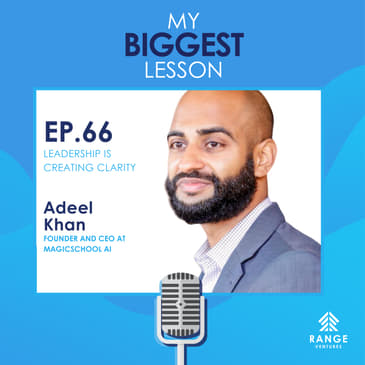
This week Chris speaks with Adeel Khan, the founder and CEO of MagicSchool.ai. Since launching a year ago, MagicSchool has become the most used AI platform in education and is the fastest growing technology platform for schools ever! Adeel is a former teacher and founding principal of the top performing public high school in Denver. He founded MagicSchool with the mission to bring an AI assistant to every teacher in the world. On this episode, Adeel shares his journey working in education with Teach America, his thoughts on Colorado's status as an innovation hub for both education and technology, plus the strategic aspects of clarity from leadership when scaling organizations.
Listen now on: Amazon Music (Alexa) | Spotify | Apple Podcasts or wherever you get podcasts!
Connect with hosts Adam and Chris and the Range VC team on LinkedIn
https://www.linkedin.com/company/range-ventures/
Check out more about what we're up to at Range.vc
See Privacy Policy at https://art19.com/privacy and California Privacy Notice at https://art19.com/privacy#do-not-sell-my-info.
[00:00:00] Hello and welcome to My Biggest Lesson, the show that brings you the key learnings from
[00:00:06] the most influential founders, executives and investors in the Colorado tech community.
[00:00:10] My name is Adam Burrows and I'm Chris Erickson. Together we are the co-founders of Range
[00:00:16] Ventures, an early stage venture firm based in Denver. You can find out more about
[00:00:21] what we're up to at range.vc. Our guest this week is Adil Khan, founder and CEO
[00:00:29] of Magic School. Magic School is one of the fastest growing products for K12 ever, with
[00:00:34] over 2 million educators using the product in just its first year. We were fortunate
[00:00:39] to lead the seed round in Magic School last August and the company just announced a $15
[00:00:44] million Series A led by Bing Capital Ventures very recently. Before starting Magic School,
[00:00:49] Adil was a Teach for America fellow, a teacher, a principal and a successful
[00:00:54] founder of a charter school here in Denver. Adil, welcome to the podcast.
[00:01:06] Thanks for having me. Excited to be here.
[00:01:07] Yeah, excited to have you here. So before we jump into the biggest lesson and talk a bit about Colorado,
[00:01:13] would love our listeners to actually get to know a bit more about you. I'd say you have a more
[00:01:18] non-traditional background for a lot of the tech founders we have on here. So if you could share
[00:01:22] a bit about your background and then tell us how your background led to you founding Magic School.
[00:01:28] Yeah, again, thanks for having me. Really excited to share more about Magic School and so much
[00:01:33] of our story is tied up in my own. That started as an educator after college and I joined Teach
[00:01:39] for America. And I think the premise of Teach for America is you go into a community where
[00:01:43] the schools need help. And that was very much the experience that I had in going to become a
[00:01:50] teacher. I was a special education teacher, an English teacher in a high school in the
[00:01:54] Atlanta area. And while we had really amazing educators, a really amazing community and great
[00:02:00] kids, the school just wasn't serving them the way that they deserve to be served. You know,
[00:02:04] join Teach for America with this idea that I know that I'm not going to regret helping kids
[00:02:08] for two years and it's a two year commitment and I'm not sure what I'm going to do after,
[00:02:12] which a lot of people join Teach for America with that idea in mind. And
[00:02:16] I joined in state, I fell in love with it and like love the kids, love the community
[00:02:20] and felt like this real sense of injustice that was happening in our public school system.
[00:02:25] And I wanted to be a change maker. And it's weird to say because most people don't think
[00:02:31] that like a principal is like a glamorous job and it's not, it's really hard work. But I wanted
[00:02:36] to be a principal very soon into being a teacher because I thought of leadership as like an
[00:02:41] opportunity to make a big change in the system. And being a principal would allow me to make a
[00:02:46] greater impact on the students that I was serving at the time. And I've been like
[00:02:49] a leadership three my whole life. I'd like been reading leadership on so I was a student
[00:02:52] body president in my college, all that stuff. So leadership, it just kind of been on,
[00:02:56] was always on my mind even in my first days in the classroom. I ran really fast at that goal,
[00:03:01] moved from my Teach for America school to a school in Atlanta where the founding principal
[00:03:06] was there and I didn't know that you could found a public school. So that was really exciting
[00:03:10] to me and the school that I'm a part of that was led by an amazing principal was just,
[00:03:15] you know, I knew I wanted to found a school like that. That brought me after kind of a
[00:03:19] Stanton graduate school to learn how to be a principal, brought me to Colorado where if you
[00:03:24] didn't know this Denver is kind of like the education reform capital of the world.
[00:03:27] There are about a quarter of the public schools in Denver public schools are public charter
[00:03:31] schools and I knew that there'd be an opportunity to found a school here greater than most
[00:03:37] ecosystems in the world. I always say like Denver is kind of the Silicon Valley of
[00:03:41] public education if you think about like all the innovation that happens here. So ran really
[00:03:47] fast at the goal and was an assistant principal and principal of residence program
[00:03:51] and then founded my own public high school in Colorado called Conservatory Green High School
[00:03:55] in the Central Park neighborhood. And it is my dream manifests incredible school with a very
[00:04:00] simple promise that we're going to love the heck out of kids. We're going to hold them to
[00:04:03] really high expectations and believe in them deeply and great things will happen.
[00:04:07] And they very much did. The majority of the kids who go to the school are from
[00:04:10] low income backgrounds. Majority are kids of color and 100% of them are accepted to
[00:04:14] four year colleges year after year and it's the top performing public high school in Denver.
[00:04:20] And from there I went on to coach principals for a year and then I took some time off.
[00:04:24] I'd been doing so much. I've been running so fast at this goal. Founder to school from 10
[00:04:29] employees to 80 employees to graduated our first class of seniors and I was exhausted and ready
[00:04:35] and also led through the pandemic you know the in and out school and had to figure out
[00:04:40] what virtual school looked like for a year and a half. It was a lot. Did some travel all around
[00:04:45] the world came back to Colorado and it was right around November December 2022. This is
[00:04:49] right when generative AI was changing the world. ChatGBT was dominating the headlines and
[00:04:56] it just struck me as I've been kind of a tech geek my whole life as I had had some time on
[00:05:01] my hands. I was looking for my next opportunity to play with it and I was just struck by how
[00:05:05] much utility there was for schools and educators in this new transformative technology.
[00:05:10] And started by kind of bringing that to you know former colleagues and saying hey check out
[00:05:15] all these cool things that chatGBT can do. Confirm my suspicion there was a lot of utility
[00:05:20] in generative AI for educators and then I found that like people weren't using it very much
[00:05:24] in schools and it was like a little slunky. The user interface wasn't friendly to educators
[00:05:28] who already had 20 million jobs so like adding prompt engineer to that list wasn't going to be
[00:05:33] likely in the cards and then you know with some nudging and support from friends who'd been
[00:05:38] kind of in tech they were like you know you can do this. I've seen you build something before
[00:05:42] yeah you might not know tech very well but you know how to build things and you know education
[00:05:46] so go for it. And that's all it required was a really simple nudge so kind of bootstrapped
[00:05:50] in that MVP together of a product called Magic School which we launched literally one year ago
[00:05:56] today. Today is Magic School's birthday so super special day for how far we've come.
[00:06:01] And that launch was a loom video with me in my living room which is where I'm at right now
[00:06:07] saying this is this platform I built with some really cool tools I think will help educators
[00:06:12] and a year later it's we've acquired over 2.1, 2.2 million educator users.
[00:06:19] I believe we have reasonably we have an educator at every single school in America
[00:06:23] and beyond internationally that's a hard number to calculate because using Magic School it's
[00:06:28] more likely if you're an educator that you've heard of Magic School than not heard of it at
[00:06:32] this point and all within a year we're partnered with over 3,500 schools and districts
[00:06:37] around the country many of which are here in Colorado, Boulder County Schools,
[00:06:41] Aurora Public Schools and some new partnerships with a lot of the school districts around town
[00:06:47] and yeah it has been an absolute dream but that's the long and short of it.
[00:06:53] That's an amazing story and one of the things that we love so much about meeting you in
[00:06:58] Magic School was the journey from start of being an educator your passion for that and
[00:07:04] what led to the insight to start Magic School. So one of the things you mentioned Colorado being
[00:07:10] an amazing place to innovate as an educator also would love to hear your perspective on Colorado
[00:07:16] Tech you've been in Colorado a while but sort of newer to sort of the Colorado tech scene.
[00:07:21] What excites you about what you see here and are there any companies besides Magic School
[00:07:26] that are you know earlier stage that you're also keeping your eye on that you're excited
[00:07:30] by? I'm so new to the startup and technology space in Colorado so a lot of this has been
[00:07:35] me learning the story of tech in Denver and the greater Colorado ecosystem. So a couple
[00:07:44] just like insights I've gained is somebody who's lived here for a decade and had no
[00:07:48] idea this even existed is one it's like a really robust and like supportive ecosystem.
[00:07:53] I got to be a part of Denver Startup Week this year and I was just so inspired from
[00:07:58] how many people showed up the energy the excitement the different kinds of companies
[00:08:02] that were represented. There's so many great things happening in Denver around
[00:08:06] the tech startup scene so that that's just been inspiring and genuinely new to me.
[00:08:11] I've had friends working in tech and you know the company that comes to mind
[00:08:14] in like the tech space as like another one that you know isn't smaller than us but like I
[00:08:20] admire is certainly Guild. I have one of my closest friends is an engineer at Guild so I'd
[00:08:24] heard about his story and the things that were happening that had been happening there
[00:08:29] and obviously like they've done an incredible work and we're definitely a company that we admire.
[00:08:36] It's tough for me to I am so in my own world. I think about my own company every second of
[00:08:41] every day and I think that I'm just so unbelievably excited about what we're about
[00:08:46] and the way this has happened. Good as a founder should be right and should be focused.
[00:08:52] That's great and I think that's one of the things that I love about Colorado Tech is sort
[00:08:58] of the welcomeness and openness right and sort of the people want to help and connect with
[00:09:03] each other and I think that that makes everyone in the ecosystem better overall.
[00:09:09] So let's switch a deal to sort of the reason we're here. We'd love to learn the
[00:09:13] biggest lesson that you've learned in your career. What's the lesson? How did you learn it
[00:09:19] and how does it influence how you work or interact with people today?
[00:09:24] Maybe a novel thing that I'd share is I've thought of myself as a leader since I was like
[00:09:28] again 14 years old reading books and that's really weird. So like while I'm not that old
[00:09:33] maybe I'm maybe I am getting older. I have thought of myself as a leader in terms of
[00:09:38] decades pretty quite a while right like three decades and one of the things that I continue
[00:09:45] to see in my different experiences and like in some ways running like founding a public
[00:09:49] school is much harder than having a tech startup. In some ways it's different but
[00:09:54] like there are some very difficult things about having a school. One thing that occurs in all
[00:09:58] of these circumstances I have has been brought to me in this experience that resonates with
[00:10:03] my first one is so much of leadership is about creating clarity. So like and founding
[00:10:09] something is about giving people direction through clarity. So I'm trying to think of
[00:10:14] something that really illustrates that for me. I've had this like mirror held up to me
[00:10:20] but you know one of the superpowers of magic school is we're able to move extremely fast.
[00:10:24] Like I think speed is like a core competency of why we've been able to be so successful
[00:10:28] in an incredibly competitive environment of AI and AI and education is also a hot button
[00:10:34] thing. Is that our team typically knows exactly what they are doing this week,
[00:10:42] what our goal is this week, what we need to accomplish. The most clear example of that
[00:10:47] from this last like two months has been when we launched the business side of the platform
[00:10:52] started monetizing we had all of this revenue that was contracted that we have to convert
[00:10:59] where we were essentially coming up on our first renewals as a company. We had a lot
[00:11:03] of outstanding revenue that needed to be renewed and you know we had a short period
[00:11:08] to kind of get people to be convinced this is something that they wanted to
[00:11:13] make a commitment to or schools and districts all over the country and world
[00:11:16] make a commitment to in the following year. So every single function of the organization
[00:11:20] was focused on what can we do until that big date of renewal. Most of our contracts are on
[00:11:26] a school year contract so there's like an actual date when they renew that is not very
[00:11:30] spread out. So every function knew what they were doing. The engineering team was building
[00:11:34] right features to make sure that the customer was really happy and really excited about
[00:11:38] that renewal. Our customer success team was making sure to do outreach, communicate really
[00:11:43] clearly all the value that had been driven to our customers through data dashboards,
[00:11:48] through direct reach out monthly meetings. So everyone knew what we were going toward
[00:11:53] and every function had a part of that goal that they could attach to and then you know
[00:12:00] at the end of it we could all celebrate together when we you know we accomplish this
[00:12:03] big moving thing. And the next thing for us is the start of next school year. So we're all focused
[00:12:08] on the start of next school year doing everything we can that's like another and it was a basketball
[00:12:13] analogy it's like that's tip off for Magic Schools. Like the school year starts right
[00:12:16] around August we're gonna have everything ready for when you know teachers are coming out from
[00:12:20] their summer hibernation and vacation and we want to be really ready to deliver the
[00:12:26] absolute best platform for them, for both the customers and also our users to feel really
[00:12:31] excited about the school year again and remember that Magic School is there for them and can
[00:12:36] support them. I want to go back to something that you said earlier in the conversation about your
[00:12:41] school leadership time right? I think you mentioned you went from sort of 10 to 80 people
[00:12:45] right during that time and you know I know you're a little bigger than that now at Magic
[00:12:50] School but you're gonna go on the same type of journey there as well. How do you think
[00:12:54] about maintaining that clarity as the team scales and the org gets bigger? Are there things that
[00:13:03] you you know are already thinking about that you're gonna have to change how you technically
[00:13:07] do things or something like that just as you scale down the road? Yeah I think that you know
[00:13:12] it's a big focus of the company right now is like the word clarity is a thematic thing
[00:13:16] that is happening as we're growing each of our functions is that you know what how are we
[00:13:21] documenting our processes and creating processes where there used to be real really casual kind of
[00:13:27] conversation or very easy because there were direct lines of understanding between the smaller team.
[00:13:34] Two I think having the right functional leader in the right place and having like the right
[00:13:39] people report to the right places and then three I think I always thought about when we
[00:13:44] were expanding our team as a school that I think about here too is that the folks who are
[00:13:49] early on the team are so core in carrying forward the culture and the message of like what why we
[00:13:55] were started who we are the way we do things because systems can cure a lot of ailment that
[00:14:00] happened in like the growth phase but culture can't be systematized and often it's like the
[00:14:05] people that you put um the other people who were in like kind of those those first stages
[00:14:11] who understand why we've been successful and can keep kind of that energy going
[00:14:15] and it's important that they know they are leaders in that there is much leaders in that as I am as a CEO
[00:14:20] of the company and they carry that both burden and privilege of like with new people they're
[00:14:25] going to ask you before they ask me how do we do things around here you know are our values just
[00:14:30] things that are on a wall or are they actually things that we deliver on and we think about
[00:14:34] we make a part of our decisions and people will read that based on the way people operate
[00:14:39] and what they hear from like your the legacy employees that have been around more than even
[00:14:42] the leader so empowering those folks who've been a part of that early journey to to be leaders is
[00:14:49] I think really important. Yeah I think that you know getting the early culture right and the
[00:14:54] early leaders is so critical and and unwinding mistakes is really painful as well right in
[00:15:00] the same vein with it um as you think about that you know how have you thought about bringing
[00:15:07] the the values and the clarity and the ability to lead into your hiring process right because
[00:15:13] you've brought on some great leaders already they're doing exactly what you want from a
[00:15:18] leadership and clarity culture perspective have you started to systematize anything into your
[00:15:23] hiring process to help maintain the same things or you know those leaders are deeply involved
[00:15:29] and and they're going to naturally maintain it how are you thinking about that as you
[00:15:33] continue the next phase of growth? We're doing a lot of calibration right now around like what
[00:15:38] we're looking for in each role and each candidate so that one we can be really really aligned on
[00:15:43] like the need that we're filling with the role before we kind of start like interview processes
[00:15:48] or start a search um and we're staying really close to the processes we're making sure that
[00:15:55] like processes are really thorough we benefit a lot from being a pretty hot company right now
[00:15:59] in like AI space where a lot of people work and it's there's a mission and impact here
[00:16:04] that I think is really compelling to get some really attractive candidates and also even though
[00:16:09] those folks are brilliant and talented we're uh that we are we are so inspired by the people
[00:16:14] that we get her talk to in these processes there's also the part like do they fit our
[00:16:19] culture and are they the right person for magic school so we need to calibrate on what
[00:16:24] that means because you know Stanford Harvard really person who checks every box on like the
[00:16:32] on the resume side uh the reason why you interview them is to find out if they're right for us
[00:16:36] and we need to count on that and then we after we do the calibration it's like let's get three
[00:16:40] or four really incredible people uh through like our final phase we have like projects they
[00:16:46] do the pretty thorough interviews that we're doing now um and trying to make those as
[00:16:51] consistent as possible so we can have a really fair and equal framework and then debriefing those
[00:16:55] folks and coming up with me who we think the best fit is amongst people who we generally think
[00:17:01] are really qualified like and that's a good problem to have is right these folks we think
[00:17:05] can do the job but like who's going to do it best who's like the best fit for where we
[00:17:09] are in this moment uh so that we can make really good decisions yeah I think it it's it's
[00:17:17] interesting you know the both the culture piece and the clarity piece um I think sometimes companies
[00:17:24] don't learn the importance of until they get bigger and they learn the importance of it
[00:17:28] because things have gotten messy right but you have the experience of having built things
[00:17:33] before not in the same vein but where clarity all these things are just as important right
[00:17:38] type of thing so I think you have a really big unfair advantage is you go into this insane
[00:17:43] phase of growth that that you're having so deal where can our listeners you know follow along what
[00:17:48] you're up to what magic school is up to so they can see the latest yeah you can connect with me
[00:17:53] on linkedin it's a deal con I'm like I now become a little bit more of a regular writer
[00:17:57] of things uh fun new persona I've taken on uh so I share my thoughts along there magic
[00:18:03] school is on every social media thing in the world magic school ai we're frequent posters
[00:18:09] well deal thank you so much for joining us