
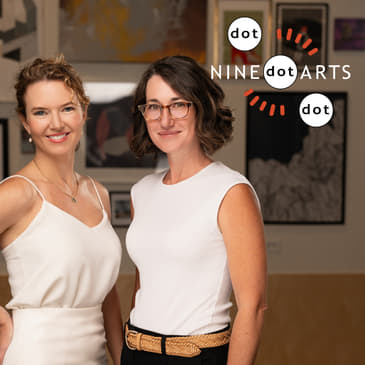
Founders Martha McGee and Molly Casey share how NINE dot ARTS was built—from a recession-era pivot to a multi-million dollar business.
For show notes and more: https://ninedotarts.com/podcast-100th-episode-special
See Privacy Policy at https://art19.com/privacy and California Privacy Notice at https://art19.com/privacy#do-not-sell-my-info.
[00:00:00] This podcast is powered by The Plug. Welcome to Dot Dot Dot, the continuing conversation around art, placemaking and how to create meaningful experiences in the built environment, all while making a positive social and financial impact.
[00:00:23] This podcast is hosted by experts at Nine Dot Arts, a national art consulting and creative placemaking firm that helps clients differentiate their projects through the power of art and culture. Well, hello everyone. I'm Olivia Dahlquist, Senior Marketing Manager at Nine Dot Arts. And today is a very special day because it is our 100th podcast recording. Cue the fireworks.
[00:00:51] So instead of bringing in a guest, we thought, why not flip the mics around? So today I have the privilege of interviewing our founders, CEO Martha McGee and Chief Curator Molly Casey. Hello. Hello, hello. Well, thank you for all the hosting you've done and thank you for now being our guests. You have spent years collaborating across the real estate and the art worlds, talking to so many innovative leaders.
[00:01:19] But when we received questions today from the audience, one of the main ones was really about connecting the dots, excuse the pun, on your own story and just learning about how Nine Dot Arts came to be. So to kick things off, I hope you can take me back to 2009 and really the founding of the firm. How did you start Nine Dot Arts?
[00:01:42] Well, it goes back actually before 2009. So in 2005, 2006, 20 years ago, when we were just toddlers, Molly and I met, we were both in the art industry. I was working in a gallery called Walker Fine Art and the Golden Triangle, and Molly had the best job.
[00:02:07] She worked at an art consulting firm called McGrath & Braun, and she was their art director. So she was managing all of the artists that were interested in applying. And then she would come over to the gallery and buy artwork from Walker Fine Art. And so it was the most exciting day when she would walk in the door. So we became friends, fast friends, through that proximity and just collaboration of working together. We'd go out for ice cream in the neighborhood.
[00:02:34] And when there was an opening at McGrath & Braun, I had the great fortune of getting selected to work there alongside Molly. We built a great relationship and collaboration at this firm. And long story short, I'll go with the very short version, but that company really struggled during the 2008-2009 recession.
[00:03:00] And the short version is the owners transitioned to a different ownership right before the recession hit. The new ownership just wasn't prepared for it and was left in a really difficult position, and they were facing a bankruptcy. And so Molly and I actually came in to support them through that effort and then also create the foundation to start Nine Dot Arts.
[00:03:28] So in that negotiation, when this one company was just simply not going to survive through that recession, Molly and I created a deal with the current owners where we would, one, make sure that all of the artists who were owed money were going to get paid. Number two, we were going to help them finish out any projects that we could complete in 90 days.
[00:03:54] And then third, that business was going to support the founding of Nine Dot Arts for any contracts that were going to extend beyond 90 days. So we actually started Nine Dot Arts with three contracts in place, which is so exciting to be a new business, and starting with three deals already underway. And those three were very successful.
[00:04:21] And in that process of beginning, the thing that you don't always know is when you are starting, you don't know if it's the bottom. But turned out, it was. And then there's nowhere else to go but up. So in addition to starting with these three contracts, we're making our way. We're a small, scrappy, bootstrap business, as we've always been.
[00:04:47] And in those initial years, with those initial projects, we were trying to get things going. We were about $600,000 in revenue, which is an entirely different world than the $9.5 million revenue company we were in 2024. So you can see how much we've grown and expanded. My goodness, what is that? That's more than tenfold.
[00:05:16] Let's do the math on it. Is that like 14-fold since we started? Don't ask me. It's a lot. I'm going to do the math. It's a lot. But that was massive growth that we've experienced since we started in 2009. But one of the first big points for us as Nine Dot Arts was getting a million-dollar contract. Because those are the ones that are big. They're meaningful in our world.
[00:05:43] And that first million-dollar contract came in. And Molly and I knew enough to know what we didn't know, which is also a skill. And we knew that we didn't have enough people and the full expertise to do the work. Of course, we said, absolutely, we can do it. Bring it on. And we called our original mentors who had founded McGrath & Braun. They ended up, like I mentioned, selling it to a third party.
[00:06:10] But our original mentors from McGrath & Braun actually came out of retirement to support us with that first major contract called Jackson National Life. That was in 2011. And they earned back all of the money that had been lost in the bankruptcy of the former business. So it was, I think, just a massive success story on all fronts. And no one knew it was going to turn out that way. But we were always looking for the opportunities to do the right thing.
[00:06:39] And in the end, I think we definitely came out ahead. Yeah. It's been a journey. No, it's been a journey. Well, and I think one thing that Martha didn't touch on was just in that founding story. I mean, obviously, we came from a place of necessity, right? We didn't set out like entrepreneurs, right? We're both art student backgrounds. And we don't have any business degrees. We haven't taken business classes. I took a math class in college called Math for the Creative.
[00:07:09] So that's why I'm not doing the math. Yeah. Because it would be creative math. But I think one of the things that was really interesting in the founding of Nine Dot was as we realized what was happening and that, you know, the McGrath and Braun wasn't going to continue anymore. We kind of had a choice of, well, do we part ways and say goodbye and try and go get a job at Starbucks maybe or something like that?
[00:07:35] Or do we want to see if there's like some viability to us continuing this on? Because we do have clients right now that need us to finish these projects. So that's cool. Like if you're going to start a business, let me tell you, that's the way to do it with some business already coming in the door. But one of the things that was really interesting was we did an exercise where we each wrote down our favorite and our least favorite things about our jobs.
[00:08:03] And we came to the table and it was kind of this like, okay, I'll show you mine if you show me yours. And we showed each other and we were like, oh, my God, we're like exact opposites, which is so perfect for a partnership because I'm going to do the things that you don't want to do. And you're going to do things that I don't want to do. So we're not going to be like fighting over the same position. To me, that was like a very enlightening moment where I was like, oh, this can work because we've been, you know, people are like partnerships.
[00:08:32] Oh, my gosh, this can be so hard. But that really gave us a lot of clarity around how we could be successful with this and complement each other's talents. So that was exciting. Yeah. There are not many partnerships that last. And we've been together for 20 years. Still happy. Still totally in love. And it's been a wonderful journey.
[00:08:57] And like Molly said, I think the key was, you know, understand each other, understand each other's strengths. And that initial part where we were trying to figure out what we were good at, I actually do love the numbers. I took math for creatives, too. But I'm really I'm into the numbers when it when it makes something make sense for a business strategy. So I'm going to go ahead and say it's like 15 X of where we were from basically 600,000 in revenue to almost 10 million.
[00:09:26] So it's been a big growth journey. But it all has been focused on growth and learning at every step along the way. We've had incredible mentors. And I also want to give a shout out to the public library system because they provided so many books on how to start a business that we read and influenced how we built the company. Our very first budget was from a book that was about how to start your business.
[00:09:56] And it had a CD-ROM in the back of the book that you could you checked out as part of the book and you would download a budget builder. So our first budget for Nine Dot Arts was from the CD-ROM at the library to give us a template on how to build a budget for our profit and loss statements. So shout out to the public library system. We appreciate you. Who needs grad school?
[00:10:21] I think one of the things that comes through for me is just this story of mentorship, too. And all that you learned from Mae Vignetta at McGrath and Braun and now all that you are sort of teaching to our team here. And like what a privilege that you get to pass that on and give amazing opportunities to not only the artists that we work with, but, you know, folks in the creative world like myself who get to have this job. So kudos.
[00:10:48] And one of the questions that we often receive is about the Nine Dot Arts name. How did that come to be and what does it really mean for how we operate today? Well, I have to start off by saying Martha and I came up with a like multiple pages in a notebook of horrible names. Horrible names. Like she still has a notebook. Oh, my God. We have so many bad names. I would love to see that. Yes, you would love to see that.
[00:11:16] I don't know if we should ever expose it to the light of day again. But no, we really thought about it because one of the things we didn't want to do was name it after ourselves. Right. One, because we would have sounded like a very German law firm at the time. My maiden name and her married name was Schaffenacher and Weidmann. So we were like, this doesn't sound like it's an art consultant. It's not as catchy. It's not as catchy. Nobody knows what we do. What do we help with like VW sales? I don't know.
[00:11:47] So we immediately went away from the traditional model of names. And thank goodness we did because we've ended up changing them since then. So I think we really wanted to start off with something like how does our name describe what we do? And so that's where we started. But it was really this profound exploration. I don't even know how it was how it came to be.
[00:12:17] But when you presented it to me, I was like, this is the most brilliant thing ever. So I'll let you because you really you can't you brought it to me. Well, it was a napkin sketch concept that was drafted up when my husband at the time and I were up in Aspen for a ski weekend. And we had taken a break. And at the time, we were both reading one of Dan Brown's novels. And it talked about this nine dot puzzle in the book.
[00:12:46] And he was like, oh, that's something cool. Maybe we could do something with it. And on the napkin sketch, we just did the solution to the puzzle. So the only way to solve the nine dot puzzle, it's three dots across and three dots down in a grid system. And the only way to solve the puzzle is using four straight lines connecting all nine of the dots without picking your pen up off of the paper. And you have to think outside the box.
[00:13:16] You have to draw the lines outside of the grid to actually come up with the solution. And when that came out on paper in that napkin sketch moment, it became really clear that, oh, that's what we do. It embodies creativity. It embodies us thinking outside of just the design or what's drawn on the floor plan.
[00:13:38] And how do we bring in all of these other concepts that make a place really exciting, like culture and image and the story that you tell? So that became just a symbol for how we operate. Yeah. It was so cool. I remember when you showed it to me, I was like, I have to practice this a lot. We better get it right. I better get this right. I was like, oh, so smart. But I need some work on this.
[00:14:08] But no, I think it's a great story because it also is just fun to present to folks, you know, when we're meeting them. And it's a great icebreaker with new clients or new referral partners to, you know, show them the nine dot puzzle. And it just kind of, you know, makes what could be maybe more of a formal business meeting a little more fun and playful and, you know, make it approachable.
[00:14:32] Because I think that's one of the things that we really pride ourselves on is we're not sort of your white box typical experience. You know, we're not sort of an intimidating art space. But we want to make sure that anybody who comes to work with us feels like this is a safe space to say, I don't know anything about art and that's OK. And we're here to, you know, embrace that, teach you, you know, impart what we know. And so I think the name helps with that approachability, too. Yeah.
[00:15:01] Well, and it's such a memory maker. Like, it's hard to forget. And if you do have a fun experience doing the puzzle, you leave and it's had like a nice impact on your day and then hopefully you remember us. So in those early projects before there was really a roadmap for this kind of work, what did figuring it out actually look like? And did you ever have any moments where you thought, OK, we are way out of our league here or vice versa and saying, OK, we're not doing enough in this space. Like, we got to go bigger.
[00:15:30] I think I may have mentioned this to you once before, but I remember jumping in for some big projects and always thinking to myself, OK, never take on anything bigger than what you can fix. It's like because there will be mistakes along the way. It is going to happen. But I felt like there were always going to be ways that we could resolve any challenges that came up, knowing that they would be there.
[00:16:00] I also remember thinking when we won the work at Denver Union Station, and that must have been around 2012-ish because it opened in 2014. At that moment, I thought, this is it. We have peaked early. We've reached the mountaintop. We've reached the mountaintop.
[00:16:27] And, you know, we were in our 20s when we started Nine Dot Arts. And so, you know, that coming on, that must have been like late 20s, early 30s. I thought, well, this is it. This is the pinnacle of our entire career. We get to do Denver Union Station, the biggest, coolest, most amazing project on the planet. And there's never going to be anything as good as this. And it was incredible.
[00:16:50] And we've since gone on to do so many more incredible projects of that scale and even bigger all over the world. So everything we've done and the way we've continued to grow and expand and push ourselves, but also maintaining our level of expertise along the way continues to amaze me. Yeah. Yeah. No, I think Union Station, that was a huge win.
[00:17:18] And just like, I just remember feeling such a huge sense of pride in that, but also being kind of terrified because the way that they were describing it was this is the living room for Denver. And I was like, oh, my God, that's a lot of pressure to make the living room the most amazing living room, especially from, you know, being, you know, from Denver. I was like, this is this is incredible.
[00:17:44] Like what an amazing opportunity to be able to make a mark and introduce people who've never been here before coming off the light rail to Denver. And we get to help be a part of that story. So that was that was incredible and scary, but ultimately so exciting and fun. And, you know, Walter Eisenberg and Dana Crawford were the main decision makers on the art there.
[00:18:09] And just that in and of itself to work with these incredible people who have shaped the fabric of the city and listen to their ideas and then shape them into art form. I mean, it was it was such a privilege. I'm so grateful for that. It taught me so much. But I think every time we get another opportunity in the door that seems like, oh, my gosh, this is this is big.
[00:18:35] I think, oh, well, we'll try it. Let's give it a shot. Like, well, we know how to do this. We did it. We did it. We did it again. We'll do it again. Oh, that's a little bigger. Well, I remember I think it was when we were working for the Denver International Airport and we were writing their master plan. I was like, this is a lot of property. This is a lot of land. We're not just looking at the art master plan for the interior of the airport. We're looking at the entire land property, which is massive.
[00:19:03] You don't even realize you're on airport property when you're driving there because it's so far away from the airport. And we were, you know, looking at how do you incorporate art throughout the entire site? And I think it was you, Martha, that said, well, it's just like looking at the floor plan for, you know, an office building or something. It's you just look at it and say, where are the most important spots? And I was like, yeah, that's true. Like, this is very scalable.
[00:19:29] So I think, you know, when we're looking at any sort of project, follow the same fundamentals of how we approach a project. So it doesn't matter if it's, you know, a small, like, law firm or a massive mixed use development that is right now a pile of dirt. Like it all we we approach it the same way in terms of our thinking.
[00:19:52] And so it makes it all very attainable, less intimidating when you put it into those sort of the processes we've put into place. Like Molly said, the scalable system and an expert team. And when you bring those things together, there's very few limits on any possibility of what we can do.
[00:20:15] I mean, you know, when we started working on masterplanned communities and masterplanned sites, we brought in urban planners to our team. When we won our first airport project, we partnered with Stantec and an aviation expert named Noel Best out of Vancouver who had built airports all over the world. So we bring in the best in the world for every single project that we do.
[00:20:43] So we're using local expertise, industry expertise and our own staff expertise in a way that that creates the scalable system. So, yes, you know, the systems are bigger. Our technology is bigger. But at the end of the day, it's like, well, it's a few more zeros on this one, but it's a lot of times the same approach. Yeah. Yeah, that's amazing.
[00:21:10] And I feel like it just shows, again, kind of speaking to our values, the tenacity and the collaboration. You just you take it to the next level, which is amazing. So when you first started, how were developers and project teams thinking about art and how would you say that's shifted over time, maybe from an ROI perspective and really the kinds of benefits that art can bring to a development? So, so interesting.
[00:21:37] I think that when we first started, art was like it was a it was like a luxury nice to have for a lot of firms. It was not a requirement. And now I think people know that if they don't have art, they're behind and they're not going to be competitive. So it's it's been a it's been a shift for sure.
[00:22:00] I also remember in the health care world, that was the only place when we first started where there had actually been some like literature written about the benefits of art in in the healing aspects. Yeah. Lower patient stays, less painkillers needed. Yeah. But that was only in health care.
[00:22:21] And so I remember I think it was a few years into Nine Dot where we started talking and listening more about how art affects people in the workplace. And then being in the office environment and having art as part of like wellness and like a requirement for keeping employees happy. So that really was like an interesting development in our career lifetime. But now it's it's pretty much like no, you anywhere, any project.
[00:22:49] And, you know, here we are working on data centers because even data centers, I mean, and we should be doing more industrial because folks who do industrial, you know, you're doing these slab concrete walls. Like, guys, these are not pretty projects. Like, let's at least beautify and add something, especially because think of the people who work there every day. They're going to be outside doing their lunch break or whatever. Like they want something nice out there. And usually they're not in the most beautiful parts of town.
[00:23:16] So just to under to know now that so many industries understand that art is just so powerful is a huge shift in the commercial real estate business, which is fantastic. I feel like that means we've we're doing our job. Yeah. Even if it's not all coming from us. Obviously, it's not. But I feel like we get hired by the early adopters and then everyone else starts to follow suit.
[00:23:41] Like Molly was describing with Microsoft, we're doing this incredible art park for them by one of their data centers in Atlanta. And so they're leading the way. But you can bet everyone else is going to start to follow suit, especially when they find out what Microsoft is getting. It's going to look so good.
[00:24:00] Also, what's changed is just the technology itself and what people are comfortable with when it comes to selecting artists and finding the right artwork.
[00:24:12] For example, when we started, when we were working with Maeve and Yetta in back in the 2005, 2006 days, the wall in the back storage area from the floor to the ceiling and edge to edge was a bookshelf that was full of projector slide carousels.
[00:24:34] So if you wanted to see artists portfolios, you know, you put those onto this thing that radiated heat and blew out like a vacuum so that you could flip through the slide projectors. Or you would put the little slides on a loop and look through, you know, on a light table and look through with a loop to see the artists portfolios.
[00:24:51] And Molly really led the charge of digitizing that entire system, which then led to the basis of us creating an app where artists could upload all of their portfolios and imagery and pricing and styles and location. That gave us a lot of information that gave us a lot of information that gave us a lot of information that gave us a massive database of artists around the world to work with, which is now about 10,000 artists.
[00:25:16] And the transition, not only internally from how we build and structure our data from this physical space to all digital system to being all in the cloud and all, you know, open source for artists to also the client's experience. Initially, clients would fly in to meet with us and see all of the artwork in person before making decisions.
[00:25:42] And now the majority of our clients will be able to make all of their selections virtually. So it's truly expanded our ability to have a range that's boundless. Yeah, I think you forgot to mention in the founding story that I would come to Walker Fine Art to look at art and then we would carry and schlep it from the gallery over. We would carry it over. Like all of these paintings and sculptures.
[00:26:09] Like people had to see everything in person. And it's incredible to me the shift that everyone's so comfortable now buying things seen only digitally. Yeah. It's fascinating. I think we all had carpal tunnel because when you pick up the art, you pick up heavy works of art, you know, with a very odd wrist. So it's very sweaty too. Because you're like schlepping and trying to be careful.
[00:26:38] Great arm muscles. Yeah, super strong. Super strong. Well, thank you for doing the heavy lifting. Hey, we're still doing it. There's nothing. You still have to move art. Yeah. Well, it's amazing to hear your founder story and just think about how far the business has come in the last 10, 15 years. And all of the artists and staff and partners that have been able to benefit from just the way you've excelled. So thank you.
[00:27:08] We are going to move on to a bit of a rapid fire Q&A game. So I'm going to ask you a series of questions and just gut reaction. Give it to me straight. We'll go from there. Sound good? Okay. I'm nervous. What are we asking? All right. Let's go. Let's go. Okay. Most overrated art trend right now? Oh, murals. She whispers it. Because I love doing murals.
[00:27:37] But Olivia, murals are not a salt. Like it's not one problem solves everything. Like murals are not always the answer. And so I love murals. I think they're amazing and they make the fabric of all of our projects and our cities better. But just because you have a blank wall doesn't mean the mural is the best solution. There could be like 15 other solutions that are not a mural. So don't just go with mural just because it's trending right now. Sure.
[00:28:06] Hire us and we can help you think outside the box and set yourself apart. Yes. Art on TV screens. Blah. Blah. Art on TV screens. There you go. Okay. What's maybe the most underrated opportunity for art in real estate or maybe locations in a development that you could really see some more art? Ceilings. I was going to say walls and the building itself. Like the building itself becoming art. Sure. Well, and I've heard you say sidewalks. Sidewalks, ground plane, streets.
[00:28:37] Harder to maintain but totally worth it. Okay. Biggest we pulled that off project moment. Oh my gosh. Um, I'm going to have to say our artist in residency at Amazon, uh, at the spheres in Seattle. And the reason I say that is because the first, um, artists that we had do the residency, Katie
[00:29:02] Todaro, we, she was ready to go in, I kid you not, four weeks. We, we got the contract and we had to have someone in there in four weeks and she nailed it. But it was, it was nerve wracking to have only four weeks to start the program and pull it off. And, and it was incredible. Um, but that one was a little like, okay, four weeks. Yeah, we got this. Well, and it's amazing because that was such a successful program that now we're adopting for other clients and projects. And it was two years.
[00:29:32] Two years. The template for so much now. Yeah. Yeah. The one we're about to do and fingers crossed, we haven't pulled it off yet, but if we do, it is going to be incredible. Uh, we are working with an arena on the Gulf coast of Alabama and Mobile, my hometown.
[00:29:52] And there is a historic mosaic from the 1960s that needs to be relocated and it won't fit inside the building. It weighs, uh, about 90 tons. And so, um, it's, yeah. You won't be doing the heavy lifting on that. Uh, we've got a whole crew of people. There's not even enough people to carry this thing. It is massive.
[00:30:18] And, um, yeah, when I say massive, I think all told it's about 90 feet also. So it's two panels that are about 90 feet long. Um, actually it might be 65 tons just to, to check my mouth on that. Um, when we cut it up, they will be in four foot by four foot sections that need to get moved inside. And then we'll put it and stitch it back together from the middle outward to prevent telescoping to one side or the other.
[00:30:44] Uh, it's a massive undertaking and it's going to have crews of, you know, up to 20 people at times. Uh, so when we pull that off, I will definitely be celebrating the, the biggest installation that biggest installation crew, uh, we've ever had. Yeah. Awesome. Okay. What is one word to describe your attitude during your first project? Terrified. Yeah.
[00:31:14] I'm going to go with terrified. Absolutely terrified. Excited. High stress. Sure. Like, oh, I got to do this. Are we going to do this? And how about now? One word to describe your most recent project? Pumped. Oh my gosh. Yeah. Proud. Yeah. Like just, I love what we do. And so there's just a lot of pride when, when a project gets put together and you see it all come to life. Well, speaking of pride, the next question is what is your favorite project to date? That's a hard one.
[00:31:44] Cause I don't want any clients to feel like their projects not special, but I have to say, and I told this to the team when I, when I did it, um, the cat bird hotel. And I say that because I, it was during COVID. It was tough. We weren't able to go and like visit artist studios. So I was really working a lot through everything being digital. And I thought, oh my gosh, I don't, you know, is this, this stuff is pretty wacky. Like I went wacky, um, for, for a hotel.
[00:32:13] And I just remember after I presented everything, everyone was really quiet. And then one person chimed in and said, the only one I don't really love is this one over here, but I'm fine if you keep it. And I was like, oh my God, they went with everything. And this is like my favorite collection I've ever built. This is so exciting. That's amazing. It's beautiful. It's so fun. I love the Perry Lane in Savannah, Georgia.
[00:32:37] And I think one of the reasons for that is we got to work on building so much of the story for not only the art collection, but it became the story for the hotel. And it's interesting because many times we're getting involved and there's an element of, you know, there's architecture, planning, architecture, design, and those things start to influence the art.
[00:33:04] But at Perry Lane, um, the story for the art became so big, it actually started to influence the, the property overall. And so the brand of the hotel, the design of the hotel, um, the ownership and the way that people interact, um, with the, the property is all built around this fictional muse named Adelaide Harcourt, who has an incredible art collection that is housed at the Perry Lane hotel.
[00:33:31] And so it's like her kind of living memoir and gift to the city of Savannah. And the art is not only built into the architecture, um, it's, it's built into the story of the place and started to just creep into every, every element of the project, which I love. And I want to add real quickly that, that the building art into architecture is one of the coolest things we get to do. It doesn't happen all the time.
[00:33:57] This is why we like to get involved super early on projects because when it does, it's like the angels in the heavens are singing, right? Like it's like the most magical moment. Um, and Catbird was one of those where we actually had these, each elevator landing, we had like a big panel that was cut out with a mirror on top, but it was all architectural. So like those panels had to be cut perfectly and then the mirrors installed on top of them. And so we had all of those panels taken to the artist's studio and she painted each one of them and they came back and got installed.
[00:34:25] And then the mirrors went on top and it's just so seamless. Um, you know, you would have thought that she painted them on site or it's hard to even determine, but it's that, that integration. Um, you feel it when you're in a space and it, Perry Lane was so similar with just like every little thing that was designed to work with art and architecture and design, like just perfectly cohesive. It just fits. It's, it's so, it's, it's so wonderful to see it.
[00:34:54] Well, and you can tell it's paid off because I think both of those hotels are some of the most repeatedly recognized and awarded projects in Denver and in Savannah. And what's the great stat about Perry Lane that was the sold for the highest key per key in the state? Yep. Highest price per key hotel sale in the state of Georgia. Amen. Amen. That's awesome. Art is business. It is. It's good business. It's good business. Okay.
[00:35:24] Wrapping up our Q and a rapid fire. Um, a city you most want to work in. Mexico city. Reykjavik. Oh yeah. I think I said that right. So an art horror story turned lesson learned. Oh, which one do we want to pick? Uh, I'm going to, I know which one cause this one, Martha actually wasn't here for this one, but, um, she definitely heard about it that night.
[00:35:49] Um, we were in, um, Nashville right outside of Nashville in Franklin, Tennessee. And it was our, uh, project with Jackson national life there. And we arrive with all of the artwork to install. And this is a million dollar art collection and I'm on site, you know, and installations are exhausting. You are schlepping. Um, and you're just, you're just on your feet all day. This was before steps, but you count a lot of steps.
[00:36:19] And, um, this, all this art had come, like we, we had a lot of it in Denver and then shipped it there. Cause we, you know, met here to look at all of the artwork and then took it there. And this piece arrives and it was mylar that was attached to a panel, a wood panel. Well, in Colorado, it's very dry as we know, but it had been in a truck driving across country to Nashville. It's very humid.
[00:36:47] And the piece was lifting, like the mylar was separating from the panel. And it was like one of the scariest things I've ever seen. Cause it was going in like the boardroom. Like this was a big deal piece. So not only was it needing a repair immediately, um, but also it's, it was 10 feet wide. So first of all, we figured out how to repair it. Amazing. We talked to the artists, simple enough, bring the iron from your hotel room.
[00:37:15] So we sneak the iron in our installation bags out of our hotel room and you remelt the glue and no problems. It's like perfect. Right? So it's pristine. It looks great. We're so excited. We're like, Oh, crisis averted, but always one lesson learned humidity, right? Think about where pieces are traveling from and what sort of effect that has. Second lesson learned, find out if there's a freight elevator before you install. So we go to get this piece in the elevator and it doesn't fit. It's too tall.
[00:37:43] And I was like, Oh, well, that's cause we're using the regular elevator. Let's go to the freight elevator. And they're like, there's, there's not one. And we're like, what do you mean? There's no freight elevator? Like what office building doesn't have a freight elevator? Like, Oh, this one just doesn't have one. There's only five floors. So all the whole install team, myself, um, some other folks were all there and we go up the fire stairs. And this piece luckily is only two inches deep on panel.
[00:38:09] And we turn it on its side and we are passing it through the center of the fire stairs. Passing it level by level for five stories. Don't let it touch anything. It's already been through enough. Um, so yeah, when you're going to an installation, you always check like how big is the art and how big is the freight elevator? Cause otherwise you may need a crane, which I think we've also had needed before. So that's fine. Very good problem solving though. You can always do it.
[00:38:39] So resourceful. Outside, think outside the box when it comes to, um, installation. Yeah. It's always good to have artists around. What about you? Oh, horror story. Okay. Turned lesson. Turned lesson. There's plenty of horror stories that we haven't learned from. We won't tell those. No, we won't talk about those. I'm going to pick the one that actually happened before Nine Dot when we were at McGrath and Brown.
[00:39:04] So back in the day, working with our mentors and they may even yet I have incredible taste and may have had selected, um, this gorgeous, uh, kind of orangish pinkish painting to go behind the reception desk in a law firm. And it was clouds and the work had been up. The law firm opened.
[00:39:28] The work had been up for maybe a month and we get a call from the woman who sits at the front desk and she says, I'm not sure how to say this. So I'm just going to say it, but there's an orgy in the clouds. I'm really like, I'm sorry, ma'am.
[00:39:57] What are you talking about? Yes. They aren't doing it in the clouds. We were like, I'm okay. We will be right there. This is if there ever was one in art emergency. So we go over to take a look at the painting and sure enough, this completely, you know, abstract painting of clouds and a sky.
[00:40:23] You zoom in one corner and you can see it clear as day. And once you see it, you cannot unsee it. That's it. Thankfully, no one else had noticed, but something had to be done. So the solution. Turn it upside down. Turn it upside down or she gone. I love it.
[00:40:47] But one thing that we learned in that is to check more about one, getting other people's perspectives. So having as many people as possible. See your work of art before it goes up. And to check like the background and the artist statement of the artist to find out, you know, what kind of interesting sexual things they're into to see if that's part of their work. It might be more than just clouds. You never know. You never know. Such good stories.
[00:41:17] Okay. Last question for our Q&A. What is one piece of advice that you would give to a developer who wants to incorporate art into their project? Start early. Hire Nine Dot. Both those. And you're good. That feels like a lovely place to wrap us up. So thank you for sharing your founder story, for answering some of these questions. And to all those tuning in, thank you for listening.
[00:41:46] And we hope you will join us for part two of this episode, which will technically be our 101st episode, where we are going to dive into all of the audience questions we received and learn even more from these fearless founders. Thank you. Thanks, Olivia. Thanks for tuning in to Dot Dot Dot, the Nine Dot Arts podcast. To learn more about our guest and some of the topics that we discussed today, check out our show notes at nine.arts.com forward slash podcast.
[00:42:17] Follow us on LinkedIn and subscribe to Nine Dot Arts wherever you get your podcasts. And if you're looking to transform your next project with art and culture, please email us at letstalkatnine.arts.com. Until next time.