
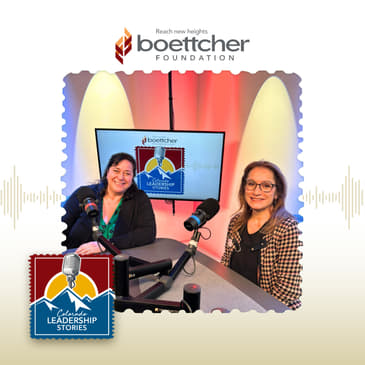
Meet Susana Cordova, Colorado’s 18th education commissioner and former Denver Public Schools superintendent, whose lifelong connection to Colorado public schools has informed her approach to leadership, learning, and service. A Denver native and DPS graduate, Susana’s deep Colorado roots continue to guide her dedication to public education across the state. Tune in to hear how her experiences as a teacher, principal, superintendent, and statewide leader continue to influence her work supporting educators, students, and families.
Listen on Apple Podcasts | Spotify | Amazon Music | Pandora or wherever you get podcasts!
Colorado Leadership Stories is a podcast presented by Boettcher Foundation
Follow us on Instagram, LinkedIn and Facebook
See Privacy Policy at https://art19.com/privacy and California Privacy Notice at https://art19.com/privacy#do-not-sell-my-info.
[00:00:00] Hi, I'm Katie Kramer, President and CEO of the Boettcher Foundation. Welcome to Colorado Leadership Stories, where we talk to everyday, courageous leaders who have made transformational impacts in their communities and are building a better state for everyone. You'll hear from leaders and organizations and communities throughout the state as we explore the idea that leadership is an activity that anyone can do.
[00:00:30] Today, I'm thrilled to welcome Dr. Susana Cordova, Colorado's 18th Education Commissioner, a position she stepped into in June 2023. She previously served as Denver Public Schools Superintendent. She's a Denver native who attended DPS schools from kindergarten through high school, later returning to lead the district under a remarkable 30 year career that began as a bilingual language arts teacher. Under her leadership at DPS, graduation rates improved significantly.
[00:00:59] And she championed an asset based approach that honored students home language and strengths. Beyond her professional accomplishments, she's a proud Denver mom and spouse deeply rooted in Colorado. Welcome Susana. Thanks. Thanks for the opportunity to be here. Oh, well, I'm excited to sit down and visit with you and just hear about your Colorado leadership story. So let's dive in. I know you grew up in Denver and of course went to Abraham Lincoln High School.
[00:01:26] This year, our theme with the Betcher Foundation is power of place. And I'm thinking about that relative to the power of your places that you've grown up and how those have shaped you. And so I'm just wondering what are some of your favorite memories from your childhood and family that first sparked your love of learning, especially given your career?
[00:01:47] Yeah, you know, it's fun to think about that, especially because I spent a little bit of my career outside of Colorado and coming back. It really hit me what a difference it makes to lead in the place that you're from. Yeah, so I love this theme. You know, my childhood, I was in the Denver public schools. Desegregation happened when I was in elementary school. And I have like amazing memories.
[00:02:13] Some of the work that Denver did, not just around busing, but around programming. So there were lots of efforts that Denver public schools put into creating opportunities for kids from all over the city to come together. And some of my favorite memories of being a student in the Denver public schools were summer theater programs. Nice. So every summer they had an elementary, middle and high school program where kids from all over the city came together.
[00:02:42] In like elementary and middle school, we did kind of like variety shows with songs and dance and little skits. And then in high school, it was always like a big musical that we put on together. And I didn't know it at the time, but that was all part of the desegregation act as a way to think about how you could get, you know, a kid from TJ and a kid from Lincoln and a kid from West and a kid from Manuel all together for the summer,
[00:03:09] experiencing the kind of things that you wouldn't necessarily be able to experience in your own school by yourself. Right. It was really fun. I didn't know about that. Yeah, it was a great program. That's great. Well, take us from Lincoln High School to fill in the gaps between then and when you started teaching. Yeah. Yeah. So what happened in between that time? Yeah. You know, when I was at Lincoln, you know, I feel like I got a great education in the Denver public schools.
[00:03:34] And I had a high school teacher at Abraham Lincoln who I didn't even take his class, but he was the Spanish teacher. And he just went out of his way to help kids like me apply for scholarships. And so he helped me apply for a scholarship. I got a scholarship to go to the University of Denver. I was an English major at DU. I wasn't exactly sure what I wanted to do. And I had a work study job in the English department.
[00:04:00] It was like answering phones and filing and a lot of downtime. And I remember I was a junior trying to figure out what I was going to do. And I wasn't exactly sure. And there was a literary journal that DU published called the Denver Quarterly. And there was an issue that was all Chicano literature. I can even remember like the desk I was sitting at, the sunshine coming in.
[00:04:27] It was like one of those old buildings on Evans, you know, where the bridge is crossing Evans now. But it's one of the old brick buildings. And there were these like poems and stories that were sort of like a mix of English and Spanish. And I had just never seen anything like that in print before. That was sort of a reflection of my experience growing up.
[00:04:51] And it was this really powerful moment for me where I both felt connected to a version of being educated. Because it's in this like super esoteric literary journal that like academics read. So it was like clearly like connected to education. But it was also clearly connected to my community and the way I remembered growing up. And I sort of remember thinking like how is it possible I'm a junior in college.
[00:05:21] I'm like 20 or 21 years old. And I had never seen anything like that before. And that was like one of the moments where I decided I wanted to be a teacher. And that I wanted to be able to create the kind of classroom experiences for kids to see themselves in education. And feel connected to both who they can become without feeling like you have to stop being who you are. What a great answer.
[00:05:49] And hearing about that story and how you ended up there. And then also knowing what I know about your career and how you continue to do that. But I want to talk about your early years in the classroom. And you've had a remarkable career in education. Teacher, principal, DPS central office, superintendent, and now statewide leadership.
[00:06:12] And I've heard you say before that the experience of teaching shaped your leadership philosophy as much as anything. And so thinking about those early years as a teacher, what were those experiences that really shaped you and informed your career path afterwards? Yeah, for sure. You know, I would say particularly early in my career, I was a very caring teacher.
[00:06:41] But I wasn't necessarily a really great teacher. And in some cases, I think I was in pretty dysfunctional settings where I had to kind of figure things out on my own. And it really helped me think about what does it mean? Like I remember the first time I was on a team that really felt like a team and where it really felt like I didn't have to do everything by myself.
[00:07:08] And I had people who could help me carry the load and even just like sharing lesson plans. And, you know, I worked as a bilingual teacher with a very, very high needs population of kids. And it's really it's too much for an early career teacher to do alone.
[00:07:31] And I sort of feel like I learned as much from the non examples as I learned from the examples of why it's so important to create the kind of teams and supports for early career teachers to want to stay with it. I never, ever really thought about leaving the profession, but I didn't always find it easy and I didn't always find support that I thought was really important.
[00:07:54] And so it helped me think through when I was able to move into, you know, positions of greater leadership, either a department chair or an assistant principal, why I felt like it was so important to create the kind of culture for adults to have the support that they need, because it made me a better teacher when I had that. And it makes a difference for kids when you've got that.
[00:08:16] And, you know, I think in so many different versions of my career, like from the classroom to the principalship to central office, it really has had this like element of the work is too important for the kids to think that it's dependent on one single adult to figure it out. And so we've got to be able to think through how do we make it easier for everybody so that we can do a better job for kids.
[00:08:46] Well, and I'm wondering if just what you responded to this question, if this fits. But one of the things I know is when you were the principal at the now former Remington Elementary, the reading scores improved over 33 percent in four years. And I'm wondering if that's sort of a feature of what you were just talking about of a team coming together. Like in that case, like how did you bring people together? How did you know where to start?
[00:09:14] How did you achieve that? Yeah. It's so fun to hear you say that because I'm going to say some things that I did as a principal that I feel like I did again as the commissioner. You know, like I came into this elementary school and like in one grade they were using a basil. In the next grade they were using whole language. In the next grade they had worksheets. In the next grade they had a workbook. And like nobody was on the same page. People were not doing the same things.
[00:09:39] And like the first thing that I did was like get everybody together to talk about like what's our vision and how are we going to do this together. You know, in some cases that meant some people were going to have to let go of things that they wanted to keep doing but was not part of the collective work. We wrote a school-wide Title I plan which allowed us to use our funding to help organize the approach to do it.
[00:10:08] And then I tried to make sure that there was training for everybody, that we were in a multi-year training professional development program to help us get better at the work. I didn't do the training. You know, I worked with our Title I department at DPS to be involved in that training. But it really was about like everybody learning and growing. I had been a high school teacher, not an elementary school principal.
[00:10:35] So I felt like it was really important for me to walk the talk. So one year I tutored a first grade student. Another year I worked and did a group every day in a fourth grade class. Yes. Because I just felt like it was really important for me to say to everybody I was asking to do this big hard work, like I'm in it with you. And, you know, I wasn't trained in teaching first graders to read. And so that meant I had to learn. Wow.
[00:11:05] That's great lessons about bringing a team together and also being in it and being willing to learn alongside the people you're leading. Well, you've done some amazing difficult things in leadership, Susana.
[00:11:20] I am thinking about the time when you were in the superintendency at DPS and what was happening during that time frame between teacher strike, pandemic disruption, the bomb cycle of 2019. There's so many things. What strategies do you use to navigate difficult moments like that? Yeah. Yeah. You know, it's funny.
[00:11:46] I don't know if I would have been able to articulate this at the time in the way that I'm saying it now. I have come to be a big reader of the Stoics. And, you know, Marcus Aurelius in his meditations talks about this all the time that like you can't spend time worrying about the past. It's over. There's no point in spending time fearing the future. You don't control that.
[00:12:14] The only thing you control is the moment and your reactions to the moment. And I have found that to be a really grounding set of beliefs and like ancient wisdom. I mean, like thousands of years old wisdom in terms of what it tells us.
[00:12:32] And so I'd like to believe that even in times of really high stress, it's important to stay grounded in your values, in your beliefs. And like you can't make the world do what you want. You know, like I couldn't change the fact that there was a teacher strike. I couldn't change the fact that there was a pandemic. The only thing I could change was how I reacted and responded to it.
[00:13:01] And, you know, sometimes better, sometimes worse. But for the most part, I think one of the things I've really tried to do is treat people with kindness, show up the way I want to show up, and worry less about how other people are behaving. And just know like at the end of the day, I have to live in my own skin. And it's going to matter to me a lot more that I'm true to my values than that I want or lost a fight.
[00:13:30] Right. And so what are some of those things that are grounding for you, those values and where they come from? Yeah. You know, and like for sure, these are like lessons from my family. Right. The way I grew up, you know, just back to the power of place. My father is from Southern Colorado, from Walsenburg. Uh-huh. And comes from, you know, his father was a coal miner. His grandfather was a farmer.
[00:13:57] So I come, you know, my mother was originally from New Mexico, grew up in Denver, just from like really humble, hard, hard, hardworking people. And so for sure one of the values that they instilled in me from a very early age is like anything you do, do with integrity, like hard work.
[00:14:21] Like there's no job that is too big or too small and that there's honor in, you know, doing the work regardless of what it is. And so I'm like a big believer in like if we're having a big family parent event at a school, like it's my job as much as anybody's to pick up the trash. Right. And like so like work hard, treat people with kindness. Mm-hmm.
[00:14:45] Like there's a real value that I have in service to others and making sure that the way that I approach the work is not just about me or what I can get out of it, but what we can do when we do that work together. So those are some of the things. Thank you very much. My mother, by the way, my father passed away about 16 years ago, but my mother, who is 80, runs a food bank.
[00:15:15] And so like she's in her 80s. She like orders the food every week. She has a group of volunteers. She does this at her high school. They put together 100 boxes of food every week that they distribute to families at West High School. And so like she's living it every day and is a real inspiration. Oh, I love it. Love it. Well, Susana, you've had a lot of firsts in your life and career, in your family, in your community.
[00:15:42] First Latino superintendent of DPS, now caller's first Latina education commissioner. Just speaking about family and background, how has your identity and background influenced your leadership? Yeah, you know, I think especially for young people who are stepping into a space as like a first.
[00:16:06] So if you're a first generation student, I spent a lot of my life really questioning my legitimacy to be in a place, like looking around and seeing, you know, who are the other people who look like me? As I moved up in my career, looking around and being like, where are the other women? Because it's still pretty surprising for women in leadership how you can step into a room and sometimes be the only woman.
[00:16:30] And so I spent a lot of time, I think, really struggling with what I would call like a crisis of confidence. And I say all the time, like confidence is really a muscle, like you have to exercise confidence. For years, I had taped onto my laptop, like I can do anything because I really did not feel like I could do anything. And so it was like, I had to look at it every day.
[00:16:58] And, you know, sometimes I'd have to make a phone call to somebody who I thought of is like so much more important to me. And I like would like sit at the telephone and be like, OK, OK, I can do anything and pick up the phone to make the call because, you know, it was really intimidating. If you don't have people in your family who have done those sorts of things, it can feel really intimidating to do it. Something that I'm really impressed with young people by what I see in young people today,
[00:17:24] I feel like I see so many young people today who are both in so many ways, I feel like braver than I am. At least they look like they are, but who are also willing to set some boundaries in a way that I don't know that I always was able to do. And so if on the inside they're struggling with confidence, I would want to tell them like nobody knows what they're doing. Like everybody's just making it up. And so like don't be afraid. Exactly. Yeah.
[00:17:53] Well, speaking of the big job of just being the commissioner, you hold the whole state, right? And so I think about the wide range of needs across the state, rural, urban, suburban communities. Maybe talk about what has been some of the biggest things that you've been learning since coming into the role as commissioner. Sure. Yeah. You know, when you grow up in Denver, I really did grow up in Denver.
[00:18:20] You know, my father's from Southern Colorado, but when you grow up in Denver, you pretty much know Colorado, I-25 from Wyoming to New Mexico and I-70 from border to border. Right. And so in the role of commissioner, I've really had the opportunity to just get into every little corner of the state.
[00:18:39] Something that I think is really important to do as the commissioner, like one of the unique positions we have as the state Department of Education is to lift up the stories of what's happening around the state. And so, like, just today, I was talking with Adam Hartman, the superintendent in Canyon City Schools, and the principal of Harrison K-8, Lacey Ladue, about the work that they're doing in literacy and to lift up their story.
[00:19:08] You know, nobody at the Department of Education is teaching third graders. Like, that's happening in schools and districts. Right. We have good line of sight into, like, the reason we wanted to profile them is because they've increased the number of kids reading on grade level and decreased the number of kids who are far behind. And so it's like, talk to us about how you're doing that. Talk to us about, like, the successes that you've been able to see and how can we help showcase and what is it that folks can learn from those kind of examples.
[00:19:36] And so what's been really fun in the role of commissioner is just getting into different communities and seeing the different flavors of what it looks like. Colorado is an incredibly diverse place. But I think no matter where you go, there are very deeply caring teachers who are committed to working with their students, being integrated into their communities, and making a difference.
[00:20:04] Well, we partner, Betcher Foundation and the department, on trying to celebrate the Colorado Teacher of the Year. And so I wanted to spend just a few minutes talking about awesome teachers. I think that everybody can think about a teacher that was transformational maybe in their life or grounding or was that person that encouraged them. And so the power of teachers cannot be understated.
[00:20:31] And so it's been fun to work on that project to try to honor the profession and lift up those that are making such a huge difference. But I also just wonder about the workforce, right? I know we don't always have enough teachers for the amount of spots and such. And Betcher has worked for a long time in partnership with Public Education Business Coalition and others on the teacher workforce pipeline. So I'm just wondering what you're seeing.
[00:21:00] How can we strengthen that educator pipeline, especially in rural communities where we see that need especially? Yeah. You know, I'll say this just really quickly on the Teacher of the Year. What is so gratifying about recognizing great teachers is you walk into these classrooms where teachers have been nominated, and every kid knows why. And, like, they are just so connected to their teachers. Mm-hmm.
[00:21:28] And it's just such a great experience to see the power that a teacher has. To change kids' lives. And, you know, what I think is really making a difference in particularly in rural communities, for sure, it's this concept of, like, how do we grow more of our own? Right. It's like there are people in our communities. Maybe they're working in the school but not as a teacher. How do we help them become licensed?
[00:21:56] And how do we reach into our classrooms to give our young people the concept of what it could be like to be a teacher? I think that's for sure one of them. But then part of the key is once you have teachers, how do you keep them? Right. And so it's like how do you create the kind of learning conditions and environment where it really makes a difference?
[00:22:21] And in talking with Adam today, like, the way he described the work, you know, he talked about his principal at Harrison K-8 was a teacher. Then she became a coach. So she started coaching her teacher colleagues. Mm-hmm. Then she became the assistant principal. Now she's the principal.
[00:22:40] And so part of the trick, I think, is to take the best teachers that we have and give them the opportunity to grow in their expertise, in their reach, in their support. They don't necessarily have to leave the classroom. I think we've got places that are doing really great work with teacher teams and teacher coaches and, you know, working right in the classroom. But shaping the conditions that help them thrive for others.
[00:23:08] And then if they want to become, you know, building leaders, that's great. Right. Because we want people who know what it means to be a thriving teacher and to help replicate those circumstances for others. Because it's never, we're never going to fix a leaky bucket. Like, we can keep putting it in, but if we don't fix that part of it, we're never going to be able to keep the people we recruit. Right. So recruitment and retention. That's right. Absolutely.
[00:23:35] The other thing I wanted to ask you, since I do have the Commissioner of Education, is about just thinking about trends in education right now. And I know I've heard you talk about something you call the big blur. Yeah. I want you to say a little bit about that. And so what's ahead for as we're thinking about the future of education for Colorado kids? Yeah. And, you know, it's really great timing.
[00:24:00] We, you know, Colorado's in the middle of, like, a really tight, constrained budget. Yeah. And even in the midst of that, I think there's been really focused support on helping ensure that our students in high school have the opportunities to build their path to the future.
[00:24:22] And, you know, the big blur is the work that we are engaged in, in K-12 and higher education and the workforce to make sure that young people have a pathway. Right. To figure out what it is they want to do. That might be earning college credits while they're in high school. Our goal is that everybody has the opportunity to earn 12 credits or an industry-recognized credential.
[00:24:48] So that might be, like, you know, a credential in coding. It might be a credential in engineering or, you know, something that is an industry-recognized credential. Uh-huh. Or a meaningful work-based learning experience. And all of the skills that young people learn when they're in the real world of adults really working and adding to the productivity of a team.
[00:25:13] And so we believe that that is well within reach of 100% of our high school students. And so our goal is that every high school student, by the time they finish high school, has met one of those three things. Wow. I think that's wonderful. And being the mother of a kiddo that had benefited from Warren Tech. Shout out to Jeffco Schools. What an incredible opportunity for him to get a sense of, could this be a career for me? Yeah. Yeah.
[00:25:41] And it's really cool in, like, the, you know, the urban districts that have, like, a bunch of business and industry and big innovation centers where they've got all the bells and whistles. But, you know, it's equally cool in Rifle. That's right. Holyoke. Holyoke. Yes. In, you know, rural, in Genoa, Hugo. For sure. In these places that are, you know, much smaller that are making connections. You know, as in Byers, they're making connections with their local health care clinic.
[00:26:10] Where actually the people who work at the clinic get certified in CPR at the high school. And so we have such great examples of the way high schools and the world of work and learning are making those connections. And where kids actually are not just seeing what it looks like in the world of work. They're doing it. Right. Oh, that's so great. So great. Okay.
[00:26:35] I want to turn this back to you for a minute on Colorado Leadership Stories about your own leadership, Susana. And you had a chance to talk about your background and the why behind what you do and lots of great stories about you've been so effective at doing those things as a leader. But I know an important part of your life is your family as well. And you've got two great kids and a wonderful partner too.
[00:27:00] And so I wonder about you as a leader in the context of your family unit as well as just thinking about how do you, from a personal side, take care of yourself to make sure that you've got enough to continue to give in these big roles. So give us some reflections on some of that. I feel like I was really fortunate.
[00:27:21] You know, I have a wonderful husband who has always been incredibly supportive in every, you know, was a person who encouraged me to think about moving into a leadership role. I probably wouldn't have done it if he hadn't sort of like pushed me to do that. When my kids were little, my parents just helped me out so much. My mom actually retired when my second child was born.
[00:27:47] I don't think I could have done it if she hadn't. And so I really benefited from, you know, the kind of family support that everybody like pitches in and helps each other. I feel like hopefully I'm doing it back toward them. There definitely were times probably when I took a little bit more than I gave and life is long. So I have the opportunity to like give back now. So that's that's good.
[00:28:15] Yeah, I think it's hard for working moms. I really do. I think it's hard in a way. It's hard for all working parents. I know in my own experience, it was not just like the complexity of big jobs and family stuff. It was also like this layer of like guilt and, you know, feeling like I have to do it all. I'm trying to think I probably was like either the deputy or superintendent when my daughter was in high school.
[00:28:44] And like making cheer bows for the cheer team from 11 p.m. to 1 in the morning because I really couldn't do other things. I couldn't chaperone trips. I couldn't go to games. There was a lot I couldn't do. And so then I just figured out like how do I carve out some time to let her know I care. And she was also really good about helping me understand like sometimes like it's nice to have bows for the team,
[00:29:10] but it's sometimes it's nice just to have you and you've got to make good decisions. I did not always make good decisions. And I feel like I'm trying to pay that forward now by telling people like make the right choices. There are times when I made choices and I think to myself, nobody who was at the meeting that I chose to go to over a family function remembers that I was there. But my family remembers that I wasn't. And so make the right choices. That's great advice. And it is. It's a juggle for sure.
[00:29:40] Yeah. Well, I think just as we wrap up with one more question before the lightning round, I wonder about we've got all these better scholars that I always want to ask advice of folks like you that have been there, done that and are continuing to just to have, you know, big leadership roles and successful careers. And do you have any advice for students that maybe they want to go into education? Yeah.
[00:30:08] Or frankly, you know, you're educating the entire state. Sure, sure. So what advice would you give to those high school students that are maybe going to graduate here in a couple of months? Yeah, 100%. I would say I have never regretted the decision to going into education. If young people are thinking about it, and maybe even if they're not, I think they should consider it. It is such an amazing profession. It keeps you young because you are around young people all the time.
[00:30:37] Every year is different. You have the opportunity to learn and grow and get better. And it is, you know, I think just such a meaningful way to live your life. It is the kind of career that you can stay in for a really, really long time. And it's also the kind of career that you can come into and out of. And one of the things that I think is really pretty amazing about educators,
[00:31:06] we have brand new teachers who are career changers and, you know, might be in the 40s, might be in their 50s, sometimes even in their 60s. And so it's like never too late to be an educator. And people bring different things at the different phases of their life into it. And so I would definitely say if you're even considering it, like reach out, learn a little bit more about it. Oh, that's great. That's great. Okay. Final four questions really quickly.
[00:31:34] But Susanna, what's your favorite Colorado hobby? Oh, for sure. Like being outside city or mountains, hiking around. Excellent. Excellent. Favorite place in Colorado or favorite Colorado landmark? Well, I live at Sloan's Lake. And so it's right. It's really hard not to love being able to like be on my porch, see the lake, see the mountains. But also really love like Garden of the Gods. Hard to beat. Yeah, it is.
[00:32:03] I grew up in Colorado Springs. So yeah, that's hard to beat. It's a beautiful spot. Okay. What action hero do you most identify with? Hmm. It's either Superman or Bizarro Superman, like in the alternative universe. Because sometimes like depending on the day, you feel like you've got it going on. And then sometimes you feel like, oh, I just really am upside down in the world, aren't I? So either one of them. That's a great answer. Okay. And then finally, what are you binging?
[00:32:33] Is there a show or a book or a podcast that has your interest or maybe is wasting your time? I don't know. Oh, yeah. Right. I am embarrassed to admit the like very deep rabbit hole I have gone down on medical dramas. Oh, okay. And so like I watched The Pit, which then made me watch, I had never watched Grey's Anatomy. And so then I watched Grey's Anatomy. You had some catching up to do on that.
[00:32:57] And then went back and watched ER and like the whole series of like medical things. I keep joking that my friends are all doctors. I love it. Yeah. Stat. Yeah. Oh, that's great. Well, thank you very much for the time today. Yeah, absolutely. And, you know, sharing your stories. And we just so appreciate your great work in this really important role for our state. So thank you. Well, thank you.
[00:33:25] I want to thank you back because, like I said, this is not work that any of us can do alone. And the work that Boettcher does, both to invest in people, our young people, to invest in our educators, to like lift up what it means to give back to our community. It's just so important. And it's what makes our community thrive. Well, thanks for that. And to quote you to you, it's all about the team. That's right. We do it together. That's right.
[00:33:54] That's what this whole thing has been about. So I appreciate that. It's really fun to partner with you. Yeah. So thank you. Thank you for joining Colorado Leadership Stories, where we hope to inspire the next generation of Colorado community builders, doers, and difference makers. Colorado Leadership Stories is presented by the Boettcher Foundation.
[00:34:15] The Boettcher Foundation supports Colorado by empowering leaders and communities with tools to tackle challenges and pursue opportunities, building a better state for everyone. With an 85-plus-plus-year legacy of giving back, we're committed to amplifying our impact for future generations. That's the spirit of Boettcher.