
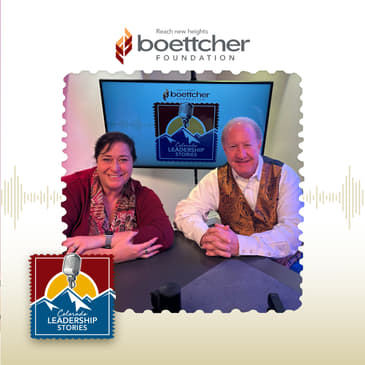
Buckle up as Paul Andrews, CEO of the National Western Stock Show, takes us on his journey from sports executive to agricultural leader. A Colorado native, Paul reveals how he turned the Stock Show into the Super Bowl of livestock shows and a powerhouse for ag education. As he prepares for retirement, Paul reflects on his 15-year legacy of developing an enterprise that has become an international cultural event showcasing the West.
Listen on Apple Podcasts | Spotify | Amazon Music | Pandora or wherever you get podcasts!
Colorado Leadership Stories is a podcast presented by Boettcher Foundation
Follow us on Instagram, LinkedIn and Facebook
See Privacy Policy at https://art19.com/privacy and California Privacy Notice at https://art19.com/privacy#do-not-sell-my-info.
[00:00:00] Hi, I'm Katie Kramer, President and CEO of the Boettcher Foundation. Welcome to Colorado Leadership Stories, where we talk to everyday, courageous leaders who have made transformational impacts in their communities and are building a better state for everyone. You'll hear from leaders and organizations and communities throughout the state as we explore the idea that leadership is an activity that anyone can do.
[00:00:27] Today, we're excited to welcome Paul Andrews, the CEO of the National Western Stock Show, a cornerstone of Colorado's agricultural heritage. A Denver native, Paul graduated from Alameda High School and earned his degree in marketing from the University of Wyoming. He began his career with the Denver Nuggets and quickly rose to become chief marketing officer for Cronky Sports and Entertainment, where he played a key role in developing major venues like the Pepsi Center and Dick's Sporting Goods Park. Under his leadership, the Avalanche set an NHL record.
[00:01:02] For consecutive home game sellouts. Now at the helm of the National Western Stock Show, Paul brings his extensive experience in sports management to foster community engagement and innovation. Notably, he's announced that he will retire after the 2025 National Western Stock Show in January. Join us as we explore his leadership journey and vision for the future of this iconic event. Welcome, Paul.
[00:01:24] Paul Andrews, Well, thank you for having me, Katie.
[00:01:26] Katie. Well, I'm very excited. As you know, I am a Colorado kid too, and Stock Show is very important to me, part of my growing up. And one of the joys that I get every year is I get to ride in the Stock Show parade with Paul Andrews.
[00:01:41] Paul Andrews That is fun. I tell you, when you got 40,000 people watching you go down 17th Street, it's a pretty different experience, isn't it?
[00:01:48] Paul Andrews Yeah, that's right. Maybe it makes you feel more important than you are. But it is really fun. I do enjoy that very much.
[00:01:54] But we want to learn all about you today. And let's start a bit about your professional journey. I know you're a Colorado kid too, and an accountant executive with the Denver Nuggets.
[00:02:04] How did your local roots influence your leadership style as you climbed the ranks in the sports and entertainment industry?
[00:02:11] Paul Andrews Yeah, growing up in Lakewood, I ended up graduating from Alameda High School in 1983. And I'll tell you, when you grow up in Colorado, and remember back then, we only had two teams. We had the Denver Broncos and we had the Denver Nuggets. We did not have a hockey team. We didn't have a baseball team.
[00:02:27] Paul Andrews You grow up, though, loving sports. I loved the Nuggets. I loved the Broncos. And as I started off in my journey in 1990 in professional sports, and I'm thankful today that really I've only had two jobs in my life.
[00:02:42] I worked for the Nuggets, the Avalanche, which became Cronky Sports, and the Rapids and the rest of it for 20 years. And then I worked for the National Western Stock Show as CEO for the last 15. So really, as a Colorado native, I think my love of just this great state and the love of our sports teams propelled me to want to start cold calling people for season tickets back in 1990 when the team won 17 games.
[00:03:09] And let me tell you, I would not wish that on anyone because I got rejected. About every 30 calls, I would get one person that would talk to me after losing that many games. But that really kind of shaped me into understanding business and propelled me to want to be in sports and entertainment.
[00:03:28] Well, you've been involved in developing major entertainment venues like the Pepsi Center. How did these experiences prepare you for your role at the National Western?
[00:03:36] After we developed the Pepsi Center in 1999 and then Dick's Sporting Goods Park in early 2000s, it was 2003, 2004, I was really at a point in my career overseeing the business operations for the Nuggets, the Avalanche, the Colorado Mammoth.
[00:03:52] I had the Colorado Rapids. I had four venues, the Paramount Theater, Dick's Sporting Goods Park, the Pepsi Center, and we did a deal with the Broomfield Event Center, which became the First Bank Center.
[00:04:04] So I was starting to get a little thin on my ability to try to manage 300 or 400 people from an office in the Pepsi Center.
[00:04:13] So really, as I looked at opportunities that might come in the future, and Jerry McMorris was the chairman of the board of the stock show at the time.
[00:04:22] He walked into my office at Pepsi Center in 2009 and said,
[00:04:25] Hey, Paul, you might want to consider doing something else. You could stay here the rest of your life, but really, do you want to make a difference in your job?
[00:04:34] And do you want to support college students that are going to need funding in agriculture?
[00:04:39] And I know you love agriculture because you grew up on a ranch in Golden. Is that something you'd be interested in?
[00:04:45] And I thought, you know what? That is something I would be interested in.
[00:04:49] And so my venue background was something the stock show board was looking for because they were trying to develop new buildings and a different business model moving forward.
[00:05:02] And they knew I had that skill set. And I obviously had a passion for agriculture.
[00:05:07] So really, that's how my experience at Kroenke Sports ended up translating over to the National Western Stock Show.
[00:05:12] Well, I want to hear much more about that National Western.
[00:05:16] But before we leave that part of your life, that story just strikes me.
[00:05:20] There's so much change that you were present to.
[00:05:24] The venues, the teams, those types of things.
[00:05:26] Is there a story or a moment that you'd like to share about something that really sticks out in your head?
[00:05:33] Maybe something you're proud of or that was you'll never forget it?
[00:05:36] Well, I'll tell you, there's so much in my 20 years with Kroenke Sports before I even got to the National Western that I was extremely pleased with.
[00:05:45] Number one, the Pepsi Center, which is now Ball Arena, was just a great project to work on.
[00:05:51] We built that place for about $180 million.
[00:05:54] I bet it's worth a billion dollars today, maybe a little shy of that.
[00:05:58] But what a great building.
[00:06:00] It was fun to be able to be part of that.
[00:06:02] Celine Dion was the first entertainment act in there.
[00:06:05] So that was amazing.
[00:06:06] And then obviously, I was at the peak of the Colorado Avalanche from 1995 to 2003.
[00:06:15] We won two Stanley Cup championships.
[00:06:18] And I'm telling you, we probably should have won five.
[00:06:22] And I became very close with Pierre Lacroix, who was our general manager and president of the team.
[00:06:28] While I was doing the business operations side, he obviously was creating an amazing team there.
[00:06:34] And so with Mr. Kroenke's support and easily the greatest sports owner that I think is in professional sports,
[00:06:43] we were able to win two championships.
[00:06:46] We did not win with the Nuggets at that time.
[00:06:49] So we made it to the third round one year against the Lakers and lost.
[00:06:54] But at the end of the day, I'll never forget those Stanley Cup championships.
[00:06:57] I'll never forget Celine opening the Pepsi Center.
[00:07:01] And frankly, I'll never forget Pierre Lacroix and my relationship with him
[00:07:05] that just developed over really about a 15-year time period.
[00:07:10] Wow.
[00:07:11] Thank you for sharing that.
[00:07:12] That's very interesting.
[00:07:13] So you move over to the National Western.
[00:07:16] And I did not know about the agricultural routes.
[00:07:19] So that's fun.
[00:07:20] But I was curious if there was a moment, like you get over and you're over there and you're like,
[00:07:25] I'm not at the Pepsi Center anymore.
[00:07:27] This is a totally different ballgame.
[00:07:30] And so maybe tell us about it.
[00:07:33] Was there a moment we were like, whoa, this is completely different?
[00:07:36] The great news about my transfer from Kroenke Sports to the CEO of the National Western,
[00:07:42] there are a lot of similarities in the live event business.
[00:07:47] A couple of things that are very evident right away are you got to sell tickets.
[00:07:51] Okay.
[00:07:52] I knew how to sell tickets.
[00:07:54] There's a few things in life I know how to do.
[00:07:56] Selling tickets is one of them.
[00:07:58] And so that translated over.
[00:08:00] My marketing experience translated over for that.
[00:08:03] Sponsorships.
[00:08:04] The Stock Show needed a sponsorship department.
[00:08:07] And thankfully, I was able to bring on one of my highest up employees at Kroenke Sports came with me to build a sponsorship department
[00:08:16] and has built it into a massive, great department that really honors our sponsors and drives a lot of revenue for us.
[00:08:24] So there are some things like ticket sales, sponsorship, live events.
[00:08:29] We were doing Stock Show Complex at the time was doing 70, 80 events.
[00:08:33] We took it to 200 by reshaping the staff a little bit.
[00:08:37] So really what I did was try to structure the staff in such a way that, yes, as a 501c3, we are going to concentrate on agricultural education.
[00:08:48] But we also have to bring in enough money to pay the bills and pay the staff and make the scholarships available for the students that we're supporting.
[00:08:58] So I formed it over about a two-year period, more like I formed Kroenke Sports Enterprises with Mr. Kroenke.
[00:09:07] And so we became a nonprofit that was operating somewhat like a for-profit.
[00:09:14] We went to 200 non-Stock Show events a year and Stock Show started paying off the debt that we had assembled at the time.
[00:09:22] And so today the business model works and we're debt-free.
[00:09:26] It's miraculous.
[00:09:27] And we're going to talk about what's coming next here too.
[00:09:30] But, you know, one of the things that I've heard you say before, and I think people don't realize,
[00:09:37] that Stock Show is the Super Bowl of livestock shows.
[00:09:40] So why is that?
[00:09:41] What makes this event so special?
[00:09:43] This event draws people from all 50 states and 30 countries.
[00:09:49] So there is no other livestock show in the world that is drawing the number of states and the number of countries that we draw.
[00:10:00] There's a lot of great livestock shows in the country and in the world,
[00:10:03] but none of them can lay claim to drawing that many people across that many states.
[00:10:09] I mean, we have exhibitors that leave Connecticut the day after Christmas because they have to haul all the way across the United States to compete at the National Western.
[00:10:19] It is the most prestigious show in the world today.
[00:10:23] If you win our show, you change your ranch life forever because people will seek you out to buy from you.
[00:10:32] They will buy your genetics.
[00:10:34] They believe that you're raising animals that are the prime animals in the world, and they want to be part of that.
[00:10:42] So we are not only drawing that, we have 30 different species at the Stock Show.
[00:10:47] I mean, it's not all about cattle, okay?
[00:10:49] We're very proud of the—usually we have about 10 or so national shows at Stock Show.
[00:10:55] That's as big as anybody's ever had.
[00:10:58] But we've got llamas.
[00:10:59] We've got alpacas.
[00:11:00] We've got sheep.
[00:11:02] We've got swine.
[00:11:03] And that's why it's the Super Bowl of livestock shows, even though we're a gigantic cattle show.
[00:11:10] But it's more about the livestock itself and the all 50 states.
[00:11:14] So that's why we are affectionately known as that today.
[00:11:17] I love that.
[00:11:17] And significant economic impact in Denver and the state.
[00:11:21] Say more about that.
[00:11:22] Yeah.
[00:11:22] So we just had that study done a year ago, CSI.
[00:11:27] And they pinpointed $171 million of economic impact in the 16 days of the National Western Stock Show.
[00:11:36] And if you take our complex for the whole year right now, we're doing about $200 million.
[00:11:41] So Stock Show itself, in just 16 days, we're filling the hotels.
[00:11:45] We've got, again, with all 50 states here, they've got to stay somewhere.
[00:11:50] And same with the 30 or so international guests that are coming here from 30 different countries.
[00:11:56] So anyway, that economic impact we're very proud of for the Denver metro area.
[00:12:01] And I dare say there will never be an event that someone dreams up from today forward that will ever eclipse the National Western Stock Show 16 days.
[00:12:11] And I'll take that bet all day long.
[00:12:13] I love it.
[00:12:14] I love it.
[00:12:15] Well, and I think if people have not been over to the complex recently, it's transforming.
[00:12:22] And so I want to spend some time talking about that.
[00:12:25] The initiatives, the changes that you've implemented in recent years.
[00:12:29] So talk about the development project.
[00:12:32] And then give us a sneak peek about what's different for 2025.
[00:12:38] As we look at redeveloping the site into what will be a 365-day-a-year agricultural entertainment experience,
[00:12:47] we are starting with what you would call phase one and two.
[00:12:51] And that's going to be the new stockyards and a new Sue Anschutz Rogers Livestock Center.
[00:12:57] And it will be accompanied by a new equestrian center that we're starting to sell the naming rights to that one right now.
[00:13:03] So those three areas will be complete, at least two of those three, meaning the stockyards are done today.
[00:13:10] The Sue Anschutz Rogers building will be done at the January 2026 National Western Stock Show.
[00:13:17] So you'll have a new arena that will seat anywhere from 3,000 to 5,000 people,
[00:13:21] depending on if you're doing it for a livestock show or a concert.
[00:13:24] You'll have an expo hall that is new that will be where we stall our animals so they get ready to come in and be judged.
[00:13:32] But the rest of the year, it will be a great expo hall for the city of Denver to use
[00:13:37] and book lots of events that we're not getting today, about 180,000 square feet of expo hall.
[00:13:43] So that will all be ready really by November of 2025 and for the January 2026 National Western.
[00:13:51] And then the final piece of that in phase one and two is the equestrian center,
[00:13:54] which will be voted on in March of 2025 here.
[00:13:58] But the plans are already set in motion for that.
[00:14:01] And I know the mayor and council are supportive of that.
[00:14:03] So that will be all opening, at least the first two, you know, the Yards,
[00:14:09] Sue Anschutz Rogers building, and our new home, the Legacy Building,
[00:14:12] which is a 100,000 square foot building that will be almost a monument to agriculture
[00:14:17] and the Western way of life.
[00:14:19] Those will open at the 26th Stock Show.
[00:14:22] So we're transitioning many of the things from the 25th show to the 26th show at the 25th show this year
[00:14:29] and kind of celebrating where many of these things have occurred on site that people are used to
[00:14:34] as we're heading towards the new buildings in 26.
[00:14:37] I love that.
[00:14:38] I love the timing just in conjunction with Colorado's 150th birthday, which I think is just beautiful.
[00:14:45] And Boettcher's been such a proud supporter of that whole redevelopment and is so excited about the Legacy Building.
[00:14:52] It's going to be wonderful.
[00:14:53] It's just going to be wonderful.
[00:14:55] Yeah, we're very much looking forward to that and showcasing that so that people can understand our history.
[00:14:59] You'll be able to walk in the lower level of Legacy Building and see the history of the National Western Stock Show from 1906 forward.
[00:15:07] And I think that's going to be special for a lot of people.
[00:15:10] That's great.
[00:15:10] And also, just speaking of the redevelopment, love the partnership between other entities in the area, including CSU Spur Campus.
[00:15:19] I mean, that whole complex, everything with the river, it's just wonderful.
[00:15:24] If people haven't been there, you've got to come see it.
[00:15:26] Yeah, there's so much to see.
[00:15:27] I mean, CSU's been a tremendous partner.
[00:15:30] City of Denver has been an amazing partner.
[00:15:32] And obviously, the citizens of Denver who voted back in 2015 to fund this campus by an overwhelming margin.
[00:15:39] I think it was 70-plus percent voted yes to redevelop this area.
[00:15:45] And then, you know, the National Western Center Authority are great people.
[00:15:48] So we're all hand-in-hand moving together with the community of Global Elyria and Swansea to develop something that all of Colorado will be proud of for the next hundred years and beyond.
[00:16:00] Right.
[00:16:01] I love it.
[00:16:01] I want to double back to something you said about the importance of education and scholarships.
[00:16:06] You mentioned that, of course, we do Betcher scholarships at the Betcher Foundation.
[00:16:09] But I know that that's really important to you.
[00:16:11] And can you share a little bit about the education and scholarship initiatives and how they fit with your vision about the future of agriculture in rural communities?
[00:16:19] You bet.
[00:16:20] And really, this was one of the key drivers when Jerry McMorris sat in my office and asked,
[00:16:24] what would I think about becoming the CEO of the National Western Stock Show?
[00:16:28] We really centered in on the scholarships that the National Western Stock Show provides to college-level students that are studying in the field of agriculture.
[00:16:38] And that really appealed to me.
[00:16:40] Growing up on a ranch in Golden, the Pold Hereford Ranch that was right off Highway 93, I loved cattle and I loved the ranching experience.
[00:16:49] And the students that we can support through the National Western Stock Show, right now we're supporting about 120 students.
[00:16:58] We're giving out $550,000 a year to those students so they can go to college.
[00:17:04] And we follow them all four years.
[00:17:06] They then have to go serve in a rural community for a certain amount of years with a bevet service.
[00:17:15] It could be equine bovine.
[00:17:17] It could be nursing care in a rural community.
[00:17:20] We're really trying to help rural America and especially rural Colorado get the services they need through the funding of our scholarship program.
[00:17:30] So we're just so excited to be able to do that.
[00:17:34] And I think by this point in time, we've given out more than $13, $14 million over the years from our scholarship trust.
[00:17:41] And that's going to continue to grow as Stock Show grows in these new facilities.
[00:17:47] I love it.
[00:17:48] Such a passion of mine too.
[00:17:50] The scholarships make a huge difference for people.
[00:17:52] Well, I'm going to ask you the same question that I asked about used to your years with Cronky Sports.
[00:17:57] But when you think about a moment at the Stock Show and your experience, maybe there's something that captured Colorado heritage or maybe there was something that was personally meaningful to you.
[00:18:07] Something that really stands out.
[00:18:09] You know, there's so many things I could say here.
[00:18:11] The junior livestock auction really is the first thing that comes to mind when you ask that question.
[00:18:18] I mean, here we are in a state that loves the West, loves agriculture, loves Western heritage.
[00:18:25] And Channel 9 broadcasts for us the opening of the junior livestock auction where, you know, companies all over this great state converge on this auction,
[00:18:37] not because they necessarily want to own one of these 98 or so, 96 to 98 animals that we auction off.
[00:18:46] They're doing it to support that youth that just haltered that animal out there on the stage.
[00:18:52] Yeah.
[00:18:52] And whether that animal is cattle, whether that animal is, you know, some sort of hog that just won their championship or a goat,
[00:19:01] the buyer is buying that animal for an egregious number, right?
[00:19:06] Right.
[00:19:07] I mean, Ames Construction last year spent $155,000, I think.
[00:19:11] It was somewhere in that neighborhood for the grand champion steer.
[00:19:16] Well, that steer isn't worth that, right?
[00:19:19] They're doing it because that money is going to that student to support their education in the future.
[00:19:25] And after that, we take a portion that goes to the scholarship trust and supports the other 120 students.
[00:19:32] So it is a win-win for the businesses.
[00:19:34] We have so many businesses that have supported us over time.
[00:19:37] Ames has been great.
[00:19:39] TransWest Truck and Trailer, my gosh, they've been buying for years.
[00:19:42] Wagner Equipment.
[00:19:43] I mean, I could go on and on.
[00:19:44] Stevenson, Ken Stevenson's bought for years.
[00:19:47] We are so blessed with great business owners in the state of Colorado that support the scholarship trust.
[00:19:55] So really, the junior auction is the first thing I think of when I think of heritage and Colorado and stock show and things that come to mind that really make me proud to be part of both Colorado and the National Western.
[00:20:08] And those are just some examples of some great companies that support.
[00:20:12] But we have, you know, 100 companies that support this auction.
[00:20:15] And I can't list them all, but I love them all.
[00:20:18] I love that event.
[00:20:19] It is so much fun.
[00:20:20] It is.
[00:20:20] Well, Paul, this being the Colorado Leadership Stories podcast, I want to turn it back to you.
[00:20:25] And there's so many things, I think, just as your friend and a fellow community member that's made you successful as a leader there in your tenure.
[00:20:33] And certainly, I think even hearing the stories today, the passion you have for the cause, for the people, just for the impact that it makes in our state.
[00:20:43] But I'm curious about your reflection about your own leadership.
[00:20:46] What do you think has made you successful as a leader?
[00:20:49] A few things.
[00:20:50] I'll tell you, a lot of people ask me, and I've had this question before, you know, Paul, were you a guy at 20 years old that said, I'm going to do this by 30 and I'm going to do this by 40?
[00:21:01] And I routinely answer that question, no, because all I did was this every day of my life.
[00:21:08] I got up and said, no matter what my job is today, I am going to be the best at that job.
[00:21:16] So if I was sweeping the floors of McNichols Arena as an operations person when I started in 1990, I was going to be the best floor sweeper that they had ever seen.
[00:21:29] And I took that same attitude every day.
[00:21:32] If it was cold calling to sell Nuggets season tickets in a year when they're going to win 12 games, I just would start cold calling.
[00:21:40] And I didn't care if I got rejected 100 times in a row.
[00:21:43] I was going to be the best cold caller.
[00:21:46] I was going to be the best sales manager.
[00:21:48] I was going to be the best chief marketing officer.
[00:21:50] That was the only goal I set for me every single day.
[00:21:55] And so as I think back on my career, you just don't know where that's going to take you.
[00:22:01] Did I think when I was 21 years old and working for the Denver Nuggets, I was going to be retiring as the CEO of the National Western Stock Show 40 years from then?
[00:22:12] You know, no way.
[00:22:13] I would have lost a lot of money if you'd have bet me that.
[00:22:16] But would I have known that I was going to get up every day of my life and try to be the best no matter what my job was?
[00:22:24] And I was never going to be the hard employee that the management team would be talking about.
[00:22:30] I was never going to be that.
[00:22:32] I said, why give your immediate superior or the people up the line from you a bunch of stress about you?
[00:22:39] Just do your job.
[00:22:40] Have a good attitude.
[00:22:42] Show up on time.
[00:22:43] And see what happens.
[00:22:45] And, well, what happened to me was I became the head of business operations for most of the sports teams in this city.
[00:22:52] And I became the CEO of the most cherished agricultural event in Colorado.
[00:22:59] And I could not have scripted that myself any better as a 20-year-old starting off my career.
[00:23:05] Oh, that's great.
[00:23:07] That is so great.
[00:23:07] And that totally reinforces what I think we believe about leadership at Betcher, that anyone can be a leader and it's an activity.
[00:23:14] And so the way you show up with attitude, your hard work, anything, those are choices that you make every day.
[00:23:19] And so I love that story.
[00:23:22] So as you think about, not that you're counting the days, but I know that the stock show starts in just a couple weeks here and then you're retiring after the stock show this year, right?
[00:23:33] Yeah, and it'll probably be somewhere in the spring, maybe the summer.
[00:23:36] But we don't want to rush the board because I want to make a great decision here.
[00:23:40] Well, you'll be hard to replace for sure.
[00:23:43] But when you think about legacy and certainly the example you've just talked about, but what legacy do you hope to leave behind as a leader at the event or even for future leaders in the space?
[00:23:54] That's a great question.
[00:23:56] And when I started in 2010, I said the first thing I wanted to do and concentrate on was creating a culture of success within the organization.
[00:24:07] People that need to work together and all of us need to support everybody because every job in the National Western Stock Show has to be done, no matter whether you're sweeping the floors or you're playing the music for the rodeo or you're organizing the Cowboys or you're organizing, you know, everybody's job is interconnected.
[00:24:27] And I wanted to create a culture of success.
[00:24:30] And I'm proud to say today I would take this staff over any staff I've ever seen in live entertainment.
[00:24:36] I think the world of them and they're doing an amazing job.
[00:24:39] So that was job one.
[00:24:40] The next job was to create a sustainable business model so that the day that I retire, the person coming in is not worried about having a massive amount of debt or having a business model where they're worried about meeting payroll next week.
[00:24:58] So those two things were the main things I wanted to concentrate on.
[00:25:03] And so over time, I had to pay down that debt just a little bit every year.
[00:25:08] And thankfully, about a year and a half ago, we paid off the final tranche of debt that the company had amassed back before I started.
[00:25:16] So we became, for the first time, a debt-free organization, 501c3, that now could even grow the scholarships we're giving out because we're debt-free.
[00:25:28] And we're in a sustainable business model.
[00:25:30] So I didn't have to wake up every two weeks wondering if we were going to meet payroll and driving enough events or driving enough concessions or driving enough.
[00:25:39] You know, we love it when people eat at Stock Show because, frankly, when you're eating there, you're supporting the scholarship trust at the same time.
[00:25:45] Those turkey legs.
[00:25:46] Yeah.
[00:25:46] So whatever you like to eat, please, people, eat.
[00:25:49] Funtil cakes.
[00:25:50] But anyway, that was, as I look at it, as I'm transitioning, what did I want to leave to the next CEO?
[00:25:57] I wanted to leave them in a sustainable business model that I'm proud to say we're in.
[00:26:04] And I wanted to leave them with new buildings if we could.
[00:26:06] And we got about 70% of the way there.
[00:26:09] We desperately need a new coliseum.
[00:26:13] And Denver's mayor is working with us now.
[00:26:15] And we're very optimistic about where that's going to go in the coming year or two.
[00:26:21] So I think everybody's got their eye on the ball here.
[00:26:24] And Stock Show, at some point, will be fully complete in phases three through eight.
[00:26:30] But I think that's going to take several more years.
[00:26:32] That's great.
[00:26:32] Well, and I do want to point out, in addition to all those things that you did, by the way, you raised how much money for this campaign?
[00:26:39] Well, you know, I got to tell you, our team has been led by Pete Coors on that.
[00:26:43] Yes.
[00:26:44] And our chairman, Doug Jones.
[00:26:45] And, I mean, I'm happy to say, as we sit here now, we've raised $121 million.
[00:26:50] So great.
[00:26:50] And I'm, again, pleased to be part of that team.
[00:26:53] But really, you've got to look at your chairman of the board.
[00:26:57] And you've got to look at your chairman of the campaign.
[00:26:58] And those are two pretty great guys to lead the effort.
[00:27:01] I know.
[00:27:02] It's been a group effort.
[00:27:03] But very exciting.
[00:27:04] Really exciting.
[00:27:06] Okay.
[00:27:06] Well, we're wrapping up and we've just got four quick questions for you.
[00:27:10] Lightning round.
[00:27:11] Well, this is going to be fun to ask you.
[00:27:13] What is your favorite Colorado hobby?
[00:27:15] Camping and boating.
[00:27:16] I have been camping and boating here in Colorado since I was just a little kid.
[00:27:20] And, well, I love every part of this state.
[00:27:23] And camping and boating, hands down, is my favorite hobby.
[00:27:26] That's great.
[00:27:27] Now, when you're boating, are you fishing?
[00:27:28] I do fish.
[00:27:29] You bet.
[00:27:29] I fish.
[00:27:30] But I love to water ski.
[00:27:32] And now, you know, we've got this surf thing going.
[00:27:34] So my kids and I, my kids are grown now.
[00:27:37] So they're all pretty athletic.
[00:27:39] And so we're trying this surfing thing out.
[00:27:41] So we'll see how that goes in retirement for me.
[00:27:43] Wake surfing.
[00:27:44] Absolutely.
[00:27:44] I love that.
[00:27:45] I love that.
[00:27:45] Okay.
[00:27:46] Favorite Colorado landmark?
[00:27:48] You know, Red Rocks Amphitheater comes straight to mind.
[00:27:51] It's hard to beat Red Rocks and go into a concert there.
[00:27:54] We're all very blessed to have that as part of our deal.
[00:27:57] Okay.
[00:27:58] All right.
[00:27:58] What action hero do you most identify with?
[00:28:01] I would say Iron Man.
[00:28:03] Tony Stark is both a great, great business leader, right?
[00:28:07] Right.
[00:28:07] And a guy that will never quit, right?
[00:28:11] So he's Iron Man.
[00:28:12] So, you know, when he faces hard situations, he just keeps going forward.
[00:28:17] And that's kind of been a way of life for me.
[00:28:19] If I face hard situations, which all of us do, I just get through them and know that someday
[00:28:25] I'll get over that.
[00:28:26] So Iron Man for me.
[00:28:27] Very good.
[00:28:28] Very good.
[00:28:28] Okay.
[00:28:28] And final question.
[00:28:30] What are you currently binging?
[00:28:31] Is there a show or a book, a podcast that has your interest right now?
[00:28:36] You know, it's a funny question.
[00:28:37] I'm binging the Vince McMahon bio right now on Netflix because I think it's just fascinating
[00:28:44] how someone built this fantasy of wrestling into an empire called the WWF.
[00:28:51] I think that's fascinating.
[00:28:52] But I will binge watch Ozark all day long because it is just such an amazing show to watch
[00:28:59] also.
[00:28:59] So Ozark and the Vince McMahon story.
[00:29:01] Vince is only going to be five or six episodes.
[00:29:04] But I'm fascinated by how he developed that business and live entertainment.
[00:29:08] Well, that's great.
[00:29:09] Well, a great way to end.
[00:29:10] Thank you very much for your time today.
[00:29:12] And we'll look forward to seeing you out at the stock show.
[00:29:14] Well, thank you, Katie.
[00:29:15] And let me say the Betcher Foundation has always supported the National Western.
[00:29:19] And we are so thankful for everything that you've done for the National Western as well.
[00:29:24] We love it.
[00:29:24] Thanks.
[00:29:25] Thank you for joining Colorado Leadership Stories, where we hope to inspire the next generation
[00:29:31] of Colorado community builders, doers, and difference makers.
[00:29:36] Colorado Leadership Stories is presented by the Betcher Foundation.
[00:29:40] The Betcher Foundation supports Colorado by empowering leaders and communities with tools
[00:29:45] to tackle challenges and pursue opportunities, building a better state for everyone.
[00:29:51] With an 85-plus year legacy of giving back, we're committed to amplifying our impact for future generations.
[00:29:59] That's the spirit of Betcher.