
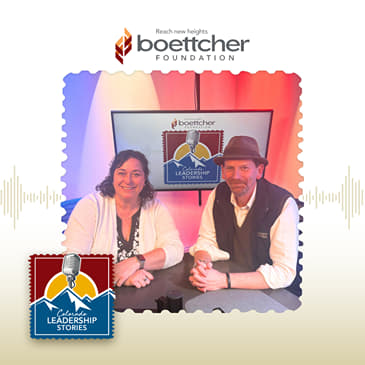
In this episode of Colorado Leadership Stories, Boettcher Foundation President and CEO Katie Kramer sits down with Michael Mitchel, a U.S. Navy veteran and founder of Leadership Veteran, to explore how his military experiences shaped his approach to leadership.
From serving aboard the USS Midway to helping transform Denver's historic VFW Post 1 into a vibrant community space, Michael shares the lessons he's learned about bringing people together and creating opportunities for veterans. He also discusses the inspiration behind Leadership Veteran, a program that equips leaders of veteran-serving nonprofits with the skills and connections to strengthen their organizations.
In honor of Veterans Day, tune in to hear Michael's reflections on a lifetime of service and his belief that effective leadership often starts with bringing the right people together.
Subscribe on Apple Podcasts | Spotify | Amazon Music | Pandora or wherever you get podcasts!
See Privacy Policy at https://art19.com/privacy and California Privacy Notice at https://art19.com/privacy#do-not-sell-my-info.
[00:00:00] Hi, I'm Katie Kramer, President and CEO of the Boettcher Foundation. Welcome to Colorado Leadership Stories, where we talk to everyday, courageous leaders who have made transformational impacts in their communities and are building a better state for everyone. You'll hear from leaders and organizations and communities throughout the state as we explore the idea that leadership is an activity that anyone can do.
[00:00:27] Meet Michael Mitchell, a U.S. Navy veteran, executive search consultant, and founder of Leadership Veteran. Michael served in the Navy from 1984 to 1991, including aboard the USS Midway in the Persian Gulf. In Denver, he led a turnaround of the nation's oldest Veterans of Foreign Wars, VFW Post, helping VFW Post One establish a permanent home and expand its work with veterans. He later founded Leadership Veteran, which brings together veterans serving non-profit
[00:01:01] from across Colorado for leadership education and collaboration. Can't wait to visit with you. Welcome, Michael. Michael Mitchell, Director of the Boettcher Foundation Thanks Katie. Thanks for having me. Well, I'm excited to dive in here. We've got a great story. Let's start with your military service. What experiences from those seven years still influence the way that you lead today? Michael Mitchell, Director of the Boettcher Foundation You know, I think fundamentally, it's the veterans, we just, we get it done, organized, right? We are able to plan and execute.
[00:01:31] And I think that's one of the unappreciated skills that employers or the community at large have veterans. I want to go back before we go forward. And I want to hear your story about why the military. So maybe give us a little bit of background about some of your growing up years and what influenced that. Michael Mitchell, Director of the Boettcher Foundation The short answer is to me, John Wayne movies as a kid. Michael Mitchell, Director of the Boettcher Foundation Is that right? Michael Mitchell, Director of the Boettcher Foundation Is that right? Well, yeah. I mean, I really did because he did a lot of Navy movies, right?
[00:01:57] Michael Mitchell, Director of the Boettcher Foundation Of course, when you're younger and, you know, John Wayne's different than I think he is now in many people's eyes, right? Michael Mitchell, Director of the Boettcher Foundation Of course, I'm a destroyer. I wanted to travel and see the world. Yeah. Blue collar family, mom, who raised us at home. And I wanted to travel. And so I went to boot camp when I was still in high school. You did. So my senior year in high school, I was in the reserves. Okay. So I quote unquote, missed my prom because it was drill weekend up at Whidbey Island because I grew up in the Northwest.
[00:02:28] Oh my goodness. But within weeks after graduation, I was active duty. That was always the plan. Well, and I should have started with thanking you for your service. I am so grateful to those that choose to serve our country. And I'm grateful to have so many members of my family. And I actually, I grew up in Colorado Springs and right by the Air Force Academy. And that I thought was going to be my path too. And until I went about your scholarship way back when, but thank you for your service.
[00:02:55] No. And I checked off a lot of boxes. I did a couple of Westpac cruises. I lived in Japan for two years on the midway, which, you know, when you're a teenager, you're pretty mouthy. So I would tease my dad about how his destroyer was razor blades. And he just kept saying, you just wait, you just wait. And then I came, I rotated back to the world in 88. And then around 91, they decommissioned the midway. So she was in Japan since the fifties. Kind of the running joke was that all the blueprints were now written in kanji.
[00:03:25] So she was the only carrier over there that whole time. Now they don't keep a carrier that long. They've had several that rotate over every couple of years. But he called me up and just started laughing. And that's how I heard for the first time. He's like, yeah, your ship's now a museum. Now you're old. And I'm like, thanks, dad. I haven't been on her yet, but I think they do a good job. Is that the one in San Diego? San Diego. Yes. I've been there with my family. Yes. You paid good money to get on her. At the time, I probably would have paid good money to get off of her. But no, Hong Kong before the changeover.
[00:03:54] And this is all in the eighties. Tanzania, I went on a photo safari in the plains of Africa. The Philippines, more times than for us, that was a working port because we were there so often. Sydney, the list goes on. So yeah, I got, and I never gave up that bug of traveling. That's great. Yep. Well, just to stay on the service before we dive into some of your more recent things. Like, I think that sometimes you think about, at least I do, military and leadership sort of go together.
[00:04:23] And so were there certain like lessons or certain things that you feel like you learned from being in the military? Or maybe there was a leader or two that really influenced you for good or bad, maybe? I don't know. Well, I still eat fast. Okay. That's a common thing. You know, you start that boot camp all the way to when you're on the flight deck. You only have, when your bird takes off for a mission, you only have 45 minutes until she's back. So you eat quick.
[00:04:48] But that aside, you know, the thing about them, at least in the Navy and the squadron, because I was in a squadron, an F-18 squadron, if they went in A-2, is you rotate every two years. And so within that structure, organizationally in the culture is institutional memory, right? Because fast forward six years, nobody's there who was prior, right? So I think for me, that was the thing that really stuck with me.
[00:05:15] But also just the confidence to make those decisions and the ability to effectively lead people. It's something you're always working on. No one always gets it right. But the important thing is to learn from those lessons. Mm-hmm. Is there somebody in particular that you, that was maybe one of your commanders or something that when you think back, you're like, oh, I really learned from this person? I did have a skipper that, like I said, I joined when I was really young. Yeah.
[00:05:42] And I tended to ask the one thing you're not supposed to ask in the military. What is that? Why? But he tried to get me to stay in. This is, background was in California, this is around 90. Mm-hmm. I was getting ready to get out and he really wanted me to stay in. This is during the buildup for the Gulf. So when I was on the Midway, I call it the pre-Gulf. We were Operation Ernest Will. It was Iran-Iraq war. Mm-hmm. So we were flagging the tankers and escorting them in and out. So Kuwait hadn't happened yet. Okay.
[00:06:12] And he was trying to get me to stay in. He thought, you know, everything I've been through and learned, I'd be a good leader. And I was like, ah, I just, I really want to go to college. I want to get a dog and get on. He's like, I'll get you back on the Midway. I was like, oh. I was really close. Mm-hmm. Because I really love being in the sea. Mm-hmm. Seriously. We did, I think, I'm trying to remember, I think it was like 135, 140 days straight. And I loved every minute of it. Mm-hmm. I loved working on a flight deck.
[00:06:40] I loved sitting on the bow with my feet hanging over and watching the dolphins. I mean, that was, in the Indian Ocean, the water's just smooth as glass. Mm-hmm. Yeah. So. Oh, that's great. Thanks for sharing that. Yeah. Well, let's talk a little bit about your connection to VFW Post 1. The first of many. Yes, exactly. And I know that began when you drove past it on Bannock Street and noticed the neon sign
[00:07:07] and stopped to find out whether it really was the very first VFW Post in the country. And here you are later, you became its commander and executive director at a time when the organization was struggling. Tell us that story. And then why did you do what you did? It's my wife's fault. Oh, okay. She was reading the book, Bowling Alone. And we were driving by and she's like, do you think that's the first post ever? I'm like, I have no idea. I had literally never been inside of VFW before. Huh.
[00:07:36] Which turns out, I heard that comment over the years when I was involved in the post. I went in and sure enough, it was. And first I would take my brother-in-law there for the buck 25 Jack and Cokes. Great. Not so much on the Coke. And then one day, I still wasn't a member. I hadn't gotten any meetings or anything like that. And we live in a Baker neighborhood. So we'd walk over. And they're at 955 Bannock, which is now the park apartment building. But the door was closed.
[00:08:04] There was a sign saying, you know, charter has been suspended, special meeting. I was like, a charter? What's a charter? So I went and I was one of two of the people who asked the most questions, which usually you know what that means. I forgot what Navy stood for. Never again volunteer yourself. And so I knocked around some of the junior roles for a number of years. And then 13 became what they called the commander. But we use the term executive director because that's what people know is that term. Yeah.
[00:08:34] And maybe for people who aren't familiar with what VFW is, can you tell about that? VFW stands for Veterans of Foreign Wars. Right. So to be a member of the VFW, you have to have been deployed into a combat theater operations. Okay. So I'm a veteran, ETO. American Legion, you could have stayed in the U.S. the entire time, CONUS. But if you're, I think their rules are if you're active duty during a qualifying period. Because not everyone, my father-in-law wasn't eligible for either.
[00:09:04] And he was a member of the 87. He jumped out perfectly sound airplanes. So you've got to be a combat veteran. And so my operation nurse will was my qualification, my eligibility. Mm-hmm. And then maybe tell us about like how many posts are there maybe in Colorado or around the country? Oh, that number, I'm rough on that. I led the posts from 13 to 16. Okay. At the time, there was 10 just in Metro Denver alone. Right. But I don't have those numbers off the top of my head.
[00:09:33] The thing about VFWs is each one is a separate entity. They're a 501 C19. Oh, I'm not familiar with that. So that's a veteran designation. Okay. American Legions, the Vietnam Veterans of America, I think some DAVs, they're considered 501 C19s. So your individual check, completely tax deductible. Mm-hmm. But foundations, as you know, traditionally only give the C3s. Right.
[00:10:00] Now, there's a few exceptions and whatnot, but as a general rule, they don't C3s. So that's why I created the Post One Foundation back in 14. And then they feed up to the state, and then the state level feeds up into the national organization. Oh, I see. Yeah. Okay. Well, that's where I wanted to go next is talk about 2014. So Post One purchased a 131-year-old building on Santa Fe Drive here in Denver and began turning it into the Veteran Community Center. And so I want to hear about this story.
[00:10:29] I know you know that our theme this year at the Veteran Foundation is power of place. And so it strikes me as that's a, it's been in a very important place. So I want to hear more about this whole story. Oh, absolutely. No, it's a great story. Some of my board members of the foundation would cringe when I tell the story, but it's really important. Oral history is important. Lessons learned are important. So around 2007, and this was the, remember, the charter got suspended. We got it back. Right.
[00:10:57] But it was really due because of management issues and debt load. We are, we sold the building in 07 to pay off the debt. It was a sizable six figure debt. Mm-hmm. At the time, we just didn't have really the membership to warrant having the building. To have a meeting, the quorum is six people. And they were meeting on Saturdays back then. I remember, I'm in my early 30s. I remember thinking, I hope there's not a quorum. I don't want to go hiking. I want to go skiing. Right. And so we sold the building.
[00:11:27] And then my predecessor started reaching out to college campuses, reserve units, just starting to get people to come in. Next thing you know, there's 25, 35 people in the meetings. So he led the post for five years. And then he's like, hey, look, I'm done. Do you want to do it? And being the commander of the post was never on my radar. But we had seven figures in the bank. We had a lot of capital because of the building sale.
[00:11:54] And also, we had a shotgun marriage with another post over on Pecos, which used to be owned by the Spinal family that owned Gitanos back in the day. Oh, sure, yeah. We were in there. We were always kind of looking for the loot. We never did find it, unfortunately. But so we had a lot of money in the bank. And word got around the campfire. So people started coming to meetings and, hey, we need this amount of money for t-shirts for this or that. And so I felt like I had to preserve that. So I thought, okay, sure.
[00:12:20] But only if we run it like a nonprofit, not like a VFW post, which I had done neither before. And my mandate was to get us into a building because we were still organizationally homeless. So we are bopping around at the VFW posts, Brooklands, upstairs, the Denver Press Club. Oh, yeah. We had meetings there, which like that spot, right? If you've been in there, right? I have been there, yeah. They got that fireplace. You were walking the front door. Mm-hmm. And so that's what we did. And I went around looking at buildings. And I found a spot.
[00:12:50] It's a fixer upper. It was over at 8th and Santa Fe. Mm-hmm. And I know the neighborhood. For the record, I did look at locations throughout Denver. Mm-hmm. Had to be in Denver because it's where we started in 1899. 1899. My goodness. Yeah, the history. So it was the returning vets of the Spanish-American War. Ah. They came back and they were having a hard time adjusting. Some things never change. There's a plaque in the state capitol building saying this is where it started.
[00:13:17] We were initially called Army of the Philippines, John S. Stewart Camp Number One. Mm-hmm. And General Hale of Camp Hale. He's the one who started it, Irving Hale. So I found the building. And again, it's within a walking distance of my house, fortunately, because a couple times I had to have thrown over there because the alarm went off. Mm-hmm. But it was a fixer upper. I personally kind of am still fond. I missed that indoor water feature when it rained. But that's how we were able to afford the building.
[00:13:44] And I created the Post One Foundation as a C3 to lead his capital campaign. Mm-hmm. Which by the way, unsolicited shout out, the Boettcher Foundation was a partner of ours among many, many organizations in the community. I mean, we couldn't have done it without it. Yeah. We ended up raising $2.2 million, both in cash and in kind. Awesome. That's great. Yeah. And we certainly were proud to be a part of that. But what changed for the community, for the Post, when you had a permanent home? Does that feel different?
[00:14:14] It did. VFW's American Legions traditionally make their revenue off their bars, or they're called canteens, right? And that's just not what we were seeing in the new generation of veterans coming out of Iraq and Afghanistan. And so we didn't have a bar. Now, we did do a saloon for first Fridays, but we really wanted to be a veteran community center. So we hosted other bed orgs.
[00:14:40] Team Red White and Blue, Team Rubicon, Mission Continues. And we were doing a lot of things. Because partly I was like, okay, they're going to age out of hiking and disaster recovery and disaster, you know, whatever. And then they should think of post one. Right. And so that's what we were doing. And then we became a veterans art gallery. We did a lot of different things there. Yeah. And then we also, with the veteran arts gallery, we always allotted at least 20% that were civilians as being part of the community.
[00:15:10] Because we wanted to be storefront. Most of these fraternal organizations' buildings are behind the locked buzzer door. Because that's how they get that canteen license. Right. We didn't want that at all. Just come in. Right? Right. And Upper Colorado performed there. That was really fun. In fact, I just saw the photo not that long ago. When I invited them in, they sent over a trio. And when they got there, they're like, well, this is VFW. We weren't expecting this. And people come in and like, this is a VFW.
[00:15:39] We weren't expecting this. I'm like, home run. Right. Okay. So then do tell. Right? So what do people see when they walk in? Art. Okay. Yeah. Describe it for us. It's a big gallery hall when you walk in the front door. And there's an upstairs and there's a downstairs. It started up, there was an art group called Art of War. Kurt started it. And we got the building. We didn't really buy it to be an art, anything. We just like, we got a location and we could afford and we'll fix it up.
[00:16:09] And he started doing first Fridays. And then we really felt like it could, the leadership felt this could be more than one event. Right. And so that's, we started expanding it. We created what's called the Veterans Art Council. Really just bring the right people in the room for the idea of creation and the brainstorming. And, you know, we would do things for the Vietnam vets. We did operation and appendants. So statistically, when you go into assisted living, you got about a year left. Right.
[00:16:37] So we're trying to keep these vets in their homes as long as possible. And we, this is way before Uber. So we signed a deal with a local taxi company and they had taken to their doctor's appointments or shopping. Again, keep them in their home. We did things like that all the time. It was just, it was a lot of fun. Yeah. And so like if, if we were walking past today, is it active all the time? Are there people there all the time or is it busy? Well, the last few years I've been really focused on leadership veteran. Right. Which we're going to talk about next. Yeah.
[00:17:07] We're going to talk about that next. I do know the vet, the first Friday is, I mean, they're the busiest art gallery in Santa Fe. Mm-hmm. And what you're talking about is the Denver's art district, Santa Fe Arts District. Yeah. The thing is when I was doing the capital campaign, I'd never done that before. I'd never started to see three before. Right. I'm doing all this literally baptism by fire, drinking from a fire hydrant. Pick your cliche. There it is.
[00:17:34] And my fundamental mistake was that I took people on my board who would say yes, not people I needed. And that neat cat me for years. Mm-hmm. I did leadership Denver. Yeah. And I remember at the time, this is, I was the class of 17. That's when we graduated. And I remember at the time thinking, God, we need something like this for the veteran community. Because I've seen vet orgs come and go for various reasons.
[00:18:02] And fundamentally, people get involved in veteran nonprofits because they want to help veterans, but they don't know how to lead, manage, or run a nonprofit. Mm-hmm. I remember this vividly. So I do executive search. And you know that saying, doctors, worse patients, lawyer, worse clients. Mm-hmm. Hi, I'm Michael. I'm a headhunter. We recruited a CFO to the board to file our 990s. Mm-hmm. As a volunteer. And I got exactly what I paid for. He didn't do it for two years. Mm-hmm. And guess what?
[00:18:32] I found out with a love letter from the IRS, they have a position on that. We got suspended, our status. And I was mortified. I had a $100,000 grant application in front of a prominent family foundation. I called Ted up and I yanked it. Mm-hmm. And he's like, well, you know, we could still have to go to the board and we'll just release the funds when it comes, when you get it back. I'm like, I was just mortified. I was so embarrassed. And I figured you only get one shot at first impressions.
[00:18:59] And I was also meeting with a donor that week in person. We were doing the Columbine and the poppy flower exhibit at the Batang Gardens, World War I's 100th anniversary. And she was about to hand me a check for 10 grand, which I desperately needed. And I said, Kim, before you give me this check, I gotta tell you what happened. And she said, take the money, hire a CPA, you'll make more money in the long run, more nonprofits at your size and stage make these mistakes than you can possibly imagine.
[00:19:28] So after I get out, get in the car and I'm done crying, literally, I'm like, leadership veteran. That's literally where the idea came from. It was a combination of that experience and what I did with Leadership Denver. So we spent, and I had to shelve that while I was finishing the capital campaign. So this is back in like 18, 17, 18. So fast forward to 2021, Denise King. Oh my God, I wear so much. I'm gonna cry thinking about her, but she, but her and Ellen over at DU, we started planning
[00:20:00] LV and we did, do we want to do it now? I'm like, no, wait until COVID's over. Cause we still weren't gathering. We got to do this in person. Cause it's the alum of my first cohort. Who's now our ED, Jared Stepp had nailed it. He said, the nonprofit education, anyone can get that. The secret sauce is the collaboration, getting to get, getting together in the room and the peer collaborations. And he nailed it. He's spot on. And I'm glad we waited until 22 to do it in person.
[00:20:27] And in each cohort, we learned something new to improve the program. I mean, yeah, we learned some, some really good stuff. I bet. The first time we did the retreat, we did a nature place and I didn't even occur. Okay. Back up. We did the 22 LV 22 from May to September. And I'm like, come July and August, where'd everybody go? Oh, it's the summer school's out families on vacation. Okay. Mental note.
[00:20:55] The next one will start in September and then in May. And that's what we did. So that's why there's no LV 23. We go from 22 to 24. Oh, I see. And in 24, we had the retreat and I didn't even encourage them to make it mandatory. We had a third who didn't come. And if the entire cohort, we had a third absentee rate. And I thought it was just me. I'm like, this is so embarrassing. It was coming. And then we had this rebellion. Eight people had been there that day.
[00:21:25] And we brought, we had an SVP from a global company come in to do a presentation on how to delegate. And two people got up and walked out in front of them. And this is a friend of mine professionally. And then the participants in the room were like, where's everybody else? We're here. Why aren't they? We're not learning from them. And I was so happy because I was like, they're buying in. This is working. So we made a mandatory going forward. Yeah.
[00:21:55] Let's back up to just a little bit about leadership veterans. So tell us about like how many participants are there? We, you shared a little bit about starting and lessons learned along the way, but it's cohort I'm guessing. And so how many are in each cohort and what's your typical demographics of who participates? Oh man. So we're averaging about give or take 15. Okay. Some years we have 17. One year we had 12. Our demographics is 50, 50, basically in gender.
[00:22:23] 20% African-American and Hispanic each. Three have alums have gone on to be become first time executive directors. All three are women, two are Hispanic. Seven percent are over the age of 70, 70% are LGBTQ and 7% are unaffiliated. And we dig that because they come into the program either looking to get into a career in nonprofit, veteran nonprofit or want to volunteer. Okay.
[00:22:49] One became a board member and the alum says he's my best board member. I love it. Yeah. And we're working on more, more stats. We're getting more sophisticated each year on the data collection. What we've been able to track at least $750,000 have been raised by our alums through connections they made or what they learned through leadership veteran. $750,000 for their organizations. I'm singing in the rain. A clinic was created. So Healing Warriors program wanted to expand their program.
[00:23:17] So they provide non-narcotic counseling and healing, massage therapy, acupuncture. And Rappau County Veterans Service Office had extra office space in Aurora. Now Healing Warriors is out in Fort Collins. And they met and talked and collaborated at the retreat. There's a clinic there now in their first year they had 1500 appointments. That's great. I'll do this all day long. Yeah. Well, it seems like it's really making a difference.
[00:23:46] And one of the things that you just shared stats-wise is just how effective it's been helping to raise money. And I know that's one of the things that you've emphasized in the program is this fundraising piece. And I've heard you describe that it's a form of leadership that can be misunderstood. So what does good fundraising leadership look like to you? Oh, let me know when we've cracked that code because I'm still learning. I mean, we're all volunteers. Right. Right. I'm doing this while I was doing executive search.
[00:24:16] And I use that past tense. I wrapped up my, I think, basically my last search over the summer. It was an ED search for the Denver Police Foundation. I'm not a professional fundraiser. I'm not a professional nonprofit executive. Although I think Matt Carpenter would disagree with me with that statement. He has before. From El Pamar. Shout out to El Pamar. Yeah. Matt's great for an Air Force guy. He really is. But no, I mean, El Pomar is a founding partner for us. Yeah.
[00:24:44] I mean, if it wasn't for El Pamar, we would not be talking about all of you today. Or, I mean, Kim's Family Foundation or Colorado Veterans Project. They've been supporting us since day one. So we're really fortunate in that. What a good fundraiser leader looks like. Someone who's not afraid to make the ask, but know when to make that ask. Mm-hmm. Which I'm still learning. But also, listen.
[00:25:14] I mean, the storytelling. I think being able to make that connection, identifying the potential donor with the, with, are they a fit for you? And are you a fit for them? Right? I think to me, people would just ask for money. And they're like, it's too transactional. Don't be transactional. Mm-hmm. Yeah. Let me know if I'm, if I left anything out. Cause I really am still learning. I mean, the thing is, is that. We all are. Yeah.
[00:25:42] I mean, you know, and in some ways it gives me the grace to sometimes get over my skis. Yeah. Um, and then ask, I am very much a forgiveness versus permission kind of guy. Yeah. Absolutely. But I also, and I, and I say this and I always get the same look, but this is from my, my executive search days. I truly do love the cold call. I really do. Um, and I love fundraising. Uh huh. I mean, what I'm doing now, I'm in my happy place.
[00:26:14] Mm-hmm. Um, it's about the P the, the, the constituents we serve. Right. Right. Yeah. Well, I'm so struck by the fact you have had this life of leadership and at the better foundation, we talk about that leadership is an activity. So Michael, when you think about all the things, the ways, the arenas that you've led in, whether it's been in your military career, this nonprofit career, all these things. What are you most proud of?
[00:26:47] You know, I look back at the post and I saw what as an organization, what they were the people that made it, what they're capable of and what the post became. I'm really proud of that. I like connecting people. I like getting the right people in the room. And the hardest part I think folks overlook is you get them in the room and then shut up, let them do the talking. Mm-hmm.
[00:27:14] I think that's easy to, people get uncomfortable with silence or feel like, well, I'm the host, I need to keep. No, you don't. You got them in the room, let them do their thing. Mm-hmm. Yeah. Well, I think you've had a tremendous impact on the community, the veteran community, but just in the community. And so it's been fun watching you in action so many years. It's been amazing. You're an incredible leader. I appreciate that. You're too kind. It's true.
[00:27:43] And just final question before we have the lightning round is this episode is going to be released on Veterans Day. So after years serving and working alongside veterans, what do you wish more Coloradans understood about veterans today? I mean, obviously we've got innate skills and traits. You know, I think people are finally always surprised how we just get things done so quickly.
[00:28:08] You know, I remember during the post-1 days, we pulled together, the post pulled together a couple, like three or four different vet orgs. And we volunteered with the Colorado 14ers initiative to do trail work up at Quandary Peak. Mm-hmm. And they kept like telling us, and then there's a break, and there's another break. And the crew was like, what are we ever going to get this thing done? Let's just go. Why don't we take another break?
[00:28:36] So I went to the team and said, you got to stop giving them breaks. Like what? Just stop giving them breaks. Just show them what you want done and literally just get out of our way. And we were done by 2 o'clock, 2.30. Mm-hmm. Right? And they told us that we put them ahead of schedule by two weeks. Right? That's what veterans do. Mm-hmm. I don't know if I can say this or if you're going to edit this out, but veterans get shit done. Mm-hmm. That's flat out. That's right.
[00:29:06] Yeah. And they do it for our country, and I'm so grateful. So grateful. Well, only less than 1% of the U.S. population serves. And of that, 30% had a parent that served, and 80% had a family member serve. Wow. So it's a very small group. We don't get a whole lot of net news. Well, thank you, veterans. So grateful for your service. Okay, lightning round, friend. Yep. So what is your favorite Colorado hobby? Well, I'm a full-fledged Colorado cliche.
[00:29:36] I hike, I bike, I ski. I have a dog, a cattle dog. Do you drive a Subaru? I used to. Okay. But now it's on a wheel drive. But I did have a Subaru, so no seven, out back, XT. Okay. But now I do a lot, I still hike. I do a lot of urban sketching, watercoloring. And so I take my kid up with me and I go hiking. Oh, that's great. Yeah. And an artist. Love it. Yep. What's your favorite place in Colorado or a Colorado landmark?
[00:30:03] I do have a favorite spot to go hiking to and I don't tell anybody where it's at. Oh, good. Because those spots are getting harder to find. Yeah, I bet. Yep. Fair. Respect that. Okay. What action hero do you most identify with? The dude. The dude abides. Is this Captain America or what? Big Lebowski. Oh. Very good. I'm so sorry I missed that. But I was like, Captain America. No. Okay. All right. Finally, what are you currently binging?
[00:30:33] Show, book, podcast? What has your attention or wasting your time right now? There's a podcast out there called Acquired that should not be successful, but it is. They drop maybe three times a year. Okay. And each episode is three and a half to four and a half hours long. Oh, wow. And it's the business history of a, they get, they just dive deep into the business history of a company. Hmm.
[00:31:00] They just dropped this week Seinfeld and it's like four hours long and I can't wait to carve out my Saturday morning to listen to it. My first episode, Lockheed, they do one of Rolex, Costco, Home Depot. Hmm. You get to understand the very beginning of how it started. And it's just fascinating to listen to. Mm-hmm. They're great hosts. They do a lot of research. But you also, I mean, I learned things that I applied to my search business, to the nonprofit.
[00:31:30] This is gonna sound silly, but I was listening to one of Walt Disney and they were talking about in an episode about how when the Wall Street Journal did a story on the like back in the 50s, 60s, he had his art department create a flywheel of the Disney ecosystem. Right? Because no one, the movies actually don't drive their main revenue. That just sends people to the amusement parks who buy the merch, you know, right? That's where I came up with the leadership at the flywheel. I was like, holy crap.
[00:31:59] I need to do that too. Right? I mean, it's those little things that seems obvious, but when you hear it. But also, it gives me permission to say, you know what? I failed at that. That's not a bad thing. I learned from that. And that's, I love that. The other one is the economics of everyday things. Hmm. 20 minutes and you learn about the business models and economics of everything from cemeteries, trailer parks, fortune cookies. It's the Freakonomics gang does it. Yeah.
[00:32:29] It's just great. Right? Those are kind of, and then I have a World War One podcast I listen to for history. I just, the Wall Street Journal has a 20 minute daily. That's pretty good. So I just, I'm all over the place. Well, those are some great recommendations. I made some notes here. Acquired. Acquired. All right. Yeah. Good stuff. Well, this has been fun as always spending some time with you and I just thank you so much for your leadership. Thank you for joining Colorado Leadership Stories, where we hope to inspire the next
[00:32:57] generation of Colorado community builders, doers, and difference makers. Colorado Leadership Stories is presented by the Boettcher Foundation. The Boettcher Foundation supports Colorado by empowering leaders and communities with tools to tackle challenges and pursue opportunities, building a better state for everyone. With an 85 plus year legacy of giving back, we're committed to amplifying our impact for future generations.
[00:33:26] That's the spirit of Boettcher.