
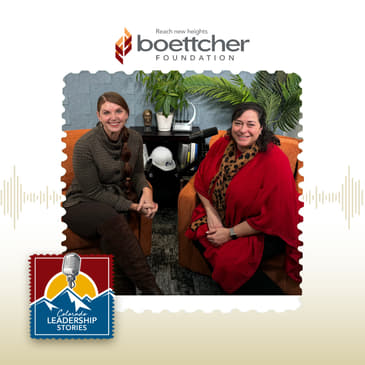
In this episode, Katie sits down with Kara Penn, a 1994 Boettcher Scholar and owner of Mission Spark. Kara's journey from scholarship recipient to social impact leader has been marked by a commitment to systems-level change and a passion for supporting mission-driven organizations.
As co-author of "Fail Better," Kara emphasizes the importance of learning from "smart mistakes,” while using failure as an asset in management and life. She also reflects on how motherhood has influenced her leadership style and the lessons she's applied from parenting to professional life.
Listen on Apple Podcasts | Spotify | Amazon Music | Pandora or wherever you get podcasts!
Colorado Leadership Stories is a podcast presented by Boettcher Foundation
Follow us on Instagram, LinkedIn and Facebook
See Privacy Policy at https://art19.com/privacy and California Privacy Notice at https://art19.com/privacy#do-not-sell-my-info.
[00:00:00] Hi, I'm Katie Kramer, President and CEO of the Boettcher Foundation. Welcome to Colorado Leadership Stories, where we talk to everyday, courageous leaders who have made transformational impacts in their communities and are building a better state for everyone. You'll hear from leaders and organizations and communities throughout the state as we explore the idea that leadership is an activity that anyone can do.
[00:00:27] Today, we're thrilled to welcome Kara Penn, a 1994 Boettcher Scholar and Principal Consultant of MissionSpark. A graduate from Colorado College, the University of Chicago and MIT Sloan, Kara has dedicated her career to achieving systems-level social impact. As the co-author of Fail Better and a recipient of prestigious fellowships like the Thomas J. Watson and the Coral, Kara brings a wealth of experience in consulting with mission-driven organizations. Her work focuses on supporting
[00:01:02] passionate leaders and organizations striving to make the world a better place. Kara is the past chair of the Boettcher Scholar Alumni Board and brought to us her perspective and deep experience in leadership, innovation and community impact. Join us as we explore her journey and insights on transformative social change. Welcome Kara. Kara Penn Penn Thank you so much. I'm so happy to be here. Kara Penn Thank you so much. I'm so happy to be here. Kara Penn Yes, we're excited to talk to you. Kara, you've been a Boettcher Scholar since 1994 and now ran MissionSpark.
[00:01:30] Kara Penn What's the journey been like from being a scholarship recipient to becoming a social impact consultant? Kara Penn Well, first I have to say that being a Boettcher Scholar and having that opportunity was absolutely transformational for me and can't be underestimated. I think it opened a lot of doors that then led to my journey and social impact. And even though I think from a very young age, probably five years old, I've always, I guess, kind of known that I really cared about people.
[00:02:00] Kara Penn And I just felt my best when I had an opportunity to give back. Kara Penn You know, this journey really became enabled by the Boettcher Scholarship and then the opportunity to live in different communities, different cities. Kara Penn And it really was a journey of kind of building skills, education and experiences to just feel like I was in a place to contribute in a social impact space.
[00:02:29] So if you kind of look at my journey across time, sure, it's involved, you know, education. Kara Penn There's been some incredible fellowship opportunities. Kara Penn But every single thing that I try to touch, you know, then and now, I really feel like it needs to be contributing in a positive way, you know, to this world that we're building collectively. Kara Penn And that's the rule for me. Kara Penn Well, I think a lot of your experiences, and it's been, it's an interesting journey.
[00:02:58] So that's where we're going to go next, have contributed to that perspective and have equipped you to, I think, really make a difference. But the professional path is fascinating. From working in a juvenile detention facility to advising low-income artists to now running a consulting firm. Kara Penn So what's the common thread connecting these experiences? And maybe just walk us through a little chronology of, from, you know, you finish up your bachelor scholarship at Colorado College, and then here you are with your own company.
[00:03:27] Kara Penn Yeah, so again, that thread, I think, is social impact. And I will say that my journey was one of really working individually, kind of one-on-one with people or small groups. Like, I was a peer counselor in high school, and, you know, just always there have been opportunities to work with people in kind of these intimate environments. And as I was doing that, I think I really realized that there are systems at play that really shape our opportunities and our lives.
[00:03:54] And I came to a place where it wasn't enough to have the one-on-one impact if we weren't looking at the systems that were shaping communities. And so that became a big piece for me. But that common thread is kind of building on the experiences that I had to just keep digging deeper and deeper to say, you know, kind of what are those influencing factors.
[00:04:20] So, for example, when I worked in juvenile detention, you know, I was connecting with individuals there. Some of them were foster youth. Some of them had been placed there, you know, based on experiences that they'd had in life. There wasn't much separating them from, you know, any kid that you would meet except that their lives and the experiences that they had had been very traumatic most of the time. And then that was playing through in their lives.
[00:04:48] And that led me to work in places like East St. Louis where we found that there was lead in the ground and in the school system. And then that was at a very young age impacting kids towards increased violence. So, you know, there's a system after system choices that we're making as a society that are harming our young people that play out in ripple effects.
[00:05:11] So these are, you know, some in that desire and move towards really social justice. I kept thinking about what are the ways that I can contribute. I've always known I'm a person who likes to work on many different things at a time and see the interconnections between them. And in some ways, consulting is one of the very best ways to do that.
[00:05:34] If you build authentic, meaningful relationships, you know, find ways to use your capabilities to add value. You can come alongside many different organizations and initiatives and then see the through line, the connections between them. Like when I've worked in the early childhood space to child protective services to domestic violence, maternal mental health. There's always this common thread of impact and social justice.
[00:05:59] And it's just, you know, how that is enabled by my, you know, by having MissionSpark and getting to touch all these things in interesting ways. Well, it does seem like your background perfectly prepared you for that type of work. And you said this a couple times, just even in your answers about just the systems level social impact. Is there a specific project or initiative that you've seen that concept really come to life in your work?
[00:06:27] Well, I'm fortunate to really feel like there are several options there. But the one I think I'll talk about today is work that I had about four years of experience engaging in. And that's really the process by which we built out the Colorado Maternal Mental Health Framework.
[00:06:45] This was an opportunity to come in and work with just a wide array of organizations, individuals, funders, policy makers around recognizing the contributions and the challenges that in the social determinants of health that really influence perinatal mental health.
[00:07:07] So when we think about, you know, that the time when we're pregnant, the time after, you know, we give birth, mental health is there's a lot that challenges mental health. And there are lots of things that are kind of protective and help you through that time. And then there are things that can make that a much more challenging time. And, you know, this was really an opportunity to say, what are all the factors at play? You know, who's most impacted by these challenges?
[00:07:34] And, you know, how do we build a system, you know, that supports both from a legislative standpoint and policies to a funding source to, you know, how we communicate in kind of ways that do not have stigma to folks and across cultures to really engage. So really proud of that work here at Colorado and how it came together and some of the legislation like family that we're certainly not taking credit for, but we're part of that journey.
[00:08:01] And I think, you know, one of the big lessons there is the systems level work is complex and collaborative always. Right. From so many different angles. Lots of stakeholders. So many different experienced people with lived experience at the table, really informing the process. And it also takes, I think, project management skills, skills that say, OK, there's a lot of complexity here. How do we keep moving? How do we keep partnering with each other? How can we depend on each other?
[00:08:28] How are we actually demonstrating that we're getting the work done and that there are results? And oftentimes Mission Spark, myself, that's what we're coming alongside to do and also to help facilitate authentic conversations among people. So it's been hugely meaningful. It's had ripple effects in all sorts of ways, I think. And it's just a real privilege to be able to do that work. Well, and Kara, it's hard work.
[00:08:54] I'm just thinking about when you're engaging in some of the most wicked problems of society, a couple things come up for me. One is just the patience that it requires and certainly the leadership skills that are required to engage in that way. And so this being the Colorado Leadership Stories podcast, I'm just curious about that. Like when you're in those situations with your firm, you're trying to make a difference for people.
[00:09:24] We're trying to support other leaders who are in this, trying to make a difference. What are some of those skills that you feel like you are, you're counting on to help you be successful? Yeah. No, I appreciate that. I laugh a little bit that you started with the word patience because it is not the first word that comes to mind. Frustrating. For my children, for my family, for probably for others and thinking about. Because there's urgency. You feel this urgency around some of these challenges.
[00:09:53] And at the same time, I mean, these take decades to make movement on and to see, you know, shifts. And so it's a yes and, I think, in holding both urgency and long-term change within here. But the leadership skills. So it was just the first thing that came to mind. I'm a very visible person. So the first thing that came to mind was Swiss Army Knife. Yes.
[00:10:14] I think there's something about working in the social sector, you know, which is often resource constrained in terms of what's available to say, what does this moment need? And how can I make myself useful to this moment and to this place? So from a leadership standpoint, I think there is a deep belief, core belief for me, that everybody can lead.
[00:10:41] And they can lead from whatever place they are. And whatever, you know, moment in time. And that collaborative leadership, always being alongside, learning, listening, contributing, you know, kind of being what the moment needs feels absolutely critical. And then that concept of servant leadership. Don't need to be out in front of something. I need to be alongside it in the ways that make sense.
[00:11:08] And I think those are some of the leadership skills. Listening, really deeply, truly listening, creating safe space for others to share. You know, so a lot of what I work with are kind of like helping to set an environment and be explicit about, you know, what we're trying to create together. And then hold us all accountable to that and with kindness. Those things, I think, are really part of that leadership path.
[00:11:37] And I think that's how I try to approach each opportunity I have. And it's funny, people will say, what are the projects that you're working on right now? And because for me, kind of impact is my currency in life. Like I always want to be contributing, which I think is something that Boettcher recognizes and supports over time.
[00:11:56] I don't really distinguish between the volunteer roles that I serve on, on boards or, you know, volunteer in collaborative ways to facilitate or serving on, you know, one of my children's collaborative school committee or, you know, a client that I've been working with. It all matters. It's all critical. And it's all part of, you know, that desire to help serve. I really don't distinguish much, you know, between that. I don't either. I don't either. We have this in common.
[00:12:26] I know we are definitely. Just part of living life. Wired that way. And I think also just, I'm thinking about your history all the way back to the time that you were selected as a Boettcher Scholar. And of course, one of the selection criteria is the service ethic, right? I'd love for you to reflect on, like, where does that come from? Is this nature, this nurture?
[00:12:44] I think about our team reminded me of your application for the better scholarship that as a teenager, you were doing these types of things, organizing an environmental education summit during the Gulf War oil spill. But you just always had this sense of social responsibility. So where does that heart for service and impact come from? Well, I certainly think it comes from my parents and kind of the values they set for me.
[00:13:13] So, you know, I think I grew up in a church environment where service was important. And I'm thinking about the youth group environment that I was in, you know, that my parents volunteered to help get middle schoolers to work together on, you know, various tasks. But I can remember going with my mom and dad just on some of the weekends to the Jeffco Action Center. I'm sure you're familiar.
[00:13:35] And we would just interface with folks and we would pack bags of food and we would have conversations. And I think those early formative experiences were just like this, you know, it's kind of selfish, really. It's like this space where like this just feels so good, so right to be in community with people and to share abundance and to not really see it as, oh, I have things.
[00:14:04] And I'm not in a position to need this. It doesn't matter. We all have moments where we need support and help. And I think just really having this sense of seeing each other as human beings and centering in that, which is something about having those types of experiences at a young age. I think the other, you know, contributing factor I mentioned earlier, like just very early on, I loved animals. I'd be a vet.
[00:14:30] You know, I used to get stuffed animals that I would care for so lovingly. And I think it was just an orientation of caring. And I was just like I was going to care for anything that came into my purview.
[00:14:41] The thing that I would couple with that kind of desire to give back, and you mentioned kind of a high school kind of activism type of, you know, opportunity that I engaged in, you know, after the Gulf War is, again, that kind of social justice and connecting to people on, hey, we can build a different future.
[00:15:02] We can educate ourselves, take action, you know, look at things through different lenses than, you know, maybe we've grown up with, put ourselves in other people's shoes. And these things aren't just happening to us. You know, we have a voice and we have a say. So I think one kind of historical through line for me is relatively entrepreneurial orientation. Something's missing. I'm going to build it.
[00:15:28] If there's an opportunity, you know, or a little bit of a vacuum at a table where a skill is needed, you know, I'm going to raise a hand and see if I can be part of that. And, you know, I think shaping the world belongs to the people who show up, you know, and do the work and do that work with empathy, kindness, listening, and humanizing each other.
[00:15:50] And I don't think there's been a time in my life where that wasn't a big part of the journey, beginning at a very young age and through the love and kindness and example, you know, my own parents. I have wonderful parents, too, and so thankful that they exposed my sister and I to opportunities to feel very selfish about being able to give back.
[00:16:14] I love that it not only benefits folks that you have a chance to serve, but also, gosh, she gives so much intrinsic value from that. But the work that you've chosen is it's difficult stuff. And I want to take this in a different direction because in addition to being an entrepreneur and a consultant and all these and a heart of gold, woman, you have a heart of gold. It's hard work and you can fail. And as it turns out, you've written a book about that, right?
[00:16:43] Co-authoring failed better. And I think that we would love to hear about that book and some of the leadership things you talk about that and even just the resiliency to get back up when you're choosing these difficult things that you are trying to make an impact with. So talk about fail better. Love the opportunity to talk about fail better.
[00:17:05] And I think, you know, one of the key lessons, you know, when we think about failure, one, I think people hear that word and they have some level of reaction to it. I certainly do. Right? They're fearing it off. And then, you know, you just either you're touching a memory in your past where it's like, oh, that brings up shame or disappointment in me when I even hear that word. Because it just it touches, you know, in such an emotional way to our core.
[00:17:33] But here's the thing, you know, failure is inevitable. And it's kind of what you do with it that counts. Right? Like every single one of us will fail in big and small ways in some capacity. Others may not look at it and identify it that way. But you, you know, internally may. And it's kind of an art and a science. Right? So I think there's a few things. You know, certainly the book talks about like how you kind of right size failures a little bit.
[00:18:00] Like how you anticipate and you kind of look ahead and you say, okay, this is a really complex, messy, challenging social issue. Like or whatever the issue may be that, you know, you're trying to tackle. And it's like, well, where are some of the places that this might go off the rails? You know? And how likely is that? And if that's possible, you know, what am I doing today now either to have warning signs that that's happening or, you know, alternative plans.
[00:18:28] So it doesn't have to be this thing that just like, you know, picks you up by the collar and shakes you around. It's something that it's like, hey, it's very likely, you know, especially with risk. Right? Anything that's really risky and worth doing, you know, increases the chance, you know, that there will be an outcome you weren't hoping for.
[00:18:47] So we think about how we plan for it, how we anticipate it, how we make course corrections along the way, and then how we learn from it and might change what we do differently, you know, in that space. So for me, it's there's this learning opportunity. And then I think the final thing, especially for all those folks out there who are, you know, real achievers. I don't know any of those. I'm not sitting across from one right now. But sometimes you really can internalize these sorts of things.
[00:19:16] And you can think about, okay, well, it's not just that I failed or struggled with this, but I am a failure, you know, if I did that. It's like, no, that's actually separate from you. You know, you risked, you tried something, you're learning from it. It's not something that we have to, like, pull in and internalize and, you know, and carry with us. It's something we can talk to other people about, set examples. Like, this was disappointing. This is how I handled it.
[00:19:43] And I think, you know, as leaders, we have the opportunity to show that level of vulnerability. Right. And to teach, you know, those folks coming up, like, hey, this is other people learn from these things, too. And you tell your story. You own your story. You shape your story in ways that can help others, you know, learn and benefit from it and model to them that this is going to be an experience you have.
[00:20:10] And the resiliency and the learning that you have in that is what propels you forward and what propels society forward. So, and I love the opportunity to just create comfort in this. Right. I loved how you talked about it at the end, too, about just the learning from and the resiliency that comes from things not always going perfectly. So, that's great. Thanks for giving us permission, Kara. That's right. Permission to all. Yes. Fail away, everybody. Thanks.
[00:20:40] We love it. It's 5 to 14. I love that. And we just had a birthday on Sunday, so we're 5 to 15. Oh, my goodness. Oh, my goodness. Well, I am curious about how your experience of motherhood has shaped your perspective on leadership. There are lessons that you've learned from parenting. Talk about failure and learning.
[00:21:07] And, oh, my goodness, resiliency from parenting that have translated into your personal, professional life. Well, I'll let you know when I have that figured out. I'm kind of laughing to myself because you brought up patience earlier. And so, one of the first things that came to mind was, my goodness, for a person who is not particularly patient, I feel like motherhood is like the absolute crash course. Right. And so, my experience was really important in learning patience and on so many different levels.
[00:21:36] And our journey to parenting was not easy, you know. And as somebody who likes to set a goal and just be like, okay, I'm ready. This is my goal. And how do I reach that goal? You know, these are the things. And then that was my experience of becoming a parent. It was actually quite a difficult journey. And then there was a good place for resiliency in that and, you know, kind of maintaining acceptance. If that's a, you know, it's kind of like I'm going to try as hard as I can.
[00:22:06] I'm going to do everything that I can and I'm going to accept, you know, the outcome. And I'm also going to accept that I'm going to be okay. And I think that's true of parenting on any given day. So, now I'm in a place of having four children, you know. And that patience is important. And I think pacing is important, especially from a career perspective. Like, I can get into a place where it's just like I need to do it all and I need to do it all right now.
[00:22:31] And this kind of pacing and understanding and stopping to reflect on what's important and what's important to my children and how all these pieces fit together feels really important in this journey. Whether a period of time is, you know, good and really positive or whether it's really challenging. And I think with kids there's always going to be phases that are super challenging. I mean, one of those right now. I love to come back to nothing is permanent.
[00:22:58] And sometimes that makes me feel sad because I'm like the most beautiful period of time. And then I just sit in gratitude that we had it, you know, and that we had this moment. And when it's super hard, it's like this too shall pass. It is not permanent. And I think there's, you know, learning and, you know, ways to bring that in. I also kind of have this space of trying to let experience and emotions flow through as opposed to kind of putting my head down and saying, okay, this is intense.
[00:23:27] This is a really intense period to both own a company and to parent and to volunteer and all of these things. But I want to experience it. I want to live life. I want to feel the emotions of that. And so I don't really love to just like put my head down and say, okay, I'm going to look up in two years or three years. It's like I want to be here in this moment and experience this moment. And so there's a lot of effort to do that. To be present. To be present. Absolutely. Absolutely. I think that's a huge leadership skill, right?
[00:23:57] To learn that, to be present to people, to be present to your own emotions, be present to your own body and how it's functioning. The relationships in your life. And both be present to pain and joy. Yes. And discomfort. Yep. Yeah. And paradox, all of those things. So true. Oh, it's fun to philosophize with you. Very, very much. I want to turn it back to leadership development.
[00:24:25] And I know we've been talking about that certainly just now in the parenting context. But you know at the Betcher Foundation, we believe in the promise of Colorado and the potential of Coloradans. And a part of this mission is trying to develop and support leaders. And you have been in this space over time. You have participated in some of our programs. You've helped deliver some of our programs.
[00:24:49] But I'm really curious if you feel like the needs of leaders has evolved over time or if it's always been the same. And I'm just curious about your perspective on that. Yeah, I really appreciate that. I mean, I think there's a few things. And I think it's something that we just deeply believe in and share, Katie, you and I, in this, is that everybody has leadership potential. Yes.
[00:25:15] And there are experiential opportunities and there are systemic opportunities that sometimes open doors for you to find that out. Like I think lots of times young people don't know or understand that they can lead from, you know, at any time in their lives, beginning now. And, you know, sometimes they're the ones speaking truth to power or they're the ones to say, hey, I'm looking at this differently. Let's introduce this or let me be the one to raise my hand and step up.
[00:25:45] And add the question, too. What comes up for me then is removing as many barriers as possible to leadership. I think as a society, we very much have built up these, like, layers that you, you know, tests that you have to pass through to get to the next layer or to, you know, to move forward. And I'm really interested in leadership opportunities right now, like Colorado Young Leaders, for example, which are really trying to create spaces for people to learn or to lead in their communities,
[00:26:13] to help develop skill sets and pathways and opportunities to serve that help people unpack that and see that in themselves, that it's not like a crown that somebody, you know, that they hand off to you. Okay, now you're a leader. Now you're a leader. And the connection I have to that is when I was a Coral Fellow, you know, I was in my early 20s. And it's an amazing program that kind of puts you in these kind of high-level internships, not the coffee-getting type,
[00:26:42] but the type where, you know, you come in and you do really interesting projects and you meet with all the highest leaders within a company or within an organization. And so I got that kind of exposure very early on. And one of my key takeaways is sometimes the leader that's there is the last person standing, right? They just kept going, you know? And it was like, oh, you know, you don't have to necessarily wait 20 years until somebody says you're the director, the manager, the CEO of wherever you are.
[00:27:11] It's like just opportunities everywhere to give. So I think that piece, I think collaborative leadership is huge. I find that some of the most effective change initiatives is when we come alongside each other and recognize the strengths of each other and don't need to excel in front of other people, but just kind of link arms and say we're doing this together. And maybe I have a unique skill set of various points that I can activate.
[00:27:38] But I'd really encourage people to that kind of collaborative and servant leadership. And I think that's what our country needs. You know, I think it's what the world needs, you know, in this space. So that's maybe at least how I've changed in my perception of leadership and kind of, you know, how that plays out. And maybe the last thing I'll mention is, you know, Mission Spark has built a fellowship program. And we've been so fortunate probably to have 20 VETR scholars come in at various points and just get to the good work,
[00:28:08] you know, the good work of helping to support nonprofits, government programs, philanthropic foundations, and larger collaboratives, you know, see that there are pathways, you know, for these passions around social impact to get in there and make a difference. And so I know I've modeled our fellowship program after some of those learnings. You know, let's just get out there and do the work. Let's practice. Let's practice. That's right. I like it. Oh, that's really cool.
[00:28:37] Thank you for reflecting on that and your continued commitment to developing leaders. And I so appreciate that in all the ways that you do it. So thank you. I don't think any of us know the ripple effects, you know, that we have of even doing the smallest thing. And I think, you know, sometimes, and I've had the experience now that I've had 28 years in my career, to see some of those ripple effects come back.
[00:29:05] And I'm sure you have, too, for it's just like you hear from somebody, you know, from a part of your life. And they come out and they say, I just want you to know this meant something to me or this is what I'm doing now. And you just think, thank you for allowing me to have this touch point with you that may have shaped you in some way. Very, very cool. And such a privilege to do the work that we do. It's wonderful. It is. Well, to wrap us up today, I have the four speed questions for you. First, what is your favorite Colorado hobby?
[00:29:35] I'm laughing because it really is at this time in my life. Like, admiring the photos that other people post of hiking 14ers and, like, doing daredevil skiing. I mean, it really is probably, you know, my favorite hobby. And if I had to actually physically do something, it's getting out into the fall. You know, just walking in the golden leaves. And Colorado is such a beautiful place to be. Absolutely it is. Well, and what's your favorite Colorado landmark? I actually think Dillon Reservoir.
[00:30:02] It's so close and accessible for many different people and places. And it's just gorgeous. Like, the way the mountain ranges, the opportunities to, you know, to bike and hike and just see the mountains reflect on the water. It's a place that's great piece for me. Yeah. It's a pretty spot. Here, what action hero do you most identify with? I am not somebody who identifies a lot with action heroes. But I have to say, I mean, we just have to come out with Wonder Woman.
[00:30:31] And because I think she was justice-oriented, right? And, but also empathetic and also, you know, trying to do the right thing. And so I, you just hear me come back to kind of wanting to build a more just and equitable world. And by all means necessary, you know, and she has some means that I don't have and some legs that I don't have and your costume. And that's great. But I'll try to identify with her.
[00:31:00] I love that. That's a great answer. Okay. Oh, this will be fun to hear your answer to this one. What are you currently binging? Is there a show, a book, a podcast that has captivated you at this time? If we're binging anything, it's Bluey in my house from a five-year-old. Any of you have seen that, you know, emotionally intelligent kids show. But the truth is I love poetry. So, you know, it's probably not going to be a podcast or other things unless it's NPR in the car.
[00:31:27] But what I love about poetry, when you're living a really busy, full life, you can pull a single poem out. Like just this little, you know, one-page, like, question or this one-page, like, sublime description of something or the way that language is used. And no matter how overwhelming or intense or quiet life is, there's always a moment for poetry.
[00:31:57] And so for me, I think that's what I would bring forward. And it's enough to kind of shift a perspective, change a mood. Yeah, poetry. That's a fantastic answer. And one we haven't had yet. And, okay, now I'm going to be, like, thinking I need to go find a book or something of poetry. Do you have, would you recommend, is there someone, an author that you really like or? Oh, gosh. Now you got it. I'm sorry. It's not a fair question. Maybe. And I'm going back to, like, what did I read in high school? I should probably do that.
[00:32:27] Yes. Lucille Clifton, Book of Light is a beautiful book. Lee Young Lee is an amazing poet. I love Jude Nutter, who's a Welsh poet. Pictures of the afterlife. I don't think it's a really well-known collection, but it's just so beautifully rendered. You could see I could do a whole podcast. I could see that. And I'm so glad that you gave us some of those little nuggets. Yeah, I still write. I mean, finding time for art and, you know, kind of the multifaceted part of yourself.
[00:32:55] It becomes a little harder when you're parenting and all of these things. And yet it's just foundational. It's critical to be creating. And so poetry is that thing for me. Oh, thank you. Thank you for that little nugget. I commit to reading a poem very soon. I'll send you some options. That way you don't have to look too far. Thank you, Kara. Well, thank you so much for coming on today. It was so much fun to visit with you. And again, continue to appreciate your commitment to making the world a better place.
[00:33:25] Thank you. And back at you. And it's been super fun. And it's always an honor to have a chance to, you know, to just be part of Betcher, to be part of the Colorado leadership environment and to be a friend to you. Thanks. Thank you for joining Colorado Leadership Stories, where we hope to inspire the next generation of Colorado community builders, doers, and difference makers. Colorado Leadership Stories is presented by the Betcher Foundation.
[00:33:55] The Betcher Foundation supports Colorado by empowering leaders and communities with tools to tackle challenges and pursue opportunities, building a better state for everyone. With an 85-plus year legacy of giving back, we're committed to amplifying our impact for future generations. That's the spirit of Betcher.