
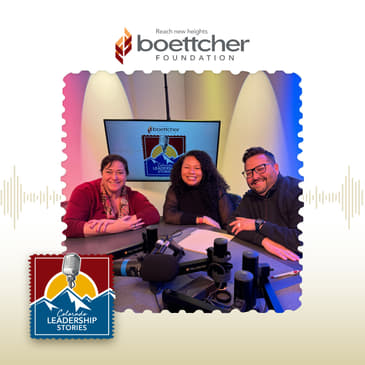
On this week’s episode of Colorado Leadership Stories, Katie and Curtis dialogue with the 2025 Colorado Teacher of the Year, Janet Damon, on how to become a champion of wellness. As a dedicated educator and advocate for student-centered learning, Janet’s journey has been defined by her passion for helping every student reach their full potential. Janet reflects on how her approach to teaching has evolved over two decades. She discusses her work to disrupt book deserts, support teacher wellness, and create communities where all voices matter. This conversation is a reminder that all educators have the power and influence to become champions of care, inspiration, and leadership.
Listen on Apple Podcasts | Spotify | Amazon Music | Pandora or wherever you get podcasts!
Colorado Leadership Stories is a podcast presented by Boettcher Foundation
Follow us on Instagram, LinkedIn and Facebook
See Privacy Policy at https://art19.com/privacy and California Privacy Notice at https://art19.com/privacy#do-not-sell-my-info.
[00:00:00] Hi, I'm Katie Kramer, President and CEO of the Boettcher Foundation. Welcome to Colorado Leadership Stories, where we talk to everyday, courageous leaders who have made transformational impacts in their communities and are building a better state for everyone. You'll hear from leaders and organizations and communities throughout the state as we explore the idea that leadership is an activity that anyone can do.
[00:00:27] Today, we're excited to welcome Janet Damon, the 2025 Colorado Teacher of the Year and a dedicated history teacher at Delta High School in Denver. With over 25 years of experience in education, Janet has made a significant impact on our students by focusing on inquiry-based learning, digital storytelling, and culturally sustaining practices.
[00:00:53] As a graduate of Denver Public Schools, Janet embodies the spirit of resilience and dedication to education that's vital for our future leaders. Today, we'll explore her journey as an educator, her philosophy on teaching, and her vision for the role of teachers in shaping a better Colorado. Welcome Janet. Janet Damon- Thank you so much. I'm so grateful to be here. Well, we're glad to have a conversation with you. And I'm also excited to welcome my colleague and friend, Curtis Esquivel, who is our Senior Director of Communications and Community Engagement.
[00:01:23] And we're going to have a dialogue today. I'm excited. Awesome. Thank you, Katie. I'm ecstatic to be here. And Janet, it's great to meet you and really looking forward to this conversation. As am I. As am I. That's great. Okay, so Janet, let's take you back. Start with your early years. So you're a DPS kid too, right? And then end up teaching in?
[00:01:41] Well, it's kind of a journey. So my dad is an Army Drill Sergeant. For most of my childhood, my dad served about 23 years. And so every year we moved, you know, in general, every three years. So we lived in South Korea, I was born in Germany, Panama, South Carolina, Louisiana.
[00:02:00] So we often would find ourselves living in a wonderful place, building a wonderful community. And then three years would hit, we would get the notice, okay, you're now moving to Louisiana, or you're now moving to, you know, another country.
[00:02:14] And so for me, it was really important to have great educators who made me feel at home, and made me connect with others and build a community and always saw the potential that I brought, the talents that I had. And so I had really phenomenal teachers in the military Department of Defense system. And I also had the pivotal teacher. When I moved to Louisiana, I had a teacher, Ms. Walsh, who was such a passionate educator. She loved to hear me read.
[00:02:42] She would often sit me in front of the other students and talk about my vocabulary and all the reading that I was doing. And that's when I began to really see myself as becoming this kind of educator. And then the next year, we moved to a more rural community that was outside and here in Colorado, actually. And I had a teacher who, you know, and I just remember walking in the room, and she looked at me and her face fell. And I don't know if it was because she thought, oh, another student. Oh, another mid-year transfer.
[00:03:11] Oh, why didn't she get sent to the class next door? But that was when I realized, wow, you can have a totally different experience based on who is teaching in the class. And that was a hard year for me. So after that, I said to myself, I always want to show up as a Ms. Walsh. And so that's kind of how my journey began. Well, let's talk a little bit more about your journey as a teacher. Where'd you go to school and then talk about your journey into education and what led you to teach at Delta?
[00:03:41] Yes. Okay. So I knew I wanted to be a teacher and I went to Metro State University and I was excited to major in history. I minored in African-American studies. I did secondary education. And then it came time for student teaching and I didn't have the resources to make that happen. And I'm an avid reader. I love libraries. So I said, well, maybe I'll do my master's in library science. I went to the University of Denver and I ended up back in a school.
[00:04:10] I was at East High School and I was recruited to be a librarian by Dr. Jodi Gehrig, who was in Denver Public Schools. And I ended up going back to MSU. And this time I had Dr. Skip Jensen as one of my professors, phenomenal, one of my phenomenal educators. And so I ended up going through this pathway of being both certified as a K-12 librarian, as a history teacher, as a literacy interventionist. And so I did all of these roles and I did all of this work.
[00:04:39] And then I thought to myself, maybe school leadership is the path for me. So I ended up going to the University of Colorado and getting my principal's license. You know, my. Wow. Yes. Yes. My postgraduate degree. And so I ended up actually working as a library services coordinator for the district. I trained. I did workshops. I did culturally responsive professional development sessions with senior leaders.
[00:05:06] And around the time of the pandemic, I really felt this moment of the need to go back to the classroom and to serve. And I just felt like I missed kids. I missed. And not only that, I really felt like all of my talents needed a home. And so I was very intentional about where to go next. And when I went to Delta, I met their principal, the founding principal of Delta High School, April McLaughlin. And she is probably the most transformative leader that I've ever worked for.
[00:05:35] She has a vision for students. She is working with Delta is a school that is really for students who are at risk of dropping out due to maybe teen parenthood. Maybe they had to go back to work during the pandemic so they can contribute to their family's income. Maybe a parent or caregiver became incarcerated. Maybe they are new to Colorado because they've left a country that is going through hardships and struggles and war.
[00:06:02] And so at that school, I feel it is the culmination of every skill that I've ever developed coming home. And so I also, when I was young, faced challenges. So it was a place where I felt like I could truly be the Miss Walsh that other people needed so that I can show up with that love. And also a skill set that has been honed over more than 20 years in the district. So it's been wonderful to work there. Great.
[00:06:30] Well, Janet, so much to learn from you. We spent a few minutes before we were recording today learning about you. And you talked about when you moved to Denver and being someone, a kid growing up in the Montbello community, but then being bused to West High School, which is quite a distance. But just that experience combined with your international background, I think that's probably impacted who you teach.
[00:06:56] And my question is more about how has it impacted how you teach as an educator? Absolutely. When I think about growing up and living, when we moved here, we moved to the Montbello community. And I was catching about a 40-minute bus ride over to West High School. And as I would take that journey, I would see kind of how the city was organized. And a lot of that was stratification around race and culture.
[00:07:22] And I would arrive at this school, and I loved going to West High. They had a Center for International Studies. They had some passionate teachers. But I also had the experience of when I first got enrolled, being placed in kind of general courses. And I remember being in one of my classrooms, and a student, she began to iron her hair. It was like the early flat ironing. And the teacher never stopped it. And I remember telling my dad, I'm a little worried.
[00:07:52] And so my dad came down the next day. And when he came down, we went to the office. We didn't even really say anything. My dad said, I got a problem with my daughter's classes. And they said, oh, wait a minute. Have a seat. We will go ahead and change all of her classes. And they moved me all into advanced and AP classes, even though they didn't have anything for my transcript. So I realized in that moment, they were making this change because my father actually came to the school.
[00:08:18] And when I went the next day to my classes, I remember passing by the courses that where I was in the first week and feeling kind of survivor's remorse. And so that informs my practice because every student needs rigor. Every student needs challenge. Every student needs to feel a sense of self-actualization through the work. And so no matter where my students come from, no matter what their past experiences have been, no matter what challenges they have faced,
[00:08:46] they deserve incredibly rigorous, wonderful, exciting, personalized learning experiences in my classroom. Thank you for sharing that. Yeah, such a formidable experience. And thinking about your father also advocating for you and thinking about all those students that maybe don't have those advocates or they're trying to figure out navigating how to advocate for themselves. That's the heart of the work. That's the heart of the work.
[00:09:10] What is the educational experience if a kid is showing up and no one at that moment can be there with them? Will the system still treat them as equitably? Will the teacher still respect their agency? So that's a huge part of my goal. Well, and to build on that, I think that one of the things that you were recognized as the 2025 Teacher of the Year was about your student-centered approach. So how do you create that safe and supportive learning environment where your students do feel empowered? Yes.
[00:09:40] Well, first, I come home to the fact that I believe in a human-centered classroom where, as a human being, I'm looking for and identifying what are your gifts and talents. And every student has gifts and talents that they show up with on the first day. And my job, one of my first jobs, is to find out what's the driver of your curiosity, what's the goals that you have for yourself, what's the dreams that you want to actualize,
[00:10:07] and how can I be a colleague, a trusted partner in helping you to reach those goals. So for me, it really comes home to how can the content be personalized to the needs of the student. One of the things, on a side note, is I'm also a certified yoga teacher. And when we think about yoga, one of the goals is that everybody can do yoga. Everyone has an access point to it. So when I think about my practice in the classroom, everyone can do the work.
[00:10:36] There are different scaffolds and supports and things that we can use to help that student have success. But that's my job, is to make sure you feel the success of what it is to own your learning journey. Wow. It's art, it's science, it's all of those things. And to see so many layers of teaching and education in your background is pretty amazing. You talked a little bit about content, and you're a history teacher.
[00:11:03] How do you make sure to make history in an ongoing way, right, year after year, relevant, engaging? I mean, I'm sure you're always aware of current events, but I also think even for you, how does your teaching evolve? Yeah. Well, one of the things I love to do is help students to see how current events have such deep historical roots. So for students, they always want to know, how did it start? Why are we dealing with this challenge?
[00:11:32] So in some ways, it's kind of like forensic investigations of how in history did these moments we're experiencing now have their roots and policies and practices and historical experiences in the past?
[00:11:46] And so I think for students to feel so excited that they know something that they can go back and tell their family member when this current event is happening, when we, you know, looking at even the pandemic, looking at different policies around immigration, looking at different challenges that marginalized communities might be facing. They want to know how, is this just happening now?
[00:12:10] And I'm always pivoting us to looking at the historical roots, because if you can understand the root system, then you can understand how to create solutions and how to create remedies. And so a lot of what we do in the classroom is, you know, centering the student not only as historian, but also as activist, as advocate, and as solutions-oriented thinker. And so that's the goal, right?
[00:12:35] We need this generation to help us solve very challenging problems that have been around for a long time. Yes. Yes, we do. And I see you as teacher, but also learner. Like, I'm so struck by all the degrees that you have, and you're continuing to learn. And I'm so curious, how has your approach to teaching evolved over the years, especially in response to, like, changing educational landscapes, student needs, societal things? Electronics, AI? My gosh, I just can't even imagine.
[00:13:05] Yes, there is so much has changed. I mean, I started teaching before kids had cell phones. I remember the first three-pound cell phone that was made is a brick. And so when you think about all of these things that students are encountering that are new, and all of the ways that innovative policies and practices and artificial intelligence and so forth. But what I've come to remember and what grounds me is that, one, I always serve kids and families. So my boss never changes.
[00:13:33] No matter what principal, no matter what leader, no matter what superintendent, my job never changes. I work for kids, and I work for families. And the second piece is that every learner deserves to have an experience where they have voice in it. They're co-creating it with me. So for me, I think the largest change really has been how to bring students back to some of those core foundational goals. They need to know how to communicate. They need to know how to collaborate.
[00:14:02] And then they need to know how to use the tools to help them do the learning. And so I really work with my students around AI as understanding that it can be a partner in your learning. You can ask AI, can you show me how to do an outline for this essay on this content? But you have to do the thinking. And that is the core of it. And I love to just see students as creative content creators and learners. So that's why the podcasting is important.
[00:14:29] Our students do aesthetic thinking to see how art over the, yeah, we do a whole thing. Aesthetic thinking is when you think about things through the lens of both the art of it and what the art is trying to communicate. So we had this experience where I took my students to Five Points for a walking tour. And there's a gallery called the Red Line Gallery. And they went into the gallery. And they're looking at all this art. And I wanted them to take that and go back to the classroom and think about what is art communicating?
[00:14:58] And what does it mean over time? And what are some universal and ancient and core problems that art is trying to solve? And I think about Toni Morrison's quote, you know, when things get hard is when the artist goes to work. And so within each of us is that artist. So I really want them to begin to connect with themselves in completion, that they are a thinker, a creator, artist, activist. And they have to be that in order to be successful in the 21st century. So prolific and inspirational. Thank you for sharing that.
[00:15:27] We want to sign up, I think, for a class if you're ever doing any adult ed or adult learning. But let's talk a little bit about some of your community work. As we know, you run sort of a, as you described it, a literary society, Afros and Books. Yes. Which I think some people may think of it as a book club, but it's so much more than that. So maybe talk about some of that work. And again, it's all along these wands of teaching and learning.
[00:15:55] Well, one of the core inspirations for Afros and Books is that my father grew up in segregated Texas. And at the time, he, as a kid, he didn't have access to a library. So the only way that he could get books was two activist librarians would load up into a bookmobile and drive it to his little rural street. And every two months or so, he would get a book. And so he loves books. And my house growing up, my childhood was filled with books and visits to the library.
[00:16:23] And so when I began to see that there are many libraries in some communities that are unstaffed, that children have no access to books. Limited hours. Limited hours. It just broke my heart. And so I said, how can I disrupt these book deserts? But also, I am a naturalist. I love nature. So how can I do a variety of things to get families outside and in Colorado's beautiful, beautiful landscapes? And so we, with Afros and Books, it's a literary society.
[00:16:50] We have book clubs for parents and mothers, and we meet on a monthly basis. But we also have these outdoor excursions. And we partner with places like the Audubon Society. We partner with Highline Canal, which is that beautiful 71 miles of trails. We've partnered with A Basin. They bring us up and our family's up to do zip lining every year. We partner with Bar Lake to do rafting and kayaking and archery. We partner with Lincoln Hills to do fly fishing.
[00:17:20] And that, I tell you, when you see kids in nature, and I know that people get a little worried about all the tech they're using, but put them outside and they go back to their inherent selves of explorer and curious learner. And so we do a lot of these things, bird watching. It's just, I'm very passionate about community coming together and really building the kind of connective tissue that a city needs to be a strong, healthy, vibrant place.
[00:17:49] And so, yeah, I'm pretty excited to do that work. And you shared with me a little bit of an anecdote about these two young women that went on this fly fishing excursion experience and sort of their connection. Yes, when you think about during the pandemic, children were very isolated from one another. And it is a human need to seek connection and community. And so these two young girls had come up to Lincoln Hills and we were fly fishing. And by like, we were doing pond, you know, like microbiology. And they were doing all this stuff.
[00:18:17] And I thought, I was looking at them and I was like, wait a minute, did I get it wrong? Did you guys just meet or do you guys know each other? And they were like, this is my friend. Mom, can you believe I made a friend today? I made my first friend in like a year. And it, I thought, wow. I thought it was just, oh, we're going to get together and do this learning. But at the root, she made a connection. And they were friends the rest of the summer. They kept in touch. Oh, I'm sure. Wow, I love that. That's great. Well, that makes me think of something else that I wanted to ask you.
[00:18:47] Because when you don't have the chance to talk to the teacher of the year very often. And I just think what we ask our teachers to be in classrooms. You mentioned the pandemic and that's where I got on this thought. Just the mental health aspects. The mom, the dad, the social services. Counselor, the advisor. The coach, let alone trying to teach them something. Yes. So I want to know how you grapple with that pressure, my friend.
[00:19:17] And how do you take care of yourself? Yes. Oh, that is such a great question. Because that is really something that I am, I see happen a lot. There's a lot of burnout. But that burnout is directly correlated to the amount of vicarious trauma that our students experience. So especially working in a high school, I was having students come back to me after the weekend. Oh, this friend got shot. Oh, this other friend got arrested. There's just so many things happening to my students. And it can feel very overwhelming.
[00:19:44] But one of the things I think is important is I have a yoga practice that I do, a mindfulness practice that I do. Yes. And I do it ultimately to show up as the best version of myself every morning when kids walk in. Because my students will show up an hour and a half before school starts and they need some breakfast. They need to talk to someone about something that they're going through. And for me to arrive with the capacity to hold all of these things, I have to have good self-care practices of my own.
[00:20:14] And so I think the well-being of teachers right now is of a critical concern just because I've seen it with my own eyes. Teachers say, you know, they start off the year strong and then they're like, I don't think I can finish. There's so much happening. And so I really think that we need to investigate how do schools become humanizing, human-centered spaces, not just for students, but also for teachers. How do we bring in wellness champions? That's something that DPS is great about.
[00:20:41] We have a wellness champion at my school, Renee Paxton, who does just things that help us to feel inspired. And so that is really something that can help create resiliency. But it's a really challenging time for teachers because they're doing four or five different roles every day. And they feel if they're not doing it with 100% of all of their being, then they're failing. And then they're going home and kind of beating themselves up about that.
[00:21:07] So if I can give anyone a message, it is just taking care of yourself is revolutionary and radical work too. And you matter. So every teacher out there, find your place to come home to yourself, your well-being, whether it's a nature hike, whether it's a mindfulness, five minutes, whether it's a yoga practice, whatever it is that makes you feel whole at the end of the day, you do that. Don't skip it. Thank you for saying that. And that's good advice for everyone. Absolutely.
[00:21:34] Especially in these service jobs that we have, right? That if we can't take care of ourselves, we can't take care of others. That's right. Yeah. Yeah. I think, you know, you shared some of this, but I think one of the unique things about being the teacher of the year for Colorado is it kind of shifts your year a little bit. And like some of the things you're going to be doing, some of the opportunities you have. Talk a little bit about what will happen in 2025 for you. Okay.
[00:22:02] Um, and some of the things you're most excited about. Yeah. Well, I'll be honest, as you mentioned earlier, I'm most excited about learning. I am a lifelong learner and I'm excited to hear from teachers around our state. What are they experiencing? What are areas that they feel like we're doing well? What are areas they feel like we could do better? I'm really excited to spend this time exploring some of the different best practices that folks are going to be sharing with me.
[00:22:29] So I just always consider myself able to grow. And so many people have poured into me throughout my career. Many mentors have taken time to give me good advice. And so I feel like that opportunity will be there as well. I will get to go to Google's campus or to meet all of the class of 2025 teacher of the years from everywhere from the territories as well. So I'm really excited to meet them.
[00:22:57] And then we actually will get to go to the White House sometime in April or May. And that'll be really a moment in time to appreciate. And then we'll also have a chance to go to space camp, which I feel like. Yeah. You grew up in the 80s. We all remember amazing. So I'm excited about that. But most of all, I'm just really excited to remind teachers and remind, you know, students and families how much they matter. How much they matter.
[00:23:26] Because really, I know it's a cliche, but it is the future. It's the future of our state. It's the future of our community. Education is a place where we can transform the outcomes of young people. It gives them access to social mobility. It gives them access to self-actualization. It gives them access to becoming all that they're meant to be. And so I think this is going to be a really special year for me. That's great.
[00:23:52] I think no matter sector, industry, background, I think all of us, we were all shaped by educators, right? Whether that was in elementary school, middle school, high school. I know Katie has some stories. I do too. But I mean, I'm who I am today because of teachers. Yes. And teachers have that special opportunity to become that one champion for a kid. That's right.
[00:24:15] And every day they see us, when we have a smile on our face, when we ask them how your day was, when we know what's going on, we become this anchor in a very, very, very fast-changing world. But we become this anchor of care. And that's, I think. All right. Take that quote. Yes. Anchor of care. Yes, absolutely.
[00:24:38] Well, and I think Colorado Leadership Stories podcast, teachers are some of those first leaders that kids are exposed to. You know, certainly they're parents in a leadership capacity in their home. But we believe everyone's a leader. And those teachers have an outsized impact in students' lives. Yeah. And so you spoke about that just beautifully. Thank you. I appreciate that. Okay. Well, I think we're here. Yeah.
[00:25:06] I think we're at the lightning round. Are you ready? Oh, yes. Oh, I feel like this is so funny. Yeah. I feel like I had two answers for every lightning round. Well, we're okay with more than one. That's right. I think that's okay. Fire away, Curtis. All right. Well, you're a Colorado kid. So this is a good question to ask you. What's your favorite Colorado hobby? Actually, it's birdwatching. Yes. I love hiking and everything. But me and my partner of 28 years now, we love birdwatching. And so today I was out birdwatching.
[00:25:36] And there's this hawk that just flew right over us. And so I love the trails, but I love the birdwatching. Okay. So I have a suspicion. And Katie asked the next question. But I wonder if these two answers are connected. Okay. So with that in mind, what's your favorite Colorado landmark? I have to say it's actually the 71 miles of the Highland Canal. Okay. And that's because it starts at the Waterton Dam. And then there's the Audubon Center. Good people watching there.
[00:26:06] Then it ends up in my neighborhood. So I also think of the trail as being this connective sort of beautiful, warbling space where nature finds its way through all of our communities and kind of pulls us all together. Well said. Love that. Love that. Okay. And this is one of our favorite questions too. So what action hero do you most identify with? This is a great question. So Miss Incredible is probably the one that I feel like because I'm a mom,
[00:26:36] a wife, a grandmother, a teacher, a yoga teacher. And I also lead a literary society. And sometimes I have to stretch a lot, but I feel like it's the love that allows me to be able to do it all. So yeah, that's my go-to. I like that. Woman qualifies her super girl too. All of those things because I think you have a cake for sure with all the things you do. All right. What are you currently binging? Is there a show, a book, a podcast that has your interests? Okay.
[00:27:05] So I read all the time, but I have to say for rest right now, I have been watching all 11 seasons of Frasier. Oh, my God. And throwback on it. Yes, I love it. Because it was like this beautiful reminder about mental health and all these things. And meanwhile, like disaster was always happening around him. So I am, yeah, that's one of my best ways to relax right now. That's one of those like greats, early 2000s. The writing is so good on that show. It's so good. That one stood out. Wow.
[00:27:34] That was, I would not have guessed that. I love that. It reminds me, I should probably watch that again. Yes, it's good. Well, as we wrap, I think the breaking news, and we somewhat buried the lead, but we wanted to make sure we could get this out into the universe. But congratulations on being named a national finalist for the National Teacher of the Year Award. Thank you. Which will be announced in? So we actually will fly out to D.C. for an interview. Actually, it'll happen in February before.
[00:28:04] And then I think when we all go out again for the White House event, that's when it'll be announced. Great. So probably spring, spring-ish. Okay. Well, congratulations. That is quite an honor and well-earned and deserved. That's great. You're such an inspiration. Oh, thank you so much. It's been an honor speaking with you today. And just thank you for the care and the heart that you have for teachers and for families and for our community. This was great. Thank you.
[00:28:31] Thank you for joining Colorado Leadership Stories, where we hope to inspire the next generation of Colorado community builders, doers, and difference makers. Colorado Leadership Stories is presented by the Boettcher Foundation. The Boettcher Foundation supports Colorado by empowering leaders and communities with tools to tackle challenges and pursue opportunities, building a better state for everyone.
[00:28:57] With an 85-plus-year legacy of giving back, we're committed to amplifying our impact for future generations. That's the spirit of Boettcher.