
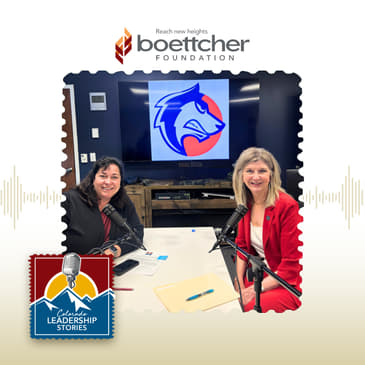
In this episode of Colorado Leadership Stories, Katie Kramer sits down with Dr. Rhonda Epper, president of CSU Pueblo, to discuss expanding access to education and leading through change. From workforce development and first-generation student success to the future of higher education in Colorado, Rhonda shares thoughtful insights on creating opportunity, building trust, and investing in communities.
Listen on YouTube | Apple Podcasts | Spotify | Amazon Music | Pandora or wherever you get podcasts!
To listen to the Dana Crawford episode referenced at 14:40, please click here.
See Privacy Policy at https://art19.com/privacy and California Privacy Notice at https://art19.com/privacy#do-not-sell-my-info.
[00:00:00] Hi, I'm Katie Kramer, President and CEO of the Boettcher Foundation. Welcome to Colorado Leadership Stories, where we talk to everyday, courageous leaders who have made transformational impacts in their communities and are building a better state for everyone. You'll hear from leaders and organizations and communities throughout the state as we explore the idea that leadership is an activity that anyone can do.
[00:00:32] Today, I'm honored to be joined by Dr. Rhonda Epper, recording live from CSU Pueblo. Dr. Epper is a leader whose story is deeply connected to Colorado communities and to the transformative power of education, a mission that personally resonates with me. She has served as president of both Trinidad State College and now CSU Pueblo, helping these institutions thoughtfully strengthen the way they serve students and their communities. Her work reflects a belief that leadership is not just about titles or systems, but about listening, building
[00:01:02] trust and creating pathways for others. Welcome Dr. Epper. Dr. Epper. Thank you, Katie. It's so good to be with you today. Dr. Rhonda Epper, Ph.D.: Well, it's wonderful to be here in Pueblo. And thank you so much for hosting us. To start off, I just wanted to share that this year our theme at the Boettcher Foundation is power of place, emphasizing how that places we grow up live and lead shape who we are. Tell us about where you grew up and how it shaped your perspective on education. Dr. Epper, Ph.D.: Okay, so I grew up in rural East
[00:01:32] Texas in a town called Nacogdoches, which a lot of people consider it to be the oldest town in Texas. There's a lot of deep cultural and historical significance in the place I grew up similar to here in Southern Colorado. The town itself in Nacogdoches was shaped by indigenous cultures, by competing nations, and by a really deep value for education. So there is a university in Nacogdoches.
[00:02:02] Dr. Epper, Ph.D.: It's called Stephen F. Austin State University. And it's what's called a regional comprehensive university. And CSU Pueblo is also a regional comprehensive university. A lot of people don't know what that means. But in higher education, we talk about RCUs or regional comprehensive universities. And they're really kind of special places because they are a public university whose primary mission is to serve the economic needs and the work of the world.
[00:02:32] Dr. Epper, Ph.D.: And the cultural needs of the workforce needs and the cultural needs of the region that they serve. And usually they're places of access for students who otherwise wouldn't have access to higher education. So my dad was a professor at Stephen F. Austin. And my mom was a school teacher in Nacogdoches. And so yes, I would say my early days were heavily influenced by education and the impact that it has on a small rural community.
[00:03:00] Dr. Epper, Ph.D.: Oh, I bet. And I wanted to spend a couple minutes talking about Pueblo specifically. When you think about power of place, it's one of my favorite places in Colorado. And growing up in Colorado Springs, like I did, we would spend some time here and every year come to the state fair and such. But I think that Pueblo is special in Colorado. It has such a strong sense of identity and pride. And so I know you're newer to the community, but I'm curious what you think the rest of Colorado could learn from Pueblo.
[00:03:23] Dr. Epper, Ph.D.: Well, you're absolutely right about the strong sense of identity and pride in Pueblo. I think what I'm learning is that Pueblo is a place where generations of people came here seeking opportunity. Many were immigrants from places like Italy and Mexico and Eastern Europe.
[00:03:45] Dr. Epper, Ph.D.: And they built this community, which grew and grew and transformed itself. A lot of it developed around the steel industry. And I think a lot of people are aware that Pueblo has endured a lot of economic hardship throughout the years.
[00:04:00] Dr. Epper, Ph.D.: But what has really impressed me as I'm learning about some of the history is Pueblo's ability to reinvent itself without losing that cultural identity. And so you have these very deep roots and traditions here around churches and neighborhoods and food traditions and families and education.
[00:04:23] Dr. Epper, Ph.D.: And I would say the rest of Colorado can learn from the power of these strong traditions and family and community ties. I think it's a source of strength. And we're going to need that strength here in Pueblo as we once again begin to transform ourselves into an economic force for the region.
[00:04:45] Dr. Epper, Ph.D.: Well, that's great. Well, we started talking about this, about you growing up in a family of educators, but I wanted to hear a little bit more about your career. And I recall that you began your higher education career in the policy world, developing policy research with the State Higher Education Executive Officers Association, while completing your doctorate in higher ed administration. Maybe tell us a little bit more about that. What values or core beliefs from that early work?
[00:05:14] Dr. Epper, Ph.D.: Or did that instill upon you? Dr. Epper, Ph.D.: Sure. So yes, I worked in the policy space for about the first decade of my career. And I think it helped me better understand the broader political forces that shape higher education, not just in Colorado, but nationally. Dr. Epper, Ph.D.: Yeah. And then after you completed your doctorate, why did you decide to leave the policy space?
[00:05:42] Dr. Epper, Ph.D.: Well, I didn't really leave it permanently. Dr. Epper, Ph.D.: Okay. Dr. Epper, Ph.D.: So I came back in later decades, and I worked at WICHE and at CDHE many years after I had worked at SHEO in those early years.
[00:05:56] Dr. Epper, Ph.D.: I also served on the board of NCHEMS for nine years up until just a couple of years ago. And that I know to most people sounds like a lot of alphabet soup. But if you've worked in the higher ed space or higher ed policy space, you know these organizations and the important work that they do in the state, in the Western states, and nationally.
[00:06:18] Dr. Epper, Ph.D.: And so I guess I would say jumping in and out of the policy space throughout my career has helped give me perspective as a leader on some of the broader challenges that we face in Colorado. Dr. Epper, Ph.D.: I think about issues like workforce shortages, economic inequality, economic mobility, rural sustainability, and civic trust. And we can talk about those a little bit more.
[00:06:45] And where I think those kind of bigger policy challenges we face are happening and where higher education can play a role. Dr. Epper, Ph.D.: Well, that was a tease. I definitely want to hear more about that.
[00:06:57] Dr. Epper, Ph.D.: Okay, so workforce shortages. I think our economy in Colorado really needs workers with education beyond high school. But parts of our state struggle to produce enough talent. Occupations like nurses and teachers and engineers and tech workers and workers in the skilled trades. We have shortages in all of these areas.
[00:07:20] Dr. Epper, Ph.D.: And our role in higher education is to be able to respond quickly to create faster and more flexible pathways to partner directly with employers and do things like expand internships and really try to retain our local talent. So Southern Colorado has seen a lot of our young talent leave for opportunities elsewhere. And we want to build a future where our local talent can stay here and can thrive.
[00:07:49] Dr. Epper, Ph.D.: So that's one area of like responding to the workforce shortages. Another area where I think Colorado needs higher education to respond is helping with economic inequality and economic mobility. So we have a state that is prosperous overall, but the opportunities are kind of uneven around the state. Dr. Epper, Ph.D.: And we know things like geography and family income and educational background really strongly influence a person's outcomes.
[00:08:19] So higher ed has an opportunity at institutions like CSU Pueblo to really play a role here by serving our first generation students, by reducing barriers that they face to complete college, and by providing pathways that lead to a living wage. Dr. Epper, Ph.D.: And then rural sustainability. Dr. Epper, Ph.D.: I'm really passionate about this issue. Having lived in Trinidad, I'm having worked a lot and spent a lot of time in Alamosa and now in Pueblo.
[00:08:48] Our rural communities are facing a lot of challenges in Colorado. We're facing population loss. We're facing aging populations, teacher shortages. We have aging infrastructure. You name just about any challenge in Colorado. Rural communities are facing those challenges probably more severely.
[00:09:10] And we have a lack of economic stability that was once supported by our legacy industries like coal mining and steel and agriculture. And so we need new economic engines to revitalize our communities. And I think higher ed can help by providing pipelines of workers who can help infuse the economy.
[00:09:35] We can develop rural teacher pipelines, health care training, distance education opportunities to our students who are far flung and remote. We can support entrepreneurship. And we can also use our applied research, which is happening right here at CSU Pueblo, to help our economies thrive. You had talked early about being an access institution.
[00:10:00] And one of the ways that I think about how some students come into is through concurrent enrollment. I know that you've been an advocate for concurrent enrollment and advanced placement as pathways for college readiness for some students. And some of our Boettcher scholars make use of those great programs across Colorado. So I'm just wondering what makes that experience so transformative for students. Well, that's correct. I have been an advocate for both of those pathways.
[00:10:28] And I do think concurrent enrollment is a powerful mechanism in our state because it kind of changes how students see themselves and what they believe as possible. So we know that one of the biggest barriers for first-generation students is how they feel about whether or not they belong in higher education.
[00:10:49] And a student who earns college credit in high school can begin to think, hey, I'm already a college student with credit on my transcript, so maybe I can do this. And I think this identity shift is really powerful. It also demystifies higher education somewhat for students, so they learn what a syllabus is and what college expectations are. And then the other way that I think concurrent enrollment is transformative is financial.
[00:11:18] So it reduces the number of credits a student has to pay for later. It helps shorten their time to degree, and it can make college feel more financially realistic. Even if they just have one class or a semester of college credit, it can make it feel like it's possible. Sure. Well, and another piece that I just wanted you to reflect on when you think about how people access education is,
[00:11:43] I know that you led online learning for the Colorado Community College System during COVID, right? And so under your leadership, enrollment grew from 10,000 to 40,000 students in just five years. So I'm just curious about your reflections on the role of online learning in expanding access to higher ed. Yes. Well, I think working in the early days of online learning gave me a perspective that was a little ahead of its time.
[00:12:13] I learned that student potential is everywhere, but opportunity, not necessarily. So we had in Colorado thousands of capable students who were not being served by the traditional model, and not because they lacked ability or motivation, but because higher education was designed around certain assumptions about time and place and life circumstances, which didn't fit their reality. And online learning changed all of that.
[00:12:42] It really turned the model upside down and removed those assumptions, and it was an exciting time in higher education. I remember those early days at CCC Online when we did grow so quickly from 10,000 to 40,000 students in about five years, and we felt like it was something transformational, like we were part of something really important that was happening. And now, of course, almost every student experiences some form of online learning,
[00:13:10] and almost every institution has an arm that focuses explicitly on the nontraditional learner. And we've also learned a lot about the fact that putting a course online doesn't automatically create a good learning experience. And we've made great strides, of course, now. We know a lot more about course design and how important it is for faculty to be engaged. And we've learned more about how to support students at a distance.
[00:13:38] But after going through COVID, so you mentioned COVID, and working in a rural college environment, I've come back to having a deep appreciation for the power of place. You mentioned that as one of your themes, and the value of the on-campus experience. And so, you know, I think during the pandemic, we showed that we can continue teaching and learning when we can't be physically together.
[00:14:05] But we also learned that something important was lost. And those things that happen on campus, those informal conversations, relationships, our traditions, and those moments for students of feeling like they really belong, those happen when people share a place. And I'll share just one more story about this.
[00:14:29] My good friend, the late Dana Crawford, she taught me a lot about the power of place when I lived in Trinidad. And I don't know if a lot of people are aware that Dana Crawford was really heavily invested and inspired by Trinidad. She owned a lot of property there. She owned a home there. She was active in some redevelopment projects there.
[00:14:54] And we could do another podcast on Dana Crawford and what I learned from her about the power of place. But I'll just say that I really came to appreciate more the value of in-person learning, especially for young people, because for many of them, and I think about myself going to college, college is where students discover who they are. It's where they encounter new ideas and build confidence and develop friendships.
[00:15:21] And we know that young people today are suffering from isolation, partly due to lingering effects of the pandemic, but also social media influences. And I see college residential instruction as a powerful antidote to this trend. And I think we can't take it for granted as parents. I, as a parent, my kids were in college during COVID, and I know what they went through.
[00:15:50] And I just think as educators also who care about our youth, we can't lose sight of those important elements of on-campus learning. So, yeah, I think just higher education has to continually adapt. And just as we've had to adapt to a non-traditional learner, we also need to hold on to what's most valuable. Well, I'm so glad you mentioned Dana Crawford at Power of Place.
[00:16:15] I actually have had her on Colorado Leadership Stories and had a chance to interview her and have her reflect on some of those stories in all the ways that, as a leader, she influenced Colorado, not just in Denver, but in Trinidad, too. So, listeners, you'll have to check that one out. That was one of my favorite recordings. It was great. It was quite an inspiration. Totally. What a great leader.
[00:16:37] So, we had just spent a few minutes talking about Trinidad, and I wanted you to reflect a little bit more about your role at Trinidad State College. And now, CSU Pueblo, you've supported different types of communities in terms of the higher education needs in those contexts. So, maybe reflect on those places and maybe what were some of the distinct needs at each place.
[00:17:01] Well, I think CSU Pueblo really can't be separated from Southern Colorado's story. So, I think that, in a sense, makes us unique. CSU Pueblo was built by and for this region, just like Trinidad State was built by and for that part of Colorado.
[00:17:20] And so, I think it reflects the values of this region, like resilience and hard work and diversity and reinvention and the belief that education creates opportunity. I think another thing that's important, an important distinction for CSU Pueblo and Trinidad State is they're both access institutions, right?
[00:17:42] And I believe that access and excellence are not mutually exclusive, that those are two important values that we hold in our value system at CSU Pueblo. And I believe our students deserve both. And those two concepts are not mutually exclusive. We provide the personal attention and hands-on support here at CSU Pueblo of an access institution, as well as the breadth of a comprehensive university, right?
[00:18:10] So, we have everything from bachelor's degrees all the way to doctoral degrees. And then, of course, our connection to a major university system. The CSU system and CSU Fort Collins is just a fantastic asset for us at CSU Pueblo. And I don't think there's any other institution quite like this one in Colorado. I also think that we are a reflection of the future of Colorado.
[00:18:37] So, we represent first-generation students and working families, our Hispanic and multicultural communities, and those looking to just improve their lives. And similar to how we talk about the need for economic mobility for our students, we are a region that itself is seeking economic mobility. And I think that's an important distinction for us in rural communities.
[00:19:04] So, we're not sitting in the middle of Denver or Boulder or another economically powerful hub. We're in a region that is looking to grow and increase the prosperity of our residents and our higher ed institutions in this part of the state. And CSU Pueblo, in particular, can help us get there. Dr. Epper, you have led institutions through periods of change and transformation.
[00:19:30] And so, since this is Colorado Leadership Stories, I'd love to hear how you've tried to build trust with leading people through uncertainty. Okay. Well, I guess this question really gets to the heart of leadership. And I don't think you build trust by having all of the answers all of the time. I think you build trust by acknowledging reality and being transparent about challenges and then inviting people into the work of finding solutions.
[00:19:59] So, my philosophy has always been to directly address problems head on and trust that people can accept hard news. And I always try to base my decisions on what is best for the long term, even when that means some people are unhappy in the near term. You know, I think most people would say that I'm a decisive leader. Not capricious, but I think you can hold two truths at the same time.
[00:20:27] So, like, understanding that the impact that change has on real people is sometimes painful, sometimes hard. And also knowing that you have to make difficult decisions when it's necessary for the good of the whole or the good of the long term. And I think our colleagues in higher education, we have a shared purpose that's really powerful. And we know that what we're doing is changing lives.
[00:20:57] And so it's easier to lead through uncertain times when we know we're all committed to the mission and we understand the importance of the work we're doing. That's great. Well, and while we're still talking about leadership, there's another question I wanted to ask you. And that is, if there's any skills or habits or leadership approaches that have been important to your success. I know that you've been in rooms where maybe you were one of the only women in that context.
[00:21:24] And so just while we're staying on some leadership questions, what would be your response to that? Sure. I've always invested a lot of time in building relationships. And building real relationships takes time. And I think it's important to dive into the layers of an organization or a community and really get to know its history and its culture and get to know people.
[00:21:50] So I'm not really a leader who flies around and drops in to say a few words. Although, of course, as a university president, that is something I have to do sometimes. But I really do like to get under the hood and understand what makes an organization work. And that maybe is one of my leadership habits that has helped me help others be successful. But it takes time. And I'm really just beginning this process at CSU Pueblo.
[00:22:19] I don't think it's necessarily a gender-based skill. It's really just having the patience and the interest in getting to know people and getting to know the work. Well, thank you for that. For these last two questions before the lightning round, I wanted to ask you to reflect sort of on higher ed in general and some of the trends. And so there's a couple of questions that I'm curious about this. I know when we have students apply for the Boettcher Scholarship, we always have more women than men that apply.
[00:22:48] And I know that that is a trend, even in higher education, where even those enrolled, 40% of college students nationwide are men compared to 60% women. And so I was just curious about that enrollment gap and what is higher education doing in response to that? Is that something you're seeing here too? It is. I think it's an important and quite honestly kind of a sensitive question facing higher ed.
[00:23:14] The fact that women now outnumber men in college, it's not a problem because women are succeeding. It's a problem because too many men are disengaging from education and the economic mobility that comes with it. And so I think the challenge we have before us is how to re-engage men in the opportunities of higher education.
[00:23:37] And it may be that we need to reframe our value proposition for men around the path to good jobs and the value of supporting yourself and your family. Because there's a narrative out there right now that questions the return on investment for college, which, by the way, is mostly not supported by the data. But having come from the community college system, I am a big proponent of all paths to higher education, including the skilled trades.
[00:24:06] So, you know, for some men, they may see a higher ROI or return on investment through that pathway. And I totally support that. I think for universities, we need to emphasize our workforce programs with a high return on investment like engineering, construction management, cybersecurity, business, entrepreneurship. And quite frankly, we're seeing more men go into the nursing profession because of its high return on investment.
[00:24:32] I mean, there's other ideas that I have for how we could really support men participating and succeeding in higher education through faculty mentoring, especially with more male role models. And for CSU Pueblo, in particular, athletics is a powerful entryway for many young men. And of course, we can't forget that it wasn't that many years ago when women were underrepresented in higher ed and in athletics. So, right, we have Title IX for a reason.
[00:25:01] But those gains for women all those years ago were made because we removed barriers and we intentionally supported their success. And so, I just think we need to look at this from the standpoint of our economy needs all of our talent that we can muster from both men and women. And if we're going to succeed, we need to be doing whatever we can to recruit and support all groups, men and women, and not leave anyone behind.
[00:25:31] Thank you for your reflections on that. I really appreciate that. All right, final question. And here I'm asking you to get your crystal ball out. When you're thinking about just with all of your experience and what you've seen change, just even in your career in higher education, if we fast forward 10 years and you think about all these things coming on with, whether it's AI or online or all these different things, what do you see about the future of higher education in the next 10 years? Okay, goodness.
[00:25:59] Well, of course, I immediately think about AI and who knows what the future holds and the ways in which we'll be influenced by technology. But let's just put that aside for a moment. I think about things like our changing demographics, both nationally and here in Colorado, where we have fewer high school graduates. And we already have a pretty intensely competitive market in the higher ed space in Colorado, and it's only going to become more so.
[00:26:24] So I think all of higher ed needs to really lean into our differentiators, ours being a regional focus. And I would see us becoming maybe more flexible, more personal, more career connected.
[00:26:41] And I think we also are going to become, in spite of AI and all the technology, I think we're going to become more human in the ways that we serve students, like getting back to that power of place concept. And I think we're going to see ourselves in colleges and universities as more of a lifelong partner, helping our students enter college, change careers, come back to college, and just stay more connected with their communities.
[00:27:10] With AI, I'll just say a quick word about that. I think AI is going to help us with all kinds of things that we're just beginning to realize, like advising, for example, tutoring, scheduling. But one thing that I know AI cannot do is replace the human touch, right? That faculty mentor, the counselor, the coach who helps build your confidence.
[00:27:35] And just that sense that students have that someone knows who you are and cares about your success. So the institutions that are thriving 10 years from now are going to be the ones that I think are helping to solve the problems that our communities are facing. Healthcare, education, economic development, and civic engagement. That's great.
[00:28:02] Leveraging technology for what it's good for and then not losing our humanness, right? Correct. Well, wonderful. Thank you very much for just spending some time. Let's go to the lightning round for these quick last four questions. So, Dr. Epper, what's your favorite Colorado hobby? Okay, well, it has to be hiking and biking in the mountains. We love taking our little camper out for a weekend getaway with our dog, which we just did last weekend. Oh, that's great. All right.
[00:28:30] And favorite place in Colorado or Colorado landmark? I'm going to have to say Fisher's Peak. Having lived in Trinidad and witnessed the reopening of Fisher's Peak to the public, it is now a state park and it's absolutely spectacular. I recommend anyone listening, go down and check it out. Yes. Special place. Okay. Is there an action hero that you most identify with? Yes. It has to be Elastigirl. I love that.
[00:28:57] I relate to her as a working mom who's trying to save the world. That's great. All right. And is there something that you're currently binging? Is there a show or a book or a podcast that has your attention right now? I'm always a year or two behind everyone else on books because they pile up in my Audible account. But I am now working my way through Kristen Hanna. I really loved the women.
[00:29:22] And I'm also currently in my library working through some old classics. Like I'm revisiting Steinbeck. I just read East of Eden and I'm now reading Grapes of Wrath. Oh, wow. Yeah. Some really interesting history that I think connects to some of our history here in Southern Colorado. Oh, wonderful. That's great. I'll have to re-probably listen to those if I'm honest about how often I have time to read.
[00:29:51] But I sure do love a good audio book. So, Dr. Epper, thank you so much for hosting us again here at CSU Pueblo and taking the time to share a little bit about your leadership story, your background, and hopes and dreams for this campus and higher education in Colorado. We appreciate it. Thank you, Katie. It was a pleasure to visit with you. Thank you for joining Colorado Leadership Stories, where we hope to inspire the next generation of Colorado community builders, doers, and difference makers.
[00:30:21] Colorado Leadership Stories is presented by the Boettcher Foundation. The Boettcher Foundation supports Colorado by empowering leaders and communities with tools to tackle challenges and pursue opportunities, building a better state for everyone. With an 85-plus year legacy of giving back, we're committed to amplifying our impact for future generations. That's the spirit of Boettcher. Thank you. Thank you.