
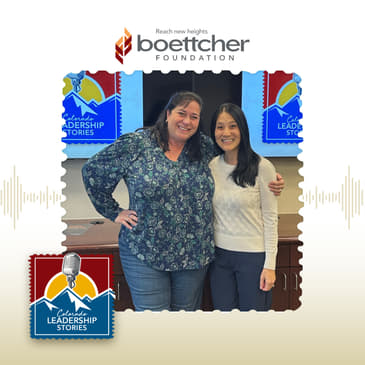
In this episode, Katie talks with Cindy Mahlberg, a 1997 Boettcher Scholar and entrepreneur who has made her mark in Colorado. As co-founder of Women in the Mix and the Colorado Center for Dermatology & Skin Surgery, Cindy has been instrumental in empowering women and supporting their professional and personal growth.
Her work emphasizes the concept of a "work-life mix" rather than traditional balance, recognizing that life is about thriving through its different seasons. Her experience as a corporate lawyer, combined with the entrepreneurial spirit instilled in her by her mother, has inspired a distinctive approach to leadership and building community.
Listen on Apple Podcasts | Spotify | Amazon Music | Pandora or wherever you get podcasts!
Colorado Leadership Stories is a podcast presented by Boettcher Foundation
Follow us on Instagram, LinkedIn and Facebook
See Privacy Policy at https://art19.com/privacy and California Privacy Notice at https://art19.com/privacy#do-not-sell-my-info.
[00:00:00] Hi, I'm Katie Kramer, President and CEO of the Boettcher Foundation. Welcome to Colorado Leadership Stories, where we talk to everyday, courageous leaders who have made transformational impacts in their communities and are building a better state for everyone. You'll hear from leaders and organizations and communities throughout the state as we explore the idea that leadership is an activity that anyone can do. Cindy Mahlberg is a dynamic leader in entrepreneurship and leadership.
[00:00:35] Cindy Mahlberg is a very special entrepreneur, deeply rooted in Colorado's community. With a background as a corporate lawyer, she earned her JD from the University of Pennsylvania's Cary Law School and her undergraduate degree from CU Boulder as a 1997 Boettcher Scholar. Cindy's professional journey reflects her commitment to empowering women and fostering community development. She co-founded Women in the Mix, an organization dedicated to helping women navigate the complexities of work, life, and family. She's also the chief operating officer at the Colorado Center for Women in the Mix, an organization dedicated to helping women
[00:01:05] for Dermatology and Skin Surgery, which she founded with her husband, who actually happens to also be a better scholar. And Cindy has been instrumental in creating a supportive workplace culture that prioritizes professional development for women in healthcare. Thank you for being here today, Cindy. Thank you so much. This is so fun. It is fun. And I know we've been friends a very long time and it's been so much fun watching your career throughout the years. And I can't wait for
[00:01:32] everybody to hear about all of those things. So we'll start back at your childhood. We'll start in your early years. And I know that you spent time working in your mother's family restaurant as part of your growing up. Share about how your family influenced your values and work ethic during your childhood. Yeah, well, thank you so much. It is so fun to be here. I still remember interviewing for the Betcher Scholarship and seeing all these warm, welcoming faces and it has shaped my story
[00:02:00] in so many ways. So it's wonderful to be here. And I love this question about my childhood and reflecting on the role of my family and my values because they have truly made me who I am today. And they showed me that caring deeply and persistence and just a commitment to being willing to pivot and grow are just so important in, I think, maintaining a hopefulness towards life. My parents are first
[00:02:27] generation immigrants and they met in Tulsa, Oklahoma, where my dad was a graduate student and my mom had landed in Oklahoma after escaping the Vietnam War. They were both working at a restaurant and my dad was a dishwasher. My mom was a waitress and they got married and my dad moved them to Colorado for his job. And so I was three years old at the time and he was a geophysicist. So this was the early 1980s.
[00:02:53] And so that job did not last very long as there was the oil bust and he soon lost his job. And so when I was six years old and that all happened, my mom was like, I'm going to start a restaurant with her. She came to the U.S. not speaking any English, not having finished high school. And she figured it out, navigated the system and ended up opening five restaurants that not only
[00:03:18] supported my family, but her extended family. And she was able to just really make a difference in so many people's lives. And I remember just listening to her as a child on these phone conversations or meetings with people and, you know, barely able to communicate just because her language skills were limited, but she would always be able to get things done. And, um, and so I grew up in that environment
[00:03:43] as a little waitress and so excited for my little 25 cent tips that people would give me, and, um, and just learning to manage people and learning what it felt like to see that environment. So, and then my dad eventually started his own insurance agency, which was very ironic because he was such a sort of introvert mathematician, scientist, and then he had to learn how to sell.
[00:04:09] And that was really hard for him, but it was an opportunity. And so I watched him go through this process of just, I'm going to figure this out. I can do it. I'm going to pivot. This is not what I studied, but I'm going to make it work. And he is still an insurance agent to this day. Oh my goodness. And does your mom still have the restaurants? No, she retired a few years ago, which was very important. It was really hard on the body
[00:04:35] to keep that up for so long. Um, but she kept it up all the way up until I think right around COVID time. Oh my goodness. That's great. What was the worst job you had to do when you were working in the restaurant? I would say, I mean, I was pretty protected from the backend, you know, kitchen things, things that just cleaning up and having to, I think, just experience some of the people who would do
[00:05:02] yucky things, right? Like they would eat their entire meal and then come back and be like, there's a hair in my food. And you're like, seriously. So yeah. But, um, but yeah, and I remember all these things like people cutting their fingers, you know, you just see all those things. So you see all of it. Yes. Yes, indeed. Well, certainly your mother's entrepreneurial spirit influenced your path. And I'm wondering how has her example shaped your approach to leadership and community building in Colorado? You've done a lot of that.
[00:05:31] Yes. Well, I think that she is such a true example of someone who did not let her challenges or her lack of resources stop her. Right. And she always prioritized relationships and people. And no matter what was happening, she always led with such deep generosity and kindness. And she really was so firm that she
[00:05:57] would never ask the people who worked with her to work harder than herself. And so I think that willingness to lead by example and the willingness to just do whatever it took to not only enable the business to thrive, but the people around her to thrive and to bring out the best in them. And she hired a lot of misfits over the years. I remember just so many stories of people who would do crazy things and, you know, beyond just serving at a restaurant, there'd be all these things. And,
[00:06:27] and she would always find ways to help and support people that worked with her. And so that is something that, um, I think I've really carried not only in business and community, but I've always just approached every relationship that I've had with how can I be somebody who brings out the best in those around me and how can I nurture that and help people be the best versions of themselves.
[00:06:51] And so I think that our business is such an important opportunity and way to serve. And I think that that servant leadership and that perspective of I'm right in there alongside everybody is what's come from her. Oh, that's great. I do want to talk more about that in just a little bit, but just following the chronology here. And I think one of the fun things about your career path is a job you had when you were
[00:07:18] an undergrad at CU Boulder, right? And you were a Denver Broncos cheerleader. I remember that and I'm being a Broncos fan as I am. Um, but is, I was just curious how that, how did that come about? Is that something you were always looking to do? And, and I can't even imagine trying to juggle, juggle college while you were trying to do, do that on the side. So I know that was a small part of a incredible career, but I want to hear about that part of your career.
[00:07:45] Yes. Well, that I, so to answer your question, it is definitely not something I always thought that I would do. In fact, I don't think I really even understood what a cheerleader did till I was in high school. Um, when I grew up, I did some gymnastics, um, but my parents just didn't have the time or resources to keep that up. So I stopped formal gymnastics training, I think when I was in third grade. And then just before high school, several friends of mine were doing all these things and they're like, Oh, we're trying out for cheerleading. And I was like, is that something I should do too?
[00:08:12] So I just showed up, tried out for cheerleading and somehow made the team. And, um, that then led to me becoming a palm, um, my sophomore year and learning dance. But I learned all of this in high school. And so I think that's what, in continuing this thread of just being willing to try things and not being afraid of the fact that I didn't have the resources or the training. Um, I just sort of went
[00:08:38] into it and I started taking ballet classes when I was 16, which I feel like nowadays people are learning dancing when they're two or three and their bodies form in such a particular way. But I was this older teenager trying to learn how to dance. And, um, I think it really fit with my personality just being somebody in that position. And, um, and so I just loved it. So I pursued it. And when I was in college, I was on the CU Express. I think now it's just called the CU dance team. Right.
[00:09:06] And did that. And then had an opportunity to try out for the Broncos and made the team. So did that and got to experience that entire journey. The year I was on it was the year after the back-to-back Superbowl wins. Uh-huh. And so, um, there was a lot of fun opportunities and we traveled to Australia for the American Bowl. And so I think just being able to represent Denver and our community, not only locally,
[00:09:34] but internationally was such an incredible experience. So even though I didn't sleep much in college, it was worth it. Yeah. I bet. I bet. Well, a fun experience to be sure. Yes. Yeah. And then you go off to grad school and, um, come back. And then here is where our lives intersected a little bit in, in one of the ways that I, as a, as a female leader have benefited from your brilliance. But I know you started Women in the Mix in 2012
[00:10:00] to support women juggling work, life, and family. And I had two young boys at the time and you promoted this concept of work-life mix. And I remember hearing you speak about this and how balance isn't a thing. Work-life balance is not a thing. It's a mix. So tell everyone what you mean by it was a mix. Yes.
[00:10:26] Because it certainly influenced how I thought about my life with my two boys. And I know you have two boys too. Yes. Yeah, absolutely. You know, I think having grown up with parents who had their own businesses and they were so busy, I was always very aware of how work can be all consuming. Right. And so when I was graduating college and making those early career decisions, I really spent a lot of time wrestling with like work-life balance. And how do I find a career path that
[00:10:54] allows me to be the professional and the mom and the friend and all those things that I want to be? And I just found myself on this path of continually hitting dead ends. I would participate in all these meetings and just feeling like, oh my gosh, this feels impossible. It feels like, you know, we can't have this, have it all. And how are we possibly going to juggle? And then I think when I had my two boys, I realized, okay, I think my framework was not quite the right
[00:11:21] framework. And I think that trying to think about like this sort of perfectly balanced work on one side, life on the other just was not the right framework. And so I think that when I was able to shift that framework for myself and just think about it as like, okay, no, this is my life. And these are all of the things that I'm involved in in my life. And these are all the areas that I need to commit time and energy to. And so I think that idea of the mix really made so much sense,
[00:11:47] right? And that it wasn't this clean, perfectly balanced thing, but it was this mixture and everybody's mix is different and everybody's choices that they have in their life are different. And so I really wanted to create a community and an environment in which we could talk about that and we could help women who are very much in that same place, develop a different framework and
[00:12:10] practically equip them with resources in that. And yeah, so it helped me so much. And for better or worse, I think I still live that concept every single day. And that might look like on a daily basis, I'm trying to field a work call while getting my kids ready for school and, you know, just trying to juggle it. And I think that what has been really important for our family is trying to make our kids
[00:12:38] a very important part of that and not trying to compartmentalize and shield them, but sort of inviting them into the journey just as I did when I was young. And, you know, we always jokingly say our kids are our HR directors and that one day they're going to be incredible HR and people managers because they get to hear all about everything that's happening in our businesses every day. And so, yeah.
[00:13:04] I'm curious about how this has changed. So when you were doing your conferences and a lot of the things that you were doing, both of us had boys that were really young and here we are, you know, it's 10 plus years later, we have teenagers. Has your understanding of your mix changed? Do you notice anything different from back then as when your boys were younger? Yeah, I think that's wonderful. So one of the things we did with women in the mix was we
[00:13:33] interviewed so many women in Colorado in all different sectors and industries and seasons of life. And at that time, it had really struck me that the season of parenting that the people we were interviewing were in had distinct patterns. And so I had sort of made a mental note of that and prepared myself. And I knew that, you know, early on they, I feel like children are in a very physically
[00:14:02] needy time of life, right? Where it's like their physical needs, they're just, are they developing all those good foundational habits of being able to sleep and communicate? And all those things are so physically demanding. And I had been told that that is going to shift. Those things are going to establish, they will learn to go to the bathroom themselves, they will learn to feed themselves. And as a result, their needs will become much more emotional and mental and developmental.
[00:14:31] Believe it or not, the amount of energy that is needed is going to be just as intense, but in a different way. So true. And so I had prepared myself for that. But I'd say even as I am in it now, right, where I have two teenage boys, and I realized that the importance of being mentally and emotionally present is so important. And that's one of the hardest things to do when you have all these things,
[00:14:59] all this mixture of things flying at you and coming at you. The being just present and available emotionally and mentally is so important. And so that is what I now find myself really trying to create the space for. And on some levels, it's like, oh yeah, well, yes, they can stay home for periods by themselves. And they can, there's, there's so much more independence. Right. But they are still
[00:15:23] in such a tender time of formation. And so I think just being emotionally and mentally available is, is challenging. It is. That's truth. Absolutely. You know, the other thing I would, would mention from my journey, and you said this, but I think it's so true as I think about how the
[00:15:46] mix has changed for me too, is when your kids are older, they're part of it. Right. And so I think that one of the recent things that has been a little bit of a shift in, in my thinking too, is they help so much more with everything, you know, and early they can't, like you were saying, they can't do as much for themselves. But I do think, um, as career loving mothers that we are, and we love, you know,
[00:16:13] that our families and our partners and, and these job, wonderful jobs that we have, um, and including them like your mother and your father did with you back in the restaurant. I think that we help them to grow up and, and understand responsibility and, and what it means to be a good partner and family member and such. And so I know that it's interesting, whereas I think the
[00:16:38] demands emotionally, mentally are, like you said, more intense as your kids grow. Um, they also can help with some of the physical stuff, right? Absolutely. So is that true for you too? 100%. And I find myself, it's, it's really interesting. And I think I've, um, I was talking to a firefighter recently and he was just sort of telling me about the patterns that he's seeing in terms of all of the
[00:17:02] teenage issues and, and things that are going on. And he was like, it's really that one of the biggest advantages now for young people is, is actually disadvantage. And that people who, are growing up in these very sheltered, protected environments where their parents are just trying to make things so easy for their kids are actually doing such a disservice for them. And that really
[00:17:28] struck me because I actually find that one of the things of being a really busy working mother is that sometimes it's easier just to get the thing done. Right. Then to walk through and let your child figure out how to learn it and do it for themselves. And you can see how that piled up, whether it's, okay, I'm going to cook you breakfast because I know how to do it and that's going to be really quick versus we're going to take the time and you're going to learn how to do it. Every single one of
[00:17:54] those little daily choices I find really add up. And I find myself so aware of, am I depriving my children of these opportunities to be uncomfortable and to have things come a little harder or to struggle? Figure it out. Because I'm in a rush and I'm just trying to get it done. Right. You know? And so I think to what you were saying of like being able to remember that they are capable and they can do
[00:18:19] things and to actually push them. And I think that's what, for me, having parents who were so busy and at a young age, I had to do all these things. That was such a gift because they didn't have the- Didn't have the time. They weren't even around or available. And so now I really have to discipline myself to just be like, no, we have to create these learning opportunities or not deprive them of things just because we're so busy.
[00:18:45] Oh, that's good. Well, thanks for the tangent there because it's been fun to be on this journey with you as we've navigated leadership and life in motherhood in all these ways. It's been fun. Well, let's go back to your journey. So you're doing corporate law and then you've got the entrepreneurial bug that you've had your whole life. So I want to hear the story about what
[00:19:08] inspired you and Matt to co-found the Colorado Center for Dermatology and Skin Surgery. What's that story? Yeah. I mean, it's funny. I jokingly say that I'm a recovered corporate lawyer, but in truth, I think that the experience of going to law school and being a corporate lawyer was one of the greatest gifts that has woven into my story. And I think that as a lawyer who was working in big law
[00:19:34] and serving huge companies and huge transactions and deals, I was in this environment of such excellence and high stakes and high expectations. And that was such an amazing training ground for forming what I do now, which is a completely different field and ballgame. But in so many ways, I feel like that was such an important part of my journey. And so when I was practicing law in New
[00:20:04] York City, I had an opportunity to do a faith and work fellowship. And it was a nine month intensive program that was designed for people early in their careers, trying to figure out how to really identify what are you called to do and how do you really live out your faith. And I paired that with this very intense time of work. And I think that what it equipped me to do was to really realize that
[00:20:30] there is this vision of what does a redeemed legal profession look like? You know, what does that look like? Like, what does it look like to have lawyers be true advisors and counselors and not be in the system where they're just charging these high billable rates and working themselves to death? And so I started on this journey of wanting to really look at business models of law firms. And I was doing
[00:20:54] quite a bit of consulting with law firms. And then that sort of morphed into consulting with mission driven nonprofits. And my angle was always, how do we make operational excellence and organizational excellence accessible to more organizations? And I really felt like that was how I could contribute to this whole narrative. And so I started developing this model or operating system for services
[00:21:22] organizations, mission driven organizations that was really focused on democratizing organizational excellence. And that was sort of my tagline. And so I was on that path and really was passionate about working with services providers and people who were trying to use their knowledge skill set to help and serve others. And then meanwhile, Matt was doing his medicine thing. You know, we had gotten married
[00:21:47] right after undergrad. So we met as better scholars and got married right after college and did graduate school together. He always had felt very called to be a doctor and knew from a very young age, that's what he wanted to do. And so as he was starting his career and working with different private practices, he just kept saying, I just want to be a really good doctor who can take care of people and who can work in a healthy work environment. You know, why does that seem sort of elusive
[00:22:15] in this day and age? And so one thing led to another and we were like, well, why don't we bring my skill set in organizational operational development and your passion for medicine? And let's see if we can create a model private practice. You know, like that was sort of our very lofty goal of let's create this model practice that maybe we can then teach others how to run their businesses and private
[00:22:41] practices really well. And we can really use this to bring together a lot of the ideas and concepts that I had been developing and consulting on and I could be on the other side of that. And so that was how we got started. And it's been a while now, right? Yeah. We just celebrated our eighth anniversary. Fantastic. So yeah, we started with just one doctor and two employees. And you're growing and building, right? You mentioned that to me that you're building another
[00:23:09] facility right now. Yes. Yeah. So we now have seven providers. So we have five doctors and two physician assistants and a team of about 45 people. Amazing. And I know that culture is very important to you. And so say more about that, Cindy. Like I've heard you talk about high love and expectation in the workplace. What do you mean by that? Talk about your workplace culture and that
[00:23:36] it's you're serving, but it's also humane to the providers as well, right? Yeah. So our vision is to cultivate a redemptive group dermatology practice that delivers the gift of healing and brings hope and joy. And our mission is to restore hope in healthcare by caring deeply, working hard and having fun. Caring deeply probably sounds pretty familiar. That resonates very deeply with me. And I think that
[00:23:59] this idea of a redemptive group dermatology practice is one where we feel that it is really important to figure out how to develop a model for a group of practitioners to be able to work well together. And so that stems to what is our legal structure and what is our governance structure and what is our financial structure and our compensation structure? I mean, all those things have to tie together and
[00:24:25] align. Because if you're just looking at a vision statement, right, it's how are you actually going to make that happen and come to life? And so we've been so intentional about trying to bring that all together. And we spent about two years consulting so many different lawyers and tax advisors and financial advisors on how do we bring together a structure that really allows us to live out our mission.
[00:24:50] And so that was, I think, a really important foundational part of it. And then on a daily, I mean, it's all of what the business gurus say, right? Like we try to really live by our core values and we really try to hire by our core values and who we are and what we do. And then we try to just make it come to life. And I think that the daily discipline and practice of that has been so
[00:25:18] instrumental. And so the high love, high expectation came from a dear friend and former client of mine where he drew this quadrant for me. And he was like, okay, imagine on one axis, you've got love. And on the other axis, you've got expectation, right? So you could have low love, low expectation, low love, high expectation, high love, low expectation, or high love, high expectation.
[00:25:42] And we were talking about that and describing our culture. And I was like, that is such a beautiful way to really say that the high love, high expectation quadrant is where people really grow and develop. And so for us, we love to bring people in where this is their first job. And they've had very little
[00:26:04] real world experience. And we tried to really from the get go, develop such solid professional habits, right? Whether it's communication, responsivity, following up, following through. I mean, don't have that foundation anymore. And so we start there. And then I think in the midst of that,
[00:26:30] because we're so intentional about our processes and procedures, and I always say that the best way to build trust is just to do what you say you're going to do. And how hard is that in a environment where, oh yeah, we'll send your prescription. And then, oh, this thing forgot to get entered. And then now the patient's at the pharmacy and the prescription's not there. And right, that all erodes trust. And so like, how do you as a group make sure that you always are doing what you say you're going to do?
[00:26:58] And so I think that has led to a group of people that we've had the fortune of working with over the years who are deeply caring and committed and who are really excited to be part of an environment that's really continually trying to get better and do the right thing. And then we spent a lot of time developing and nurturing people on. I think that's where the love comes in. I'm known for my two to three
[00:27:25] hours sort of one-on-one meetings that just are going deep into what are you about and how can we help you be the best version of yourself? Oh, I love it. That sounds like a wonderful place to work. I think it just is incredible to prioritize culture. We do that here too. And I think it definitely makes a difference, right? When you feel values aligned with an organization. So back to the conversation about mix. So what's it like working
[00:27:53] with your life partner and you're also, it's your business partner. Is that ever difficult? And is it hard to separate since you, it's all in the family? I mean, you didn't plan for this question, but I'm like, I'm curious. Yeah, it's such a great question. I know. I feel like I need to have a subgroup for spouses who are in business together. You know, for us, I think we have very complementary skill sets and I take it very seriously that I'm in my position as a standalone professional and
[00:28:23] not just because I happen to be married to the doctor, right? I will always refer to him as Dr. Malberg at work. And we really try to have our domains at the office. And so we try to just run like one of my greatest, it makes me so happy when people have no idea that we're married. And that happens. We have people who work with us for periods of time and they're like, I thought it was weird that you had the same last name, you know?
[00:28:54] And so I was like, that means that we're doing something as far as maintaining that professionalism. Now, on the personal side, are there times when we probably talk about work a little too much? Yes. But I will say that this is such an intense thing to do, especially sort of at the pace that we have been building and growing. Right. But I actually feel like it's been one of the greatest gifts to be able to share it together. I bet. Because I think that if we were each doing our own separate thing, we would have this
[00:29:23] really intense thing going on that the other person wouldn't really understand. Right. And so instead we are, we are all in this together and, um, and it's been so far fun, but we think that it's probably one of the hardest things that we've done as a couple. Well, I bet. I bet. Well, let me segue into the last question and then we'll move to the lightning round. Um, cause you know, maybe you'll give us example, you'll have another one,
[00:29:48] but at Betcher we talk about leadership and, and that it can be risky and it's difficult. And I'm curious if you can speak to a time when you feel like you had to take a risk as a leader and then what came of it? Yeah. So I think that because we are in a services business, I think that our, our biggest risks often feel like the people. Yeah. It often feels like the people that we're bringing into this journey with us. And, um,
[00:30:16] as I was thinking about this, there's been several people, um, who have interviewed with our team and for one reason or another, they were not a shoo-in. Um, it was not a clear like, oh yes, you know, stellar resume, stellar experience, stellar everything. And so, yeah. And there have been times when against conventional wisdom, I've made a decision to hire somebody or
[00:30:41] we've made a decision to bring on somebody. And in each one of those cases, I would say we saw something, right? Something where we felt like this is somebody that we could develop and that hopefully in our high love, high expectation culture, that maybe they would be exposed to a different experience that would allow them to find a different gear. And, um, we have so many success stories where we've really, I think, been able to help shape and form people in a way that
[00:31:11] just sort of prepares them for any job or thing that could come their way. Right. And then we've had some royal failures that have not worked so well and that have caused a lot of, you know, heartache and things like that. But I think on the whole, I think we're batting above 50. And so, um, so I think that is something that is, um, it always feels like a risk. And then right now you alluded to, we're in
[00:31:39] the midst of building a new office that is about 10,000 square feet in the Denver tech center. And it's bigger than the space we need. Um, and we're sort of building with this hope and this vision of being able to serve more patients and bring in more providers. And so I think that is definitely a, um, big time and financial risk. And so I'll let you know in a couple of years. How it goes. How it goes. Right. Well, great, Cindy. Let's move into the lightning round.
[00:32:09] Okay. Um, and, and we'll start with what is your favorite Colorado hobby? I love discovering new hikes and hidden gems, um, that are sort of off the beaten path. Uh-huh. Love that. And you hike with your family? Yes. Uh-huh. Family sport. Good deal. Okay. What's your favorite Colorado landmark? So I have to say Mount Albert, Colorado's highest peak, because that is also where we got engaged. Uh-huh. That's great. Yeah.
[00:32:39] That's great. Okay. Um, what action hero do you most identify with? I would say Elastigirl from Incredibles. Oh, yeah. Right. Yeah. I always picture the carrying of all these things and flying through the air with a huge wingspan and that's how it feels. That's a good one. Yeah. That's great. Okay. And then what are you currently binging? Is there a show or a book or a podcast? Yeah. So I have recently read Strengthening the Soul of Your Leadership by Ruth Haley Barton. Oh.
[00:33:07] And it has been such a needed, um, sort of reset in the midst of all the things going on and how do I really focus on the soul of my leadership and who I'm becoming in the midst of all of these things that are going on. Wow. I haven't read that one yet. I'll have to check that out. Yeah. It's a great one. Good. Sounds very centering to our work. Well, good. Well, it was wonderful visiting with you.
[00:33:32] Thank you for coming in and getting caught up and sharing some, uh, stories in, um, leadership in life. It's wonderful. And you're such an inspiration. Thank you so much. As are you. Thank you for joining Colorado Leadership Stories, where we hope to inspire the next generation of Colorado community builders, doers, and difference makers. Colorado Leadership Stories is presented by the Boettcher Foundation. The Boettcher Foundation
[00:34:00] supports Colorado by empowering leaders and communities with tools to tackle challenges and pursue opportunities, building a better state for everyone. With an 85 plus year legacy of giving back, we're committed to amplifying our impact for future generations. That's the spirit of Boettcher.