
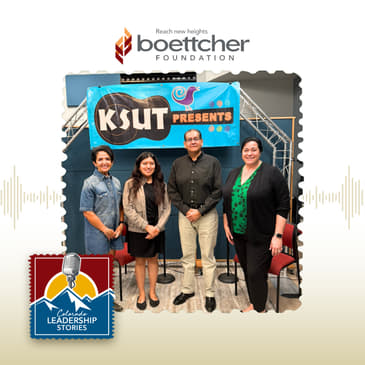
Join Boettcher Foundation Chair Michelle Lucero and President & CEO Katie Kramer for a conversation with Melvin Baker, who served as Chairman of the Southern Ute Indian Tribe for nearly 15 years. In his last public interview before resigning due to health reasons, former Chairman Baker reflects on tribal sovereignty, cultural preservation, economic development, and the values that guide leadership in the Southern Ute community.
From protecting land and language to investing in future generations, this episode of Colorado Leadership Stories explores how respect, partnership, and a deep connection to place continue to shape the tribe’s purpose and vision for the future.
Listen on Apple Podcasts | Spotify | Amazon Music | Pandora or wherever you get podcasts!
Colorado Leadership Stories is a podcast presented by Boettcher Foundation
Follow us on Instagram, LinkedIn and Facebook
See Privacy Policy at https://art19.com/privacy and California Privacy Notice at https://art19.com/privacy#do-not-sell-my-info.
[00:00:00] Hi, I'm Katie Kramer, President and CEO of the Boettcher Foundation. Welcome to Colorado Leadership Stories, where we talk to everyday, courageous leaders who have made transformational impacts in their communities and are building a better state for everyone. You'll hear from leaders and organizations and communities throughout the state as we explore the idea that leadership is an activity that anyone can do.
[00:00:32] Today, we're recording in studio at KSUT Public Radio in Ignacio. For those who may not know, KSUT has been the trusted voice of the Four Corners region for nearly half a century. KSUT started in 1976 as a small radio station created by the Southern Ute Indian Tribe to serve its community with local news, music and cultural programming. Over time, it's grown into a broader regional service, but it's never lost that core connection to the Southern Ute people.
[00:01:00] Today, from its Tribal Media Center here in Ignacio, KSUT continues to be a hub for Indigenous storytelling and community-centered media across the Four Corners. This is a special episode of Colorado Leadership Stories. I'm joined by Boettcher Foundation trustee and our current chair, and Ignacio's very own Michelle Lucero, who's here in her hometown. Welcome, Michelle. Thank you, Katie. Go Bobcats.
[00:01:26] And our very special guest, too, the chairman, Melvin Baker of the Southern Ute Indian Tribe. Good morning. Welcome. Welcome to the Southern Ute Indian Reservation. Oh, thank you for having us. We're excited to be here. As we dive in, I want to start with the place we're sitting in. You both grew up here. You knew each other in high school. I love this. Chairman Baker, you lead a nation rooted here. This region sits at the unique crossroads of Ute history, with both the Southern Ute and the Ute Mountain Ute tribes connected to this land.
[00:01:55] From your perspective, how does that shared geography shape the identity of this place today? And how does that history continue to influence the community going forward? Well, I think today, between the Southern Ute and Ute Mountain, you know, it's always remembering who we are and where we come from. This is us, you know. At one time, the Southern Ute Mountain Ute Indian Tribe were all one together, but we were separated by the governments over the years. And the Southern Utes are here in Ignacio, Colorado. And, you know, we continue to work together. The ceremonies are the same.
[00:02:23] We have the bear dance, the sun dances. We still share that valued culture here and, you know, work with our community. And Michelle asked you the same question. This is home for you. It is home. You know, I think the beautiful thing about this is growing up in Ignacio and being part, I say, parked in air quotes of the tribe. We learned a lot of the traditions. We learned how to build a loom and how to bead. We went to bear dance. We knew when we were allowed and not allowed to go to Sundance.
[00:02:53] And it's even though I'm not, you know, part of the Southern Ute Tribe, you're made to feel like you are part of that just based on growing up here with everything that's so beautiful about this tribe and these peoples. Before we go deeper, it's worth pausing on a term people hear, but maybe don't often fully understand. Tribal sovereignty. Chairman Baker, when you use that term, what does it actually mean in practice?
[00:03:19] Tribal sovereignty to me is self-governance. You know, we control our own destiny. You know, there's a lot of things out there, but again, it's from our leaders on down, what's best for our people within our reservation boundaries. You know, looking for and taking care of our elders, the people today and those yet to come. The sovereignty is in control of our own destiny, making our own laws, everything that we move forward with. But again, I just want to share that the Southern Ute Indian tribe is very active working with the community all around us.
[00:03:48] There's so much that the tribe does, you know, but sovereignty, we're not selfish. We're not saying it's just about our people. It's about everyone. So sovereignty, you know, an example is, say, water, air quality. The state of Colorado has their standards. The Southern Ute Tribe standards surpass the state's air and water quality. That's just an example of how we're taking care of Mother Earth in sovereignty and control of our own destiny for our people.
[00:04:12] And one of the things I think is a hallmark of especially your leadership as the chair of the tribe is that is really applying that. You gave an example there with water, but give a little more around how that sovereignty has shaped other decisions around community. And then some of the priorities that, you know, you and the council around land and resources. How do you apply that sovereignty? Well, I mean, again, you know, I think when the leadership makes decisions, it's always with the membership first in mind.
[00:04:40] But if we were doing a large project, like let's just say a water project, it's not just for us. It's what we share that with our community members. And, you know, as Michelle knows, we're a tri-ethnic community. We always grew up. There's a Native American archival member. There's a Hispanic and a white community. But we've always worked together to help each other out to shape it. I think we've all learned from that growing up. You know, if we help each other, we can move mountains. We can get a lot more done. And we don't have any, you know, discrimination toward each other because it's all about survival.
[00:05:09] And a lot of a famous quote, I say famous, but it's always been said from time to time. One of our past leaders, Mr. Leonard Birch, always said, what's good for the tribe is good for the community. So he was a lot older than me. But again, those values that he carried, it's all of us here together in our little part of southwest Colorado. If I could just follow up real quickly with that was something the chairman said, that tri-ethnic community. I don't think people understand it or feel it unless you see it and you know.
[00:05:38] I didn't face any type of discrimination until I left. And it kind of shocked me because we didn't see that. We just saw, I saw Chairman Baker, who I knew then as Mal, as Mal, right? And he, as Michelle, we didn't see that him as a member of the tribe. It was just who they were as a person. And that was, I think, can be kind of jarring when you do leave the community and you see it and you feel it. I was curious, and I really wanted to ask this question.
[00:06:07] What does the government-to-government relationship look like with the state of Colorado and the federal government? The relationship is good. It's good, but it can always get better. Again, I'm going to refer back to Mr. Leonard Birch, who always used to, when I first got on council, so I would hear him talk about whether it was various governors or whoever. He would always say, our friends, knowing he knew the people that were going to work with us. Our attorneys, the law firm, they knew all the people, whether it was Washington, Denver.
[00:06:35] With the state of Colorado over the years, I think it can be better. I mean, we do have the Colorado Commission of Indian Affairs. We work together. But it can definitely get better. We make a lot of trips up to Denver. Locally, we work with the La Plata County Board of Commissioners. We meet quarterly. We meet with the Durango City Council from time to time and talk about issues coming up. We meet with Archuleta County. We meet with the National School District. We meet with a lot of people within our area.
[00:07:03] But like, say, Archuleta County is outside the reservation boundaries, but it doesn't matter. You know, there's areas in Archuleta County that tribal land is there, but still. So we have good working relationships, and we can always be better. And I think it depends on new people coming in. You have people moving in from out of state that don't have a clue about what we are and building those relationships. And I think the biggest challenge is we need to educate them and really let them know, you know, companies cannot just come in and put something on our reservation land without protecting our cultural resources, the land, the right-of-ways.
[00:07:33] I mean, we have it down to a science, and a lot of people don't know that. You know, they just think they can encroach. Yeah, right. I mean, when you visit other countries, we tend to pay attention to that. We forget about that within our own country sometimes, that, you know, there's a cultural respect that you need to have on the reservation. And you're right. I think they don't pay attention to that as closely as they should. Mm-hmm.
[00:07:56] And the Southern Ute tribe is often recognized for its economic strength and long-term vision around economic development. Chairman, we had a chance to talk about this a little bit at breakfast. But I want you to talk about how that success has come about. Well, I think we started off small when the tribe in the early 2000s created the financial plan. We hired a lot of different people. The oil and gas development back in the past was a majority of the royalties were going to other operators.
[00:08:26] And the Southern Ute Indian tribe, oh, I think we were just getting the royalties, which was not. But the leadership at the time, again, under Mr. Leonard Birch, made that bold decision to we're going to do things different. We're going to start it. And it started small. I think we talk about maybe starting off with an $8 million project for Red Willow Production Company. And it just elevated from there. And each year as we went, then we created the financial plan. And that financial plan is a roadmap. How do I get from here to there?
[00:08:50] You know, along the way, the ventures, we hired a lot of good people, smart people that, you know, knew how to invest in oil and gas production, all of that. So, you know, at this point, we branched out all across the United States for various real estate, whatever it is. You know, we have offshore drilling platforms. But we're partners with a lot of people. But, again, you've got to, you know, we're not saying we're going to do it 100% on our own. But, again, you've got to build up, you know, partners.
[00:09:15] And, you know, for me, I've said it before also, I think that it would be great someday that we could partner with some of our sister tribes because we have the experience and the technology, the know-how to let's move each other forward. But, you know, there's so much out there. The Sunni Indian tribe is doing a lot of things that people have no clue about the properties, all that. So, you know, there's always a new venture tomorrow, you know.
[00:09:38] What are some of the top priorities right now for the tribe when you think about just reflecting on tradition but also forward-looking leadership? Well, I think first and foremost for me is health. Our people, our elders, our children, those yet to come, you know, health. Education is a big thing that we talk each and every day about how we need to train or teach our younger children who are going to be our future leaders. How do we do that? It's a struggle. You know, I mean, it's not easy. But, again, those are the goals.
[00:10:07] In order to maintain where we're going, you know, we have to do that. So, again, health to me, you've got to be healthy to be, you know, doing what you do, educate, protecting our cultural resources. Again, we're, you know, we don't do developments without checking the whole land first, whether it's a new development. There's something in the ground that shouldn't be disturbed. We go around it. We, you know, we're, I mean, the past leadership has always set us up for always thinking ahead.
[00:10:32] You know, these are the things you got to, you know, whenever we look at stuff, we get scenarios like maybe a medium case level, a low case, a high case, you know, not knowing what's going to work. But we do our due diligence on every project we're doing, even if it's investing with other companies that are non-tribal related. It's just a deal that you work out. But we always have the membership with first and foremost in mind, protecting our cultural resources, our land, our water, air, everything. Mm-hmm.
[00:10:58] It's great business practices, right, that I think sometimes people don't appreciate, you know, that you've created under your leadership a bit. Would you agree with, I mean, is that? I think I share what I've learned from the past leaders. What I always say to people is the past leadership, some of the names I mentioned, you know, they always say it's like building the house. They created the foundation. Now it's up to us to finish it out for the future. You know, who's going to do the walls? Who's going to put the roof on?
[00:11:27] Who's going to, you know, for those, again, not yet born yet, those future tribal members that will be coming, we've got to maintain this house, keep it in order, and strive, and that would be our goal for our people. I think another one of your goals that you've talked about and emphasis is cultural preservation. Mm-hmm. So how do you personally think about balancing that cultural preservation with the economic development that you just talked about? You touched on it a bit, but can you give a little more examples of how you really put that into action?
[00:11:56] Well, I think whenever we're thinking of any new development or a certain piece of land because it's there, it's available. Of course, you've got to look at all the aspects that go with it. We had a certain piece of land identified and somebody wants to put something there. We had to see, okay, is it available? Yeah. Okay. Second of all, we look at, of course, protecting cultural resources. So we'll have archaeologists go in and make sure it's cleared. So once that clears, we're good to go and we can do something on it.
[00:12:20] But then we also got to carry it through to where the infrastructure, you know, the water, the sewer, the gas, you know, the protection of that, you know, how are we going to and how much is that going to cost? You know, it's just the steps. But again, first and foremost, our cultural preservation, we have to protect that land. And, you know, we cannot, I think in the past, we've had people that thought they could do things on our land and dig and put things without a right away, without crossing permits, without going through cultural resources. So again, if there's some identified in the area, you stay out of it.
[00:12:49] We just stay away from it, protecting it. This year at Betcher, our theme is focused on exploring the power of place. That is, where we come from shapes how we lead. So Chairman, the tribe's connection to this place goes back generations in a way that's deeper than most Coloradoans experience. And we both know there's very few original Coloradoans these days that are in our beautiful state.
[00:13:13] So what early memories or stories were passed down to you have shaped how you think about leadership, responsibility, or service? Some of the values, I think when I think of sitting with my grandmother, and even if we're talking on a traditional sense, you know, she would tell me the do's and don'ts, which you can and can't do. You know, why they do certain things. If it's even like to say hunting on a reservation for our people, there's certain animals that we should not be taken as per our ancestors. You know, there's various reasons why.
[00:13:43] And I think today some don't see that. And I'll just say bear. You know, we have the bear dance and they say that that's your brother bear. You don't shoot those, you know, and, you know, just all the traditions that go with it. There's protocol. There's certain things you can do. There's certain things you can't do. But I think all in all, what I learned from my grandmother is always regardless is respect everybody, respect the land, respect the people. And if they don't know, educate them and teach them. You know, those are some of the things you can carry with you and remember, and it can guide you in your life as you go forward.
[00:14:11] When I go to other reservations, I have to respect their cultures, you know, and values and stuff. And sometimes I don't know either, but it's a protocol. But I think really just the values of being a good person, having a good heart, helping those who need help. Tradition-wise, again, you know, just respecting those values of what everything in front of us means. Well, since this is Colorado Leadership Stories, we do want to hear a little bit about your leadership journey.
[00:14:39] And I know before you came into tribal leadership, you spent years as a wildland firefighter and various other jobs, as I was learning, all around this community. What did those experiences teach you about teamwork and leadership that maybe have helped inform how you lead in your capacity as chairman? I think when it first started back in the day, it was all about a job. Had nothing. The tribe had nothing. There was no jobs. If you ever found one job, you better stick with it. You better stick with it.
[00:15:08] And that was it. And then as I, you know, I did go to school. I went to learn how to paint cars at Haskell Indian Junior College in Haskell. And, you know, did that. I thought it was what I want to do, paint nice cars. But I didn't like it because of the things you're doing, the breathing in all the solvents. It's not healthy. And I'm like, this is not for me. And so I kind of just grew up wherever jobs were available, work wherever. I used to work at the Sky Ute Downs Event Center with a gentleman.
[00:15:37] We got Mr. Keene Richards and we used to feed the buffaloes down there and take care of the arena, set it up for rodeos and stuff like that. And it was just a job. And eventually I moved to California, not knowing what I was going to do. Just, you know, never been on a plane in my life. Flew from Drango to California. My girlfriend, I had my son, you know, he was like a year old, but we moved there. And I went to a foreign place that I had no idea what was going to be. It was a tough economy there as well. It was a small town.
[00:16:05] And I remember looking at like a maintenance worker job and I'm like, oh, I could probably do that. So I went into the county building to get an application and said, hey, I'd like an application for this job. And the lady, one of the things I learned, she said, okay, well, you can fill out an application, but we already know who the job's going to. And I'm like, why am I even going to fill out an application? And so I'm like, thank you. And then there was some big fires that went on around that time. My wife at the time, she worked at the U.S. Forest Service in the main office and had a regular job working there.
[00:16:35] And there was over 200 fires going at one time. We had some major dry lightning come through the area. And I had no clue. They were hiring people off the streets, anybody. Come to the warehouse, trucks, unload food, do this and that. So I went over, got a job, started delivering food to Oregon fire camps and all that. Then they had a special one day like a firefighting class because they needed so many people. And it was through the state of California. But I was in northern California, probably about 15 miles on the Oregon border, way up north.
[00:17:04] So me and my friends, I played on an all-Indian basketball team there. So we all kind of went over to school. We took the class. We passed it. And the next morning, we're on a bus to Happy Camp, California. And I'm just like, I don't know. I'm not from there. So we went down and we learned the basics. And I got to meet people from the U.S. Forest Service, some of my supervisors. And we were learning the basics. And then they were kind of encouraging me, you should put in and stuff. So they wrote me some really good stuff and whatnot. And then I put in a job. At the time, I got a call from the Forest Service.
[00:17:31] I was cleaning at a machine shop, cleaning parts that they made for $4 an hour all day long and hot solvents. And I got the call. And I'm like, hey, do you want to come and work? And it was a sacrifice. Because I took the job. And I told my immediate supervisor, I'm like, look, Monday, I got a new job. And he tried to convince me not to go. I'm like, no, I'm going. But the challenge was I had to drive about 45 miles to get to work every morning. And we started at 6 in the morning. So that's where it first started. And I learned a whole lot.
[00:18:01] Well, firefighting was a part of it. But there's so much more in the mountains and stuff that you got to do. Everybody. I brought some. When I came back, I was hoping I could bring some of those values. My goal was really to come back home and create a Southern U, our own hot shot crew or a fire team out there. But again, I don't think people, in my opinion, you're not ready for me. I mean, I went to fire academies. And I'm used to all the big fires that you see on TV. You know, thousands of acres, cities, LA, Malibu, just all through there.
[00:18:31] And I learned it. Learned a lot of teamwork. And it's just you're young, but you don't see the dangers. You just, it's a job. You know, all my jobs have always been hard work and hard work and never thought of an office job ever. That's right. Well, and I think that you have multiple jobs now, right? As I learned, you're up and on the ranch and growing hay and all sorts of things. I feel like I kind of did things backwards. I should have been doing that when I was younger. I started this about six, seven years ago.
[00:18:59] And I'm like, wow, I'm kind of too old to really start learning how to ranch. It's keeping you young. Yeah. Yeah. Yeah. It's what I call my exercise. That's right. Was there a mentor that really influenced you and maybe the way you lead in this capacity? I think one of my jobs when I worked at construction project management years ago, we did probably millions of dollars in projects. I did have a gentleman, Mr. Ray Cornell, that was my mentor.
[00:19:26] And he taught me so much how to work with contractors, how to, you know, negotiate, how to never let them walk over the tribe. He was not a tribal member or native, but he had the values of hard work, you know. And I think of all the things he taught me, you know, don't let contractors walk over you. You know, they're going to do this. Make sure you check the contract. Make sure you check contingency. Make sure you look at the scope of work and the time frame. I mean, I learned so much from him. So he was a great mentor to me.
[00:19:55] And, you know, I carry those values with me today. I don't, you know, I mean, I could have somebody come over and do some work for me. I'm like, you know what? I'm not impressed. Get your tools and go. I don't worry about it no more. Yeah. Yeah. So it's just, that's how we should be with the tribe. You know, we don't got time for that. We're, if we're going to talk a deal, let's talk a deal. You want something? I want something. Well, let's make it happen, you know, but we have a goal in mind. We have to, but yeah, the individual I mentioned, he was one of my biggest mentors. I love that.
[00:20:25] So we've talked about a couple of these. I'm going to bring them all back together. You've led major initiatives across the tribe, the Southern Ute Casino and Resort, where we just had breakfast this morning, the Growth Fund. And the absolutely beautiful Southern Ute Cultural Center and Museum. Talk to us about what they represent from both an economic and a cultural perspective for the tribe. Well, I think, you know, again, I came in right when the Growth Fund was being created. It had been created, I should say.
[00:20:55] I came in a year or two after, but it was already in place with the Tribal Council. I think creating the Growth Fund and the financial plan was really what was going to keep us going. You know, the KSU, the museum, as you talked about, that used to be right here in this location. It was an old warehouse and they kind of made do with it. And then they built a new museum. We were at one point a 501c3, getting a lot of, you know, free benefits and stuff. And then eventually the tribe took it over. But again, it's to preserve our culture or whatnot.
[00:21:24] You know, then again, the casino, you know, it was actually just, you know, 100 yards from here as well. It had, I think, 20, 25 rooms and it had a small gaming floor, bingo hall. And that's where it was when it was really in the infant stages. But it did well because it was small. It was always packed, you know, and we thought, well, we should go a little bit bigger. And I know that we hear it today. We might have went too big, you know. And I've mentioned that the demographics of not having a million people within this area.
[00:21:49] But, you know, again, we have people that have come through, looked at consultants and said, you have a gem. This is awesome, you know. And we're not giving up, but we're still maintaining it because it also puts a lot of people to work. It hires, as I've mentioned to you earlier, that, you know, the Southern Indian tribe is the largest employer in this area down here. And that goes with the permanent fund, the casino, SUS, as well as the growth fund. And, you know, the growth fund was just a mechanism to let's start investing. Let's start looking at different ventures.
[00:22:19] And it just ballooned and really went. And, you know, we're maintaining that today, you know. But, you know, SUS is our new, like our IT people, you know, everything about it. We have our own thing. We just did a big, I don't know, over $60, $70, $80 million broadband project. But again, you know, some of the philosophy is always if there's grant funding being offered, use it. Use other people's money first. But you always got to play by the rules and be successful. And we've done that, you know, hiring the right people.
[00:22:45] But I don't know where this will ever end, you know, but we're on a good path and we're doing good. But we have to maintain that, you know, I don't know what the future is. We have our own academy for our youth. It was a vision of the past leaders, you know, that created that. We teach the kids education from infant to sixth grade. You know, so those are some of the things. But along the way, you know, there's a hiccup here and there with everything. Nothing's perfect in this world.
[00:23:07] But, you know, it's just always about how we as Southern Ute tribe, you know, we maintain our status and we got to play by the rules. This morning we talked about the new housing project, which is, to your point, it's constantly moving and evolving. Tell us a little bit about that because it's, we got to see it and we're going to see it a little closer. But it's absolutely beautiful. Yeah, well, I think when I think of housing back in the day, there wasn't much.
[00:23:33] It started in the 70s with probably HUD housing and it was select, you know, I don't even think they had building inspectors on site. They got X amount of money. The tribe gave the land. They built houses. Tribal members bought them, you know, and then you also have that part of the BIA that you got to go through because you got to get your paperwork done through the BIA. And that's been a slow hiccup per se. And then we, they created the Southern Indian Housing Authority. They're just a bypass, the Southern Indian tribe. They get funding from a HUD.
[00:24:00] But again, they have their own rules and regulations and stuff. But then they have done some housing over the years by Michelle. We're Michelle across the street. They have some townhouses, some single family dwelling units there. And they've been there forever, but they maintain that. And that was kind of all we had. We didn't have much, you know. Some people might get a trailer or something. But after the financial plan started around 2000, we put 80 brand new houses up in an area we call Cedar Point, south of Ignacio.
[00:24:29] And 30 of them are home ownership. You could buy them from right out. And 50 of them are rental units. And at that point, it was all for tribal members only. I think it actually still is because, you know, if you're going to buy it, we've just elevated on the need, you know, the need. And then we built some townhouses about six years ago. And I think there's 25 new townhouses up in that Cedar Point area. It was really getting all the infrastructure there, the water, the sewer, the gas. We're fortunate we have our own water plant that we provide our own water.
[00:24:57] We have a sewer plant just down below the hill that, you know. And again, that is used by even the town of Ignacio, the Ignacio school districts, the casino, everybody. Even our own tribal organization, nobody gets it free. You know, for the tribal members, you all got to pay a fee. You know, if we have an issue with, like, say, a housing development where a sewer line might break or it needs repaired, the Sunday Indian tribe has always just went in and fixed it at their own cost. You know, if you're out in the real world, they might say, sorry, your rent's going up 50 bucks. We got to repair that.
[00:25:26] But the tribe always has taken it on, you know, and repaired it. And we don't raise the rents. You know, we keep it. And we just continue to grow. You know, we're growing. It's a slow venture. But I think along the way, you look at the comparison to our local Durango area, the price of rentals. And with that, not only for our tribal members that need homes, our staff, our teachers, our police officers, wildfire, you know, individuals, just our permanent fund, growth fund staff, you know, just anyone. You know, we're trying to keep it reasonable.
[00:25:55] We're not out to make a profit. But it's just reasonable housing for the community. But it's owned by the tribe. And it's open to not just tribal members, but anyone that wants to come put an application and get selected. That's such an important need throughout our state everywhere is affordable housing. So it was neat to see that project going up here as well. I wanted to ask a question and just build on, you alluded to this with the Cultural Academy.
[00:26:21] But the Betcher Foundation team was down here with a number of other foundations who, last month actually, to learn about what's happening in this region. And one of the things that we were learning about is your efforts on preserving the Ute language and culture. And that work just continues today. Are you seeing progress with that? And what are some of the challenges that you're encountering? Well, I think there is progress and there's continued progress.
[00:26:48] But I think the big issue is we're losing a lot of our fluent-speaking elders. You know, they're of age and we're losing them. And if we don't, we keep saying it. If we don't capture their knowledge, you know, then we're going to lose that. I think right now, from what I understand, we have around like a little over 30 fluent-speaking Ute. But again, that's Southern Ute. But we have our sister tribes, Ute Mountain Tribe and Ute Indian Tribe. And I think the dialects, just a hair off, you know, they say it a little different.
[00:27:16] But again, that's to me that they know what they're talking. You know, they know what they mean. The elders can talk all day long in Ute and they know what they're talking about. But it's a challenge because of that, you know. And again, finding those right teachers that can teach you the right way. And I think the big gap is the academy goes from infant-toddler to sixth grade and they learn it. You know, I just during, I think it was, what was it, the last Easter? I think I had a get-together with my family and I have grandkids.
[00:27:43] And my grandson is 11 or 10 and my granddaughter is like 7. And I said, okay, when we gather, I'm like, who's going to do the invocation for the mill? They're like, we will. And they did the whole thing in Ute. I was like, wow. I love that. Yeah, that's what they learned. You know, that's what they're learning. But we got to keep that. But like I said, the gap is when they go into the public school, it goes away. They're not, you know, I've seen young kids that went there talking like a couple little old ladies or old men talking to each other.
[00:28:12] But then you get to that level and it goes away. And you forget about it. We need to maintain that. We need to do a better job. You know, it's never too late. But, you know, we strive for that. We have a few members that, you know, that speak it and they're working on different programs for the tribe. Chairman, tell us how many are in the tribe right now and how many live here on the tribal lands and where the rest are. Okay. Well, we're around 1480, 1,480 total, just a little under 1,500.
[00:28:42] And then from what I understand, around maybe 400 of our tribal members, enrolled tribal members live off the reservation, meaning they live in Denver, California, Albuquerque, just wherever, you know. So, but yeah, it just seems like at one point or another, they'll eventually come home. Maybe they moved there to go to college and they liked it. They got married. They have a family and that's what they know, you know. And it's kind of, as Michelle knows, when you've been gone a long time, when you come home, it's kind of foreign at first. You're like, huh? Everything changed? This isn't where I grew up. Yeah, this is different. Yeah.
[00:29:12] So, yeah, we, you know, we're striving, you know, keeping what we have and maintaining that, you know, and we welcome during our ceremonies, the bear dance is coming up. You know, a lot of people come home for the bear dance, you know, and that's a great time to gather, see your family, have your picnics, go do some dancing, you know, all of that. Just a great time, you know. Well, maybe say a little more about that. I know that you both know what that is, but tell me more about that experience. The bear dance happens in the spring. It's a spring celebration.
[00:29:42] It brings everybody together. Flowers are blooming. Light. Rivers are coming to life. It's just a gathering of, you know, coming together. You know, we have so much going on. It's like the reawakening out of winter. You know, the history behind it, you know, there's a history where, you know, some Ute men went to the mountains and they witnessed some bears dancing and they were taught how to do it and how to sing the songs, take it to your people. And that's kind of where it was established. But there's a lot more to that. I'm just hitting the tip of the iceberg of some of that culture.
[00:30:10] But again, we maintain it every single year. Or suddenly, I think there's a Utah they might already had on Randallette. The Utes that live up in that area might already had their first one. And we have Southern Ute. And as soon as that's done, they have Ute Mountain will have their bear dance and they have one up in Utah. So we have all the tribes put on a bear dance at one time or another. And it's again, especially for us, it's just that welcoming of spring, you know. It's a new fresh start. And it's a big feast. And really anyone could dance.
[00:30:40] And that's the beautiful thing about it is you can join into the cell, even if you're not a tribal member. Well, the catch to that too is it's women's choice. Yes. Oh. So the men have no say so. So if any lady out there sees, you know, him there, come on. And you have to, you can't say no. You know, I think they used to say something like, if you say no, you have to pay him money. Exactly. It might've been a time where that's where you were like, okay, I've always wanted to like talk to this guy.
[00:31:09] I'm waiting for bear dance. Right. Yeah. You cannot say no. And the women have their shawls and all they do is go up and they get their shaw, grab a, and they point like, and they just turn, let's go. And then you got to line up. Oh, that's great. The men are on one side, the women are the other. Then you kind of go together and then they break them up and they pretty soon they're, you know, one-on-one. Well, you sometimes get one guy and three girls. Ah, that's great. But it's a lady's choice. It's just always been that way. They always talk about you can't be jealous. Oh, and you can't dance with your relatives. Like you can't dance with your wife, your girlfriend.
[00:31:39] You can't dance with your family members. It has to be someone else. You cannot dance with your own. And the shawls are beautiful. Like, I don't know that I owned my own shawl. I might've at one point, but I would borrow them from some of the elders or some of the others. And that was, I mean, that's the beautiful thing about it too, is just to see these unbelievably beautiful shawls out there. And it is, it's, you know, kind of the girls were in charge for a minute. And I think, you know, during the winter months, all that time they say that's when they're making their new shawls, their beadwork, their regalia.
[00:32:08] They're just all through the winter looking forward to that spring, you know, and like Michelle said, a lot of them will bring extras. They'll bring, so if somebody needs a shaw, like, hey, we got some and they're just going to share. It's just a great, you know, joyous celebration for all. And then followed up by the last day as a feast, as a feast. And then, you know, the last dance, that's the last, last, last dance of the whole thing. And it's kind of the dancers versus the singers. So you can see who can go longer. Oh, long. Yeah. Yeah. And so the singers, it goes back and forth.
[00:32:38] Sometimes the singers outperform the dancers because they'll keep singing. And when somebody falls of the whole dancers, male or female, it's over. It's done. That's it for the year. Yeah. Oh, wow. So it's just, you hear everybody like, oh, you know. Exactly. Sometimes it's kind of maybe a draw, like, man, both of them, you know, hung out for an hour or more, you know, just singing and dancing. And yeah. And we invite singers from Ute Mountain, Ute Indian Tribe.
[00:33:04] They all come down and our singers from Southern Ute go to their bear dances and sing with them because it kind of gives them all a break, you know. And everybody does it just a little different, you know, and stuff. A lot of them are well-recognized, you know. People know them. They know their voices and, you know, compared to a long time ago, the way they did it with some of our past elders, you know, that they really got into it. And when we have the kickoff, we have the Bear Dance kickoff and it started by the academy, the youth. They have the first, that's in the, like, 10 o'clock in the morning.
[00:33:35] The Bear Dance chief will go down and explain everything, talk about the whole ceremony, talk about everything. And then they get in there and start the first with all the kids. So, yeah. But I think everybody waits to, you know, it's hot. Dusty. And they wait till that last day. And that's when it's really packed. I mean, you can't even find no parking out there. You can't. To park a town and walk down. Yeah. Okay. So we're looking at different things. Maybe parking up here this year and having shuttles take them down. We have the multi-purpose facility just down below and they park there.
[00:34:04] And they have vendors there as well. That sell beadwork, food, just whatever. It's one of the most special times of the year. It is. You look forward to that. I love that. So, speaking of looking forward to something, because we could talk about Beardanza. Well, thank you for sharing. We're going to have to bring you down for a bit. I would love it. So let's think about the future, Chairman, and the future of the Southern Youth Tribe. What opportunities are you most excited for? What am I most excited for?
[00:34:32] I think the growth of our community. I mean, every year there's something changing and you have to adapt to those changes. You know, I mean, as we did have the largest gas spill here in the La Plata County area. And, you know, I think the big issue, because again, we have done more than the state. I'm sorry, but we have, even though it didn't happen on tribal land, but we knew the spill could affect the tribal land as well as the Animas River. And we're putting a lot of our money and resources toward it.
[00:35:01] But again, things like that, the preservation, what have we learned from that? We do a lot of oil and gas development. We better make sure that all them lines underground for the future are up to date. Old lines leak. We need to hold these outside companies accountable. And it just does not affect Southern Youth land. It affects the whole community. So, you know, upgrading all of those things, better working relationships with our partners from the state, the counties. You know, we're getting a lot more people just reaching out to the tribe.
[00:35:28] You know, we're getting a lot more recognition from universities like Denver University. This is the, you know, time of memorial. The youths have been roaming the Rocky Mountains forever. And, you know, now they're really starting to acknowledge that, you know, that. I think when we talk about even when we go to Denver, we talk in the legislation, you know, the new legislators coming in that don't even know who. They don't even know there's two Indian tribes in the state of Colorado. You know, we're really, we got to build that working relationship.
[00:35:55] And, you know, I was fortunate enough to meet the mayor of Denver. So there's a lot of people reaching out, a lot of organizations reaching out, you know, sometimes. And I think at times it can be overwhelming because everybody wants you to be on their boards. Hey, come and be on our board. And how many can you do, you know? I mean, our business is here first and foremost.
[00:36:14] But, you know, we'll pick and choose, you know, pick and choose amongst the council if this organization has any really good values for the tribe to be a part of, you know, being on the board, having some say and whatnot. But, again, we work there. And that's all we can do is continue to grow with our partners. You know, I don't think there's going to be a whole lot of change, you know, with the exception of more housing, more people. And keep doing what we're doing as long as we're doing it right.
[00:36:39] And, again, working with our neighbors, everyone included, all the government, state, local, Washington, you know. We make our chips out there and meet with some of the, you know, like one person that's really has always been great coming down every time is Mr. Hickenlooper. You know, he always stops by. He visits the academy. He's always just in. You have others that are, hey, I'm here for an hour. Show me. Let's talk. And I got to go, you know. And I like Mr. Hickenlooper. He's like, I don't care. I'm talking. I'm visiting. They make that time.
[00:37:08] You have the ones that make that. And the ones that really reach out to us, whether it's on wildlife issues, water issues, air quality issues, you know, oil and gas development. All these things, you know, even though what I mentioned in the beginning about this spill, you know, we have a lot of other people reaching out to us. Attorney General, you know, we're working with EPA, you know. But again, our tribe, you know, we pride them on our environmental department because, like I said, their standards are passive in the state of Colorado's. And it's like, well, what says more than that we are protecting our homelands?
[00:37:38] You know, we'll hold you accountable for, you know. Well, I have one more leadership question for you. I know you have spent your life serving your community. And I know you're also a father and grandfather. We talked about your granddaughter. And how has being a father and grandfather shaped how you lead? You know, I think I grew up where, and Michelle probably knows, you know, we're kind of like old school.
[00:38:04] You know, we had next to nothing because it was mentioned in the meeting I went to a while back by an elder. We were poor and we didn't have anything. But to me, I still carry those values. I will teach my kids, you got to do this. You got to be paying attention. You got to be on this, but I'm not going to give it to you. You've got to earn it. I'll help you when you need it. For my grandkids, you know, I think, you know, I think of like the hay fills. Like someday I can't wait till all the boys are over here bucking bills.
[00:38:33] And, you know, and I realized today their minds are elsewhere. And I have to, you know, like, oh, well, I don't know just, you know, it's just not what they're doing. So again, you know, it's just I have my threshold on what I will and won't do. And that's, you know, where they have to learn. And I think my children have done very well. You know, they're doing their own thing and they never reach out to me.
[00:38:56] They never ask for anything, you know, but I'm always willing to spoil my grandchildren in the moment's notice, you know, just kind of waiting for them to get a little older. Let's go fishing. And I was fortunate last fall and the year before I got to take my niece's children, who I claim as my grandchildren as well. They're not my real grandchildren. They're my brothers, but my brother passed. And so you kind of take over. So I was able to take five of them hunting this year. Oh, lovely. My nephew shot his first deer.
[00:39:21] So I had to teach them how to pray for the animal, how to gut it out, how to do everything. It was his first deer ever. And from the way we do it, the way I was taught, you know, when you shoot your first deer, you give it to the elders. You give it away. And the next one, you give it to the next. And then the third one, you can keep it for yourself or your family. But, you know, out there in the mountains, the sun's coming up. We're saying prayers. And I'm teaching them what I was taught. But it's just spending time, you know.
[00:39:47] I think right before they all were able to hunt, well, my first nephew, they'd like right there, right there, right there. And I'd shoot and miss. And they're like, oh. They probably thought I was missing on purpose or something, you know. Because once you do, that's when the work begins, you know. So, yeah, those values are what were passed down always, you know. So I want them to always remember that, you know, the animal sacrifices life for us, for the people it's going to feed. So we have to pay our respects to them. Love that.
[00:40:16] Michelle, final question before we go to the lightning round? You bet. Ooh, lightning. Get ready. Buy lightning. So my friend, Chairman Baker, this guy is amazing, I'll tell you. Listers could take away one thing from this beautiful place that we grew up, from your leadership, or from the story of the Southern Ute Tribe. What would you hope that they take away? Well, I hope that if they came here to visit, you know, they will be treated with the utmost respect. And they're willing to learn our culture.
[00:40:45] And we're willing to share with the museum what we're all about, who we are. And we're not going anywhere. We're always going to be here. Not all the tribes are fortunate enough to do that, whether it's financial. They don't have this. They don't have that. But again, we're, I keep saying, we're not going anywhere. We're here. And we're going to maintain. And you come from the outside. We're willing to teach you what we can, whatever questions you have.
[00:41:07] And not just on the Southern Ute side, but our community, the town of Ignacio, the things that we, you know, all the people like Michelle, like I said, well, we know each other. And I mean, the stories, the high school, we support everything we can for our people. So that it's a nice, friendly place to be, you know. I love it. Yeah, it seems like a great place to grow up. Beautiful. We pride it. It is beautiful here. The campus is beautiful. Our Veterans Park is beautiful. All the buildings we put are beautiful. There's a lot of thought process that goes into it.
[00:41:36] So it's clear. Here we go. Okay. So four quick questions to wrap us up. I'm curious about what is your favorite Colorado hobby? My favorite Colorado hobby? Gosh, I've had a lot of my favorite. I think just being in the mountains because I love to hunt. I love, I'll hunt, I'll take a gun and I won't shoot anything. I just hike. You know, what's on the other side? I think cutting firewood, helping people.
[00:42:04] You know, if Michelle needs a load of wood, I'll go get it. Don't worry about it. I'm going to always help them, have an open heart and help everybody that needs help, regardless of whether I know them or not. But I think one of my hobbies, yeah, I mean, fishing, hunting, all those things, you know. I ride my motorcycle. I do have a motorcycle, so I ride when I can. There's just never enough time in a day to do all those things. Of course. Yeah. But just the natural beauty, enjoying it, you know. I mean, I see the earth is changing. The Pine River down here used to be flowing with water all summer long.
[00:42:33] We used to go swimming in there, playing in the river. Nowadays, it's a trickle. Things are different. We have to adjust to those changes just the same. All right. What's your favorite Colorado landmark? Hmm. I would have, again, the Sudden Yacht Reservation, just being way up in the mountains where, I think one day I was telling summer, you know, there's areas when I go, I hike, and I'm like, oh, wow. And you have to know how to get there, you know. And a lot of people don't know those areas. It's just, I look at it as the top of the world.
[00:43:03] You're looking, I can go to areas on the east side and look over the whole community of Ignacio, the airport, and I'm like, wow, it's on top of the world you're seeing. And then all the animals, the eagles, the bears, the deer, the elk, just the wildlife. It's just, you're just in tune with everything. It's just, I couldn't say there's others out there that are my favorite, but I'm kind of grounded to here. You know, I'm not a big traveler. I don't go to foreign countries. I eat just the basic meat potatoes.
[00:43:30] I'm not a, you know, Chinese, Italian, and all these different, you know, that's why I always tell people I couldn't travel because I would starve. I'd have to pack my own. I mean, that's just me. I mean, I've just been grounded here for all my life and haven't branched out too far. Okay, Chairman, is there an action hero that you most identify with? An action hero? Gosh. I don't know about action. I'm thinking football, but.
[00:43:58] The action hero, I guess, I don't know, didn't really grow up watching. I'll say it's a Hong Kong foo-y. No. No, I guess Batman, probably. Spider-Man. I don't even watch movies. What is it? Do good, right? Yeah, that's right. Yeah, yeah. The do-gooders. That's great. That's great. All right, here's your last one. What are you currently binging on? And I don't know that you do a lot of TV, but tell us. A show, a book, a podcast? I think she knows the answer.
[00:44:27] Probably watching the Hallmark Channel. I love that. I love that more than everything. I love watching the fall harvest things going into fall with the families. I love the Christmas. I sit there all day on weekends and drink coffee and watch the Hallmark Channel, try to get my grandkids into it, you know. And then, of course, the other is like building channels, like building houses, all of that stuff, because I do some of that too. You know, I was a housing director for the tribe, and you take something and fix it up.
[00:44:55] It's like, wow, look what it could be. Reforestation of the land, fixing up the land. And I love doing all those things. But when we talk TV, I mean, that's probably just sitting there watching the Hallmark. That is the best answer ever done. Chairman Baker, thank you so much for your time today. And Michelle, so wonderful to be in Michelle country too. Chairman Baker country. Well, you're here. There's no way, you know, you grew up here and you're here.
[00:45:23] And since you've gone and you've seen it develop, and it's all positive. It's all positive. Positive things, you know, I mean, like most communities. And like I said, you know, the tribe is a big part of everything that's happened here. You know, financially, land-based, just everything about it. But we still maintain our standards, and we make sure that nobody's crossing a line against us. And we work for the community. And I'll again say it, you know, as former chairman Mr. Birch used to say, what's good for the tribe is good for the community. It's just something that his vision, work with all the good people.
[00:45:52] Some of the names we mentioned earlier that help get us to where we are, to shape us who we are. And you learn from them elders. You learn their projectives on how they wanted to move forward and the needs of the community. You know, what is that going to take? And let's get it done. And thank you for your leadership and continuing to steward all of this. Thank you for visiting, and welcome to the Sunni Reservation. Thank you for joining Colorado Leadership Stories, where we hope to inspire the next generation of Colorado community builders, doers, and difference makers.
[00:46:22] Colorado Leadership Stories is presented by the Boettcher Foundation. The Boettcher Foundation supports Colorado by empowering leaders and communities with tools to tackle challenges and pursue opportunities, building a better state for everyone. With an 85-plus year legacy of giving back, we're committed to amplifying our impact for future generations. That's the spirit of Boettcher.