
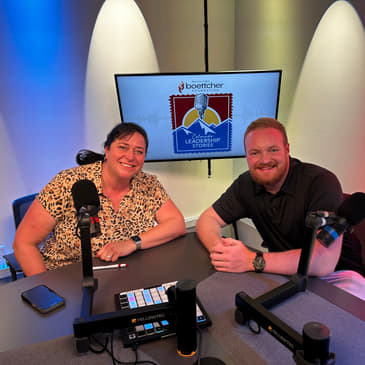
The Governor of the Colorado Buffaloes football program is a Boettcher Scholar. As he enters his junior year on the field, Camden Dempsey reflects on his newfound fame and potential for influence after Coach Prime recently appointed him press secretary for the team. Camden also shares insights about the rigors of being a Division I student-athlete, persevering through adversity, and why he talks so publicly about mental health. With graduate school on the horizon, Camden also shares details of how his experiences in Mongolia planted the seed for his post-undergraduate plans to study internationally and serve others.
Listen on Apple Podcasts | Spotify | Amazon Music | Pandora or wherever you get podcasts!
Colorado Leadership Stories is a podcast presented by Boettcher Foundation
Follow us on Instagram, LinkedIn and Facebook
See Privacy Policy at https://art19.com/privacy and California Privacy Notice at https://art19.com/privacy#do-not-sell-my-info.
[00:00:00] Hi, I'm Katie Kramer, President and CEO of the Boettcher Foundation. Welcome to Colorado Leadership Stories, where we talk to everyday courageous leaders who have made transformational impacts in their communities and are building a better state for everyone.
[00:00:18] You'll hear from leaders and organizations and communities throughout the state as we explore the idea that leadership is an activity that anyone can do. Today, we're excited to welcome Camden Dempsey. Camden is an undergraduate at CU Boulder studying finance with a minor in leadership studies.
[00:00:41] He's also a Boettcher scholar and the definition of a student athlete. As a redshirt junior this fall, Camden is one of the long snappers on the Colorado Buffalo's football team. And recently, Coach Prime, who many of our listeners know as Dion Sanders, announced that Camden is the
[00:00:58] 2024 official governor of Colorado football. It is great to see you, Governor, and thank you for joining us today. Thank you so much for having me on, Katie. This is a
[00:01:08] really full circle. I mean, we've known each other for so long and it's really cool to be able to sit here and just be able to chat about stuff ever since I was a freshman. It's cool to be here. So thank you for having me on.
[00:01:18] Well, it is fun, Camden, and the truth is we go back even farther than that, right? From Boy Scout Troop 1876, the Colorado Boutonnieres, little shout out to them. And of course, you're an Eagle Scout as well.
[00:01:30] But it has been awesome seeing you grow as a leader this many years and here now you're the governor. And so I cannot wait to hear all about all the things that you are up to at CU. Well, you got to start there.
[00:01:43] I mean, this is just so much fun. This is a new found community role and fame for you. I mean, you probably never expected to be so famous in this way.
[00:01:52] But last month, you became a very public persona when it was announced that you would be the governor of Colorado football. And you gave your first state of the program address. I just watched it again this morning.
[00:02:04] It's about eight minutes in length and thus far has 29,000 views, maybe even more at this point. How did this happen? Talk about the governor role and how things are going as you're heading into the season this fall.
[00:02:17] Yeah, so it really all started back at the beginning of the summer. We had a leadership retreat with all of the athletes on the team
[00:02:24] who were kind of the older guys who were going to be, you know, kind of the ones leading this charge into 2024 for the season. And so coach invited us out. We were at this beautiful ranch and we got to, you know, sit down and talk as a team.
[00:02:36] Which we don't like we have team meetings but it's really cool to actually get to sit and chat and just get to know one another on a more personal level outside of football.
[00:02:43] And we were talking just about the state of the team and our expectations going into the season. And one of the things that came up was we have all this media out there about us right now.
[00:02:53] And it's really hard because, you know, coach can, you know, go ahead and say something online. But I think one time he said, you know, that was the equivalent of firing a bazooka, right? Like if coach says something it's big. It's a big deal.
[00:03:05] And we don't really have a lot of athletes on our team who, you know, either feel empowered or be really kind of, you know, want to get out there and talk about this press because, you know, it's former teammates, it's former friends.
[00:03:15] We've got some guys who, you know, are out there and, you know, may not be happy with the program and stuff. So we've got a lot of media out there about us and it's tough to really be able to fight back on that
[00:03:25] because there's some stuff out there that's just not true. So we were sitting down and talking and I've known coach, I'm, you know, returner. I've been there for three years is going into my fourth year and he kind of looked at me and he's like, you know what?
[00:03:37] You're going to be the guy. You're going to be the person like kind of press secretary for the team and you are going to keep it straight with people. You're going to tell the truth and A that's like a really, you know, kind of daunting task, right?
[00:03:47] Being told by your head coach that, you know, you're going to be the guy responsible for, you know, keeping stuff true about your teammates. But he also gave me a lot of freedom in that role, which is something that I'm really thankful for
[00:03:57] because not only do I want it to be a role that, you know, is about, you know, kind of defending our team against the press and or, you know, that but also I really want to make
[00:04:04] it about highlighting the amazing things that our athletes are doing because like you said, you know, there's this idea that, you know, a student athlete is only as much as their sport and I just don't believe that's true.
[00:04:14] I mean, we've got guys who are doing amazing things every week, whether it comes to stuff in the community, whether it comes to stuff business wise or personal family stuff. So this role is really not only about, you know, just the media, but also about highlighting
[00:04:26] my teammates and that's something that I've been really excited to do. I mean, we saw we had those first two videos, which were really fun to create. And I think there's going to be a lot more coming down the pipeline here during the fall.
[00:04:40] I think it's so great that we get to know so many more of the incredible humans on the team. Right. And I'm so impressed with how you all prioritize character and service and that stat to that
[00:04:56] highest GPA, whatever that stat was, it just, I mean, you, you all are working hard on the field and off the field and I think it's, it's really, really exciting. You've had a lot of leadership roles, Camden, but for this one, what's your
[00:05:08] favorite part of this leadership role? Yeah. Well, I can tell you like, first of all, it's been a lot because like, you know, most of the time if you're being put in a role or if you take a role on like this
[00:05:17] and you're doing media, you know, you've got, you know, people that, you know, help create like a media calendar and stuff like that. And, you know, coaches really given me a lot of freedom on this to be able to talk with
[00:05:28] and do what I want with the role to highlight our teammates. But I'll be completely honest. You know, I got through those first couple of weeks, got those videos done. And then I was like, oh my gosh, I have no clue what type of content to do.
[00:05:38] Like it was a lot to figure out at first and trying to figure out how to be a leader on the team at the same time and, you know, not make it about myself. Cause that's the biggest thing that I've wanted to do with this role is not
[00:05:48] make it about me, the governor. I want to be a platform to empower my teammates. So I think my favorite part has been that I, you know, talked about doing some stuff before summer ended. I got super busy and trying to figure out all this out and didn't
[00:06:00] have a chance to get to that, but fall camp is coming up, starts Sunday. And that's basically a month where, you know, we are in full football and I've got the opportunity to work with my teammates on stuff. So I've got a content calendar.
[00:06:14] I'm planning on stuff to do. And it's really going to be about highlighting not only the good that the team does, but also the good that each individual athlete does highlight, you know, our team dads, highlight our team fathers, highlight the service activities that guys are doing.
[00:06:28] I think that, you know, you have an amazing group of young men here in Colorado who really care about the state and want to give back. And I don't think that that's seen enough. So that's really what I'm excited to highlight. And it's the best part.
[00:06:40] It's so fulfilling. Like is a diehard buff. I can't tell you how cool it is to be able to talk about this team and the amazing stuff it does. Well, and you've grown up around it, right?
[00:06:49] I mean, hasn't your family had season tickets to the 60s or something? 1967. I love it. I love it. You just bleed black and gold. I love it. How many followers, new followers have you gained on Instagram in the last month?
[00:07:02] Well, I think it was like at least 1200, which is crazy. And I got verified too, which was crazy because my mom and dad are both like, why do you have blue check mark next to your name? And that was a really cool moment.
[00:07:13] And then like the YouTube channel alone, it's at Camden Dempsey, the governor, go check it out. It's got like 4,300 subscribers, which normally that takes a lot of time to build. There are only two videos right now, but you're going to be putting out a lot more
[00:07:28] and a lot more about our guys. So that's really fun. That's great. Well, it has been a whirlwind for you the last three years at CU and you came before coach prime was hired. And I remember that time a number of players left the football program, transferred out.
[00:07:45] And I know there was a point where you were probably sure not of your own future. And now we're here. So I guess what have the last three years taught you about yourself? That's a great question.
[00:07:57] I have learned so much about myself through this process, whether that be from, you know, when I came into CU, I was, you know, brand new little freshman just trying to figure out where my classes were on campus.
[00:08:09] And I tore my ACL about six weeks into the season. I was an offensive lineman back then. I was 290 pounds, a lot bigger and having to deal with the adversity of that, of, you know, coming into a program, having so many expectations and then getting injured
[00:08:23] immediately was really tough and having to figure out, you know, how do I deal with this idea that, you know, I feel like everyone around me is advancing and I'm here trying to rehab just to get back to normal, just to get back to that starting point.
[00:08:36] And that taught me a lot about, you know, just kind of the self-confidence side of just knowing and being true to who you are and knowing that, you know, as long as you're doing the things to keep you going the right way and staying true to your values.
[00:08:49] That was really big for me because there was a lot of doubts in that time where I was like, you know, my knee's not feeling great. I don't even know if the position I'm going to be is there when I'm done.
[00:08:58] And having to, you know, one of the things I did was I transitioned from being an offensive lineman to a long snapper because I lost about 40 pounds. And doing that at a Division I level, you know, takes a lot of, you know, pushing down your ego.
[00:09:08] And, you know, I was snapping into a net for about, you know, six months, just trying to learn the basics of it. And luckily the coaches were graceful enough to let me have that time to get to where I needed
[00:09:18] to be. But it's really been a complete learning experience this entire time. And the other part too, I guess, has just been how I interact with other leaders. I mean, I've seen, you know, three head coaches in my time here at CU
[00:09:32] that's dealing with, you know, very different personalities, very different approaches towards leadership, you know, dealing with, you know, some pretty turbulent shakeups, losing, you know, pretty much 90% of my friends on the team, you know, either to transfers or not coming back.
[00:09:45] And that was big too, because, you know, it took a lot of faith in the program and a lot of understanding that, you know, to me, CU is my school. It's my home. I love it. And I'm not leaving.
[00:09:57] And so I've seen about a roster's worth of turnover in my time at CU, which is just crazy. But I've wanted to make the most of it. And I've wanted to leave the biggest impact on the school that I can.
[00:10:08] For me, that means, you know, staying and trying to make the most out of the program that I can. So that's so great. And I want to talk a little bit more about your journey as a student athlete, how you're balancing academics and athletics.
[00:10:22] So this is a bit of a loaded question, but take us through, like, what is your typical day look like during the season? I just want to hear that and then just speak a little bit about the pressure of trying to balance that.
[00:10:36] Yeah, no, I think that's one thing that, you know, a lot of people get caught up in, you know, kind of the idea that, you know, oh, it's all, you know, all fame and all this stuff. Do they just see the game part?
[00:10:46] Well, they don't see the travel aspect of it. I mean, for a typical day in the week for me, at least last season, I'd wake up at, you know, 5 45, get into practice, have a team meeting at seven. We'd practice until about 11 and then go grab lunch by noon.
[00:11:02] I'd have class at 12 30, 12 45. I'd have class until probably about five or six p.m. And then I'd finally be able to go home, start working on homework and stuff like that and grab dinner, try and, you know, hang out with a few friends
[00:11:15] and have a bit of a social life and then go back and rinse, repeat. It's it's it's a lot of pressure. I mean, granted, I do very well when, you know, there's not a lot of time to do stuff.
[00:11:26] I guess that's another thing I've learned since freshman year. I've learned how to balance that because freshman year was really tough trying to figure out, you know, where do I fit all this stuff in? But it's taught me a lot about, you know, what's important.
[00:11:38] Well, and I think that, Kevin, you're so good at so many things and I've seen you be successful in a lot of ways. And I'm sure being able to be a Division one athlete, you have to have that confidence and you have to be able to perform.
[00:11:52] Is there ever been a time when you've struggled with confidence that you feel like you had to overcome some of that? Yeah, I mean, I'll tell you the entire transition over from offensive line to long snapping has been something that,
[00:12:06] you know, I'm leaving a position that I've done for, you know, I've only did it. I only was an offensive lineman for four years out of high school and, you know, then coming in and feeling like, you know, you're knocked down around, right?
[00:12:18] You get so comfortable in this position and then it's, wait, I have to learn something completely different that people have been doing since they were super young and trying to do it at a very high level. All well, the program is going on behind you
[00:12:31] and you got to try and catch the ride while it's still going. So I think that was definitely a bit of a confidence issue, but the thing that got me through it was pushing down the ego and realizing that like, you know, I'm on my own schedule
[00:12:44] and I will get to where I need to be and having the trust in that process. But then also just the amazing people are happening who've helped me get through it. Well, and you were an just star athlete in high school
[00:12:57] and one of the best offensive linemen in the Denver metro area. And here you have adjusted to being, you know, in a different role on the team. And I wonder if that's been difficult too. Yeah, it's weird because, you know, I grew up, you know,
[00:13:13] thinking of myself as an offensive lineman, and you know, like eating like an offensive lineman. And I'll say the two positions are very different. So I was a center for four years. And going from something that, I mean, offensive line is, you know, 75, 80% physical and, you know, 20, 25% mental
[00:13:32] to a position that is, I mean, you have to be a sniper. It's all mental. You get one rep to go out there offensive line. You can rely on the guys around you to, you know, maybe jostle around a bit and help you in your position.
[00:13:44] Whereas, you know, long snapping, you're out there on your own and you better get it right or else you're toast. So it is one of the positions. I mean, unfortunately, I've played two positions where like, if people know your name, you've done something wrong, right?
[00:13:56] So that's like my own choice. That like, I was like, dang, I should have chosen like receiver or something, but they're not exactly looking for 250 pound receivers. So, well, well, that was the last football question. I it's hard to not just talk about that, but you again,
[00:14:10] so many different aspects to who you are as a human. And I do want to switch gears into some of your other passions and interests. And we talked about this right at the beginning, but you became an Eagle Scout in 2018, I think, and really interesting Eagle Scout project.
[00:14:24] And so tell us about the project. What inspired it? Because I think it's one of the coolest ones I've ever heard about. Yeah. So I'll preface it by saying the biggest gift my family ever gave me was the ability to travel.
[00:14:36] And when I was younger, I got to travel a bunch. So one of the things with Scouts is, you know, you're you're you're a member of the community and you're either a citizen, you know, of your local local area citizen, of your country citizen of the world.
[00:14:49] And so when I was looking at my Eagle Scout project, I was like, dang, I've traveled a lot. I feel like I'm a citizen of the world. I want to do something with a global impact. So I did something that was a little bit less traditional
[00:14:58] for an Eagle Scout project. I spent about a year and a half planning a project. It was in Inner Mongolia, China, which was absolutely crazy. He's thinking back on it now. And we took a group of 16 US volunteers and 18 Chinese volunteers.
[00:15:15] Most of our US volunteers had never been outside of the country before. And we planted 100 trees over the course of three days in China. And it was an incredible experience. We just the first part of people going to China for the first time
[00:15:29] was a culture shock for a lot of them are American friends. And then by the same time, there were Chinese journalism students who we're working with. We were out in the middle of nowhere like, oh, hot. It looks like Denver. It feels like Denver.
[00:15:41] But I mean, it's you know, it's not the first place you think of when you think of China. And for them getting to meet up with Americans and have that experience of, you know, that kind of cultural exchange was just so valuable in addition to the help
[00:15:54] that we provided the local village and having these trees that could generate produce and also help reduce the impact of these dust storms coming down from the Gobi Desert. So that took about a year and a half to plan.
[00:16:05] I was up on Zoom meetings before Zoom was cool. Back at like two or three a.m. Because I'd have to talk with my Chinese contact across time zones, fundraised about $23,000 for it. And I think we ended up having like 18, you know, 800 or 2000 service hours.
[00:16:21] Just for that project alone. But that was like my first big leadership test on how to manage that. There are a lot of stories that went along with that. But I think the biggest thing for me with that is it was an amazing experience.
[00:16:34] But I've always said I want it to be like the smallest line item on my resume. Like, I feel like, you know, I've done that. But I want to go on to do even bigger and better things.
[00:16:44] And that's something that, you know, it's a great starting out point. Well, sure. Were there some things? I think that that's one of the coolest things. As you know, my sons are in Scouts and you grow so much as a leader through that experience.
[00:16:56] Was there something that you, as you reflect back on that, that you feel like you saw yourself growing? Yeah, I think the first thing I learned was how much my mom really pushed me on that. Because that was she helped me out a ton.
[00:17:10] My mom and dad were both, you know, really helpful. But in terms of just me personally, it taught me how to really communicate with adults at that age. Because you're in high school. Well, and you were young when this was. So were you like 16 or 15?
[00:17:23] I think I was 15 when it happened. Holy cow. And you know, like I went into a meeting in China one time to talk about these types of projects. And the person who I was sitting with apparently like worked with Al Gore on a project.
[00:17:35] And here I'm like a little 14 or 15 year old, like, oh my gosh, I'm in a meeting room with someone who's at that level. And having to fundraise, I mean, I, you know, again, something that I forget about a lot, but the fundraising process for that was huge
[00:17:48] because we wanted to pay for all of our volunteers, food, housing, all while they were in China. And so we fundraised or I went around to local optimist rotary Kiwanis clubs in the morning before school and pitched them, which like again as a high schooler is terrifying.
[00:18:05] You're going into a room with a bunch of adults and trying to sell them on why they should donate to a project that you're doing across the world. It's not affecting like their local community, but it's across the world.
[00:18:15] So I fundraised about half of my money from that. I think I pitched 12 or 15 clubs. And then the other half I went and I was in China and I pitched a private equity group, which was absolutely crazy. And they agreed to support the other half.
[00:18:28] So it was incredible. It taught me so much just, you know, communication, you know, keeping on top of scheduling like time management that I still use to this day. But it was that was not to mention wrangling
[00:18:41] a bunch of Wiley scouts to try to focus on the program. That's great. And the other organization I wanted to talk about just how your service ethic shows up in such a big way as I know you served on the board of Robbie's Hope Foundation
[00:18:56] and that advocates for mental health and suicide prevention. Talk about the significance of mental health to you and why has it been such a priority for you in your life? My sophomore year of high school, one of my best friends who I'd swam with forever
[00:19:11] went to elementary school with, played tennis with Robbie Eckert. He died by suicide and that was really tough as a sophomore in high school. It made me grow up pretty quick. I mean, the thing that came out of it that was really good was this foundation
[00:19:26] that his family created. They were kind enough to let me hop on the board as like a 15 year old, which is a pretty young age for a kid to hop on a board of directors. But I got to work with them for about five and a half years
[00:19:38] and really sort of push forward the program. Our goal was to cut teen suicide in half in Colorado by 2028. Working on that still, or the foundation is still working on that. I left the board because I was a little too old.
[00:19:52] They wanted someone with more of a youth voice and I'm not even on TikTok. I don't understand what the kids are thinking these days. But I step aside to let someone younger hop on that board role. But it's super important to me because my role has always been
[00:20:07] if I can stop at least one family from having to go through that, that's really important to me. And that's something I've tried to take into me with athletics, with CU, we do a mental health week every week. I've been huge advocating on that.
[00:20:19] And then also just with my own athlete teammates. We've got a great support system up at CU but it's something that's very close to my heart because of how deeply it impacted me. And it's something that I'm gonna take with me for the rest of my life.
[00:20:33] Well, and I think you're a good role model that way and I know that you know that this is a drum that I beat a lot. I just think it's so important that we take care of ourselves. And I think about the pressure that you're under,
[00:20:44] the pressure I'm under. I've got this incredible fun job and want to be a good mom and partner to my husband and all the things. How do you take care of yourself? What advice do you give people about specifically taking care of your mental health?
[00:20:58] Yeah, with kind of the student athlete all the other stuff that I've been doing. I've gotten really good about scheduling my time. I think that that is the number one thing you can do to help your mental health because I don't think we realize that like,
[00:21:11] when you're spending time, you're spending it because it's the most valuable thing that you own. And so me, I do, I very strictly block off my time as to what's football, what's class and then what's left for me and how I manage that and how I spend that.
[00:21:26] And so for me, I get my energy from people. I love talking with people. So I'm pretty extroverted. I hang out with friends a lot. I love to go out and whether it's going out and fishing or one of my other favorite things to do,
[00:21:36] I just love to drive around Boulder. It's so beautiful. Just being able to go up and hang out, but really being strict with my time and hanging out with people who love and support me. I think that's the number one way I take care of my mental health.
[00:21:48] I love that. And I want to talk about the people that do support you. You are surrounded by a bunch of people that love you and support you in all the ways. And you have had a lot of mentors I know. So I'm curious outside of your parents
[00:22:05] who I know that you would probably mention, is there anybody in particularly influential that has been a good role model for you as a leader? See, this is my favorite question because this is where I get to plug the Betcher Foundation. Oh, cool.
[00:22:16] Say you don't have to like keep like mouthing to me like, say Betcher, say Betcher. No, no, seriously, the Betcher Foundation between you and then Tiffany Anderson, you guys have been like massive role models and support roles for me as I've gone through this.
[00:22:31] I mean, Tiffany, she was a college athlete and she has helped me out a ton in terms of figuring out just how to deal with the student and the athlete side of stuff. So, I mean, the Betcher Foundation has just been incredible in that role in providing mentors.
[00:22:45] Another mentor that I've had, I mean, just the professors at CU, I've clicked with a lot of them. I actually met up with one this morning. Her name is Beverly Carnes, absolutely amazing. She runs like her own granola brand but she's also a professor
[00:22:58] and she did like corporate finance and entrepreneurial finance with me. And just those connections are super valuable in helping me figure out like, hey, she was a great professor but she's also helping me on the, you know, building a brand side of this governor stuff
[00:23:11] on the entrepreneurship side. So between Betcher, just the staff and faculty at CU and then, you know, he's not around still but my grandpa is someone that like was a big mentor to me. He's the reason why I came to CU
[00:23:26] and I still think of him a lot and I miss him a lot but he was, I know that, you know, first games or whatever, he's still there with me. So that's, you know, those are my big mentors. That's awesome. Camden, tell us about your plans after college.
[00:23:39] Have you thought that far ahead? I know that you have some interest in entrepreneurship. I know you've got this international interest. What are you thinking about? How's that going to evolve? So I think right now what I'm trying to plan to do,
[00:23:53] so I've got one more year left for my undergrad at CU. So I'm going to graduate with finance and marketing and then I'm going to go on and I'm going to do my master's at CU because Betcher, you know, covers a fifth year
[00:24:04] which is amazing and such a gift and I'm going to do my master's in either finance or real estate and I'm trying to set myself up best as I can for a really cool career out of college that's in kind of that finance or entrepreneurship space
[00:24:17] but before I do that I'm going to try and apply for probably, you know, either Fulbright, Mitchell, Rhodes, one of those scholarships for post-grad because I think one of the things that people don't often think about is athletes when they're student athletes they're stuck on campus
[00:24:31] for pretty much a majority of the year, right? We get May, we get a couple weeks in July and then we get winter break but you know if we've got a bowl game or something like that we're still on campus and travel is something that, you know,
[00:24:45] super important to me and my family so I want to get out I want to get, you know, get to travel get to do some really cool job opportunities outside of Colorado and stuff but then after that probably want to bring it back here
[00:24:57] hang out in the startup community in Boulder and either join a startup or start up my own business because, you know, I think it's it's just something that really excites me Awesome. Well, you will go far my friend I'm certain of that
[00:25:09] All right, you have survived the interview except for the lightning round question So which there are four and so here's your first one What is your favorite Colorado hobby? Colorado hobby, I love fishing or at least like I'm like I do too I recently knew to love fishing
[00:25:26] Okay I was just up at I think it was Lake Isabelle or one of those I was up driving around yesterday and just found a lake and went out and had a fly rod in the back of my car and that's really nice because it's good, you know,
[00:25:39] Boulder gets, you know, kind of loud sometimes and to be able to just step away get out in nature and just be quiet and calm down is one of my favorite things Oh, I hear you there buddy and that is my mental health thing
[00:25:50] I love love love to fish Yeah, it's so great It's meditative, I think Absolutely Okay, favorite Colorado landmark See, I'm a Boulder student so I have to say the Flatiron Of course Like that's required but what I will say is there's this beautiful spot
[00:26:05] of Flagstaff called Lost Gold's Lookout It's not like a it's not a hard landmark from Colorado but it's another place that I go to just hang out and meditate It's 15 minutes outside of Boulder but it feels like you're miles away You're up on top of this mountain
[00:26:19] You can see, you know, all across the front range and it's absolutely beautiful Man, it's a beautiful place to go to school up there Yes I know from personal experience All right, Camden What action hero do you most identify with? Action hero? I'd probably have to say
[00:26:41] I've never thought about before Probably like Captain America That fits Yeah, I feel like that's that's probably what I align with the most Absolutely I love it Okay, and finally What are you currently binging? Is there a show, a book, a podcast something you can't get enough of
[00:26:59] that's feeding your soul or wasting your time or however that works out for you So show-wise, I love Game of Thrones I've been watching House of the Dragon That's one of my favorite shows out there right now I'm watching that with my mom actually It's really fun Nice
[00:27:12] We like to watch every Sunday And then otherwise I've been playing Red Dead Redemption 2 I've never been a video game person but I think like, you know There's like the main story but I kind of just like going out and like hunting and fishing and riding a horse
[00:27:26] and I'll do that after practice like if I don't have enough time to go out and drive I'll just come back and ride a horse for 30 minutes On the video game On the video game, yes Yes, we have that at our house too
[00:27:36] So I know exactly what you're talking about That's great I haven't heard that one before Love it All right, my friend Well, as always Lovely to see you We are so proud of you all the things And yes, all the things you've accomplished
[00:27:50] and also just of who you are as a human and love that heart for service and the way that you embrace leadership and we're just excited for you for what's next So congratulations Thank you so much Yeah, and if you're
[00:28:04] If anyone wants to like keep up to date on all this stuff Yes You can follow There's the YouTube channel which is at Camden Dempsey I think if you search the governor CU on YouTube You'll be able to find it Yep We'll be doing more stuff around camp
[00:28:16] and around the program and stuff like that That's going to be really fun And then you can also hit my Instagram or Twitter which is both I think just at Camden Dempsey And yeah, find me there Perfect All right, sco buffs Sco buffs Thank you for joining
[00:28:31] Colorado Leadership Stories where we hope to inspire the next generation of Colorado community builders doers and difference makers Colorado Leadership Stories is presented by the Betcher Foundation The Betcher Foundation supports Colorado by empowering leaders and communities with tools to tackle challenges and pursue opportunities
[00:28:53] building a better state for everyone With an 85 plus year legacy of giving back we're committed to amplifying our impact for future generations That's the spirit of Betcher