
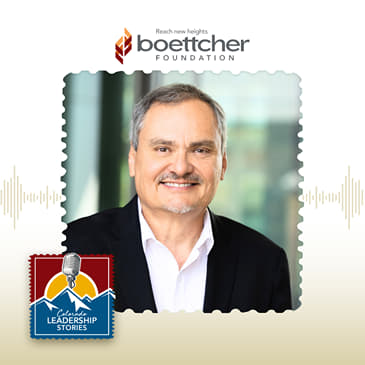
Water connects Colorado's communities, landscapes, and livelihoods. Few understand those connections better than Alan Salazar, CEO and manager of Denver Water and a longtime public servant whose career has touched nearly every corner of the state.
In this episode of Colorado Leadership Stories, Alan joins Boettcher Foundation President and CEO Katie Kramer to reflect on his Colorado roots, decades of public service, and the relationships that have influenced his approach to leadership. He also discusses the growing challenges of drought and water scarcity, sharing why collaboration across communities is essential to Colorado's future.
Subscribe on Apple Podcasts | Spotify | Amazon Music | Pandora or wherever you get podcasts!
See Privacy Policy at https://art19.com/privacy and California Privacy Notice at https://art19.com/privacy#do-not-sell-my-info.
[00:00:00] Hi, I'm Katie Kramer, President and CEO of the Boettcher Foundation. Welcome to Colorado Leadership Stories, where we talk to everyday, courageous leaders who have made transformational impacts in their communities and are building a better state for everyone. You'll hear from leaders and organizations and communities throughout the state as we explore the idea that leadership is an activity that anyone can do.
[00:00:30] Meet Alan Salazar, a fifth-generation Coloradan born in Leadville, whose family roots stretch across the San Luis Valley and the Western Slope. Today, as CEO and manager of Denver Water, Colorado's oldest and largest water utility, Alan helps provide water to more than 1.5 million people. But his connection to this essential resource, public lands and communities they sustained began long before he stepped into this role.
[00:00:55] He studied water and natural resources law at the University of Colorado and has spent more than three decades helping shape Colorado's future through public service. Throughout his career, Alan has advised governors, members of Congress and the mayor of Denver on some of the state's most pressing challenges, from infrastructure and growth to natural resources and the creation of Colorado's first water plan. Alan, welcome. Alan Salazar, Director, California Institute of Technology, Colorado, California Institute of Technology
[00:01:25] And I'm excited to dig in. So, as you know, the Boettcher Foundation every year has a theme and this year is power of place. And for us, the power of place recognizes that leadership does not emerge in a vacuum. It's shaped by the communities and lived experiences that form who we are and how we lead. I know that you were born in Leadville and are a fifth-generation Coloradan with roots across the state. Tell us about your family's deep connection here in Colorado and how it helped shape you.
[00:01:55] Katie, I always was born in Leadville, but it's such a cool place to have been born. But the truth is, I was born there in the hospital there. But I grew up, my first couple of years was in Minturn, Colorado, where my parents were from. But I mostly grew up in the metro area. Mm-hmm. So, I like to, you know, Leadville is a cooler place to say you're from. But the truth of my heritage is that I have family on the western slope, San Luis Valley, but essentially grew up on the Front Range.
[00:02:24] So, that's how I came of age. What it means to me, place is important. And I don't want to get into that view of, well, if you're here a long time and you're a native, you're somehow more deeply connected to the state. Mm-hmm. I have a greater reference, frankly, for people who are newcomers and immigrants. And so, I don't want to be off-putting about all of that heritage. But the truth of the matter is that it does shape you.
[00:02:53] And in my case, the word that comes across strong for me is diversity. Mm-hmm. Not only diversity of landscape, but diversity of people. And you can get into the depth of that, but that's the word that comes to mind. Mm-hmm. I love it. That's a great, great answer. And I want to hear more about just your journey. You have such an interesting background and have done so many things. And so, let's talk about that.
[00:03:22] You heard in the intro, I shared that you have been in rooms with all sorts of Colorado's important leaders at different levels. But take us along. Take us along on the journey from where you, where'd you graduate from high school here? And then how, tell us about those stories. A quick resume then. Thornton High School. Yay! University of Colorado, undergrad. University of Colorado Law School. Okay.
[00:03:48] And after law school, I had the, I passed the bar, luckily. But my interest in the law was always more focused in public policy than the practice of law. Yeah. So I had the opportunity shortly out of law school and passing the bar to go to work for a U.S. Senator. Mm-hmm. Mm-hmm. Worked for two U.S. Senators. Gary Hart was my first hire. Or I was Gary Hart's, I was the first hire in his office, let me put it that way. Mm-hmm. Senator Tim Wirth after that. Yeah.
[00:04:17] Governor Roy Romer after that. A clip with President Clinton's first presidential campaign in 1992. In 1996, I took a leave of absence from Governor Romer's office to be the state director for President Clinton's re-election. Mm-hmm. And then back to, well, back to Romer in 1994 through the end of his third term, Governor Romer that is. Mm-hmm.
[00:04:44] Chief of Staff for Congressman Mark Udall for about 11 years. Chief Strategy Officer for John Hickenlooper when he was governor. And a stint with Hillary Clinton's presidential campaign in 2016. And then the mayor, that job as Chief of Staff for Mayor Hancock. Mm-hmm. Right after that. And started with Denver Water in 2023.
[00:05:13] So the lily pad for me has been government, public service, and that's how I've managed to make a living and thrive. Right. Well, I'd love to dig into that a little bit. And when you think about those different levels, you've got this municipal level, statewide, and of course on the national stage too. Maybe talk about what's different or maybe they're all the same in different contexts because it's the scale is just different. I don't know.
[00:05:40] So maybe just share a little bit about what that's like at those different levels. Yeah. For me, it's been a mix of politics and policy. Yeah. And for some people, it's the politics that they're most interested in. And you can build a career just doing political campaigns and political consulting and being in that world. For me, politics was always the path to government and public policy. Mm-hmm. And that's where I really thrived. And every one of those experiences has been different.
[00:06:08] I've had an opportunity to be up close with people who have had leadership positions. Mm-hmm . And it just dawns on me, most of those people were men. Mm-hmm . But interestingly enough, the managers, leadership that I've had the privilege of being mentored by have been women, strong women in each one of those jobs, frankly. Mm-hmm .
[00:06:36] So what stands out for me is the leadership example of elected officials, but also some people behind the scenes. Mm-hmm . Glad to explain what that is. But strong women, I can think of three of them. Well, I want to hear about it. Yeah. You got the next question. So yes, please tell. Yeah. Well, my first boss was Senator Hart, but actually I was working for a state director, Susan Smart. Mm-hmm . After that, it was Betty Miller in Senator Tim Wirt's office. Mm-hmm .
[00:07:04] Betty Miller, Jefferson County commissioner, long-time political advocate, and I think a strong woman. Mm-hmm . In Roy Romer's office, my first boss was a woman named B.J. Thornberry, who was the deputy chief of staff. And so when I think of those three women, I think of the lessons they taught me. Mm-hmm . And so I think of the things that I think of, including paying attention to your reputation, paying attention to being truthful with people.
[00:07:34] And anyway, could go on. But those are the, when I say those bosses, those are three people, three women that stand out for me. Mm-hmm . That's great. And when you think about lots of the things, I'm sure you were involved with so many interesting, whether they are policy issues or huge projects. Mm-hmm . Is there one that maybe stands out or a couple that you're like, oh, I'm really proud of the progress we made doing this? It's interesting.
[00:08:01] Um, Governor Romer, when I was with him, I was his deputy chief of staff, ran his reelection campaign in 1994 and finished out a term with him. And he used to say that he would, he had a mind like a hay baler. Mm-hmm . So when something would happen, he would deal with it and then it would go on the conveyor belt and then he would not think about it. And I'm afraid I, I may have picked up that same, you know, you deal with a problem and you move on, the conveyor belt moves on. Mm-hmm .
[00:08:26] I think one thing that stands out for me in particular was my time with Mayor Hancock, chief of staff for seven years. And going through COVID and George Floyd and seeing and having a firsthand seat at how the city evolved from this thriving, almost overly developed community. Right.
[00:08:54] I remember in 2019, people were worried that Denver had gotten too, there was too much growth, too much development. And can we just kind of calm down a little bit, you know? Wah, wah, wah. Wah, wah, wah. Exactly. And then to be hit with COVID and all of that, um, that experience stands out for me pretty significantly. Yeah. But the thing that it really stands out are not problems that we worked on or that I worked on, but the relationship with the people that were part of those teams. Right.
[00:09:23] And that stands out for me more than anything. Huh. Well, and I, since we're just talking about leadership, this is Colorado leadership stories, of course. Mm-hmm . I'm just thinking about all of those teams that you had exposure to, you know, certainly there was whoever was the elected name or whatever. Mm-hmm .
[00:09:41] But, um, when you were thinking about how, when you were trying to make progress on difficult issues, whether it was COVID or anything, what are some of the maybe leadership skills or attributes that are absolutely mission critical? Um, in, when you're trying to do something to help the community. Yeah. Uh, I think the biggest thing that stands out, the quality that stands out, self-confidence is important in life and whatever career you choose. Mm-hmm .
[00:11:10] Uh, very hard to find that in public life, particularly with people who were elected officials. Willing to not put the mistake on staff or blame somebody else. I think it stands out for me that somebody would inspire a team by acknowledging a mistake and taking responsibility for it. And, uh, so those kind of emotional moments stand out for me. Mm-hmm .
[00:11:34] Uh, in terms of leadership skills, again, developing trust, uh, uh, building a reputation for, uh, truthfulness. Mm-hmm . Uh, listening to people. And again, that self-awareness, self-reflection. Mm-hmm . Mm-hmm . And not just self-confidence. Those are just some things that stand out. Yeah. That sounds like it. I loved how you were describing your career as kind of a lily pad. That's fun. And we're going to get to your current lily pad in a second. Yeah. But, um, I have one more question I wanted to ask about just the journey, Alan.
[00:12:01] And that is, how, how did you make the jump from one thing to the next? Were you asked? Were you, is there, are you a learner and you wanted to have a new challenge? Like what was the quality of helping you decide when it was time to make a shift? Mm-hmm . I was fortunate, um, having got, gotten kind of into the space. Mm-hmm . Uh, proving value.
[00:12:29] Um, uh, the reputation followed with it. And I usually, doors opened, uh, for me that I wasn't planning for. Sure. Most of the things that I planned for didn't happen. You know, it's just interesting. I didn't plan to end up at Denver Water. It was an opportunity that presented itself. Mm-hmm . When I worked for Hillary Clinton's campaign in 2016, I was very confident that she was gonna be the next president.
[00:12:54] Um, and my thought was my career having been in public service would then be, you know, maybe I'd go into consulting or in the administration or something. Mm-hmm . And that's the way it would work. Mm-hmm . Mm-hmm . I did not expect, uh, an opportunity, uh, to be chief of staff for Michael Hancock. It presented itself. Mm-hmm . So as much planning and strategery, uh, that I've put into, you know, trying to figure out what's around the corner for myself, the truth is it was really just doors that opened
[00:13:21] because people knew me or knew of me and the timing worked. Mm-hmm . And you did a great job in those respective roles. Well . So I can say that. Thanks, Katie. I appreciate your confidence. But it's, uh, it's true. I think that when, when you think about the leaders, um, in this community, your name's always at the top of the list, Alan. And so we're so lucky that you're at Denver Water. And so you can maybe tell us about that, how that opportunity presented itself. Yeah. And, um, and, and maybe why you took it.
[00:13:50] Well, it's in a weird way, full circle for me. Okay. Because when I was in law school, what I was interested in was natural resources law. Mm-hmm . So I took mining law, uh, Indian law, um, public lands, uh, water, uh, water law with, uh, David Goetches who- Yeah, sure. You know. I know David, yeah. And was one of the kind of seminal figures in, in natural resource policy and, in law. Uh, so that was my intention. Mm-hmm .
[00:14:18] Uh, I'm gonna use these skills, get my law degree, and then go to work for, uh, my hope, my, my goal was the Native American Rights Fund. Mm-hmm . Mm-hmm . Mm-hmm . Mm-hmm . Uh, and that, and that, and that's, that's, that's the way it, uh, it, it, it evolved. So having gone through public policy and, uh, involved in a lot of issues, uh, not just
[00:14:43] natural resource related issues, um, uh, and, and ending up at the city, which is a variety of issues of all kinds. Mm-hmm . Um, my predecessor, Jim Lockhead, who'd been the CEO, highly successful, um, to CEO of Denver Water and a water lawyer of great renown. Probably nobody in Colorado knows as much about the Colorado River as Jim Lockhead. Mm-hmm . And I'd worked with Jim in various other capacities. So he's leaving just about the time that Michael Hancock's term is ending. Mm-hmm .
[00:15:13] And the Board of Commissioners was looking for a candidate to at least fill in, in an interim capacity. Mm-hmm . Uh, having done their search, they didn't, they didn't land on somebody they wanted to offer the job to. So it was kind of like serendipitous for me. Mm-hmm . Uh, but again, full circle because I started, with the interest in natural resource policy and, uh, ended up in, uh, uh, one of the really premier opportunities to work on natural resources policy.
[00:15:41] And it's his, it's, uh, the legacy for me at Denver Water is interesting because when I started with, uh, Gary Hart, when I was working for Senator Hart, the controversies in water at the time included endangered species. Public lands management, uh, Two Forks was a proposed water project that people have forgotten about that would have, uh, arguably put Denver Water in a good place in terms of water supply for the future. It was very controversial. Mm-hmm . Mm-hmm .
[00:16:12] And I remember working on that issue for Senator Hart. He was a critic of Two Forks. And so I remember a young staffer, you know, hanging around people, uh, who really knew their job and on this big topic. And I did not think that issue would come back to even be on my radar. Yeah. Ironic. I mean, it is ironic.
[00:16:38] Well, and for those people that maybe don't know about Denver Water, tell us, tell us about sort of the scope of what you're up to. Yeah. Wonderful organization, 1100 employees, um, 1.5 million people depend on Denver Water to, to supply clean drinking water. Not just the city of Denver, but, um, about a dozen other communities in the area. We are responsible for, uh, 25% of the state's population.
[00:17:06] We use about 2% of the state's water. And so, um, management principles around efficiency, um, uh, excellent workforce, uh, dedication to a public mission. And that's, uh, what attracts me and have kind of sustains me through, through this experience at Denver Water. Well, and one of my favorite stories that I've heard, I've heard about you, you can confirm
[00:17:30] if it's true, is that Alan, when you were hired there, you prioritized meeting over a thousand employees from maintenance crews to the office staff to really understand their stories and expertise. So why'd you do that? And what'd you learn from talking to them? Well, uh, put yourself in my shoes, guy who had been in government, um, not a water engineer, not a water lawyer, and they've entrusted you with, uh, leadership of this organization.
[00:17:59] So one of the things I had to do is establish some credibility with people in some cases, uh, worked there for 20 or 30 years. Right. And, uh, the only way I think authentically that you can do that is to meet with people who do the job and do the work and learn from them. And, uh, so I was determined to meet all 1100. I think I, I may, I'm pretty sure I didn't quite get to the full goal, but what I've done
[00:18:26] since then is offer up, uh, coffee hours with any employee who wants to spend time with me. And then I try and get out into the field. Yesterday I was at a dam inspection, uh, Strontia Springs dam in the Waterton Canyon. And that was a four hour experience with a crew of, I don't know, a dozen of our employees. And, uh, value for me was not only learning what the intricacies of a dam inspection would be, but hanging out with the employees and learning from them and trying to understand their story.
[00:18:56] And do they have families and what are they willing to share? So, um, I do it as much in a selfish way as anything else, because I come back from those experiences and conversations, understanding more about the job. Right. I had to prove myself essentially. So. Well, and I think it built a lot of credibility too. And hopefully, and you learn some things. I think, I think it's inspirational and I think it speaks to just to the, you're not a leader
[00:19:24] without being able to work with people. And so, so I, I just think I, I really admire that. I, when I heard that story, I thought that was amazing. Katie, it's interesting. Why can you say that? Because whatever you do, whatever the job is, whether it's in politics or government or an architect in a company, or you're designing whatever in the business world, uh, managing a nonprofit, um, you are, you are always in the silo of the mission. Right.
[00:19:52] But it's people that make it work or not. Totally. And I think there's some common, uh, understanding about how to work with other people, how to inspire trust and how to, uh, learn from them that should be transferable no matter what you're responsible for. Oh, I think that's right. That connection is everything. And, um, so a little bit more on the water, waterfront. I wanted to talk about the water plan. So I know that you were instrumental in creating the first one, 2015. Is that right?
[00:20:22] It was in the Hickenlover administration. That's right. I remember that. And then updated in 2023. Tell us about that. Why did, why did that have to happen? And what, what does it help us do? Well, Katie, I'm going to, um, truth in advert advertising. So I was the chief strategy officer for John Hickenlover at the time, responsible for his, uh, legislative affairs, policy development, um, uh, press communications, all that.
[00:20:51] Uh, and he, uh, appointed John Stulp to be the first water czar, if you will. I had known, um, uh, Russ George, who was the Department of Natural Resources director for Governor Owens and speaker of the house. And Russ had put in place, uh, water round tables to try and build collaboration in the water sector. Uh, when he was at DNR, Governor Ritter, I think continued that, uh, that work.
[00:21:21] He did in fact. And, um, and so when John Stulp came on, he wanted to build that into something more permanent. And so the truth is that we're sitting around a table, John Hickenlooper, John Stulp, James Eklund, Mike King, who's the, um, director of the Department of Natural Resources. And I'm being the political cynic here. We're going into a reelection, John. Do you really want to touch the third rail that is water by trying to do a plan?
[00:21:52] And, uh, he looked at me, we argued as we often did with one another. And I said, well, you know, I don't know. There's something about this plan thing that makes me nervous. It seems like, you know, Stalin had a five-year plan. And, and John looked at me, got a big grin on his face. He says, this is not about Stalin. This is about developing something that's a collaborative process for people. And so I came to love the plan. But the truth is, I was very skeptical about it. John Stulp was the leader of that effort and I stayed close to it.
[00:22:22] Um, the real value of the water plan was that it forced collaboration and conversation. And it's not so, it's, it's not that the final product's not important, but it was actually the process. And so we got through that. People, uh, felt it was added value and it has, and that's why it was updated. And so we squeezed out, or I shouldn't say we, uh, even in the face of my skepticism, um, this, this work came, came to fruition and is now a permanent part of how we think about,
[00:22:52] uh, the water policy, uh, challenge. What was one of the biggest differences between 2015 and 2013 that needed to be updated? Well, there's, it's always, uh, evolving. Evolving. I think an awareness of we'd had the 2013, um, uh, drought, which is the last big drought we had, um, saved by a big snowstorm and some rain. And, uh, the biggest drought before that we can get into in 2002 and 2003.
[00:23:18] I think one of the biggest changes when we got over the political hurdle when a governor actually thinking this was a good idea and not being punished for it in 2014. The politics of it, I think, was the real hurdle. Right. Well, and I think it's on everybody's mind. I mean, I, I, I was selfishly really looking forward to having this conversation with you. Um, this year is hard, right? I was just on the Eastern Plains last week and spent some time with some farmers in Washington
[00:23:47] County and just, you know, there's no, barely any crops. Right. Um, their wheat, wheat harvest was so meager this year. And I, we interviewed another producer, um, near Pueblo, um, and just how they basically have lots of their land follow this year. And just focusing on some of, um, um, just the vegetables because there's just not enough.
[00:24:14] And so, um, I'm asking the water guy to reflect on one of the, the worst droughts ever. Right. And that we can remember maybe, but, um, yeah. Talk to us about this. I joke with Jim Lockhead, my predecessor. We get together with some frequency and I like to pick his brain. And I said, Jim, you set this organization to be so successful and everything's awesome. And then I show up and all this breaks loose. Right. And he said, well, that was the plan.
[00:24:43] Um, it is the worst drought we've had since 2002, 2003, and in some ways worse. And one of the re one of the realities that we have to get our, our heads around is that drought has always been a permanent fixture in this part of the world, but the intensity and the, uh, um, the, uh, the drying climate, the climate change aspect of drought is what is alarming.
[00:25:10] Um, we recovered pretty quickly from the 2002, 2003 drought. Um, and we, uh, recovered very quickly in 2013. This one looks to be, um, uh, I don't want to call it a new normal, but it is a warning from mother nature that this may be the emerging reality of this part of the world. So we're going to have to think very differently about water efficiency, conservation, collaboration.
[00:25:36] My, uh, talking about previous, uh, uh, employment, my, when I worked for Congressman Mark Udall, he had a great saying, he said, Alan, no matter how many laws we pass, no matter how many regulations we get in place, mother nature bats last. And it has stuck with me because she is batting big time. Right. And so we have to figure out how to react to this and respond to it. There are tools.
[00:26:04] And I, I, I'm, I'm, I'm not by nature an optimist, but I am hopeful. And I think we, uh, we know what we need to do. Um, but it is, it is tough when we're probably going to have, um, uh, barring a miraculous recovery next year, we'll probably have a, uh, a stretch here that we have to manage through scarcity. Right. So what do you wish people understood about these times, um, right now?
[00:26:32] Well, I like to remind people that we do serve 25% of the state's population and we use 2% of the state's water. And that's been relatively the case since the 1970s. So technology, efficient use, wise customers, people who understand that their lawns probably need to evolve over time to be more in, in, in, in, in sync with, uh, what mother nature has for us here, uh, collaboration along the Colorado river.
[00:27:01] And again, it's managing scarcity. Um, human beings do know how to manage scarcity and we're going to have to get even more, um, um, uh, creative in that space. But what I want people to understand is, um, significant challenge. Mother nature does bat last. Let's take climate change as a reality. Let's quit arguing about the politics of it. Mm-hmm. Let's see this as an emerging reality in this part of the world.
[00:27:29] And manage the resource, the scarce resources efficiently as we possibly can. And we know how to do that. And I think, um, you know, we'll get through it. And is that where the hopefulness comes? That's where the hopefulness comes from. Yeah. And I also have seen it firsthand in the, in the expertise of our people. Yeah. Uh, one of the first people I met in the job was, uh, my counterpart, uh, in, uh, Glenwood Springs, the head of the Colorado River District.
[00:27:56] Historic tension between Denver water, Front Range water utilities, and the front, and the Western Slope. You know it if you look, pick up a Colorado history book, you know, you know the story. Uh, a lot of good progress has been made in the last 20 years around collaboration and, uh, uh, creating a stronger bond between these two entities. Mm-hmm. Because we care about where our food comes from. We eat on the Front Range. Right. In addition to watering our lawns.
[00:28:23] And so we, the future of agriculture matters to us. We ought to have that view that we're a water utility, but we're an anchor institution that's designed to focus on the prosperity of the people we serve and the communities that are outside of our area. Right. So Andy was, Andy Mueller, who's the head of the River District. One of the first people I met. This is Andy, you know. He was a history major. I was a history major. So we hit it off on the personal level. Don't always agree on things.
[00:28:48] But you start with the, uh, premise that collaboration, um, and I keep using that word because I don't think there's a better one, is really our way out of, uh, scarcity. Mm-hmm. Thank you for that. And yes, he's a, he's a wonderful leader. We're glad to have both of you guys at the helm here as, as we're navigating this. Well, um, Alan, I want to turn it back to you, um, as we have just a couple more questions and thinking about, um, also your presence as a leader in the community.
[00:29:15] And, and I'm lucky that I get to serve on a, on a board with you, um, at the Denver Metro Chamber of Commerce. But I know that you're involved in a lot of other things in the community. And I think if I remember right, arts organizations have been something that's been important to you, whether it was the Denver Center for the Performing Arts or the Art Museum, I think. Um, so I appreciate the fact that you're a public servant and in those ways too.
[00:29:40] So I guess the question too, is how do you choose which things that you want to spend? I bet you have very little discretionary time, my friend, but, um, for that precious time that you do have, and you're still choosing to be a leader in these other contexts, how do you choose what you're going to be involved in? Katie, I suffer from not being able to say no. Wow. Darn me too. I know that about you. Uh, part of the reason I've been able to carve out some time, uh, and justify it, um,
[00:30:10] because, uh, I'm, I'm, I'm, I'm very much interested in the arts. Uh, it is what makes us human and, uh, talked about the diversity of people in Colorado, but the diversity around the globe. One of the things that unites us is, uh, um, universal interest in, uh, theater and arts and music and culture. Mm-hmm. So I think it's good to spend time in that space.
[00:30:36] It also, I think, selfishly, uh, hopefully helps Denver Water in the sense that I'm then an ambassador for the organization I'm responsible for in these other circles of people. But personally, I've just always been kind of a frustrated, uh, cultural person. So art, you know, not, not good enough to be a good artist and, and too shy to be an actor, but I've always been interested in those things.
[00:30:58] And I think the prosperity of any community depends not only on, uh, water and infrastructure, but also on the cult, on the cultural arts. I completely agree. It makes us human totally. And we have such wonderful assets here. We do indeed. In our, not in the Denver metro area, but throughout the state, frankly. So, um, we're blessed that way. Um, well, final question before the lightning round. And that is, you, you know, that we have an opportunity to work with leaders across the state.
[00:31:28] And I'm thinking about, uh, with this question, all the young leaders that we have a chance to work with our better scholars and those that participate in our fellowship and, um, lots from rural backgrounds and, and all over, frankly. But I, when you think about your career journey and your personal journey too, for that matter, um, what advice would you give to folks that say, you know what?
[00:31:56] I want to make a difference like Alan, um, in for, for Colorado. What would you say? Well, Katie, thanks for the question. And thank you for the leadership you provide. And you get to hang around with young leaders and emerging leaders all the time. And I think that's, uh, uh, awesome. Um, I, I mentioned that I had mentors and people who opened doors for me. Uh, it is always what, you know, because you have to prove yourself in any job that you take. Right.
[00:32:26] But doors sometimes have to be open. Connections have to be made. Relationships have to be created. And so I carve out time, whether it's, uh, employees or their kids or people I meet say, Hey, if you're interested in a career in public service, or if I can spend time with you and share, I I'm, I'm glad to make time to do that because people did that for me. So the advice issue always comes up. What is your advice?
[00:32:53] And I used to tell people, young people, uh, including my own son, uh, follow your passion because it seemed like the right thing to do modified that a little bit. I think there needs to be, uh, self-awareness about what you're good at. Sure. And hopefully you can combine that with your passion. And again, I come back to self-confidence is important, but self-awareness and self-reflection is maybe even more important, uh, develop relationships, make sure they're authentic
[00:33:20] and not, uh, transactional and, um, and, and listen. And, um, uh, the network of people that you know and that know you can only come back to help you. Oh, certainly is the, you're the best example of that. I mean, I think that you were saying, right. You just show up and do a good job and put your heart and soul into it. And then opportunities doors open, right? Let the chips fall. I love that. That's great. Okay.
[00:33:48] Well, lightning rounds, um, four quick questions. And so curious, what is your favorite Colorado hobby? I used to be, I used to run a lot. Knees don't work for me so much anymore. Uh, and I'm, I'm of an age where I'm told you shouldn't be doing that anyway. And I ran too, too much on pavement. And so, you know, lesson learned. I'm still a hiker and a walker. I like to be outdoors. And, uh, that's my, um, that's my go-to. Love that. Okay.
[00:34:16] Is there a favorite, maybe Colorado landmark or a place that you love in this state? So I'm going to go kind of off, uh, script here. Uh, cause you would think the mountains, you would think nature because that's the heart of Colorado. And I can't, I can't pick between the mountains and the plains. And, uh, you know, one of my favorite landmarks is the Denver airport, the teepee architecture. I know I'm home when I'm flying in. For sure.
[00:34:44] Um, even with the turbulence, I know I'm going to land and it's one of my favorite, uh, Colorado landmarks. Well, that's great. That's great. Um, okay. What action hero do you most identify with? Action hero? Sure. Yeah. Uh, I am, I am not, uh, athletic. Uh, I am afraid of spiders, but I think I'm going to go with Spider-Man, Spider-Man because
[00:35:08] Peter Parker is, uh, full of self-doubt and guilt over the death of his uncle. I didn't have a dead uncle, but the guilt and self-doubt and a little bit of hand wringing and, uh, weariness, that's certainly kind of where my personality is, sadly. That's an interesting answer. Yeah. Yeah. I just went into a psychological space with you, Kate. I didn't intend to, but there you go. It should be Aquaman, but I don't think it fits me. No, I love, I love Spider-Man.
[00:35:36] And you know what I love that and also fits when I think about you to reflect you back to you is just the humbleness, friend. I mean, that he shows up with in the world, tries to make a difference. Thank you very much. I was born, uh, uh, embarrassed. So it started out with a headstart on humility. I love that. All right. Well, final question for you. And that is, what are you binging? Is there like a show or a book, a podcast, something maybe that has your interest right now? Yeah.
[00:36:06] My son turned me on to a knight for seven kingdoms. Uh, and I'm not a game of Thrones person. Yeah. Cause the dragon thing just never made sense to me, but I'm a history buff. Yeah. And this is a series, uh, about, uh, uh, uh, the relationship between an, uh, young, uh, man, uh, and a little boy. And it's set in medieval England. And so I'm working my way through that series. Well, nice. That's a good one. I'll have to write that one down. And I love history too. So we, that's another fair thing.
[00:36:36] Let me say the book too. I guess I didn't answer that one. Yes, for sure. I want to say the book. Uh, I'm excited about, uh, the Odyssey, the film that's coming out. Yes. So I dug out from, since college days, um, I decided to try and get through the Odyssey. I'm going to do that. But if I had a book that I wanted to share with people, it would be, um, Viktor Frankl's, uh, Search for Meaning. Yes. I, it's a, it's a digestible read and a very profound read. And I often go back to that book. Mm-hmm.
[00:37:04] It's probably the most influential book I can think of in my life. So I'll share that. Good. Sharing your journey and your reflections about leadership and thank you for your, your leadership at Denver Water and in the community. Wish me luck. Thank you, Katie. Wish us, which, which, wish us luck. Wish all of us luck. Snow, snow, snow. Yeah, that's right. Rain, rain, rain. Thank you.
[00:37:30] Thank you for joining Colorado Leadership Stories, where we hope to inspire the next generation of Colorado community builders, doers, and difference makers. Colorado Leadership Stories is presented by the Boettcher Foundation. The Boettcher Foundation supports Colorado by empowering leaders and communities with tools to tackle challenges and pursue opportunities, building a better state for everyone.
[00:37:56] With an 85-plus year legacy of giving back, we're committed to amplifying our impact for future generations. That's the spirit of Boettcher.