
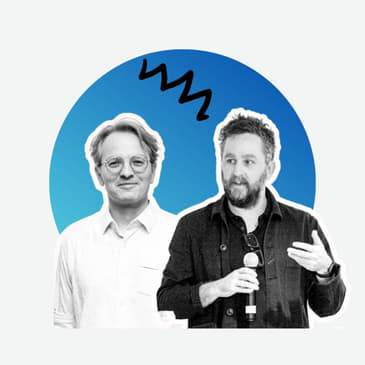
In collaboration with Month of Modern, Daniel Koehler and Clay Odom, professors from the University of Texas join host Adam Wagoner on the show to discuss the transformative impact of AI on architecture. Recorded live in downtown Boulder, this event featured a panel discussion with an audience of architects and enthusiasts to explore how AI is redefining the traditional architecture industry through innovative technologies and new design possibilities. Daniel and Clay recently collaborated on a major exhibition that explores the impact of artificial intelligence on architectural design. The conversation centers around the integration of AI in architectural education, the democratization of design tools, and the implications of AI on construction processes.
This episode is sponsored by Modern in Denver Magazine
Listen & Subscribe on Apple Podcasts | Spotify | Amazon Music | Pandora or wherever you get podcasts!
Check out Adam's firm, High Low Buffalo!
This podcast is powered by The Plug Podcast Agency
See Privacy Policy at https://art19.com/privacy and California Privacy Notice at https://art19.com/privacy#do-not-sell-my-info.
[00:00:01] AI has kind of hit us all of a sudden head-on. Didn't really quite see it coming. It's just changing so fast. And it's gonna... Architects aren't really fast, I think you mentioned that.
[00:00:14] An architect or a designer in collaboration with AI to expand the architectural imagination.
[00:00:20] So all that creativity is not in a data set, making things up. That's what we do all day.
[00:00:28] So it means like, AI elevates, you also elevate.
[00:00:37] Hi! Hello! Hello! Hello! Hello! Hello! Hello and welcome to Architecting.
[00:00:42] Hello! Welcome to Architecting. There you go.
[00:00:45] I'm Rebecca Wagner here with the host Adam Wagner. Hey Adam, who's on the podcast today?
[00:00:52] So today is... I just say it's a special one every time. Every time.
[00:00:58] Every time. But I'm still on a break. But this is a special one. It's in collaboration with Month of Modern. Or I was invited to do this event with Month of Modern. Which is just a great, great events they do up there in Boulder.
[00:01:18] Yeah, tell... For those who might not know, what is Month of Modern?
[00:01:21] Month of Modern was started by Harvey Hines and his architecture firm.
[00:01:28] And it's been going on for a while. And now it's a full nonprofit.
[00:01:33] And so they host different events and different things for all of October in Boulder.
[00:01:43] And so this is the second year that I've done something with them.
[00:01:46] But this event, they called it Cocktails and Conversations, Architecture After AI.
[00:01:52] So it was at a live event in downtown Boulder where they had a mixologist come and mix up some cocktails.
[00:02:03] And then we had Daniel Kohler and Clay Odom, two professors from the University of Texas, come and have a panel discussion about AI and architecture.
[00:02:17] Nice.
[00:02:18] Yeah, so they just put together this big exhibition.
[00:02:22] So we had a bunch of TVs there and it was cycling through all these images that were put together by a number of architects.
[00:02:31] And then we talked about it and talked about the future and...
[00:02:36] And what did you drink?
[00:02:37] AI.
[00:02:38] Some good cocktails.
[00:02:39] Nice, okay.
[00:02:40] Yeah.
[00:02:41] This was a little bit ago, but it was a good event.
[00:02:44] I say it's a little bit ago because we've had a lot between now and then.
[00:02:48] Yeah, it's been busy.
[00:02:50] So we have some cool episodes coming up.
[00:02:53] The next episode after this is another special one with Thomas Pfeiffer, who was doing a lecture at the University of Colorado.
[00:03:04] And I was able to get him to come join my grad studio that I'm teaching right now at CU and have a fun discussion with him.
[00:03:16] So that will be coming out next.
[00:03:18] And then we just got back this last week from...
[00:03:22] The AIA Colorado Practice and Design Conference.
[00:03:27] Yes.
[00:03:27] In Keystone.
[00:03:28] In Keystone, Colorado.
[00:03:30] So during that, I interviewed all four of the keynote speakers and then I was on a panel.
[00:03:37] Mr. Popular.
[00:03:39] And so all of those we made into video podcasts.
[00:03:44] And so there'll be some really cool ones.
[00:03:46] Julie Snow, Marlon Blackwell, and a lot of other great ones.
[00:03:51] So cool stuff coming up.
[00:03:54] Yes.
[00:03:54] Stay tuned.
[00:03:55] Enjoy.
[00:03:57] Our emcee today is Adam Wagner, right here.
[00:04:02] Adam is a super cool guy.
[00:04:07] And yeah, not too bright because he actually interviewed me for an hour and didn't quit.
[00:04:18] So yeah, he asked one question.
[00:04:20] I talked for an hour.
[00:04:21] So you're going to want me to leave real soon.
[00:04:25] But no, he has this podcast about architecture, which is just beyond cool and wonderful for the profession.
[00:04:35] And he's been rightfully honored as architect of the year by the AIA just a couple of weeks ago.
[00:04:43] Well deserved.
[00:04:45] I think the point that I'm trying to make here, month of modern podcasts, it's all about building a community.
[00:04:52] We're not here just to design buildings or furniture or spaces.
[00:04:57] We're here on Earth to do something important.
[00:05:01] And nothing's more important than building communities.
[00:05:04] Thank you.
[00:05:11] Yeah, thanks, Harvey.
[00:05:12] A really good point of the community.
[00:05:15] And I just want to say, again, thank you to you and Stephanie and everybody, that whole team.
[00:05:21] For what?
[00:05:22] There we go.
[00:05:23] I've never used a mic before.
[00:05:24] For what you guys have created.
[00:05:27] And just, you know, a lot of work has gone into this and into this event and these events.
[00:05:33] And so thanks for creating such a good thing here.
[00:05:39] Yeah, I'm happy this is a, we get to do this event.
[00:05:43] And this is a fun, it will be like a fun loose sort of thing.
[00:05:48] So you'll be drinking.
[00:05:49] You all have microphones on the table.
[00:05:52] So we want to just really get your input here and talk and feel free to get up and go get more food.
[00:06:01] And I've been told to remind you that when you speak into the microphone, get a nice thing close to your mouth and talk into it.
[00:06:08] Full disclosure, this will be made into a podcast episode.
[00:06:11] So your thoughts will be live in perpetuity or at least however long it stays up on the internet.
[00:06:19] But today, yeah, I'm excited.
[00:06:21] We have two gentlemen here from the University of Texas.
[00:06:24] So we have Daniel Kohler, who is the assistant professor and Clay Odom, associate professor.
[00:06:32] Both are AI experts in the long history of the AI movement within architecture.
[00:06:41] And I've put together this exhibition behind us.
[00:06:44] So what we're going to do is they're going to give a brief sort of overview and introduction of their work.
[00:06:50] We're going to start a little bit of a dialogue here and then quickly move into sort of question and answer, Q&A, but more of just creating this conversation.
[00:07:00] So feel free to butt in.
[00:07:03] Yeah.
[00:07:04] So thank you guys for coming up here.
[00:07:06] Thank you, Stephanie, for organizing this all, for inviting us.
[00:07:14] It sounded at first like a crazy idea.
[00:07:17] Like her email came out of nowhere saying, hey, I saw your exhibition, which you had in Holston.
[00:07:24] And can we bring it here to Boulder?
[00:07:27] And we're like, okay, like, why not?
[00:07:31] And now we're here.
[00:07:32] And yeah, thanks.
[00:07:34] Thanks for organizing this.
[00:07:35] So I make it very quickly so that we can have like a conversation.
[00:07:41] So I'm actually like just finishing up this very published soon, like a book on actually the implications of artificial intelligence or especially generative AI.
[00:07:54] My point is that generative AI is very different from any kind of form of digital or kind of computer imagination from computer what you heard before.
[00:08:03] And this book I'm telling is for most of representation to actually how we act or what implications it has for the cities.
[00:08:11] There are kind of three kind of how it impacts how we think as architects of buildings.
[00:08:16] First, if they do something with us, how we actually design, we design differently with AI.
[00:08:23] Second, that what the AI actually generates is micro-assisted images is much different forms of buildings than you used to.
[00:08:32] Like it's obviously much more opportunities.
[00:08:35] And third also, it means it opens new possibilities how you operate actually at larger scales, what you can actually do as an architect.
[00:08:44] So just very shortly.
[00:08:47] So what means like different how you model different models?
[00:08:50] You can now today like, you know, when you once like prompted an image or work with GPT, you see how instantly you get the actual result.
[00:09:00] It means for architecture means like this like now work, which I do with students actually.
[00:09:05] You work with very simple materials directly begin to augment like full reality.
[00:09:12] Now we speak about visualizations, but think a bit further, combine it with mixed reality devices.
[00:09:19] Begin to augment now regulations, everything into space.
[00:09:23] It means you will not sit on a laptop anyhow later or in very soon, very close future.
[00:09:28] I'm talking about a few years just.
[00:09:30] But actually you will work with models in real time scale, which are very interactive with you,
[00:09:38] so with augment all the kind of whatever you can think of regulations, material behaviors, simulating like real physics and so on in real time.
[00:09:49] This.
[00:09:49] So how you would then design?
[00:09:52] What those models can do?
[00:09:54] I mean, you see it in the in this one is the speculative world of like how full resolution.
[00:10:00] I mean, how many drawings you saw before that have trees in it?
[00:10:06] Which architects would design with trees?
[00:10:10] You wouldn't because it's so damn difficult to draw actually trees.
[00:10:14] So we were never actually taking trees into the buildings, never designed really with nature.
[00:10:20] So I'm super excited about that.
[00:10:23] But new kind of architecture integrates with nature.
[00:10:27] You get them basically for free if you begin more to listening actually those outputs.
[00:10:32] There's a number point.
[00:10:35] So I took this image loaded up to to a chip it T or some chip it T for model and ask, OK, what do you find the image?
[00:10:44] What what it tells you?
[00:10:45] It was generating for me the interiors of that building.
[00:10:49] It generated for me like the valuable artifacts of this building.
[00:10:52] It put out all the stakeholders from the owner, client, not the people who live, who the people who like fired upon anyone who's like involved in this building.
[00:11:02] So those models, not large language models, the scale and the data of what they work means they know or like they know context which you ever have dreamed maybe before to get actually as an architect your hands on.
[00:11:16] So kind of the detail and richness of information, but also the depth of that.
[00:11:21] So what we can actually design when we get to this point we need to handle.
[00:11:26] That means also that we get context too, which we like to blend out.
[00:11:30] It's very easy to stumble upon like very weird, bizarre, extreme precarities, poverty and so on in those images.
[00:11:40] So what I did is actually mapping or you see this map mapping out or generating around like 1 million images.
[00:11:49] We are analyzing now how those models like really represent this mapping, but also now begin to use this images, for example, assessing like qualities in this images which you have access to.
[00:12:02] For example, carbon emissions.
[00:12:04] What is with embodied carbon emissions, but not like for one building, but you do this for the entire planet.
[00:12:11] So we have a kind of access to those, not to information which like we need very urgently actually.
[00:12:20] And those models give this.
[00:12:22] What is like how it applies to reality?
[00:12:25] I think we can enter in convenient ways practice.
[00:12:29] So here, for example, that's some slides from the startup, which we now do is like you upload an image.
[00:12:35] Which it extracts from this the mode of construction.
[00:12:38] So it knows a kind of like x-ray from that building or like the existing just an image.
[00:12:43] From there, I can generate images, but know it actually the cost estimation.
[00:12:48] I can very precisely like actually now train models that know exactly what kind of parts I would touch, which like how much time like some building parts keep.
[00:12:59] And so like things you even put like in detail, like that I can talk like not think about.
[00:13:04] And then you put this in the app and anyone can from their sofa directly like communicate with that.
[00:13:10] Generate by themselves, complete democratization of design and all so on and what so on.
[00:13:15] Great. Thank you.
[00:13:17] I will be slightly less intense than Daniel in terms of my opening remarks.
[00:13:24] But I think the great thing about working in this format with my colleagues, Daniel and Corey Beak, is that each one of us kind of brings a different perspective and methodology to the technology.
[00:13:39] We all are interested, I think, broadly in the implications of technology writ large and have been for a long time on the practice, the theory, the pedagogy and the ultimate built outcomes of architecture, architectural thinking in the real world.
[00:13:59] And I think what Daniel is alluding to in his opening is that when we started this two years ago, it was purely two dimensional world that we were generating in this generative AI text to image kind of language.
[00:14:14] Even before that, in the world of GANs generative adversarial networks that preceded, it was similar. It was very two dimensional. It was about style and it was about a certain kind of seductive imagination.
[00:14:29] Where we are now, two years later, is that we're moving into three dimensional territory, physical outcomes, analysis, and all of the implications that that has on the profession of architecture, the teaching of architecture, and the thinking of architecture.
[00:14:47] And actually, even more interestingly, how architecture can be disseminated and engaged by non-architects, the public.
[00:14:56] And I think that really is a powerful, powerful aspect of this.
[00:15:00] And I think there are some definite implications and some massive kind of issues that we will probably come up in the conversation.
[00:15:12] It is a little bit scary from time to time.
[00:15:14] But I think if we start to think about how tools have always affected the way we see and the way we practice and the way we think, the invention of perspective was one of these seminal moments in the history of architectural thinking and output that changed how we make what we do.
[00:15:32] Right?
[00:15:33] It changed the built environment.
[00:15:34] It changed the built environment.
[00:15:35] This is like that times 100, maybe plus the invention of the wheel and maybe fire at the same time.
[00:15:42] I don't think I'm being hyperbolic, maybe slightly, but not too much.
[00:15:47] It is that impactful.
[00:15:49] It is that powerful.
[00:15:50] It's that fraught like any technology.
[00:15:53] And I think if you're going to have people testing this new capacity for extension of human thought, creativity, community, even the fact that we're all here talking about this today is one example of that.
[00:16:08] We've created this sort of digital campfire that we're all gathering around and we're going to tell stories about the future.
[00:16:14] And I think that's a really fascinating part of this.
[00:16:17] I myself am personally way more interested in the three-dimensionality of all this, how we make out of this.
[00:16:24] Also, how does it affect our imagination?
[00:16:27] How does it affect how we start to consider tectonics, materiality, spatial capacity, the interaction between space, contexts, and human beings?
[00:16:36] I think if we can kind of center that within the sort of cophony of possibility, both good and bad, that we can kind of like find a way through.
[00:16:45] And I think having architects and designers engage with this rather than waiting for something to happen and for other people to figure it out is absolutely critical.
[00:16:54] And we all have to be engaged in it in whatever way that you feel comfortable.
[00:16:59] But it's happening.
[00:17:00] It's here.
[00:17:00] We're actually maybe even five or six years behind where even the construction industry and some larger sort of multinational kind of architectural operations are.
[00:17:10] And so here we are.
[00:17:12] And I'm looking forward to the conversation.
[00:17:14] I think it's a really, really exciting time.
[00:17:16] It's a little bit scary, but it's also super exciting.
[00:17:19] And so thanks for having us.
[00:17:20] And thanks to Stephanie, Leah, and everybody that made this happen.
[00:17:25] Really happy to be in Boulder.
[00:17:31] I felt really short there.
[00:17:33] I don't like that feeling.
[00:17:35] Yeah.
[00:17:35] You know, we met a few times before this to kind of talk over this event.
[00:17:39] And I think these guys have done enough of these talks where Daniel especially was kind of saying, you know, this can easily go down a sort of dystopian route.
[00:17:48] Right.
[00:17:48] Like the speed at which this is moving.
[00:17:52] We all understand the speed of how fast this is going.
[00:17:55] And even just learning new things right now about the sort of analysis part of the possibilities here.
[00:18:05] And the idea that this kind of computerized like rendering to analysis thing can be as impactful as the wheel.
[00:18:15] You know, it's kind of like, well, in what ways?
[00:18:18] So I think like, how do you see AI, since we're kind of grouped here together, impacting the role of the architect?
[00:18:27] Do you see it as a sort of bifurcating moment where the profession gets even more sort of splintered?
[00:18:33] Or does it sort of solidify the role back to the kind of master builder?
[00:18:40] Or does it even matter anymore?
[00:18:42] Oh, I think it matters.
[00:18:43] I think actually architectural education as one of maybe the last kind of like true liberal arts kind of educations, the broad based way that we teach and learn the profession of architecture, the discipline of architecture, and all the associated parts of that, I think, become even more important to find our way through.
[00:19:04] I think it gets maybe rid, it's not rid, but it like recalibrates in some ways, our relationship to some of the other aspects of architectural, certainly the profession, but I think also the discipline as well.
[00:19:16] And I'll separate those a little bit because the discipline is maybe slightly larger than the profession in some ways.
[00:19:22] But I think design really matters more now than ever.
[00:19:26] We were having a conversation before about when it's so fluid and frictionless to generate images so quickly.
[00:19:33] And some of them, if you look closely, there's still strangeness in all of them.
[00:19:38] There's a little bit of uncanny weirdness.
[00:19:40] But to navigate through that in the ability to discern what's good, what's not, comes from training.
[00:19:47] There is expertise underlying all this stuff.
[00:19:49] As fluid as it seems, as easy as it might appear, there's training.
[00:19:54] There's technical training, certainly, that's always been at the core of architectural education and practice.
[00:20:00] But there's aesthetic understanding.
[00:20:03] There's historical contextualization.
[00:20:05] There is understanding broader relationships and ecologies of interactions.
[00:20:10] And so for me, that's kind of the core of it is still going to be there and maybe amplified and amped up.
[00:20:18] So in the last generations already, let's say 50, 60, very long already, architecture lost ground and ground and ground.
[00:20:29] Got more and more splintered, more specified.
[00:20:31] So now you're already happy that for an architectural competition, you can make a facade pattern.
[00:20:37] You're not doing a bit.
[00:20:38] Not any architect does anymore buildings.
[00:20:40] One reason of that is that we don't have expertise or knowledge how to deal actually with data.
[00:20:48] We cannot objectively really talk about spatial quality.
[00:20:53] We don't know how people are just feeling well in spaces.
[00:20:58] We cannot.
[00:20:59] Very simple things we can't actually argue.
[00:21:01] I think that now with AI or the kind of democratization, these kind of access come back.
[00:21:10] Or like because it's like also data-driven, you have a very easy access first to working with data.
[00:21:16] So architects can actually their expertise in design thinking, what our strengths are.
[00:21:22] I mean, actually architecture is one of the last disciplines.
[00:21:25] There you get trained or minimum scores.
[00:21:28] There you get trained to think about very complex, wicked problems.
[00:21:33] Like a building, like taking thousands of things and putting it in one thing together.
[00:21:39] Like no one is actually doing this or learning this.
[00:21:42] So those skills gets highly important now.
[00:21:46] Then it's like also about, I mean, I can't get out any kind of information from those models.
[00:21:53] But how?
[00:21:55] So like the kind of knowing, I mean, how you design with this kind of ambiguity or like how you simply make a model up with hand,
[00:22:04] how you sketch and quickly know like, hey, there's this deadline.
[00:22:07] I need to come up with something.
[00:22:10] That gets very crucial actually.
[00:22:13] Well, no, you need to map this.
[00:22:15] And then like just, yeah, how you've worked in actually navigating those models.
[00:22:20] Combined with this, I think it gives us actually a lot of access to new kind of disciplines also.
[00:22:27] Like actually becoming like really much more interdisciplinary.
[00:22:31] But how does that, yeah, the idea that we're able to collect the data in a more meaningful way
[00:22:37] and then reinterpret it into something else?
[00:22:41] Like I guess there's, to me, there's sort of two paths within AI here of sort of like generative image based sort of thing.
[00:22:51] And then there's a sort of data like you were talking about sort of with, yeah, right.
[00:23:00] And so are you saying that the collection of data is, I guess, in what ways is it really furthering the role of the architect?
[00:23:10] The images are nice for us as architects.
[00:23:12] Right.
[00:23:13] Because they're this kind of aesthetic surface.
[00:23:16] So then I'm like, I'm designing like I'm, when I'm prompt or like get this out,
[00:23:21] I instantly understand how fundamentally different this is from previous forms of designing.
[00:23:27] But for model, it doesn't matter if it's an image of a text of a molecule, whatever.
[00:23:34] Like it's just the different forms of vectors.
[00:23:37] It's just like a matrix of numbers and that's it.
[00:23:41] Then you also, when you download a model and you open it, it's basically just a matrix of numbers.
[00:23:47] So just numbers, nothing more.
[00:23:48] There's no magic into this.
[00:23:50] Just okay, 175 billion numbers.
[00:23:59] So when you know, when you learn that actually it's not about the image, not about the 3D,
[00:24:05] but also as an architect, you know that when you do some construction work or like on a construction site,
[00:24:12] it's so messy.
[00:24:14] And there's so many different forms of data or objects, modes, how, you know,
[00:24:18] like every different craft is like going on a construction site.
[00:24:22] You need to talk differently to those people.
[00:24:25] So I think there's already like a skill set in architecture to negotiate or bring from very different fields,
[00:24:33] perspective, data actually together.
[00:24:35] We need just also to talk to computer scientists saying,
[00:24:39] hey, look, I need only not only image, not only 3D.
[00:24:43] I need actually this kind of data.
[00:24:46] And this is what large companies are doing.
[00:24:48] Like they're actually looking, for example, to data sets of bridges.
[00:24:55] Just with the vibration of bridges, you can then figure out the lifetime when you should repair not only bridges,
[00:25:03] but anything from concrete.
[00:25:05] Then apply this back on the city.
[00:25:07] This is not amazing.
[00:25:08] You'd know now the whole building stock went to repair and to exchange things.
[00:25:13] So it never just needs, and it needs intelligence, design thinking, to actually to put this to play.
[00:25:21] Yeah.
[00:25:24] All right.
[00:25:25] Well, we have a lot of different professionals out here.
[00:25:28] Any, how the cocktail is hitting, are they hitting good yet?
[00:25:31] Let's get them, let's get some questions going.
[00:25:34] Any thoughts from this?
[00:25:35] Yeah.
[00:25:37] Linnea.
[00:25:37] Hey, hi.
[00:25:39] Sorry.
[00:25:40] I had a couple questions.
[00:25:42] So one is the idea that AI is an architecture of inclusivity versus exclusivity in different manners.
[00:25:50] And I just would like to hear what you have to say about those two kind of differing ideas about that.
[00:25:56] I think they actually embody, AI embodies both of those in different ways.
[00:26:02] The other question I had is about how you think the general architectural field will embrace quickly this idea of AI.
[00:26:14] Will it be through its efficiency and effectiveness?
[00:26:18] Or will it be through its creativity and kind of expansion on kind of idea making?
[00:26:26] I mean, I think that's a fascinating question.
[00:26:28] And that seemed, if I was to game out what the first question would be, that probably would have been it.
[00:26:33] I think it does link up a little bit with what Daniel and Adam were just talking about, which is like, which data?
[00:26:42] What kind of data set?
[00:26:43] Which data is important at the time?
[00:26:45] And that leads to sort of questions of like, you know, when we first started this again, when you generated certain kinds of through prompts.
[00:26:53] Granted, this text to image will privilege that right now as the example.
[00:26:57] But there was so much, you know, very clear bias in the outcomes.
[00:27:03] Because the data sets that were being trained on were selected by humans to do, and they had the inherent bias of the people that selected it.
[00:27:12] And so that's gotten better because more people have gotten involved.
[00:27:16] And those data sets have been expanded, and the problems have been out, you know, the issues were designed for.
[00:27:23] And so I see it as a design, that's a design question.
[00:27:26] And to me, the more people that are involved, the more players there are, the more people there are engaged in developing and, you know, basically helping to train these models, the better it gets.
[00:27:40] And so I think within the last two years, that difference has shifted drastically.
[00:27:44] We were having a conversation about this, Daniel and I, at the airport earlier.
[00:27:48] And our friend Andrew Kudlis had talked about this in the first symposium about bias.
[00:27:55] But I think you could split that off in terms of like, okay, what's important to us?
[00:28:00] Okay, after that question, then what other things are we interested in?
[00:28:03] And then what's our role in developing the tools or in helping to develop the tools?
[00:28:09] Could we, you know, Daniel and I kind of represent two sides of the, not two different sides, but two, maybe two edges of the spectrum of kinds of users.
[00:28:18] And Daniel is way more technically knowledgeable.
[00:28:22] He's way closer to computer science with architectural kind of like underpinnings.
[00:28:26] And I'm way on the other side of that.
[00:28:29] I have way far less technical, deep technical knowledge, but I'm still deeply embedded in developing these tools and engaging them and developing my own approach to it.
[00:28:41] And I think that's all part of it.
[00:28:43] Now, in terms of how, you know, firms, like which side of the spectrum does it fall on?
[00:28:50] I mean, I think there's a reason that text-to-image was so seductive and so easily picked up by architects and designers writ large early on.
[00:29:00] Because it hit us right in the sort of like solar plexus of what we dig, right?
[00:29:05] Which is imagery and really interesting things and dichotomies and heterogeneity and all of these kind of like things that the early models and now today even more so allowed to sort of come to the surface.
[00:29:18] Daniel mentioned trees on buildings.
[00:29:21] I mean, the sort of ubiquity of nature fused with architecture was everything when it first started.
[00:29:27] And it still is, but it's just gotten more refined.
[00:29:30] And so I think the idea of selection, our role in that in whatever way that we feel comfortable with, is actually the way that it drives forward and how we keep the human monsters.
[00:29:41] But I'm trying to buy the humans, right?
[00:29:45] I don't know if that totally answers, but I'm trying to.
[00:29:48] Maybe to a second follow-up question, like how you think like AI, how would you think AI would enter more architectural practice?
[00:29:57] So like this, I mean, architects are very stubborn sometimes.
[00:30:04] Also the whole field, I mean, it's highly complex.
[00:30:09] Everyone works in different ways.
[00:30:11] Like every contractor has their own habits and so on.
[00:30:13] So like any technology before, which was about to automate things or like things like I can repeat things quickly, like a Word document, whatever, Excel sheets.
[00:30:26] That couldn't be applied to the building sector.
[00:30:31] We were actually, we were not really affected by automation or digital technologies.
[00:30:36] We draw on Autocad or Revit, but it's like, it's still like a very analog thinking process where you're modeling on a screen, but still you're modeling.
[00:30:46] It's still like a very analog process in the way of, like in the design process, not much changed.
[00:30:55] Generative AI is very different.
[00:30:58] Generative AI is messy, much more human.
[00:31:02] It makes things up, hallucinates like humans.
[00:31:05] It's very similar to how you would design actually.
[00:31:09] It's lying all the time, like whatever.
[00:31:12] Like so it's very similar to that.
[00:31:16] So for that, I think also it can much more adapt.
[00:31:21] One quality of this is actually that you can or like, it's basically like a translation machine.
[00:31:26] You can very quickly between messy stuff translate.
[00:31:31] For that reason, like it's maybe the first technology which really will come or like there will be, there will be something which can be very applicable for something like to a huge range of contractors at launch.
[00:31:46] I just have the fear of what I think.
[00:31:49] It won't be architects who then speak or like not the classical.
[00:31:55] It won't come from sites.
[00:31:57] When you look for something to newspapers, it's not so that Facebook or TikTok have on the page of New York Times a window or like a column.
[00:32:10] New York Times has an account and TikTok.
[00:32:13] You get more, you know, like you will get more embedded into something else.
[00:32:17] It's always how those, not big tech and so on, how those work.
[00:32:23] So, but it means also it needs very early on or it needs like a conscious discussion, even like what it could be even be.
[00:32:34] Like what would be, what would be qualities what you would see.
[00:32:37] But there's for sure something coming.
[00:32:40] That's an interesting idea of sort of how do we act quick enough to, to not be swallowed up or again, kind of like I was talking about before of like, or do we just all kind of splinter and morph into something else.
[00:32:53] I'm curious.
[00:32:54] I'm curious right now, what sort of examples of AI assisted architecture are being built or like how that, how that first will enter the physical world?
[00:33:07] Or is it just more about the design process?
[00:33:10] You know, it's creating its own sort of architectural style in a way, I think, but from a digital perspective.
[00:33:16] And how do you see that entering into the physical world first if it hasn't already?
[00:33:22] Well, I mean, there are definitely large development driven kinds of, well, this is called development driven kinds of practices that, that are already using AI for things like planning.
[00:33:37] You know, that's the most direct way.
[00:33:40] And in terms of just like automating certain kinds of tasks that are a bit more just rote in a way.
[00:33:47] And I love drawings and plans and, but I think that's the, that's been the easiest way in.
[00:33:52] And there are developments that have happened that way already.
[00:33:55] And that's kind of the, maybe the side of the previous question is like, which, which direction does it go?
[00:34:02] And you all, I mean, you see this in every technology.
[00:34:04] It gets used immediately for, you know, I'm going to maximize profits.
[00:34:09] I'm going to do these things.
[00:34:10] And architects are notoriously kind of, at least the best ones in my opinion are notoriously kind of bad at that, you know?
[00:34:17] And maybe it's because the priorities are slightly different.
[00:34:20] But maybe if you look at the positive part of that, that maybe this would allow the other kinds of firms, let's say the design oriented kinds of firms to find certain kinds of efficiencies, certain kinds of things that would allow them to do more.
[00:34:36] That's what I'm interested in personally is this, the expansion of capacity to make better things.
[00:34:41] That's it at the end of the day.
[00:34:43] If it's AI, I think it is.
[00:34:45] But if it's something else, I'll try that too.
[00:34:48] Because at the end of the day, we need a better built environment.
[00:34:50] We need a more interesting built environment.
[00:34:52] We need a more humane built environment.
[00:34:54] We need an environment that's built that understands labor and understands capital and all these things too.
[00:35:00] And so for me, that's the end game.
[00:35:02] And we're in a really interesting time where that's being developed.
[00:35:05] And that's, again, why we have to be involved.
[00:35:08] But I think there's definitely a dystopian black mirror kind of version of this in terms of like corporate co-optation and use of this to sort of get rid of certain kinds of tasks.
[00:35:20] And you see that with the chat GBT, you know, I mean, the embedding of all these things in email and all that stuff.
[00:35:25] I mean, it's already there in terms of like, you know, making those kind of tasks easier.
[00:35:31] If General Tavari brings really something new on the table, it brings also something new on the table how we actually design or build building.
[00:35:38] There are really now a handful, maybe 10 kind of startups that are already running web-based or as an app where you upload an image from your living room.
[00:35:50] So it generates from that renovated version and then you click on the furniture and you buy it, what it gets like generated into that.
[00:35:59] The same you do with whatever material and so on.
[00:36:03] So this is now two years after, like we got the resolution that you can generate an image that looks like 3D or that that looks like you could understand that this is a building.
[00:36:15] Now project this two years further.
[00:36:18] It's not anymore in interior.
[00:36:20] We have models already that, I don't know, maybe you know, saw this from OpenAI, the Zora model, the video model that renders like continuous kind of scenes, video scenes up to one minute.
[00:36:35] They look spectacular.
[00:36:37] Like think of this like you would design in that way.
[00:36:41] And then you can click on everything and order directly.
[00:36:44] Or you tell a robot, this brick is there, this brick is there, this brick.
[00:36:50] You know, like it's very easy to map this into our form of data format, send this to our kind of machine and so on.
[00:37:00] Yeah.
[00:37:01] Yeah.
[00:37:06] Yeah, Harvey.
[00:37:08] Yeah.
[00:37:09] AI has kind of hit us just all of a sudden head on.
[00:37:14] Didn't really quite see it coming.
[00:37:16] But we have a client who made a fortune software company.
[00:37:24] He's a programmer.
[00:37:26] And he's so far ahead of us in our design.
[00:37:29] So he shows us these finished buildings that we haven't even started to think about yet.
[00:37:35] And he's got them all drawn out and everything.
[00:37:39] And I was talking to him.
[00:37:40] It was like, I got to change my mindset or my employees need to change their mindset to be programmers.
[00:37:46] Because if you don't know the right questions to ask, if you don't know the right commands to make, you can't do it.
[00:37:53] And that might change very quickly.
[00:37:55] Obviously, I'm remembering because I'm old.
[00:37:58] When computers happened, you had to know Fortran to get computers to work.
[00:38:03] And then Mac came out with a simple system where it was more intuitive.
[00:38:10] But from my point of view, the AI is still kind of like Fortran.
[00:38:15] It's programming, something that I'm not familiar with.
[00:38:18] Maybe it'll change soon, but we're not there yet.
[00:38:22] But my clients are.
[00:38:23] I was talking to a big developer, and he's saying that they're doing all their pricing designed through AI.
[00:38:30] They're not using contractors anymore for their pricing.
[00:38:33] And instead of waiting three weeks, three months for pricing, they can get it in minutes.
[00:38:39] And it's just changing so fast.
[00:38:42] And architects aren't really fast.
[00:38:45] I think you mentioned that.
[00:38:46] We've got to catch up quickly.
[00:38:50] Well, it's interesting because I think, I mean, architects, because we are trained to be quite generalist in terms of like the world.
[00:38:58] Like everything can be part of our project.
[00:39:01] That's why architects were so quick to jump into generative AI.
[00:39:05] It wasn't meant for architects.
[00:39:06] It was just meant as an exploration of how an artificial intelligence might work.
[00:39:11] But we were quick to jump into it because, like I said, it made things that we were understood and we were trained to kind of get.
[00:39:18] And then we could use our training to push it further.
[00:39:21] I think that's fascinating.
[00:39:22] I mean, it is though, like, I mean, you mentioned it and Daniel mentioned it too, the interface between it and the physical world.
[00:39:28] I mean, there are robots being trained now to interact with the world to learn in a very different way.
[00:39:35] And that kind of physical sensorium that we're all trained to kind of interact with the physical world that we live in is now helping to train AI systems.
[00:39:45] And so our interface with it is very fraught, I think, but it's still super exciting.
[00:39:52] I think, again, putting the friction in the system of like making things, I think, is the current thing that we're doing to try to like press back on it a little bit.
[00:40:01] Like, I want to make this thing 3D.
[00:40:02] Oh, that's really great.
[00:40:03] It's just 2D.
[00:40:04] How do I get to the 3D?
[00:40:06] That's been the more recent kind of like turn that pushes it forward.
[00:40:11] But it's the addition of friction.
[00:40:12] So once we get to that, what's the next piece of friction that will let us kind of like slow it down so that we can understand it?
[00:40:17] Yeah, I don't know.
[00:40:19] But I think there's so much there.
[00:40:20] And I still think the training matters.
[00:40:22] I think what we know inherently matters.
[00:40:24] I think all of that, the basic of composition, the basics of materiality, I think it matters.
[00:40:30] AI does think different.
[00:40:31] It is.
[00:40:32] It is more human than other forms of technology.
[00:40:36] I agree with Daniel there for sure.
[00:40:38] But our interaction with it is important.
[00:40:41] Yeah.
[00:40:42] Scott?
[00:40:43] A critique that I heard about AI a few years ago was, AI is writing poetry while I'm the trash collector.
[00:40:50] And I want my AI and my robots to do the opposite.
[00:40:54] I'd like to write the poetry while it collects the trash.
[00:40:56] I feel a little bit like this is a parallel in the architecture world, that it's generating the fun part of architecture is the conceptual design,
[00:41:05] the envisioning, the creativity, the creating something new.
[00:41:07] And when I look at these amazing images, I see AI doing it, frankly, better than I can.
[00:41:14] And the second part of that is then my job becomes, how the hell do I build that if that's what the client actually wants?
[00:41:21] And so many of these images are untethered from the reality of practicality of building, whether it's plants entwining itself into architecture.
[00:41:31] We know the water destroys buildings faster than anything else.
[00:41:34] Or skyhooks, you know, parts of buildings that are just hanging out over space.
[00:41:39] And how do you get mechanical systems riding through them?
[00:41:42] How do you make it meet code and ADA and everything else?
[00:41:44] And I do wonder if architects are going to get relegated into this position of being servants to the creative AI,
[00:41:52] where our job just becomes the how the heck do we actually make that stand up?
[00:41:59] No.
[00:41:59] Well, look, in AI is like we're trained like on any kind of data.
[00:42:09] So computer scientists give in a way or like how you actually progress in this learning is that you try in a way to represent with that what you have learned reality or that what exists as close as possible.
[00:42:23] So all that creativity is not in a data set and no one else than the architect who prompted those images were actually coming up with this idea.
[00:42:34] This is not AI, AI generated.
[00:42:37] It's not like you push on a button.
[00:42:39] Like someone very intentionally wanted to have trees or wanted to have it from recycled materials, a building with pottery on it, whatever, making things up.
[00:42:50] This is what we do all day.
[00:42:52] So it means like AI elevates, you also elevate.
[00:42:56] Any kind of form of automation, like they were already in the medieval times, were already like riots against like first kind of machines.
[00:43:07] Water mills were burned because of automation and the fear that job loss.
[00:43:13] Did anything, did anyone like works less?
[00:43:17] Like with all that kind of automation which you already went through that you sit now on the computer, not with a pencil work and blah, blah, blah.
[00:43:23] No.
[00:43:24] And here's the same.
[00:43:25] Like it adds, it will not automate or it will not like take over your job.
[00:43:31] It will complement your job.
[00:43:32] And this will add detail.
[00:43:35] And now when I'm working with my students now, okay, boom, you get this image.
[00:43:39] And now you enter exactly like doing the studio.
[00:43:42] It's not anymore that we talk about how the space is arranged and how the building looks like and if it's a bit more left and right.
[00:43:50] No, we talk about not even in our life cycle.
[00:43:53] We talk how a building ages.
[00:43:55] How building actually gets old.
[00:43:57] What you do when something decays in the building.
[00:44:00] When do you move out?
[00:44:02] When you do move from somewhere else?
[00:44:03] When do you begin to plant another part of a building?
[00:44:06] Such discussion I have now with students.
[00:44:09] A completely different realm and very beautifully like we, you know, so many topics.
[00:44:15] We could never really grasp when we, or especially in schools, like when you just have this few months.
[00:44:22] You cannot really scratch the surface, but actually the complexity is like you told us before in the intro, like the best thing is community building.
[00:44:31] Now all that what belongs together.
[00:44:33] And I think we have now a bit more of that access to what we can add in like how we make actually a building.
[00:44:41] I mean, I would say like to that, because I think it's a really important point and interesting point to make.
[00:44:47] I think for me, and maybe an analogy would be that I think it is an easy leap to say that, you know, AI is going to become sentient and then it's going to take over the world.
[00:44:59] That's the sort of, you know, the dystopian hellscape version.
[00:45:03] I think at the moment we're more like, it's process of interaction is way more training a dog or something like that, right?
[00:45:11] Like where you're interacting with it directly and you're getting it to do things that you want.
[00:45:15] I mean, I think it's important, Daniel made the point, but it is, we can't say it enough that these images are directed in collaboration with AI.
[00:45:23] That's actually really the way that they should be described, an architect or a designer in collaboration with AI to expand the architectural imagination.
[00:45:33] I think that's a better way to understand it at the moment.
[00:45:36] I think certainly it is scary and frightening to think about like, you know, sentient robots and things like this.
[00:45:43] But I do think right now for sure it is an extension of human capacity made by humans.
[00:45:49] It didn't come from outer space.
[00:45:50] We made it.
[00:45:51] So it already is an extension of humanity from the get go.
[00:45:56] And so for better and for worse, and with all the fraught and amazing capacity that we hold as a species.
[00:46:04] And so I think the one other thing that I've been wanting to say that I think in terms of the imagination,
[00:46:10] it allows us to access new or expanded ways of seeing the world writ large.
[00:46:17] Daniel and I both have shared a fascination with trees and forests.
[00:46:19] And this kind of like, you know, the world would web and all of these kind of things.
[00:46:23] And the world would web is a really interesting parallel to what your question was.
[00:46:27] Because before the internet, before cybernetic theory and the internet, we didn't have the capacity to describe forests as networks of interconnected beings.
[00:46:41] It did not exist.
[00:46:42] The internet technology allowed our imagination to expand to the point where Suzanne Simard and people like her went out into the forest,
[00:46:52] started to see these rhizomal networks and understood them through this lens.
[00:46:57] And all of a sudden, the imagination that was brought by technology allowed us to see new things in the world.
[00:47:03] And that's affected everybody.
[00:47:05] The way we see ecology, the way we understand plants as part of the world very differently than Aristotle did, for example.
[00:47:13] And so I think that that part to me, maybe I'm a doe-eyed optimist, but I prefer to see it that way.
[00:47:19] That it is an extension, and by that extension of imagination, these possibilities will emerge.
[00:47:25] And now there's going to be a skyhook.
[00:47:27] There's been skyhooks in student projects forever.
[00:47:29] You know, it's like it's a rite of passage of design.
[00:47:32] And so I think it gets worked out.
[00:47:35] But I think that negotiation and interaction between is really where the interesting stuff lies.
[00:47:40] Yeah.
[00:47:41] And Scott, I mean, I think your question, I think it's on a lot of our minds, right?
[00:47:45] How do we hold that position of poet?
[00:47:47] And I think it comes to a little bit of like, I guess I know in my own experience, you know, I'm playing around with different programs, trying different things.
[00:47:57] And seeing these images and thinking, it's easy to think, okay, someone just pushes this button, and it creates this, and that's what happens.
[00:48:06] But then when you start getting into these programs, and you push the button, and it looks like shit, and 45 minutes.
[00:48:13] I think for me especially, it's easy to hit a wall of being like, okay, I only have like 45 minutes to play around with this today.
[00:48:20] And it doesn't look good.
[00:48:21] And I don't know kind of what the next step here is.
[00:48:25] It's like, I think maybe speaking maybe from the profession side here, what's some advice on just getting into this and getting maybe past that wall a little bit and merging our own kind of poeticness with the machine itself?
[00:48:40] First, it's great.
[00:48:42] Yeah, very practical.
[00:48:45] First, they don't speak English.
[00:48:47] This is not English what you're writing or prompting.
[00:48:50] Like, it's basically data or probabilistic distribution of word fragments.
[00:48:58] So when you prompt an image, like, don't describe, like, you should stop to write, like, normal sentences for example.
[00:49:11] Stop writing normal sentences.
[00:49:12] Yeah.
[00:49:13] Stop to write, like, sentence much more, think, like, composing things.
[00:49:18] Write like William Ginsburg.
[00:49:20] And it'll be better.
[00:49:22] Just howling at it, yeah.
[00:49:23] So this is the first.
[00:49:24] But second is, so those images, it's not that you put a prompt and then you get a result.
[00:49:31] And then, yeah, cool.
[00:49:32] When you have a prompt.
[00:49:33] So what the model then does or thinks how this relates to any kind of concept or any kind of combination of this concept that exists.
[00:49:41] It's a solution space or called latent space.
[00:49:44] This can be billions of images.
[00:49:47] So it's not only that you push one button, do it 500 times or something.
[00:49:53] Don't do it by itself, automators, wait, so on.
[00:49:56] Then look at one variation and generate all this image the next generation.
[00:50:02] And the next generation.
[00:50:03] And next.
[00:50:04] If you get, like, a house, then make the next generation and say, hey, make the house made of bananas.
[00:50:11] That's all.
[00:50:12] So it's constant, actually.
[00:50:14] Though these images, they're not a craft or, like, instant.
[00:50:18] But it's actually, like, really, like, deep dive into rabbit holes.
[00:50:22] Because, and, yeah, the bad needs, like, really the agency, like, your imagination.
[00:50:27] Not only imagination, but your narrative.
[00:50:30] That these skills of, like, really going along and, like, knowing also what to exchange, what, when.
[00:50:37] And very similar as when you move from a sketch to the next kind of plan and the sectional.
[00:50:44] No, I think in some ways it's a straight design process.
[00:50:47] I mean, there are arcane ways to understand it.
[00:50:50] But to me it's just a straight design process.
[00:50:52] I get a set of things.
[00:50:53] That one's good.
[00:50:54] I'm going to make more on that.
[00:50:55] Then I'm going to make more on that.
[00:50:57] And it's, like, branching and evolving through that series of decisions.
[00:51:01] Which is exactly how design works.
[00:51:03] That's good.
[00:51:04] That's bad.
[00:51:04] Let's do more of that.
[00:51:06] Let's keep this.
[00:51:07] But now you can actually, you can interrogate the images in different ways.
[00:51:12] Like, you can change prompts within the stream of prompting is very common.
[00:51:18] You can query images for what the AI thinks the right prompts are.
[00:51:23] You know, all of those things.
[00:51:24] I mean, it's quite humorous at times, too, when you do that.
[00:51:27] I mean, Corey and I did that on a project that we built, a public art project.
[00:51:30] And we queried, you know, we used images of it to query to see, like, how we could prompt and make more.
[00:51:36] This was before, like, some other things.
[00:51:38] But, like, and we were getting back, like, you know, it's like Selena mixed with purple, you know, flowers or something.
[00:51:48] I mean, you were getting really strange prompts.
[00:51:50] But then you would use those prompts and you would get stuff that was quite similar.
[00:51:52] So there was something weird in the way that it was happening at that time.
[00:51:57] But you can train your own image sets now, like, too.
[00:51:59] So you don't have to rely on others.
[00:52:01] When you ask the way you frame your question, like, say, hey, always start to prompt.
[00:52:07] When you think with data, you would not start with a blank sheet and just begin to write.
[00:52:13] You would begin already with some, you would induce knowledge to some kind of start.
[00:52:17] You can upload your image, even now to chat.gbt, and ask to analyze this image and change certain aspects
[00:52:26] and then write a prompt for ABC kind of or platform.
[00:52:31] Right.
[00:52:32] You can do this also already in Mitchell or some that you actually describe the image.
[00:52:36] So, like, don't start also from scratch.
[00:52:40] Right.
[00:52:41] Yeah.
[00:52:41] And that's just the thing, right, of, like, not knowing what you don't know how to ask it to know what to do,
[00:52:47] that you know that it knows.
[00:52:49] But is it?
[00:52:49] Is it?
[00:52:50] Yeah.
[00:52:50] I mean, it's very simple.
[00:52:51] But in a lot of basic sense, right?
[00:52:53] Like, we always work with precedents.
[00:52:55] And so, like, when you, and then also start in similar ways that you, hey, you search precedents
[00:53:03] and ask sort of how they can combine and how to continue with this.
[00:53:07] Right.
[00:53:08] Yeah.
[00:53:09] I'm curious in the audience who has been sort of using different tools in successful ways or unsuccessful ways.
[00:53:17] This is supposed to be collaborative.
[00:53:19] Come on.
[00:53:20] How many cartails are we in?
[00:53:24] Lindsay has.
[00:53:28] I've just been using MidJourney to generate some images.
[00:53:33] I feel like it's successful in generating ideas, but it's not, I'm not able to get it, like, as specific as I would like.
[00:53:41] We've also been playing around with some different tools for rendering.
[00:53:45] But kind of in the same vein, I'm not able to get things quite as specific as I would like to there.
[00:53:50] I feel like the technology is not quite there yet.
[00:53:54] Right.
[00:53:54] Right.
[00:53:54] And I feel like that's my same thing of where I'm still thinking in the sort of, like, 3D modeling world where I'm like, I know the specific thing that I want.
[00:54:02] And I want to make it look a little bit better.
[00:54:05] And, like, maybe I'll go to Varys or something like that and, like, kind of play around there.
[00:54:08] But there seems to be this disconnect for me, at least, of, like, I have this masking and I have this form.
[00:54:16] I want to take it to MidJourney and play around.
[00:54:18] I can't.
[00:54:19] It blows it up too much for me.
[00:54:22] But I'm in control, I guess.
[00:54:24] If you think it positively, why it's not giving you the result you want?
[00:54:29] Because that result, what you want or intend, is not inherent or coherent with data sets.
[00:54:37] When the data set is trained on social media, when people load up images of things they like,
[00:54:44] that means that this is not aligned maybe with the preferences of not only people but also how things are usually combined.
[00:54:53] So if you take this into account that it's actually, like, a synthetic knowledge, like, real synthesis, like, real, like, from a plural body of data,
[00:55:01] then this actually that you not directly instantly get what you want, like, like, you apply a texture or, like, choose something,
[00:55:08] like, is actually an enormous source of knowledge when you begin to, like, be careful.
[00:55:15] Like, we'd note it takes us a moment to say, hey, what's happening now?
[00:55:19] Why actually am I not getting this result?
[00:55:23] So when you see this then more, it becomes, like, really collaborative.
[00:55:26] And I really enjoy this, that it brings you, like, a step away from this kind of being this top-down letter of being an architect
[00:55:36] that you, like, you need to be collaborative.
[00:55:40] But it is frustrating.
[00:55:42] It is frustrating.
[00:55:43] And it does take time.
[00:55:44] And I think it is, like, traditional design in that way, too.
[00:55:49] It takes time.
[00:55:50] And it takes, you know, care.
[00:55:51] And you've got to learn some new things along the way.
[00:55:54] So it's frustrating from that perspective.
[00:55:56] I feel where you're coming from.
[00:55:58] And I'm there with you most of the time, to be honest.
[00:56:01] But I think there are new ways to sort of, or at least more recent ways, not new, but more recent ways,
[00:56:08] to impart different pieces of information, not necessarily through mid-journey.
[00:56:14] It's a little bit more constrained.
[00:56:15] But there are other platforms that allow you to interact more directly,
[00:56:19] that allow you to do, you know, mask areas and do very specific massing or very specific formal things.
[00:56:26] And that's really exciting to me.
[00:56:28] I think it gives me a little bit more agency in that.
[00:56:30] I can make, like, a 2D graphic black and white, you know, image.
[00:56:36] And then do different kind of prompting around that and have things happen.
[00:56:41] So I feel a little bit more in control there.
[00:56:44] And so there's exciting stuff like that.
[00:56:46] That's still a little bit for the average user.
[00:56:48] It's still a little bit, you know, it's a bridge too far, really.
[00:56:51] That's getting simpler and simpler every day.
[00:56:55] So things like that.
[00:56:56] But I think the frustration is well-earned, to be honest.
[00:56:58] If you're learning new things, it's just hard from time to time.
[00:57:01] What are some of those other programs that you've been playing around with?
[00:57:04] Well, I mean, Stable Diffusion through Comfy UI is really great, I think, for doing some of those kind of aspects of it.
[00:57:13] Runway ML is another one that I use a lot of times to do, like, video things.
[00:57:18] And it used to could do...
[00:57:20] Oh, sorry.
[00:57:21] Yeah.
[00:57:23] Yeah.
[00:57:24] Yeah.
[00:57:24] Stable Diffusion has a bunch of different instantiations.
[00:57:26] Daniel can talk about that more explicitly.
[00:57:28] But through an interface called Comfy UI that's open source.
[00:57:32] And it's, like, it is different than MidJourney because it's not a subscription.
[00:57:37] And there's more functionality in there.
[00:57:39] It's deeper, though.
[00:57:40] And so, therefore, more complex in some ways.
[00:57:43] And there are other ones, too, multitudes of other things as well.
[00:57:46] So I think there are lots of platforms.
[00:57:49] I mean, even Photoshop now has tons of little pieces of AI functionality to take an image and make it bigger or to imagine what's beyond the frame.
[00:57:58] Like, things like that are really powerful.
[00:58:01] And I was...
[00:58:01] I mean, just the other day, I was playing with a MidJourney image, took it to Photoshop, made it slightly bigger, and took it to Runway and made a video.
[00:58:08] You know, of sort of imagine it three-dimensionally.
[00:58:11] Then once it's three-dimensional, then you can take it into something like Polycam or something like that.
[00:58:17] And you can make a 3D Gaussian splat model, which gives you little points in space.
[00:58:22] And then you have a three-dimensional, a quasi-three-dimensional model that's messy, depending on what you're putting in there.
[00:58:27] But it's...
[00:58:28] To me, it was like, yes, this is, like, the first time I've gotten something three-dimensional.
[00:58:32] And there are people that are way beyond me on that.
[00:58:34] But I think that's really exciting territory.
[00:58:36] And so, you know, things like that.
[00:58:39] So, Daniel, you were talking about how, like, at the beginning of the Internet, remember the very first website?
[00:58:46] It was so rudimentary.
[00:58:47] And that was, like, what, 30 years ago now.
[00:58:50] So I feel like we're at the very beginning, the crux of this AI.
[00:58:54] So is it going to take 30 years for us in practice to be able to make something of this?
[00:59:02] No.
[00:59:03] AI will unpack it faster for us, yeah.
[00:59:06] I mean, when you compare the pace, it's better to do the text models.
[00:59:11] GPT-2 could give you a list of words.
[00:59:14] GPT-3, everyone understood, hey, I can talk to this thing and do banana or anything with that.
[00:59:20] GPT-4 is already very well sophisticated.
[00:59:22] GPT-4 is now the model which was released last week, passed now, I just waited this morning, in IQ test and achieved, oh, got 120 in IQ test.
[00:59:34] For the large-language text models, they removed in the benchmarks the so-called human evaluation.
[00:59:41] So they are not benchmarked against human capacities anymore, like critical thinking, creativity, whatever you can.
[00:59:53] It's passed for text models.
[00:59:57] And this happened in, yeah, the seminal paper or, like, the main technological thing or paper was published 2017.
[01:00:08] 2017 was, like, the transformer paper when, like, the technology was, like, and then just, like, scaled and trained, trained new models.
[01:00:17] There's no difference in computer science for language if it's text, if it's an image, if it's molecules.
[01:00:25] It doesn't matter.
[01:00:26] It's like a form of a medium of data, like a different domain of data.
[01:00:32] And I think that in this way, like, it will enter more discipline in this kind of way that you can.
[01:00:39] Yeah, you mentioned that, like, the cost estimates, it's already done automated, an automated way for one of the contractors.
[01:00:48] So I think it will more, like, in kind of apps or kind of little things where the pop-up or very quickly gets established or integrated,
[01:00:59] which makes a lot of things very smooth or very quickly, instantly things accessible and makes it very fluid.
[01:01:08] And then we're actually, like, not far away from actually talking about to realize such kind of images because the affordance actually now, you know, it's so hard.
[01:01:18] Like, a lot of things, because you have to talk to so many different people or involve people to make things different, things not getting really different.
[01:01:27] So if now this kind of communication now gets, like, really gets very smooth in a way, you can also argue for it's very realistic that you make things just very different.
[01:01:40] Or that actually this creativity comes really into play.
[01:01:44] I guess I just want to add on to that question a little bit.
[01:01:47] Like, I feel like 30 years ago when the internet came out, none of us could quite get our heads around the fact that we were going to need a website.
[01:01:55] And now everyone, obviously, we need a website.
[01:01:59] It's how we do a lot of communication.
[01:02:01] So to me, it sounds like that time has been cut by a third.
[01:02:05] And we better get on this AI train or get off the pot.
[01:02:12] So what would you suggest we in practice do to, like, fast track ourselves?
[01:02:20] It helps.
[01:02:21] It's much simpler.
[01:02:23] Do you have, like, a GBT or Claude account?
[01:02:26] Oh, yeah.
[01:02:27] Oh, so you're on the train.
[01:02:31] Yeah.
[01:02:31] And if you need more power and more access, there's also enterprise accounts where you get even higher access.
[01:02:40] And that's it for a moment.
[01:02:47] She asked, who's playing with AI?
[01:02:50] And there's about a few.
[01:02:52] There's, like, waving hands up and down, about half, yeah.
[01:02:56] But I think that is a good point.
[01:02:58] It's like, Stephanie, you're breaking your own rules with the microphone.
[01:03:05] You made these rules about using.
[01:03:09] Yeah.
[01:03:09] Open it on your cell phone and let her talk to it.
[01:03:16] No, that's a beauty because it's, I think that entry barrier is much, much lower because it's so similar in actually what humans do.
[01:03:27] And it's very instantly, actually, you can begin to work for that.
[01:03:34] As programming gets closer to natural language, then that's when it becomes extremely fluid, right?
[01:03:40] And so, but we're all, I mean, I think the thing is that everybody in this room is using AI already.
[01:03:47] 100% of us are using it.
[01:03:51] And that's maybe the first thing to acknowledge.
[01:03:54] And then starting to be, then trying to start to make ourselves aware of that and then how do we interface with it and then how do we feel about it?
[01:04:00] I think everybody has the ability to make choices within this.
[01:04:02] It's a big, big, broad, like, spectrum.
[01:04:06] But I think the one thing that we can't do as a profession, as a discipline or as people is ignore.
[01:04:11] I think that's the worst possible thing.
[01:04:13] Because, again, I think we have agency in affecting how things play out.
[01:04:19] We have the ability to sort of make our own.
[01:04:22] I mean, I think, you know, certainly large firms are probably already doing this.
[01:04:26] I don't know for a fact.
[01:04:27] But, Daniel, you might.
[01:04:29] I mean, they already have their own models.
[01:04:31] Daniel has his own models that he's training right now.
[01:04:33] Corey and I have little small ones that we're using to just try to make our own work, you know, again.
[01:04:39] Things like that.
[01:04:40] And so that kind of, like, certain kinds of model building that's somewhat proprietary, somewhat directed and specific, totally interesting and happening.
[01:04:54] But this interface with GPT is a great one in some ways, too, because you can query GPT to how to do some things.
[01:05:00] I mean, we do it all the time.
[01:05:02] Like, oh, I want to write a little script in Grasshopper.
[01:05:05] Like, give me some code.
[01:05:07] And it's not bad.
[01:05:09] You know, you can get, you can code inside of things using that.
[01:05:12] And that kind of, like, extension of my capacity, I feel less anxiety about not being a computer scientist because I can now focus on being a designer, which is what I want to do.
[01:05:23] Right?
[01:05:24] Yeah.
[01:05:25] Russ?
[01:05:26] Russ?
[01:05:26] Okay.
[01:05:26] So let's see if I can get this question out of my head.
[01:05:30] I struggle with getting Photoshop to fill the sky with blue.
[01:05:34] Right?
[01:05:34] Like, I ask it to fill blue sky and it gives me, like, three other buildings and, like, some dude in the corner weirding out.
[01:05:41] Right?
[01:05:42] And I struggle, like, as a small practitioner to deal with that because I think, like, as educators, you get time to deal with this.
[01:05:49] Right?
[01:05:49] Right?
[01:05:50] And if you're in a larger firm, you pay for three people to go do that.
[01:05:54] Right?
[01:05:55] In fact, there are firm, there's a firm in Texas right now that there was an article in the New York Times where one of the editors went and said, you know, they can build their own high-end house.
[01:06:06] And they put in some parameters and got a house.
[01:06:09] Like, it wasn't what they wanted, but it was getting close.
[01:06:12] People are inherently lazy.
[01:06:16] Like, they like the easy things.
[01:06:17] I don't.
[01:06:18] Like, I think that may be what separates architects in some ways.
[01:06:21] I struggle and I kind of appreciate that struggle.
[01:06:24] I think the big firms will be fine.
[01:06:26] How do small practitioners figure out how not to get eaten by developers in Texas?
[01:06:34] You know, like, how – because I think there's space.
[01:06:37] Like, I think that the technology is great.
[01:06:39] It can give us iteration where, like, I may be able to come up with five iterations of a problem.
[01:06:44] It can come up with several thousand.
[01:06:46] Right?
[01:06:46] And I, in my humanity, probably can select some of it more that is more appropriate.
[01:06:53] Right?
[01:06:54] But some people just don't give a shit.
[01:06:55] Five, right?
[01:06:56] They want – I want to build a building for $5.
[01:06:59] Well, I'll tell you what.
[01:07:00] Five dollars does not pay an architect.
[01:07:02] Right?
[01:07:02] So, how is small practitioners – like, can we harness this technology?
[01:07:10] I don't know the answer, to be honest.
[01:07:12] I think that's a really difficult one.
[01:07:13] I think – but in many ways, that's the question that's been going on for a long time.
[01:07:19] It's always big firms that have the ability to have certain kinds of investment that then swallow up medium-sized firms
[01:07:26] and build market.
[01:07:27] And then, like, the small people get squeezed out.
[01:07:30] That's the classic model.
[01:07:31] I think I really don't know the answer to that question other than to say that finding the lowest level way to use it to get you somewhere else faster would be the first and most important stuff.
[01:07:51] You know, like, if it cuts a half a day off of one of your interns or something, then all of a sudden that's already paid for itself in some form and fashion.
[01:08:00] That doesn't answer the bigger question, which is how do you compete against bigger – you know, I think that's a much broader and massive question.
[01:08:07] I think it will increase the agency of smaller practitioners.
[01:08:12] I think – I honestly think that.
[01:08:14] I think that you – that the expertise of a small practitioner, the sort of, like, multidisciplinary quality of a small office where you have to wear so many hats,
[01:08:24] I think it can help you on other sides of things.
[01:08:27] I mean, like, if nothing else, it can help you with bookkeeping.
[01:08:29] It can help you – and, you know, things like that that are really – I mean, that seem like nothing to a big firm, but to a small firm, that's a big expense or a big time suck.
[01:08:39] And so that's not a sexy answer, but, like, that's an answer.
[01:08:42] And I think – I feel your frustration with Photoshop.
[01:08:46] Also, his AI is not that good, but it's helpful in some scenarios.
[01:08:50] But I don't know what –
[01:08:51] For unicorns, guys.
[01:08:52] Yeah.
[01:08:53] Well, and I think, you know, Ross, to your coin, like, I was talking to them, and I was saying, how are you guys staying up ahead of this?
[01:09:00] Like, how are you staying ahead of it?
[01:09:02] And how are you communicating with this group of, like, people, these collaborators here?
[01:09:06] And they're, like, text, you know?
[01:09:09] Like, they have a group, and they text.
[01:09:10] And it's, like, a thing of, like, continuing our community aspect here, bringing that back again, you know?
[01:09:17] Like, of us getting a group of us young – of us smaller firms together and, like, really sharing what we're doing and, you know, building on each other and doing that.
[01:09:27] Because I'm in the same boat with you.
[01:09:28] You know, I can spend a half a day on it if I can spare it, and then I'll get, like, a little bit further on something that I'll use once a month, you know?
[01:09:36] But, yeah.
[01:09:39] Alex?
[01:09:40] So I come at this from the contracting perspective.
[01:09:43] And there was an interesting billboard that I think was actually in Times Square not that long ago that said, AI won't build your house.
[01:09:50] And it was interesting in conversation with some other builders where the analogy that was given is that AI can't swing a hammer.
[01:09:56] And the easy response was, but AI can figure out a million ways to build your house without no one needing to swing a hammer.
[01:10:02] And I think that the larger commentary there was simply that in the physical world of construction,
[01:10:09] there's these inherent limitations as to what AI is capable of.
[01:10:13] And what it's not capable of.
[01:10:14] The design world exists in a very different capacity.
[01:10:19] Where does the AI community see those inherent limitations of AI being capable?
[01:10:25] And then the arbitrary line of where human capacity has to take over.
[01:10:31] Now we're getting somewhere.
[01:10:33] These are getting more and more heady as we go.
[01:10:36] But I think, I mean, again, an incredible question, an important question.
[01:10:39] I mean, I think one example that comes to mind, you said, I couldn't hear what you said at first about the hammer, about the AI can't swing a hammer.
[01:10:48] Yeah.
[01:10:49] I think one example that would.
[01:10:53] That it can come up with a hundred different ways you don't need a hammer.
[01:10:57] Right.
[01:10:57] Exactly.
[01:10:58] Because that's the Deep Blue analogy, right?
[01:11:00] Where when IBM's Deep Blue started playing chess or Go, it was the game of, it was the Go game where deep, I think it was Deep Blue, AlphaGo.
[01:11:11] Or AlphaGo invented a move that had never been done before in the game of Go.
[01:11:15] Yeah.
[01:11:16] And it was like an act of creativity, let's say, or an act of finding ways not to use the hammer, let's say, of the existing moves.
[01:11:27] And so I think there definitely is that.
[01:11:30] But the physical world, as much as, I mean, this is where I differ a little bit with Daniel's analogies because, yes, it's all data.
[01:11:39] But the physical world operates in a different way.
[01:11:43] And I think all architects, as well as certainly builders, people that make things, are interested in ultimately in the physicalization of them.
[01:11:52] The reality of it.
[01:11:53] Like, I'm not interested in the image.
[01:11:55] I love the image.
[01:11:56] I think it gets me somewhere.
[01:11:58] It gets me excited.
[01:11:58] It makes me think about the real thing.
[01:12:00] Like, I don't want to live in the image.
[01:12:01] I want the real thing.
[01:12:03] And so I think that's the ultimate goal, right, is making stuff.
[01:12:08] And there are examples.
[01:12:09] I think it will, certain hand, like craft, will be elevated even further than it already is.
[01:12:17] I think other aspects can be automated.
[01:12:20] And so I think it's ultimately a hybridization that gets us, hopefully, to a better built environment.
[01:12:27] I don't think it takes all, I don't think you have an automated swarm of robots building everything.
[01:12:32] Although, you know, we do have, like in Austin, it has an icon.
[01:12:37] You know, that's, and one of their goals is kind of that.
[01:12:40] You know, they're cutting out tons of labor practice, or at least that's their claim,
[01:12:46] that they're cutting out labor practice to build better buildings.
[01:12:49] I think you could challenge that on several levels.
[01:12:53] But they are trying that, right?
[01:12:55] And they're already trying to cut out little pieces of human, you know, agency inside of that as they can.
[01:13:01] And so, you know, that's one side.
[01:13:03] But the other side for me is like, oh, there are going to be points when I need that person to craft that thing
[01:13:10] because the robot cannot do it, right?
[01:13:12] So, but I feel the anxiety.
[01:13:16] Like, I totally understand the anxiety about practice, about making.
[01:13:20] I totally understand it and not only empathize with it, I share it.
[01:13:25] I have the same anxieties.
[01:13:29] I mean, you can already today, like, it gets somewhere that's like a very practical use case.
[01:13:35] Use your phone to 3D scan on site, directly scan into the 3D model or to a sketch there.
[01:13:43] And again, like send this to someone else who would build this.
[01:13:45] It would be much easier than reading a plan, for example.
[01:13:49] So, I think for small practitioners, like such kind of tools, they would much more benefit
[01:13:55] because it would make your work, you know, seamless.
[01:13:59] Like you would, much quicker could actually operate.
[01:14:03] It means also you could much more, you know, like small scale projects,
[01:14:07] which are by nature much more difficult, much more special.
[01:14:10] Exactly these things you can do.
[01:14:12] And then when you say like, oh, like there's developer projects, like,
[01:14:18] to me, they also have some very dystopian notions to this or repetition and so on.
[01:14:24] So, I think that actually that kind of form of automation now is not anymore working for repetition,
[01:14:30] but it can be something applied in very different ways always.
[01:14:36] So, I think that actually small, on the smaller scale, you have much, much more benefits, actually.
[01:14:45] And bigger, bigger corporal.
[01:14:49] So, sorry.
[01:14:50] It doesn't actually intimidate me at all.
[01:14:52] I just think it's redefining what construction actually is going to be.
[01:14:55] And I think that the people that are going to be resistant to it will just get left behind.
[01:14:58] It's like any other industry.
[01:15:00] But the way I actually find it most interesting is that we use automation for a ton of different things
[01:15:05] that replace people, overhead, things like that.
[01:15:08] But my day is not any less busy, for lack of a better term.
[01:15:11] It's just redefined.
[01:15:12] Like, I assert my innate qualities in order to best deliver that product.
[01:15:19] I think that that's really obvious in the physical world.
[01:15:23] I am really curious as to what that's going to look like in the design world.
[01:15:27] And I know you've kind of mentioned this can be like, you know, complementary to the iterative process
[01:15:32] and stuff like that.
[01:15:33] But are you able to, like, at this point, articulate where that kind of arbitrary line
[01:15:38] that limits what AI can do versus human design?
[01:15:41] You know, in other words, like, AI is really good at this.
[01:15:43] And it will always be that human input on the design side is required on this and that.
[01:15:48] Yeah.
[01:15:49] I mean, robotics is a good example.
[01:15:52] Robots could just, like, be on a sample line or for car industry, like, really apply to.
[01:15:57] Because they do all the same.
[01:15:59] Which on the construction side never happens.
[01:16:01] But now, what they take those newer kind of models or large language models to train, actually, robotics.
[01:16:09] So you have a virtual environment.
[01:16:11] Or that's the real reason why you have video models.
[01:16:13] To actually simulate words and, like, real physics.
[01:16:17] And then train, actually, robots.
[01:16:20] So, like, in the last, like, keynote speech from NVIDIA was actually Wally, not from that cartoon,
[01:16:27] was coming on the stage, which was trained and behaving like Wally.
[01:16:33] So we are in this stage of robotics now.
[01:16:35] So I think it gets very realistic.
[01:16:38] Or, like, there comes now you can, I think, from NVIDIA, there's a startup where you can already peer order, like, a humanoid for your kitchen for $16,000.
[01:16:46] It's not much.
[01:16:48] So I think, like, it's very, like, getting actually something on the construction side, which is not any more experimental, isn't closer reach.
[01:16:57] Well, I think, like, certainly five to ten years.
[01:17:00] And it will be very, very nice.
[01:17:04] But in practice, I think also the methods of construction have to change because of sustainability.
[01:17:12] And there comes an impact for me over actually simulating materials, simulating construction methods, and so on.
[01:17:21] It becomes, like, new know-how into that.
[01:17:26] And surprisingly, always with something sustainable, like hempcrete is an example, a ramped earth, most of those materials are mostly, like, locally sourced.
[01:17:37] And they're actually super cheap and locally produced and so on.
[01:17:43] So I think at the end, like, this whole kind of world of super specific, creative, and so on, but much more actually benefit, again, like, more a local-based business or actually this kind of expertise and know-how of what in your community or, like, in your whatever, like, range, like, can be sourced and how to actually put this into action.
[01:18:15] I got my first cocktail here.
[01:18:17] That's very good.
[01:18:23] What else do we have?
[01:18:24] Really good.
[01:18:25] Mostly two of one bar.
[01:18:30] I mean, I think just that idea, that vision you painted of augmented reality, of actually, like, getting back the idea of physical models in creating, it seems so amazing and desirable.
[01:18:49] But it does seem very far away.
[01:18:52] But, I mean, it's interesting of hearing maybe it's not.
[01:18:57] I mean, to the point about automation, I think even I worked and was a student of Greg Pascarelli that started as a shop architect back in the early 2000s.
[01:19:11] And, you know, they were one of the first firms to start to leverage, not automation per se, but certainly parametric kind of like capacities and digital fabrication.
[01:19:24] And then introduced on the Barclays Center, for example, certain kinds of augmented reality.
[01:19:31] And this was a relatively long time ago to sort of start to locate things in space and different unique parts are there, you know, where they're QR coded or the version of the QR code at that time.
[01:19:44] So they could know, so the contractor could know exactly where that unique one out of 5,000 part would go.
[01:19:50] And so that's an interesting old example of, but now those kinds of tools are totally ubiquitous.
[01:19:57] Like there's a company, FollowGround, that Daniel and I know those guys, and they have this kind of augmented reality work that they've been doing for a long time to bring that level of, oh, I need to bend things or I need to place bricks by hand, but show me where it goes kind of stuff in terms of augmentation and reality.
[01:20:17] That's not AI per se, but it is certainly technologically enabled work.
[01:20:23] Like, then if you layer in AI on top of that in terms of like set, giving me the exact perfect brick to pick next so that I can save 10 minutes overall on this certain task, which is like, I mean, Amazon did that years ago with the Kiva robotic system, right?
[01:20:37] To pick random stuff that seems random, but it actually is faster.
[01:20:40] Like all of that is, I could see playing out, you know, and it is playing out in the built environment and could be one of those things for smaller firms that would start to allow for levels of craft, levels of detail,
[01:20:52] levels of control that might be outside of the capacity for small firms or small clients or something like that to have.
[01:21:03] Yeah.
[01:21:05] It sounds like there's a good, a fun conversation in the back.
[01:21:09] Can we, can you, what are we talking about in the back?
[01:21:13] What do we got?
[01:21:15] Get that, just turn on the mic.
[01:21:17] What do we have?
[01:21:23] Hello?
[01:21:24] Hello?
[01:21:26] So when Harvey started his practice, we were dragging stones up.
[01:21:34] And then when I started my practice, we were drawing stuff with lead and vellum.
[01:21:39] And now we're doing everything in Revit and AutoCAD.
[01:21:43] Where are we going to be in 10 years as a profession?
[01:21:54] I think it'll be more fluid for sure.
[01:21:57] I think, I think you're going to be, I think you're going to see the ability to generate levels of detail that would take you four weeks to get to in Revit or, or another platform like that.
[01:22:12] It happened way, way quicker with more precision and more variability.
[01:22:16] I think that will a hundred percent be, be there.
[01:22:19] It might be more advanced than that, but I think that's totally doable.
[01:22:25] I have also one question.
[01:22:27] Who likes to work with Revit?
[01:22:30] Who enjoys?
[01:22:32] Oh, really?
[01:22:33] Yeah, yeah.
[01:22:34] I do.
[01:22:36] Do you love it?
[01:22:36] How are they, Andrew?
[01:22:37] Chris?
[01:22:39] There's about four hands that went up for the podcast audience.
[01:22:43] I'm always on the creative side of course I'm her.
[01:22:47] And Ryan is one of them.
[01:22:48] So Revit, the thing with Revit is that like, I don't have to count doors, right?
[01:22:53] Like I don't have to schedule windows.
[01:22:55] I don't have to do any of that.
[01:22:56] So like, that's the power, right?
[01:22:58] I don't, I've only known maybe one practitioner in my career that has designed in Revit because it's like over cumbersome, right?
[01:23:06] But Revit is good for counting things, right?
[01:23:08] Yeah.
[01:23:08] It's the accountant.
[01:23:10] I do all my designing in Revit.
[01:23:12] I do conceptual modeling, I think is, I really enjoy it.
[01:23:17] And it translates well where I'm not switching programs.
[01:23:21] And it's not good because I was just on an Autodesk video.
[01:23:24] I'm not just saying that, but yeah.
[01:23:26] How do you get into your model in Revit though?
[01:23:29] Like Revit has this axonometric way of dealing with the world.
[01:23:33] And like, I feel like if I try to stand in my Revit model, I need to put a camera and then I need to figure out how to do a walkthrough.
[01:23:40] And then, I mean, I know how to do those things.
[01:23:42] Right, right.
[01:23:43] But it's not as intuitive as say some other 3D programs where I can just go through a wall and I'm in this space and I can see, you know, the way light comes through the window and stuff like that.
[01:23:53] That is true.
[01:23:54] I mean, I set up, we'll get in the weeds here, but yeah.
[01:23:57] Set up different views and just...
[01:23:59] You mean more in a week.
[01:24:00] And then, you know, using Twinmotion, using Enscape, right, to do those sort of things that are live linked, but...
[01:24:08] But exactly those...
[01:24:09] All technology, yeah.
[01:24:11] Those tools like all software packages, which are like, I'm feeling a bit like constrained, but they feel always so rigid, not like all hard to handle.
[01:24:20] And this will be all gone.
[01:24:21] And also like for an architect in the 60s, so like now when you're really analog, that was...
[01:24:29] This rigidity did not exist.
[01:24:31] Like it just came actually over a certain period of platforms, not like maybe AutoCAD already, not changing line colors.
[01:24:39] Or having discussions in the office that what kind of line color you should be and what layer and...
[01:24:45] Nothing to do with architecture.
[01:24:47] And this will be all like gone, right?
[01:24:49] It would be...
[01:24:50] Because like there's machines, but the first thing what they would do, like making interfaces between this.
[01:24:56] You have now already, it's called NVIDIA Omniverse, like a platform that translates to any form into any format.
[01:25:03] Or really like it starts already like being like very applicable for professions.
[01:25:09] I think...
[01:25:10] I'll take a slightly different tack.
[01:25:12] So I think if you...
[01:25:14] If Revit or the organizational like logic that underlies a program like Revit and the ability to control schedules and to have that data accessible and already plugged in,
[01:25:27] which I get and understand both as a business idea and also just as a pain in the butt to do, the old-fashioned way.
[01:25:39] So that...
[01:25:40] Those sets of relationships of common elements that Revit really is geared around, right?
[01:25:46] Is something that through logics like...
[01:25:50] And let's just say like next token kind of logic that underlies like large language models.
[01:25:56] Like what's the next thing that goes next to this thing that I just put out there?
[01:25:59] That kind of logic is going to get embedded in things like Revit so that you can produce parts, components, systems, next room, next detail, what comes next in that unfolding kind of way.
[01:26:16] In a more fluid, maybe more interesting, equally precise, and equally somewhat controllable way.
[01:26:25] And then not now.
[01:26:27] And so that's...
[01:26:28] I think that kind of stuff actually doesn't separate sort of like wildly quote-unquote creative design from just getting things done.
[01:26:39] And I think maybe one of the positive potentials of something like AI or the AI revolution or the ubiquity of AI in design is that that stuff and the things that we're seeing here get fused together into sort of new ways of working.
[01:26:57] So that you can have control, have ubiquity, have things that you recognize as doors and windows and walls and like you don't have to reinvent the lexicon to like notice that or to appreciate it.
[01:27:08] I think that will be really exciting, to be honest.
[01:27:11] Like if Revit got better in that way to do better buildings, then I think it would be great.
[01:27:18] I think it's there too.
[01:27:20] I mean Daniel's done a whole...
[01:27:21] I mean Daniel's early work was all about like parts and components and ubiquitous components.
[01:27:28] And I still find it fascinating.
[01:27:29] Parts and holes are something that you learn as a first-year designer.
[01:27:32] I think it works the same way.
[01:27:35] Syntax and composition.
[01:27:40] Yeah.
[01:27:42] Can you hear me?
[01:27:43] We see how Revit and AI really integrates into the design community.
[01:27:48] But how do you translate that into the construction community?
[01:27:53] I'm here with Dave Sloan and Drew from Hammerwell.
[01:27:59] How does the technology, excuse me, transcend to what happens in the field?
[01:28:08] Transcend to what happens in the real world you said?
[01:28:11] Or in the field?
[01:28:12] In the field.
[01:28:14] Yeah.
[01:28:15] So construction.
[01:28:16] I know only like more like examples from larger companies.
[01:28:22] So when you build at the same time worldwide, let's say 300 buildings, then it makes very much sense that your windows, for example,
[01:28:34] are nearly all the same or like that they have some similarities.
[01:28:38] So now you produce at some point in China those windows.
[01:28:41] Then you know like when those windows would arrive at the site.
[01:28:46] But maybe there's like a delay in that and you ship them not to this building but to another building.
[01:28:51] I don't know how many arbitrary kilometers away from that.
[01:28:55] So what larger companies already do, for them a building is not a building anymore,
[01:28:59] but like just a data set or a set of management of very fluid kind of arrangement or set of doors, drywalls,
[01:29:09] take whatever you want that gets applied like it's not this thing for this building or can get exchanged and so on.
[01:29:18] So there's a completely different perspective and also like make synergies and costs and time and whatever like things.
[01:29:28] So on that level, like it changed very much.
[01:29:30] Like now that it's like you don't perceive or you don't work on one building,
[01:29:35] but the same like gets actually the whole supply chain gets now your project in construction.
[01:29:41] You're editing and like working with this like understanding of this all.
[01:29:47] So it's like it's very different now.
[01:29:49] Like what's so so I think also like instead of like too much thinking at like what it does replace and that what you do every day is more like what can add.
[01:30:01] It's the same as like social media or like like any kind of media like ads always like another layer how you,
[01:30:10] you know, like contact your folks or something.
[01:30:13] So in the same way, like it's like it's adding like another complexity or another layer.
[01:30:19] And then I think and this is like productive, like not like what it now removes from from my or like like replaces,
[01:30:27] but actually what additional.
[01:30:29] And I think in some way like you're like this.
[01:30:32] I can flip around this kind of idea of automation.
[01:30:36] Now that it's actually like reverse it and like, hey, like how can make a benefit though?
[01:30:43] Yeah, maybe it's I mean, I think it can be I mean, I think all of that stuff is true.
[01:30:47] But I think it's also could be very simple in a way more straightforward and simple way.
[01:30:52] It could just like the analogy I was making before.
[01:30:54] It can save me eight steps on a task that took 16 before.
[01:30:57] And for a construction person, that's everything because it adds up.
[01:31:02] And so I think at a very fundamental baseline level, like that kind of aspect of it is certainly part of it.
[01:31:09] And then you apply that to every part of the supply chain, every part of the material sourcing.
[01:31:14] I think one of the things in terms of like the window analogy that you were making is that, you know,
[01:31:20] even things like Autodesk Fusion and, you know, you have all these capacities using ML to sort of like fine tune material assemblies and reduce and reduce materials.
[01:31:28] But you end up with parts that are highly complex and very difficult to fabricate.
[01:31:33] And so I think as soon as aspects of construction like that get automated through a lens that's that's less unique and more traditional,
[01:31:44] then all of a sudden you can start to see like other kinds of aspects, you know, filtering through and providing better buildings and and more interesting kind of like traditional buildings or simple or more straightforward buildings that are better done.
[01:31:57] Yeah.
[01:31:58] Well, I think, you know, just on on that note, I think to Daniel's point before, I'm happy we kind of stayed out of the dystopian kind of realm here and had this long conversation.
[01:32:09] And I think that's part of the evolution of the discussion around AI of how we evolve past the initial fears and how do we move towards this sort of understanding how it how it can work within our lives and in different ways.
[01:32:25] And I just thank you guys for coming here to Colorado and sharing your thoughts.
[01:32:30] And thank you for a month of modern for for hosting this and for the awesome cocktails.
[01:32:40] You can visit architecting.com.
[01:32:43] That's architect dash I N G dot com to see images from this week's guest.
[01:32:48] And please rate and review the show wherever you listen to podcasts.
[01:32:52] Have a great week and keep connecting.
[01:32:57] Hi, I'm Eli.
[01:32:59] This show is made by my mom and dad and these people.
[01:33:04] This podcast is powered by the plug.
[01:33:07] This is Sarah Hubbard, host of You and Me Kid, a podcast about starting and raising a family on your own.
[01:33:14] We just launched season two and I'm speaking with single moms, those still considering and experts in relevant fields to give you a real sense of what the day to day experience of solo parenting looks and feels like.
[01:33:25] Plus, this season, I've partnered with California Cryobank, the number one sperm bank in the US.
[01:33:29] So wherever you are in the process, this podcast provides some support, humor and helpful information.
[01:33:36] Listen to You and Me Kid wherever you get your podcasts.
[01:33:39] The Rodecaster Pro 2 is the world's most powerful all-in-one audio solution for all types of creators, including podcasters.
[01:33:47] Graffiti and Julius use one at the plug.
[01:33:49] It offers studio quality audio and revolutionary features for creators.
[01:33:53] While being incredibly easy to use, Rodecaster Pro 2 all-in-one production solution for podcasting.
[01:33:59] It's on sales for $690 right now.
[01:34:02] And there's a link in this episode description.
[01:34:04] Check it out.